Skip to content
Download on the App StoreRead in the appIn the app
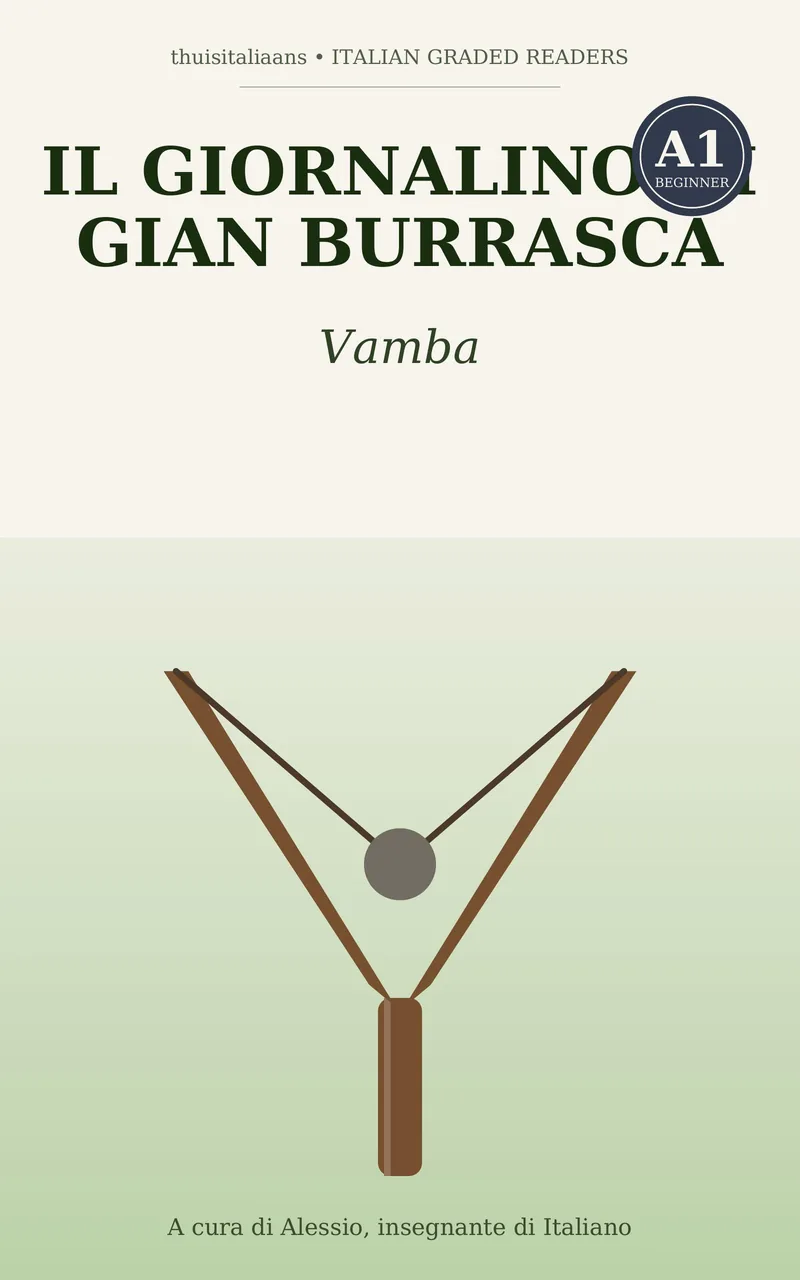
Cover of the easy Italian book Il giornalino di Gian Burrasca by Vamba, CEFR level A1, thuisitaliaans series A1
Italian Graded Readers · Level A1

Gian Burrasca: an Italian graded reader at level A1

Vamba · adapted by Alessio Insegnante · CEFR level A1

Vamba's classic (1912), rewritten for learners of Italian at level A1: calibrated sentences, footnotes, a final glossary and comprehension questions in every chapter.

Ebook $4.99 · also in 6×9 paperback

Look inside: the first page

Cover of Il giornalino nuovo

CAPITOLO 1

Chapter vignette

Il giornalino nuovo

The New Diary

Oggi è il mio compleanno. Io ho nove anni.

Io mi chiamo Giannino Stoppani. Io vivo a Firenze, con il babbo, la mamma e le mie tre sorelle: Ada, Luisa e Virginia.

Le mie sorelle sono grandi. Ada ha ventidue anni. Luisa ne ha venti. Virginia diciannove.

Nella mia famiglia tutti dicono che io sono un monello. Le mie sorelle mi chiamano «Gian Burrasca». È il mio soprannome, e mi fa rabbia.

Ma io lo so perché mi chiamano così: perché io combino sempre qualche guaio.1

Oggi ho ricevuto molti regali.

famiglia = family · monello = scamp, imp · guaio = trouble, scrape

1 «Gian Burrasca» vuol dire «Giannino tempesta»: una burrasca è un temporale, e Giannino combina guai come un temporale rompe le cose. È il nome che gli danno le sorelle, e nel libro non si toglierà più: sarà il suo nome per sempre.

Chapter 1 · CEFR A1 · 32 words of the real textGet the book on Amazon ↗︎

The plot of Il giornalino di Gian Burrasca

Giannino Stoppani, known to everyone as Gian Burrasca, is nine years old and has a natural talent for disaster. In his diary he records every prank, every escape and every punishment: stolen fish, experiments gone wrong, hypocritical adults mercilessly exposed.

Sent to boarding school to be «straightened out», Giannino organises his most famous revolution, the one against the rice soup. A classic of Italian humour that makes children laugh: and adults even more.

Why read Il giornalino di Gian Burrasca to learn Italian

Laughing is the best engine for reading on: motivation never runs out here. Giannino's first-person diary is also a perfect model to imitate for writing your own diary in Italian, using everyday vocabulary.

Inside the glossary

Glossary

burla · prank, hoax ((sin. scherzo, beffa))
Uno scherzo fatto a qualcuno, di solito alle sue spalle.
A joke played on someone, often behind their back.
Heavier than a joke: a burla always has someone at the receiving end. Giannino's begin as small copyings and hidings and grow, one by one, into things that break lives: a fiancé driven out, an election lost.
complotto · plot, conspiracy ((sin. cospirazione, trama))
Il mettersi d'accordo di nascosto per fare qualcosa contro qualcuno.
A secret agreement between people to act against someone.
At the college Giannino is no longer alone: with Tito, Maurizio and Carlo he becomes part of a band, and every prank is now a plot. It is the first time in the book he has allies: and Vamba is right that four boys against the rector are far more frightening than one boy alone.
disubbidire · to disobey ((sin. trasgredire, non ubbidire))
Non fare quello che dicono i genitori o i grandi.
Not to do what the grown-ups say.
Giannino disobeys, but almost never out of malice: he disobeys because nobody has ever explained why he ought to obey. It is his only weapon as a child against a world that gives him orders instead of reasons.
divisa · uniform ((sin. uniforme, vestito))
Il vestito uguale per tutti quelli che stanno insieme, come i soldati.
The same clothes worn by everyone in a group, as soldiers do.
At the college Giannino hates the uniform because it makes him look like everyone else. It is the first time his own clothes have been taken from him, and it is the first piece of himself he loses: a uniform, the book quietly says, wipes a child out, and what is left is a number, in the dormitory, in the refectory, in class.
dote · dowry ((sin. corredo, assegno))
I soldi o le cose che una sposa porta con sé nel matrimonio.
The money or goods a family gives to a daughter who marries.
In 1907 Italy no woman married without one. The three Stoppani sisters wait for a dowry the way one waits for permission to live, and Aunt Bettina is the possible dowry. Giannino drives the aunt away with a prank: and unknowingly cancels three marriages. It is the book's first great scrape.
eredità · inheritance ((sin. patrimonio, lascito))
I soldi e le cose che restano ai figli quando un parente muore.
The money and things left to the children when a parent dies.
The whole Stoppani family lives waiting for Aunt Bettina's inheritance: to talk about the aunt is to talk about when she will die, and Giannino grasps this as a child. The book says something hard: in Ottocento bourgeois families the death of an old woman was good news, and nobody said so aloud.

The glossary contains 25 entries in all

Inside this reader

CEFR adaptation

The text is fully rewritten for level A1, with controlled vocabulary and syntax, while staying faithful to the original plot.

Footnotes and glossary

Footnotes on difficult words and a final glossary, so you can read independently without a dictionary.

Comprehension questions

Every chapter ends with questions to check understanding, just like in class.

Paperback and ebook

6×9 paperback on cream paper, or Kindle ebook. The same text also lives in the ti app.

Language focus: what you practise

In this level-A1 edition you mainly practise the present tense, the passato prossimo, basic articles and prepositions, short coordinated sentences. The vocabulary revolves around daily life, pranks and school: the key words, with translations, are in the glossary below and recur throughout the text, so you learn them in context.

About the author: Vamba

Vamba, pen name of Luigi Bertelli (1858–1920), was a journalist and founder of the «Giornalino della Domenica», a magazine that revolutionised children's literature in Italy. Gian Burrasca is his immortal creation.

Details and difficulty level

A1 is the first step of the CEFR: short sentences, present and passato prossimo, high-frequency vocabulary. This reader suits anyone who has just started learning Italian or has completed a first beginner course. Format: 6×9 paperback on cream paper or Kindle ebook; 10 chapters with footnotes, a final glossary and comprehension questions. Paperback ISBN: 9798187975020. All level A1 books →︎

Essential glossary (Italian · English · Dutch)

ItalianEnglishDutch
lo scherzoprankde streek
il collegioboarding schoolhet internaat
la punizionepunishmentde straf
la fugaescapede ontsnapping
la minestrasoupde soep
il guaiotroublede problemen
i grandigrown-upsde volwassenen
la marachellamischiefhet kattenkwaad

Frequently asked questions

What level of Italian do I need to read Il giornalino di Gian Burrasca?

This edition of Il giornalino di Gian Burrasca is rewritten for CEFR level A1. A1 is the first step of the CEFR: short sentences, present and passato prossimo, high-frequency vocabulary. This reader suits anyone who has just started learning Italian or has completed a first beginner course.

Is this Vamba's original text?

No, it is an adaptation: the plot and spirit of Vamba's original remain, but vocabulary and syntax are rewritten for level A1, with footnotes, a final glossary and comprehension questions at the end of every chapter.

Which formats is it available in?

Paperback (6×9, cream paper) and Kindle ebook on Amazon. The ebook is $4.99. The same text also lives in the amo Italian app, with vocabulary translated into 17 languages.

If you liked Il giornalino di Gian Burrasca, read next

Prefer to read with a teacher?

A graded reader takes you a long way, but speaking is something you learn with someone. I teach Italian online worldwide and on location between Ede and Amsterdam: see online lessons, Italian for beginners and the pricing.

Not sure which level you are at? We work it out in ten minutes during a free introductory session: just get in touch. You can also browse all books at level A1.

Book a free introduction

Keep learning with thuisitaliaans

Il giornalino di Gian Burrasca also lives inside the ti app, with tap-to-translate vocabulary in 17 languages and animated scenes. On the site you'll also find 700+ free Italian exercises and the blog for Italian learners.

The book, then the screenEvery novel in the series is also in amo Italian, with a tap dictionary and notes for your level.€5,83 a month yearly plan★★★★★(11)by Alessio, teacher since 2018«Great app, very aesthetic design, every activities are well developed and it makes you crave studying more and more every time you open the app. …»Italy · App Store · Read in the app →