Skip to content
Download on the App StoreRead in the appIn the app
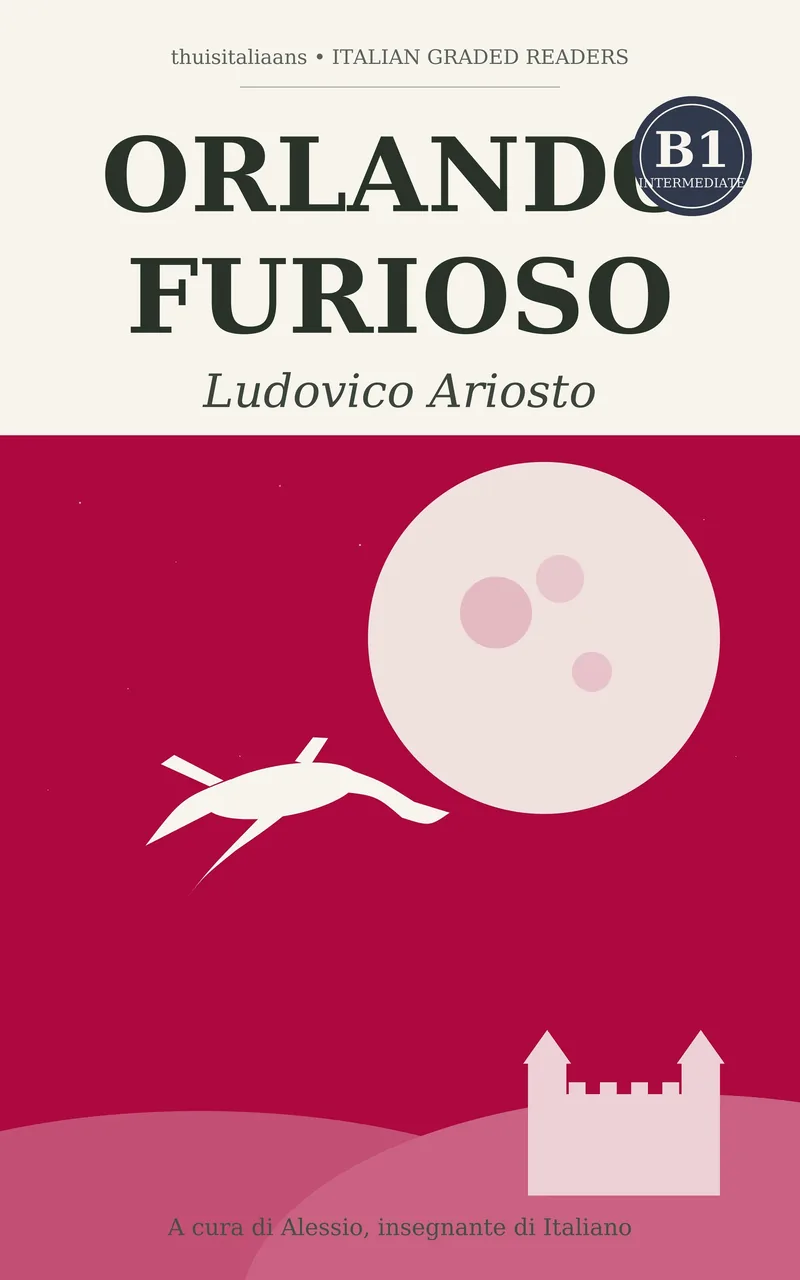
Cover of the easy Italian book Orlando furioso by Ludovico Ariosto, CEFR level B1, thuisitaliaans series B1
Italian Graded Readers · Level B1

Orlando furioso: an Italian graded reader at level B1

Ludovico Ariosto · adapted by Alessio Insegnante · CEFR level B1

Ludovico Ariosto's classic (1532), rewritten for learners of Italian at level B1: calibrated sentences, footnotes, a final glossary and comprehension questions in every chapter.

Coming soon on Amazon Browse the series

In production · soon in 6×9 paperback and on Kindle

Look inside: the first page

Cover of La fuga di Angelica

CAPITOLO 1

Chapter vignette

La fuga di Angelica

Angelica’s Flight

In Francia, al tempo di re Carlo Magno, c'era una grande guerra.

Un esercito enorme era arrivato dall'Africa. Lo comandava il re Agramante, giovane e ambizioso. Voleva conquistare la Francia e vendicare suo padre.

Contro di lui stava Carlo Magno, l'imperatore dei cristiani, con i suoi dodici paladini.1

Il primo dei paladini si chiamava Orlando. Nessuna lancia poteva ferirlo, nessun guerriero poteva batterlo.

Ma in quei giorni Orlando non pensava alla guerra. Pensava a una donna.

paladino = paladin · lancia = lance · guerriero = warrior

1 Carlo Magno è un re vero: incoronato imperatore nell'anno 800, è il fondatore dell'Europa medievale. Ma il Carlo del poema è un re di leggenda, circondato da dodici campioni (i paladini) come Artù dai cavalieri della Tavola Rotonda. Ariosto eredita questo mondo da secoli di racconti francesi e italiani, e ci costruisce sopra la sua storia.

Chapter 1 · CEFR B1 · 27 words of the real text

The plot of Orlando furioso

Charlemagne's army is besieging Paris, and the most beautiful princess in the world has escaped from his camp. Half the knights of both armies ride after her: among them Orlando, the emperor's greatest champion, who abandons the war to look for her. What he finds in a wood, one afternoon, will take his reason away: two names carved on a tree.

To give him back his wits, a friend will have to fly to the Moon on the hippogriff: up there, everything lost on Earth is kept in bottles. Ariosto's masterpiece (the poem that invented the flying horse, the ring of invisibility and the journey to the Moon) fully retold in simple prose. It is the sequel to Boiardo's Orlando innamorato: there Orlando falls in love, here he loses his mind.

Why read Orlando furioso to learn Italian

The stories interweave like a modern series (Ariosto suspends one thread and picks up another) training you to hold several plots together in Italian, the key B1 skill. And if you read the Orlando innamorato (A2), the same characters are here one step up: a natural level ladder.

Inside the glossary

Glossary

ampolla · vial ((sin. fiala, boccetta))
Un piccolo vaso di vetro dal collo stretto, per conservare liquidi.
A small narrow-necked glass vessel for keeping liquids.
On the Moon, in a valley, stand thousands of vials: inside each is the sense that someone lost on Earth. Orlando's is the largest of all. The image is comic and terrible at once (human reason reduced to a liquid in a bottle) and it is one of the most quoted inventions in the literature of any age.
anello · ring ((sin. cerchietto, vera))
Un piccolo cerchio di metallo che si porta al dito.
A small circle of metal worn on the finger.
Angelica's ring is the most powerful magic object in the book: on the finger it cancels every spell, in the mouth it makes you invisible. It passes from hand to hand (Brunello steals it, Bradamante wins it, Melissa carries it, Angelica takes it back) and at every passage it changes the story. It is the great-grandfather of every magic ring in modern literature.
armatura · armour ((sin. corazza, difesa))
L'insieme di piastre di metallo che protegge il corpo di un cavaliere.
The set of metal plates protecting a knight's body.
Armour in the poem is a second skin: it says who you are, protects you, represents you. That is why the scene where Orlando tears his armour off is so powerful: he is not removing clothing, he is removing his own name. A knight without armour, in the world of the Furioso, is no longer a knight: only a man.
assedio · siege ((sin. accerchiamento, blocco))
L'accerchiamento di una città per costringerla ad arrendersi.
The encirclement of a city to force it to surrender.
The siege of Paris is the backdrop of the whole poem: while the knights chase loves and enchantments, a real war is fought beneath the walls. Ariosto alternates the two planes constantly (fable and history) and the siege is there to remind us that his heroes' choices have a price: every paladin who rides away is one sword fewer on the walls.
avventura · adventure ((sin. impresa, peripezia))
Un'esperienza fuori dall'ordinario, piena di rischi e di sorprese.
An out-of-the-ordinary experience, full of risks and surprises.
The Furioso is the adventure machine: every crossroads hides one, every character chases another. Ariosto weaves them like threads of a carpet: he leaves one hero on the edge of a cliff and moves to the next. Today's readers call it suspense; he called it the art of 'leaving Orlando' at the right moment.
battesimo · baptism ((sin. rito d'ingresso, sacramento))
Il rito con cui una persona entra nella religione cristiana.
The rite by which a person enters the Christian religion.
Ruggiero's baptism is the promise running through the whole poem: the prophecy announces it, Bradamante waits for it, Atlante fears it. When it finally comes, on the hermit's island, it is no solemn scene: it is a man saved from the sea keeping his word. In the Furioso even destiny's turning points have simple manners.

The glossary contains 49 entries in all

Inside this reader

CEFR adaptation

The text is fully rewritten for level B1, with controlled vocabulary and syntax, while staying faithful to the original plot.

Footnotes and glossary

Footnotes on difficult words and a final glossary, so you can read independently without a dictionary.

Comprehension questions

Every chapter ends with questions to check understanding, just like in class.

Paperback and ebook

6×9 paperback on cream paper, or Kindle ebook. The same text also lives in the ti app.

Language focus: what you practise

In this level-B1 edition you mainly practise the present subjunctive, the conditional, real hypothetical clauses and discourse connectors. The vocabulary revolves around knights, madness and magic: the key words, with translations, are in the glossary below and recur throughout the text, so you learn them in context.

About the author: Ludovico Ariosto

Ludovico Ariosto (1474–1533), poet at the Este court of Ferrara, worked on the Orlando furioso all his life, publishing three versions up to the definitive one of 1532. His elegant irony is one of the most modern voices of the Renaissance.

Details and difficulty level

B1 is the threshold of independence: longer sentences, the present subjunctive, rich everyday vocabulary. This reader suits intermediate students and anyone preparing a B1 certification (CILS, CELI, PLIDA). Format: 6×9 paperback on cream paper or Kindle ebook; 20 chapters with footnotes, a final glossary and comprehension questions. All level B1 books →︎

Essential glossary (Italian · English · Dutch)

ItalianEnglishDutch
l'ippogrifohippogriffde hippogrief
il sennowitshet verstand
la folliamadnessde waanzin
la lunamoonde maan
il cavaliereknightde ridder
l'assediosiegehet beleg
l'anelloringde ring
la spadaswordhet zwaard

Frequently asked questions

What level of Italian do I need to read Orlando furioso?

This edition of Orlando furioso is rewritten for CEFR level B1. B1 is the threshold of independence: longer sentences, the present subjunctive, rich everyday vocabulary. This reader suits intermediate students and anyone preparing a B1 certification (CILS, CELI, PLIDA).

Is this Ludovico Ariosto's original text?

No, it is an adaptation: the plot and spirit of Ludovico Ariosto's original remain, but vocabulary and syntax are rewritten for level B1, with footnotes, a final glossary and comprehension questions at the end of every chapter.

When is it coming out?

The book is in production and will be on Amazon soon, in paperback and as a Kindle ebook. The same text already lives in the amo Italian app.

If you liked Orlando furioso, read next
Prefer to read with a teacher?

A graded reader takes you a long way, but speaking is something you learn with someone. I teach Italian online worldwide and on location between Ede and Amsterdam: see online lessons, Italian for beginners and the pricing.

Not sure which level you are at? We work it out in ten minutes during a free introductory session: just get in touch. You can also browse all books at level B1.

Book a free introduction

Keep learning with thuisitaliaans

Orlando furioso also lives inside the ti app, with tap-to-translate vocabulary in 17 languages and animated scenes. On the site you'll also find 700+ free Italian exercises and the blog for Italian learners.

The book, then the screenEvery novel in the series is also in amo Italian, with a tap dictionary and notes for your level.€5,83 a month yearly plan★★★★★(11)by Alessio, teacher since 2018«Great app, very aesthetic design, every activities are well developed and it makes you crave studying more and more every time you open the app. …»Italy · App Store · Read in the app →