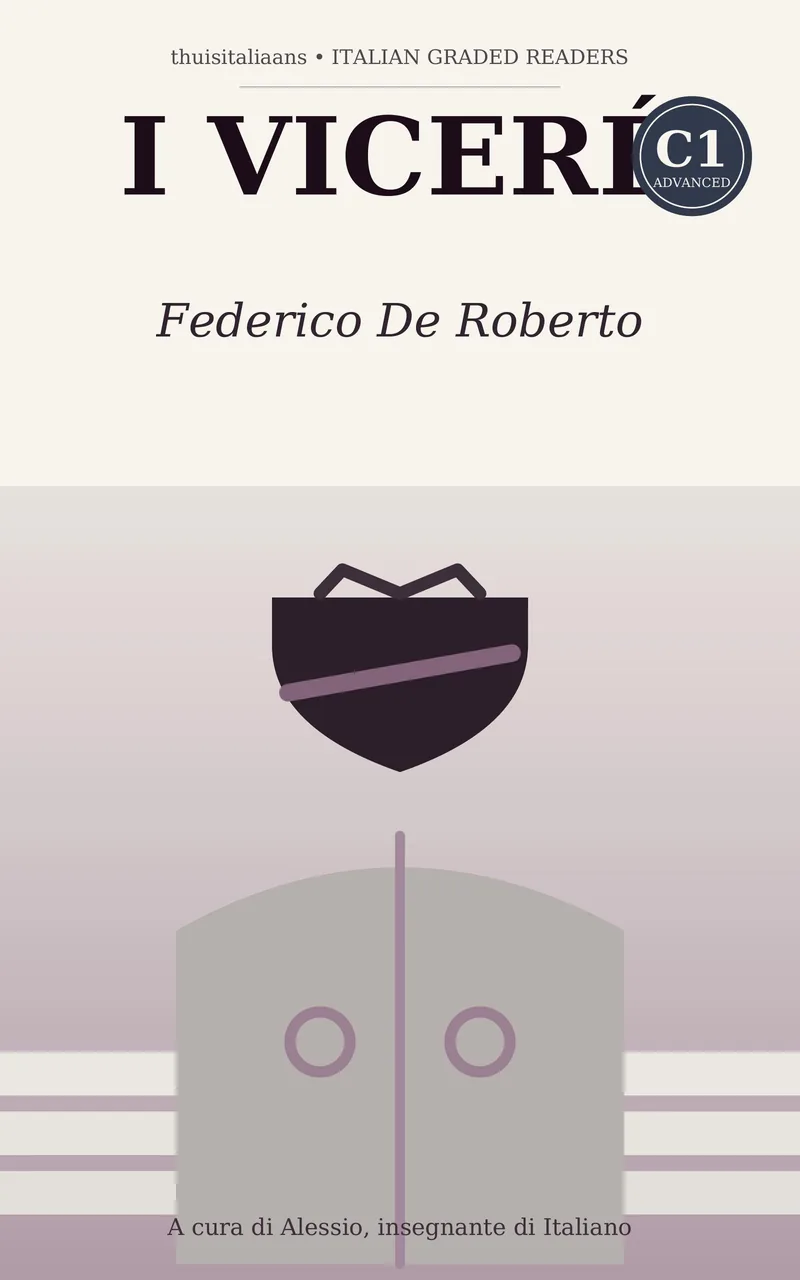
I Viceré: an Italian book for advanced learners (C1)
Federico De Roberto · adapted by Alessio Insegnante · CEFR level C1
Federico De Roberto's classic (1894), rewritten for learners of Italian at level C1: calibrated sentences, footnotes, a final glossary and comprehension questions in every chapter.
Available on Amazon, in paperback and on Kindle
The plot of I Viceré
Catania, nineteenth century. On the death of the old princess, the Uzeda di Francalanza family — descendants of the Spanish viceroys of Sicily — hurl themselves into a ferocious war over the inheritance. Ambitious monks, calculated marriages, hatreds handed down from father to son.
As Italy achieves unification, the Uzeda change flags without changing nature: power stays in the family, under any government. A merciless, magnificent novel about the continuity of power, anticipating The Leopard by sixty years.
Why read I Viceré to learn Italian
The family saga keeps your memory in training: names, kinships and alliances intertwine like a nineteenth-century TV series. De Roberto's irony must be caught between the lines — the most valuable reading exercise there is at B2.
Inside this reader
CEFR adaptation
The text is fully rewritten for level C1, with controlled vocabulary and syntax, while staying faithful to the original plot.
Footnotes and glossary
Footnotes on difficult words and a final glossary, so you can read independently without a dictionary.
Comprehension questions
Every chapter ends with questions to check understanding, just like in class.
Paperback and ebook
6×9 paperback on cream paper, or Kindle ebook. The same text also lives in the ti app.
Language focus: what you practise
In this level-C1 edition you mainly practise the passato remoto, gerunds and participles, literary vocabulary, shades of register and rhetorical figures. The vocabulary revolves around power, church and politics: the key words, with translations, are in the glossary below and recur throughout the text, so you learn them in context.
Essential glossary (Italian · English · Dutch)
| Italian | English | Dutch |
|---|---|---|
| l'eredità | inheritance | de erfenis |
| il principe | prince | de prins |
| il monaco | monk | de monnik |
| la famiglia | family | de familie |
| il potere | power | de macht |
| il deputato | member of parliament | de afgevaardigde |
| l'odio | hatred | de haat |
| il testamento | will | het testament |
About the author: Federico De Roberto
Federico De Roberto (1861–1927), a disciple of Verga and Capuana, carried verismo inside the palaces of the aristocracy. I Viceré, little understood on publication, is now recognised as one of the greatest Italian novels of the nineteenth century.
Details and difficulty level
C1 stays close to the original language: structure and style remain near the author's text, with footnotes and a glossary for literary vocabulary. This reader suits advanced students, teachers and lovers of Italian literature. Format: 6×9 paperback on cream paper or Kindle ebook; 20 chapters with footnotes, a final glossary and comprehension questions. All level C1 books →
Frequently asked questions
What level of Italian do I need to read I Viceré?
This edition of I Viceré is rewritten for CEFR level C1. C1 stays close to the original language: structure and style remain near the author's text, with footnotes and a glossary for literary vocabulary. This reader suits advanced students, teachers and lovers of Italian literature.
Is this Federico De Roberto's original text?
No, it is an adaptation: the plot and spirit of Federico De Roberto's original remain, but vocabulary and syntax are rewritten for level C1, with footnotes, a final glossary and comprehension questions at the end of every chapter.
Where can I buy it?
On Amazon, as a paperback or Kindle ebook: you'll find this and every other title in the series on Alessio Insegnante's author page.
If you liked I Viceré, read next



Keep learning with thuisitaliaans
I Viceré also lives inside the ti app, with tap-to-translate vocabulary in 14 languages and animated scenes. On the site you'll also find 700+ free Italian exercises and the blog for Italian learners.
Discover the ti app