Italiano in pratica
by Alessio · teacher of Italian for foreigners, ITALS master’s in teaching Italian abroad (Ca’ Foscari University, Venice) and a master’s in teaching Italian as a second language (Giustino Fortunato University, Benevento)
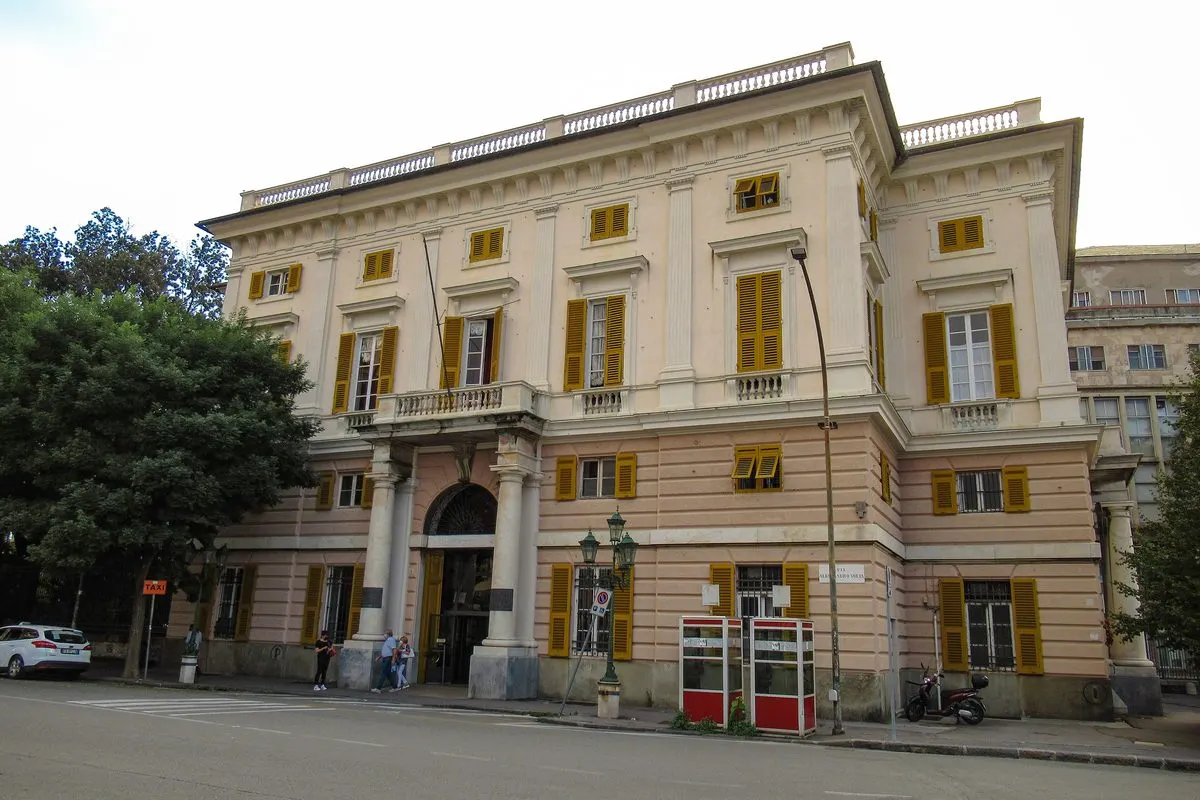
As a visitor in Italy, for something that can't wait but isn't an emergency, go to the guardia medica, the out-of-hours doctor; in summer many tourist areas have a guardia medica turistica. Bring your ID and, from the EU, the European Health Insurance Card. For an emergency, call 112.
A fever that won't go down, an ear that hurts on the third day of the holiday, a cut that might need a stitch. It's not an emergency, but it's not a pharmacy job either, and you need to tell a doctor what's wrong in a language that isn't yours.
Here's where to go, the sentences to describe the problem, and the questions the doctor asks, most of which you answer with sì, no or a number.
| Italian | English |
|---|---|
| Ho bisogno di un medico. | I need a doctor. |
| Mi fa male qui. | It hurts here.pointing |
| Ho la febbre da due giorni. | I've had a fever for two days. |
| È grave? | Is it serious?answer: sì or no |
| Devo prendere un antibiotico? | Do I need an antibiotic?answer: sì or no |
| Sono allergico a... | I'm allergic to...allergica for a woman |
| Mi può fare la ricetta? | Can you write me a prescription?answer: sì or no |
| Mi serve un certificato per l'assicurazione. | I need a certificate for my insurance. |
Read the Italian out loud once before you need it. The questions marked sì or no get a one-word answer you can understand.
For something urgent but not an emergency, the guardia medica (officially continuità assistenziale) sees patients at night, at weekends and on public holidays; in summer many seaside and mountain areas open a guardia medica turistica for visitors. For an emergency, go to pronto soccorso or call 112.
Ask your hotel or a pharmacy for the nearest one: dov'è la guardia medica? Visitors may pay a small fee for the visit. From the EU, bring the European Health Insurance Card; from outside, your travel insurance details.
| You say | English |
|---|---|
| Dov'è la guardia medica? | Where's the out-of-hours doctor? |
| C'è una guardia medica turistica? | Is there a medical service for tourists?sì or no |
| Ho la tessera sanitaria europea. | I have the European Health Insurance Card. |
| Si paga la visita? | Do you pay for the visit?sì or no |
| You hear | English |
|---|---|
| Ha un documento? | Do you have ID? |
| È in vacanza qui? | Are you here on holiday?sì or no |
| Si accomodi in sala d'attesa. | Please take a seat in the waiting room. |
Point and say mi fa male qui, it hurts here; then add how long: da ieri, since yesterday, da tre giorni, for three days. For general symptoms: ho la febbre, ho la nausea, mi gira la testa.
If the pain comes and goes, say va e viene; if it's getting worse, peggiora. Two words that save a lot of explaining.
| You say | English |
|---|---|
| Mi fa male qui. | It hurts here. |
| Da tre giorni. | For three days. |
| Ho la febbre alta. | I have a high fever. |
| Mi gira la testa. | I feel dizzy. |
| Il dolore va e viene. | The pain comes and goes. |
| Sta peggiorando. | It's getting worse. |
| Mi sono tagliato. | I've cut myself.tagliata for a woman |
| You hear | English |
|---|---|
| Dove le fa male? | Where does it hurt?point |
| Da quanto tempo? | For how long?da... |
| Quanto ha di febbre? | How high is your fever?say the number: trentotto |
Mostly closed questions: whether you have a fever, whether you take medicines, whether you have allergies, whether it hurts when they press. Answer sì, no or un po', a little.
If you don't understand, say so and ask for a yes/no version: può fare una domanda più semplice? Doctors are used to it.
| You say | English |
|---|---|
| Sì, un po'. | Yes, a little. |
| No, nessun farmaco. | No, no medicines. |
| Prendo questo. | I take this.show the box or the active ingredient |
| Non ho capito, può ripetere? | I didn't understand, could you repeat? |
| You hear | English |
|---|---|
| Ha febbre? | Do you have a fever?sì or no |
| Prende farmaci? | Do you take any medicines?sì or no |
| È allergico a qualcosa? | Are you allergic to anything?sì or no |
| Qui le fa male? | Does it hurt here?sì or no |
| Respiri profondamente. | Breathe in deeply. |
| Si stenda qui. | Lie down here. |

In the  amo Italian app you practise inside real-life pathways: il bar, il ristorante, i trasporti, la casa and more, with listening, dialogues and the grammar explained in English. This page gives you the phrases; the app trains your ear.
Half the A1 course free, no sign-up
★★★★★(22)by Alessio, teacher since 2018
Downloadamo Italian for iPhone ↗︎Search for amo Italian
The doctor writes la ricetta, the prescription, which you take to a pharmacy. The instructions come as how much, how often and for how long: una compressa due volte al giorno per cinque giorni. Repeat it back to check.
Ask for a written note of the diagnosis if you need it for your insurance: mi serve un certificato per l'assicurazione.
| You say | English |
|---|---|
| Mi può fare la ricetta? | Can you write me a prescription?sì or no |
| Due volte al giorno? | Twice a day?sì or no |
| Per quanti giorni? | For how many days? |
| Mi serve un certificato per l'assicurazione. | I need a certificate for my insurance. |
| You hear | English |
|---|---|
| Le prescrivo un antibiotico. | I'm prescribing you an antibiotic. |
| A stomaco pieno. | On a full stomach. |
| Se non passa, torni. | If it doesn't go away, come back. |

For chest pain, difficulty breathing, a bad fall, heavy bleeding or a high fever in a small child, don't wait: go to pronto soccorso or call 112. At the emergency room patients are seen by urgency, not by arrival, so the wait for minor problems can be long.
At triage a nurse asks what happened and gives you a priority code. Have your ID and health card ready.
| You say | English |
|---|---|
| Dov'è il pronto soccorso? | Where's the emergency room? |
| Ho un forte dolore al petto. | I have a strong pain in my chest. |
| Non riesco a respirare bene. | I can't breathe properly. |
| Quanto c'è da aspettare? | How long is the wait? |
| You hear | English |
|---|---|
| Cosa è successo? | What happened? |
| Aspetti qui, la chiamiamo. | Wait here, we'll call you. |
Italy has had a national health service, the Servizio Sanitario Nazionale, since 1978. It covers everyone resident in Italy and is run by the regions, which is why fees and services can differ between, say, Tuscany and Sicily. Residents are registered with a family doctor, the medico di base; visitors are not, so for anything urgent but not an emergency they use the out-of-hours service, the guardia medica, or in summer the guardia medica turistica that many seaside and mountain areas open for tourists.

A visit there costs non-residents a small fee set by each region: in recent years, roughly €15 to €20 at the surgery and €25 to €35 for a home visit. EU citizens with a European Health Insurance Card are treated on the same terms as Italians; travellers from outside the EU need travel insurance. At the emergency room, the pronto soccorso, patients are sorted by urgency with a five-level code, from 1, the most urgent, to 5, so a minor problem can mean a long wait.
Italian attitudes to health have their own flavour. Many Italians are convinced that a draught, un colpo d'aria, brings on a stiff neck or a cold, that you should never go out with wet hair, and that a scarf in spring is common sense. Doctors are addressed as dottore or dottoressa, and patients expect time to explain: describing a symptom in detail is not complaining, it is how a visit works.
Read next: Why is the pharmacy the first stop for small health problems in Italy? · Carabinieri or Polizia: who does what in Italy?
Italians rarely answer with a bare sì or no. These are the forms you will actually hear, so you know which way the answer went.
| You hear | English | It means |
|---|---|---|
| Sì, certo. | Yes, of course. | yes |
| Certo! | Sure! | yes |
| Come no! | Of course! (literally: how not?) | yes |
| Volentieri. | Gladly. | yes |
| Va bene. | Fine, OK. | yes |
| Prego. | Go ahead / please do. | yes |
| No, mi dispiace. | No, I'm sorry. | no |
| Purtroppo no. | Unfortunately not. | no |
| Non c'è. | There isn't any. | no |
| È finito. | It's sold out / all gone. | no |
| Non si può. | That's not allowed. | no |
| Non ancora. | Not yet. | no |
Six real replies. Tap Yes or No for each one.
The grammar behind them
This guide as two printable pages, in English: the phrases to say, the yes/no questions and what you will hear.
All 43 phrase PDFs · €9Already included in the full course · €39 a year.
Or keep the eight phrases as an image, to save on your phone or pin:
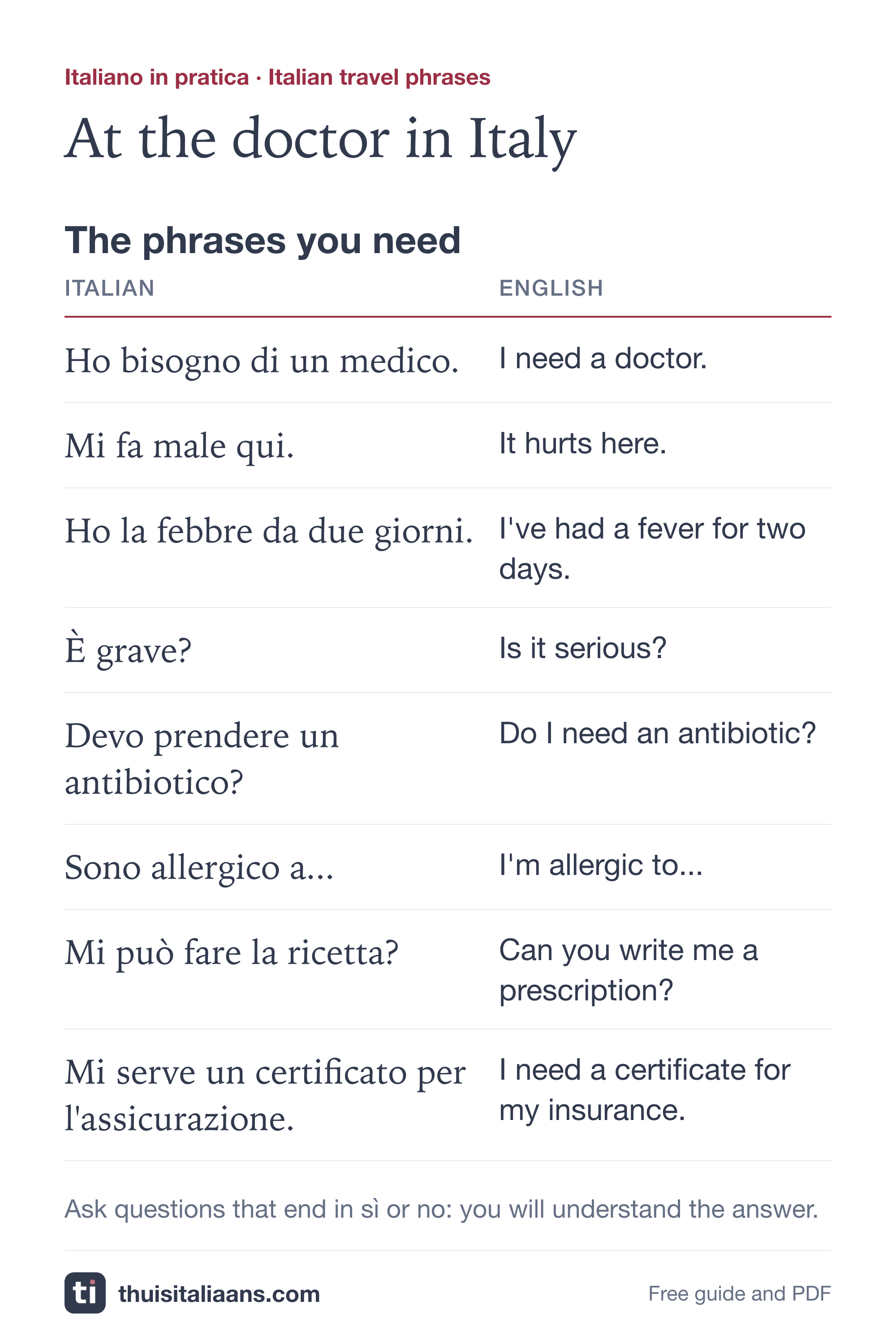 Italian phrases: At the doctor in Italy
At the «guardia medica» (out-of-hours doctor) at nights, weekends and holidays, and in summer at the «guardia medica turistica» that many tourist areas open. For emergencies, the «pronto soccorso» or 112.
If you come from the EU, bring it: it gives you access to public healthcare on the same terms as Italian residents. From outside the EU, bring your travel insurance details.
«Mi fa male qui», while pointing to the place.
The hospital emergency room. Patients are seen in order of urgency, not of arrival.