Italiano in pratica
by Alessio · teacher of Italian for foreigners, ITALS master’s in teaching Italian abroad (Ca’ Foscari University, Venice) and a master’s in teaching Italian as a second language (Giustino Fortunato University, Benevento)
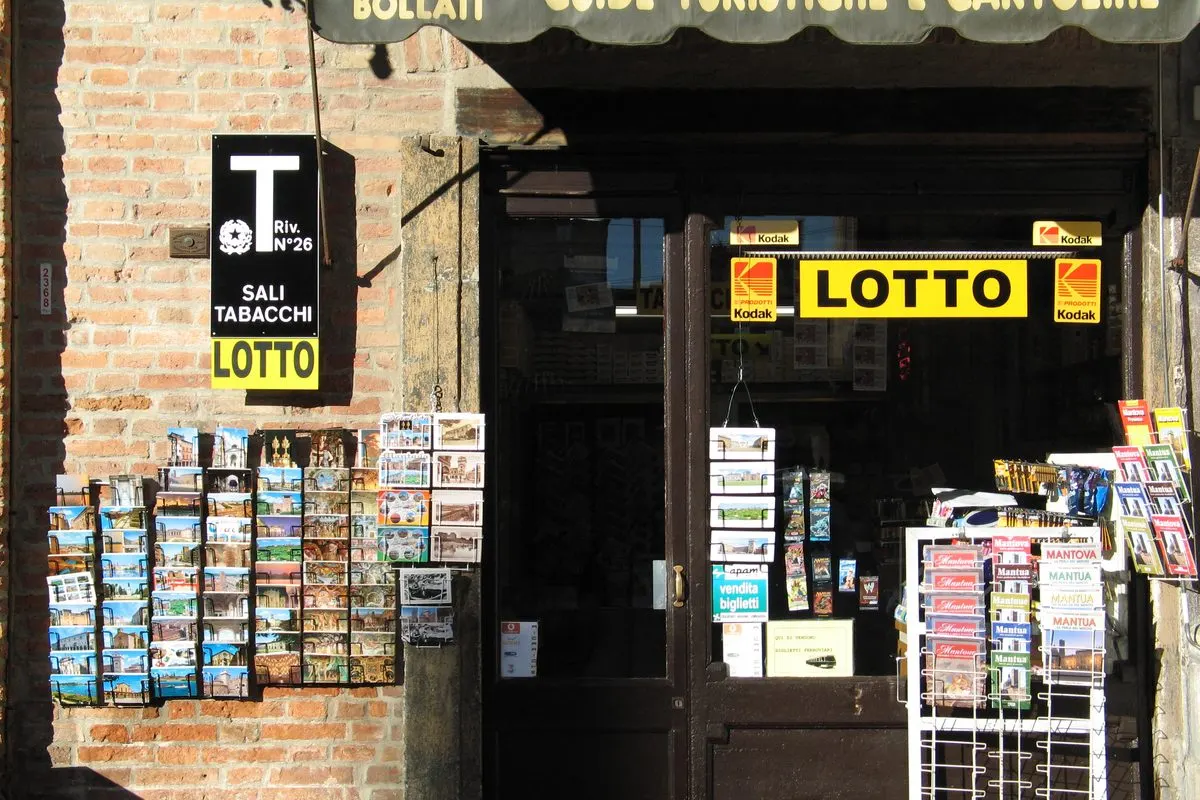
Look for the sign with a white T on a black or blue background. Inside you can buy bus and metro tickets, stamps, phone top-ups and the marca da bollo, the revenue stamp needed for many official forms. In many cities you can't buy a bus ticket on board, so this is where you get it first.
Visitors walk past the tabaccheria for days, thinking it only sells cigarettes. Then they need a bus ticket on a Sunday and discover it's the only shop that has one.
The tabaccheria is a small public service desk disguised as a shop. Here is what it sells, what to ask for, and the closed questions that get you a clear answer.
| Italian | English |
|---|---|
| Avete i biglietti dell'autobus? | Do you have bus tickets?answer: sì or no |
| Due biglietti, per favore. | Two tickets, please. |
| Questo vale anche per la metro? | Is this valid on the metro too?answer: sì or no |
| Avete i francobolli? | Do you have stamps?answer: sì or no |
| Un francobollo per l'Inghilterra. | A stamp for England. |
| Fate ricariche? | Do you do phone top-ups?answer: sì or no |
| Posso pagare con la carta? | Can I pay by card?answer: sì or no |
| Mi serve una marca da bollo. | I need a revenue stamp. |
Read the Italian out loud once before you need it. The questions marked sì or no get a one-word answer you can understand.
A tabaccheria, also called tabacchi or il tabaccaio, is a licensed shop that sells tobacco and a set of state-regulated items: transport tickets, stamps, revenue stamps and lottery tickets. You recognise it by the sign with a large T, white on black or blue.
Many are also a bar, so you can buy a ticket and have a coffee at the same counter. Opening hours follow the shops: often closed for lunch and on Sunday afternoon, except in stations.
| You say | English |
|---|---|
| Scusi, c'è un tabaccaio qui vicino? | Excuse me, is there a tobacconist nearby?sì or no |
| È aperto adesso? | Is it open now?sì or no |
| You hear | English |
|---|---|
| In fondo alla strada, a destra. | At the end of the street, on the right. |
| Riapre alle quattro. | It reopens at four. |
Ask for un biglietto dell'autobus or un biglietto per la metro, and say how many. In most cities the same ticket works on buses, trams and metro for a set time, usually 75 to 100 minutes; ask if you're not sure, because rules change from city to city.
Buy before you travel: in many cities drivers don't sell tickets, or sell them at a higher price. Validate the paper ticket in the machine on board, obliterare, unless you tap in with a card.
| You say | English |
|---|---|
| Avete i biglietti dell'autobus? | Do you have bus tickets?sì or no |
| Due biglietti, per favore. | Two tickets, please. |
| Questo vale anche per la metro? | Is this valid on the metro too?sì or no |
| C'è un biglietto giornaliero? | Is there a day ticket?sì or no |
| Devo timbrarlo sull'autobus? | Do I have to validate it on the bus?sì or no |
| You hear | English |
|---|---|
| Corsa singola o giornaliero? | Single ride or day ticket?a choice of two |
| Vale novanta minuti. | It's valid for ninety minutes. |
| Sono finiti. | They're sold out.try the next one |

Yes. Most tabaccherie sell francobolli, so you can post a postcard without queueing at the post office. Say where it's going: Italy, Europe or the rest of the world cost different amounts.
The red letterboxes are the Poste Italiane ones. Some have two slots: per la città, for the same city, and tutte le altre destinazioni, for everywhere else.
| You say | English |
|---|---|
| Avete i francobolli? | Do you have stamps?sì or no |
| Un francobollo per l'Inghilterra. | A stamp for England. |
| Tre francobolli per cartoline, per gli Stati Uniti. | Three postcard stamps for the United States. |
| Dov'è la cassetta delle lettere? | Where's the letterbox? |
| You hear | English |
|---|---|
| Per l'Europa o fuori? | For Europe or outside?a choice of two |
| La buca è qui fuori. | The letterbox is just outside. |

In the  amo Italian app you practise inside real-life pathways: il bar, il ristorante, i trasporti, la casa and more, with listening, dialogues and the grammar explained in English. This page gives you the phrases; the app trains your ear.
Half the A1 course free, no sign-up
★★★★★(22)by Alessio, teacher since 2018
Downloadamo Italian for iPhone ↗︎Search for amo Italian
Ask Fate ricariche? and give your operator, your number and the amount. The cashier tops up your SIM directly, or sells you a scratch card with a code. Have your Italian number written down: you'll be asked to read it out digit by digit.
Recharges usually come in fixed amounts, such as five, ten or twenty euros. Check the number on the receipt before you leave: a wrong digit sends the credit to someone else.
| You say | English |
|---|---|
| Fate ricariche? | Do you do phone top-ups?sì or no |
| Una ricarica da dieci euro, per favore. | A ten euro top-up, please. |
| È per questo numero. | It's for this number.show it |
| È già arrivata? | Has it arrived yet?sì or no |
| You hear | English |
|---|---|
| Che operatore? | Which network?say the company name |
| Mi detta il numero? | Can you read me the number? |
| Controlli lo scontrino. | Check the receipt. |

A marca da bollo is a revenue stamp: a sticker with a value that you attach to many official applications and certificates, from residence permits to some school forms. Tabaccherie sell them; the office that asks for one tells you the value.
Visitors rarely need one, but people staying longer meet it in every bureaucratic step. Check the exact amount on the form before buying: there's no refund for the wrong value.
| You say | English |
|---|---|
| Mi serve una marca da bollo. | I need a revenue stamp. |
| Da sedici euro. | A sixteen euro one.say the value on the form |
| Avete la marca da bollo? | Do you sell revenue stamps?sì or no |
| You hear | English |
|---|---|
| Di che importo? | What value? |
| Le marche da bollo le abbiamo finite. | We've run out of revenue stamps.try another shop |
Usually yes: Italian shops must accept card payments, and many tabaccherie take cards for every item. Small amounts are still often paid in cash, so keep some coins for a single bus ticket.
If the card reader is at the other till, the cashier will say so. Contactless works almost everywhere.
| You say | English |
|---|---|
| Posso pagare con la carta? | Can I pay by card?sì or no |
| Va bene contactless? | Is contactless OK?sì or no |
| You hear | English |
|---|---|
| Certo, appoggi pure. | Of course, tap away. |
| Il bancomat è di là. | The card reader is over there. |
In most countries you buy a bus ticket from a machine, an app or the driver. In Italy the classic answer is a small shop with a big T over the door. The tabaccheria is a licensed retailer: the state grants the licence to sell tobacco, and with it comes a set of other regulated goods and services, from stamps to revenue stamps, lottery tickets and, in most cities, local transport tickets.

That's why the tabaccheria works as a little public office on every high street. People pay some bills there, top up their phones, buy the marca da bollo for an official form, or post a postcard without queueing at the post office. In smaller towns it may be the only place open on Sunday morning that sells a bus ticket.
Payment has also changed. Italian shops are required to accept electronic payments, and tabaccherie now take cards for tobacco, stamps and revenue stamps too. Still, many locals pay small amounts in coins, and a single bus ticket is the kind of purchase where having change saves everyone time.
Read next: Why can't you buy a ticket on the bus, or hail a taxi? · Why is the Italian post office also a bank?
Italians rarely answer with a bare sì or no. These are the forms you will actually hear, so you know which way the answer went.
| You hear | English | It means |
|---|---|---|
| Sì, certo. | Yes, of course. | yes |
| Certo! | Sure! | yes |
| Come no! | Of course! (literally: how not?) | yes |
| Volentieri. | Gladly. | yes |
| Va bene. | Fine, OK. | yes |
| Prego. | Go ahead / please do. | yes |
| No, mi dispiace. | No, I'm sorry. | no |
| Purtroppo no. | Unfortunately not. | no |
| Non c'è. | There isn't any. | no |
| È finito. | It's sold out / all gone. | no |
| Non si può. | That's not allowed. | no |
| Non ancora. | Not yet. | no |
Six real replies. Tap Yes or No for each one.
The grammar behind them
This guide as two printable pages, in English: the phrases to say, the yes/no questions and what you will hear.
All 43 phrase PDFs · €9Already included in the full course · €39 a year.
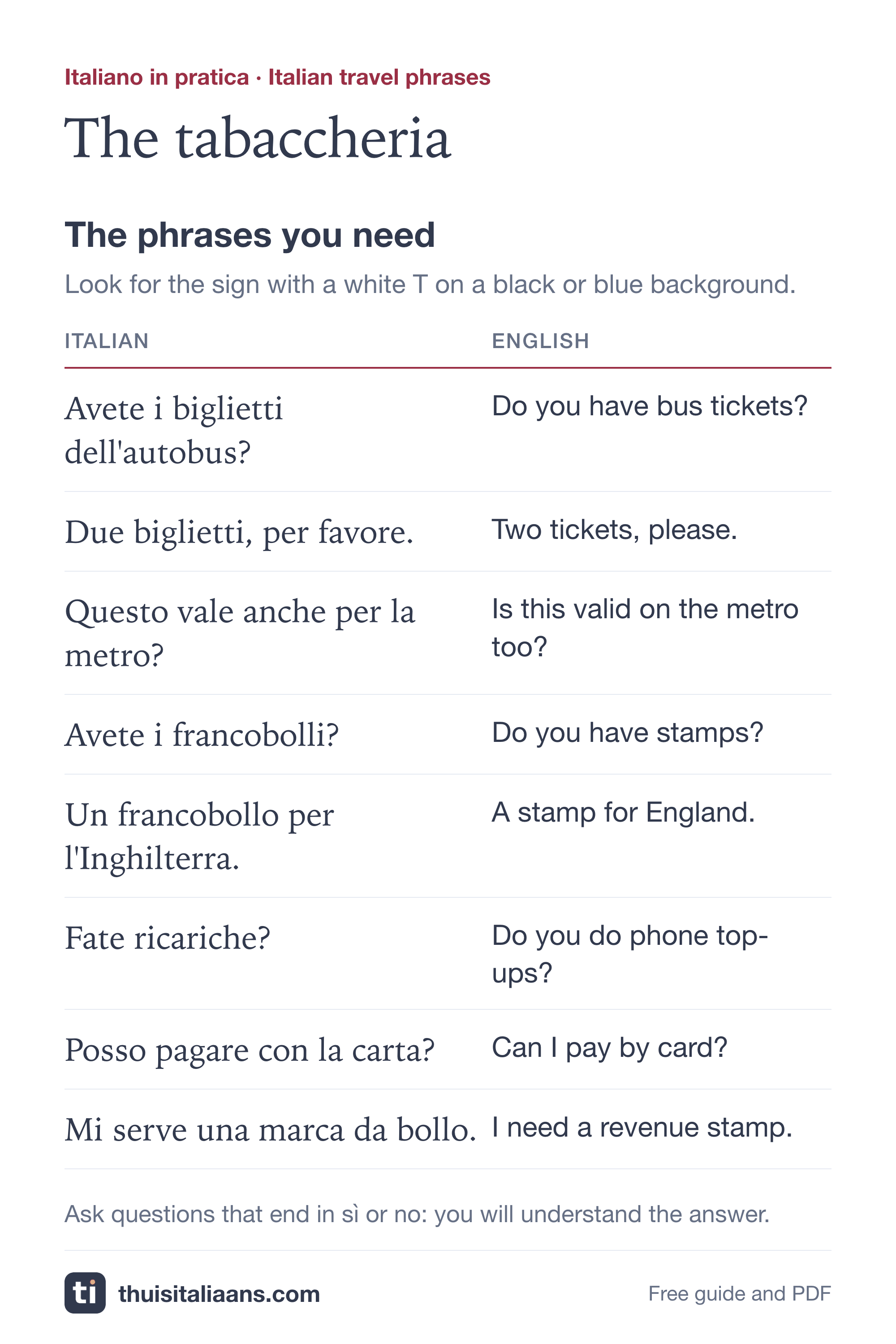
Or keep the eight phrases as an image, to save on your phone or pin:
 Italian phrases: The tabaccheria
Tobacco, but also bus and metro tickets, stamps, phone top-ups, the marca da bollo revenue stamp and lottery tickets. Many also let you pay some bills.
At a tabaccheria, a newsstand, a ticket machine or the transport company's app. In many cities you can't buy one on board, so get it before you travel.
Yes, most tabaccherie sell stamps. Say whether the letter or postcard is for Italy, Europe or the rest of the world.
A revenue stamp: a sticker with a set value that you attach to many official forms and certificates. The office that asks for it tells you the amount.
By the sign with a large T, white on a black or blue background.