Italiano in pratica
by Alessio · teacher of Italian for foreigners, ITALS master’s in teaching Italian abroad (Ca’ Foscari University, Venice) and a master’s in teaching Italian as a second language (Giustino Fortunato University, Benevento)
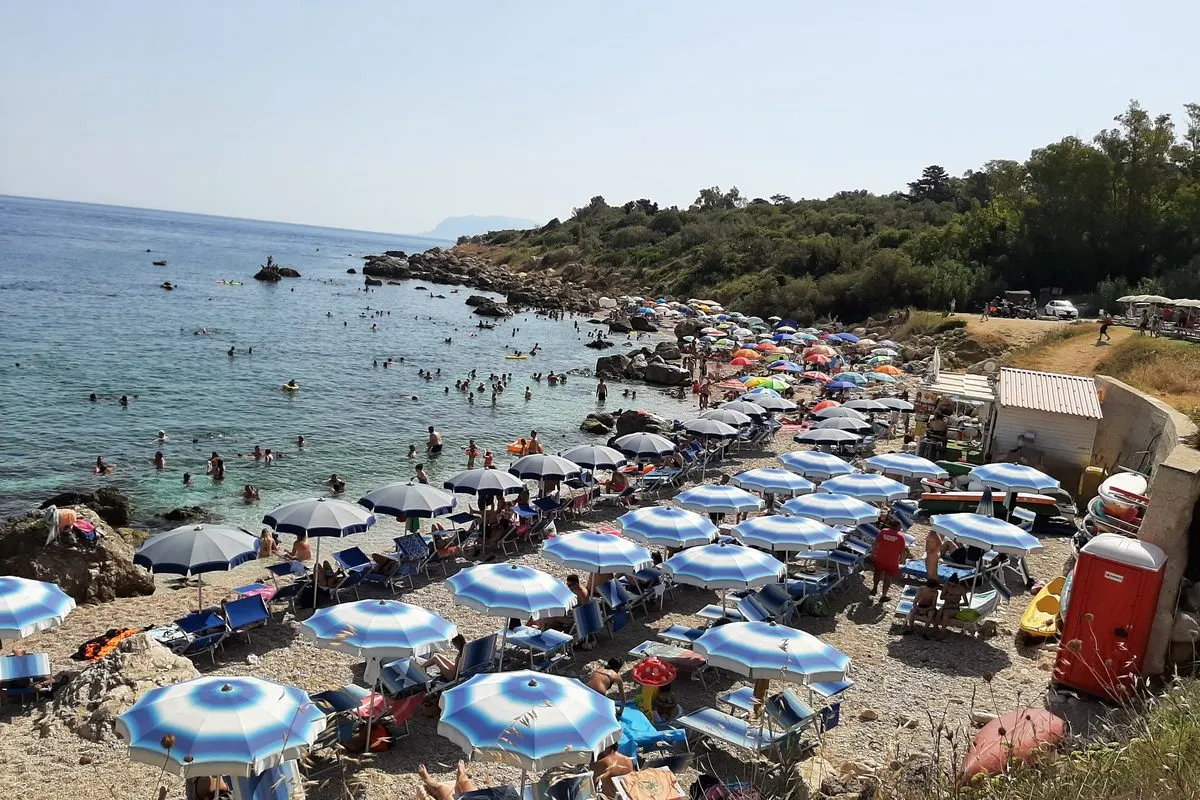
Much of the Italian coast is divided into stabilimenti balneari, lidos where you pay for a sunbed and an umbrella, and spiagge libere, free beaches. Ask for a half-day price in the afternoon. A red flag means no swimming.
You reach the sea and find rows of matching umbrellas, a bar, a row of cabins and someone at a desk. That's a lido, also called bagno or stabilimento, and it works like a club you join for the day. A few hundred metres on there's the free beach: no rows, no desk, bring your own towel.
Here's how to rent a spot, ask about prices and services, understand the lifeguard's flags and, if you head for the hills instead, ask about a trail. With closed questions, as always.
| Italian | English |
|---|---|
| Avete un ombrellone libero? | Do you have an umbrella free?answer: sì or no |
| Un ombrellone e due lettini, per favore. | An umbrella and two sunbeds, please. |
| C'è il prezzo per mezza giornata? | Is there a half-day price?answer: sì or no |
| Le docce sono comprese? | Are the showers included?answer: sì or no |
| Si può fare il bagno? | Can you swim?answer: sì or no |
| È una spiaggia libera? | Is it a free beach?answer: sì or no |
| Il sentiero è segnato? | Is the trail marked?answer: sì or no |
| C'è acqua lungo il sentiero? | Is there water along the trail?answer: sì or no |
Read the Italian out loud once before you need it. The questions marked sì or no get a one-word answer you can understand.
A stabilimento balneare, or lido, rents you an umbrella and sunbeds for the day, with toilets, showers, changing cabins and usually a bar. A spiaggia libera is a free public beach, often with fewer services; a spiaggia libera attrezzata is free to enter, with umbrellas and sunbeds for rent.
In August and at weekends lidos fill up: arrive early or book. The strip of sand closest to the water is open to everyone for walking along, lido or not.
| You say | English |
|---|---|
| È una spiaggia libera? | Is it a free beach?sì or no |
| Bisogna prenotare? | Do you need to book?sì or no |
| Si può stare anche senza ombrellone? | Can you stay without renting an umbrella?sì or no |
| You hear | English |
|---|---|
| Siamo al completo. | We're full.no |
| La spiaggia libera è lì. | The free beach is over there. |
At the lido's desk, la cassa: ask whether there's a free umbrella and the price, for the day or for half a day. Prices depend on the row, la fila: the first row by the water costs the most.
The half-day price, mezza giornata, usually starts after lunch. A lettino is a sunbed, a sdraio a deckchair, and a cabina a changing cabin.
| You say | English |
|---|---|
| Avete un ombrellone libero? | Do you have an umbrella free?sì or no |
| Un ombrellone e due lettini, per favore. | An umbrella and two sunbeds, please. |
| C'è il prezzo per mezza giornata? | Is there a half-day price?sì or no |
| Quanto costa in terza fila? | How much is it in the third row? |
| Si può pagare con la carta? | Can I pay by card?sì or no |
| You hear | English |
|---|---|
| Tutto il giorno o mezza giornata? | The whole day or half a day?a choice of two |
| In prima fila è tutto occupato. | The first row is all taken. |
| Ombrellone numero quarantasette. | Umbrella number forty-seven.your spot |
A red flag means swimming is forbidden, because the sea is dangerous or no lifeguard is on duty. Rules on the other colours vary from region to region, so ask the lifeguard, il bagnino.
Lifeguards work set hours in high season, roughly from late morning to early evening. Outside those hours you swim at your own risk.
| You say | English |
|---|---|
| Si può fare il bagno? | Can you swim?sì or no |
| C'è il bagnino? | Is there a lifeguard?sì or no |
| Il mare è mosso? | Is the sea rough?sì or no |
| Ci sono meduse? | Are there jellyfish?sì or no |
| You hear | English |
|---|---|
| Bandiera rossa. | Red flag.no swimming |
| Oggi c'è corrente. | There's a current today.be careful |
| Non andate oltre le boe. | Don't go beyond the buoys. |

In the  amo Italian app you practise inside real-life pathways: il bar, il ristorante, i trasporti, la casa and more, with listening, dialogues and the grammar explained in English. This page gives you the phrases; the app trains your ear.
Half the A1 course free, no sign-up
★★★★★(22)by Alessio, teacher since 2018
Downloadamo Italian for iPhone ↗︎Search for amo Italian
Showers, toilets and cabins are usually included in the price, though a hot shower may cost extra. The lido bar serves everything from coffee to lunch. Ask with closed questions.
Italians stay at the beach for lunch: many lidos have a restaurant, and a panino or a plate of pasta under the umbrella is a summer ritual.
| You say | English |
|---|---|
| Le docce sono comprese? | Are the showers included?sì or no |
| La doccia calda si paga? | Do you pay for a hot shower?sì or no |
| C'è una cabina libera? | Is there a cabin free?sì or no |
| Il bar fa da mangiare? | Does the bar serve food?sì or no |
| You hear | English |
|---|---|
| Ci vuole il gettone. | You need a token.for the shower |
| Il bar chiude alle sette. | The bar closes at seven. |

Ask a closed question about the thing you're worried about: il sentiero è segnato?, is the trail marked?, è difficile?, is it hard?, c'è acqua lungo il sentiero? In the mountains, red and white marks show the way.
At a mountain hut, un rifugio, or a tourist office, ask about time, not distance: trails are measured in hours. Sentiero chiuso means the trail is closed: don't go.
| You say | English |
|---|---|
| Il sentiero è segnato? | Is the trail marked?sì or no |
| È difficile? | Is it difficult?sì or no |
| Ci vogliono più di due ore? | Does it take more than two hours?sì or no |
| C'è acqua lungo il sentiero? | Is there water along the trail?sì or no |
| Il rifugio è aperto? | Is the hut open?sì or no |
| You hear | English |
|---|---|
| Segua i segni bianchi e rossi. | Follow the red and white marks. |
| È per escursionisti esperti. | It's for experienced hikers. |
| Il sentiero è chiuso. | The trail is closed.no |

Visitors from Australia, Britain or the Netherlands are often surprised to find so much of the Italian coast run as private beach clubs. According to the environmental group Legambiente, about 43 per cent of Italy's sandy coastline is held in concession by stabilimenti balneari, and in Liguria, Emilia-Romagna and Campania the share reaches around 70 per cent. The tradition goes back to the bathing establishments of the nineteenth century, and the concessions are a long-running political argument, because European competition rules require them to be put out to tender.

For many Italian families the lido is a second home for the summer. They rent the same umbrella every year, in the same row, next to the same neighbours, and children grow up on that stretch of sand. What a concession can't take away is the shoreline itself: by law everyone has free access to the strip by the water, the battigia, even in front of a private lido, and the right to cross the lido to reach it. You can walk and swim there; the sunbeds are what you pay for.
Beach days have their own timetable. Italians go in the morning, eat lunch at the lido or under the umbrella, and come back in the late afternoon when the sun is lower, leaving the hottest hours to shade or a nap. Many grew up with the rule that you wait two or three hours after eating before you swim; it is more tradition than medicine, but you will still hear grandmothers say it. In August, and around Ferragosto in particular, the whole country seems to be on the same beach.
Read next: Why do so many Italians live by the ferry timetable? · Why are children welcome everywhere in Italy?
Italians rarely answer with a bare sì or no. These are the forms you will actually hear, so you know which way the answer went.
| You hear | English | It means |
|---|---|---|
| Sì, certo. | Yes, of course. | yes |
| Certo! | Sure! | yes |
| Come no! | Of course! (literally: how not?) | yes |
| Volentieri. | Gladly. | yes |
| Va bene. | Fine, OK. | yes |
| Prego. | Go ahead / please do. | yes |
| No, mi dispiace. | No, I'm sorry. | no |
| Purtroppo no. | Unfortunately not. | no |
| Non c'è. | There isn't any. | no |
| È finito. | It's sold out / all gone. | no |
| Non si può. | That's not allowed. | no |
| Non ancora. | Not yet. | no |
Six real replies. Tap Yes or No for each one.
The grammar behind them
This guide as two printable pages, in English: the phrases to say, the yes/no questions and what you will hear.
All 43 phrase PDFs · €9Already included in the full course · €39 a year.
Or keep the eight phrases as an image, to save on your phone or pin:
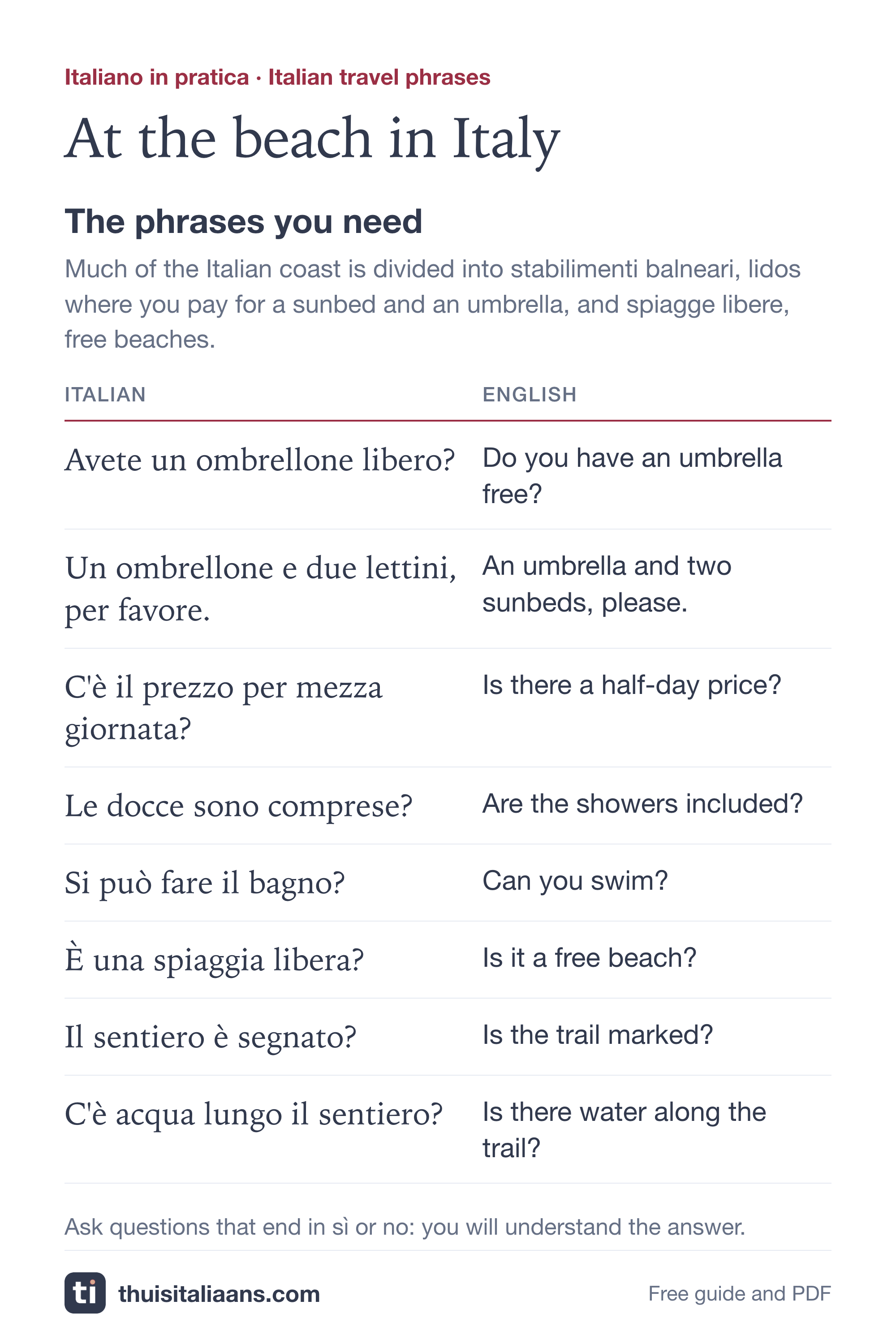 Italian phrases: At the beach in Italy
A private beach club, or lido, where you pay to rent an umbrella and sunbeds for the day, with showers, toilets, cabins and usually a bar.
No. Next to the lidos there are free public beaches, «spiagge libere», and the strip of sand right by the water is open to everyone for walking along.
Swimming is forbidden, because the sea is dangerous or no lifeguard is on duty.
«C'è il prezzo per mezza giornata?». Half-day prices usually start after lunch.