Italiano in pratica
by Alessio · teacher of Italian for foreigners, ITALS master’s in teaching Italian abroad (Ca’ Foscari University, Venice) and a master’s in teaching Italian as a second language (Giustino Fortunato University, Benevento)
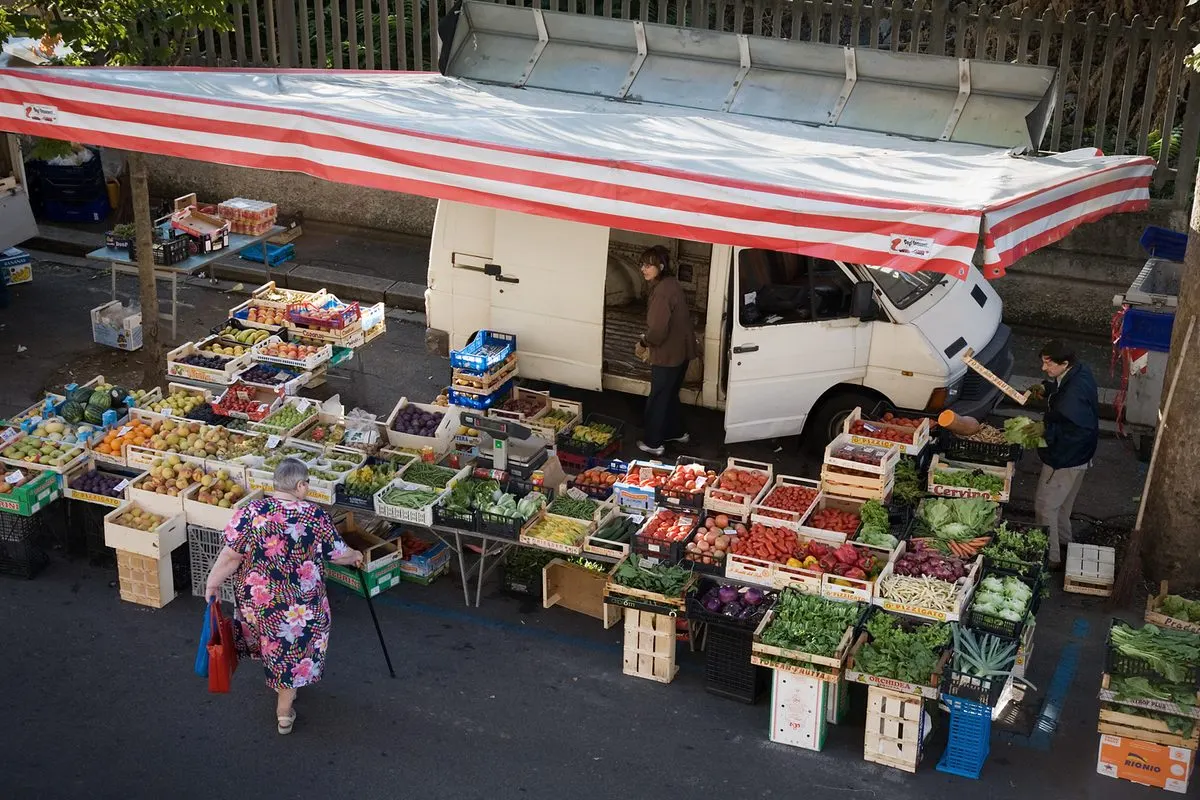
Greet when you walk in, and ask before you touch: in many small shops and at the market the seller picks for you. Prices in shops are fixed; at the deli counter and the market you buy cheese and ham all'etto, by 100 grams. Always take lo scontrino, the receipt: shops are required to give you one.
A small shop in Italy is not a self-service: you say buongiorno, the shopkeeper asks what you're looking for, and brings things to you. At the market it's the same, with a queue that has no numbers and a unit of weight nobody uses at home.
Here's how to ask the price, try something on, ask for another size and pay, with questions that come back as sì or no.
| Italian | English |
|---|---|
| Quanto costa? | How much is it? |
| Posso provarlo? | Can I try it on?answer: sì |
| C'è una taglia più grande? | Is there a bigger size?answer: sì or no |
| Ce l'avete in blu? | Do you have it in blue?answer: sì or no |
| Do solo un'occhiata, grazie. | I'm just looking, thanks. |
| Lo prendo. | I'll take it. |
| Mi fa lo scontrino? | Can I have the receipt?answer: sì |
| Si può fare il tax free? | Can I get a tax-free refund?answer: sì or no |
Read the Italian out loud once before you need it. The questions marked sì or no get a one-word answer you can understand.
Quanto costa? for one thing, quanto costano? for more than one. In shops prices are fixed and haggling isn't done; at flea markets and some souvenir stalls a polite mi fa uno sconto? is fine.
When you just want to browse, say so: do solo un'occhiata. The shopkeeper will leave you in peace.
| You say | English |
|---|---|
| Quanto costa? | How much is it? |
| Quanto costano questi? | How much are these? |
| È in saldo? | Is it on sale?sì or no |
| Mi fa uno sconto? | Can you give me a discount?at a market; sì or no |
| Do solo un'occhiata, grazie. | I'm just looking, thanks. |
| You hear | English |
|---|---|
| Posso aiutarla? | Can I help you?answer: do solo un'occhiata |
| Cerca qualcosa? | Are you looking for something?sì or no |
| Il prezzo è fisso. | The price is fixed.no discount |
Ask posso provarlo? (provarla for a feminine word, provarli for a plural) and you'll be pointed to the fitting rooms, i camerini. Italian clothing sizes differ from UK and US ones, so try before you buy.
Size is la taglia for clothes and il numero for shoes. Too big is troppo grande, too small troppo piccolo, too tight stretto.
| You say | English |
|---|---|
| Posso provarlo? | Can I try it on?sì |
| Dove sono i camerini? | Where are the fitting rooms? |
| C'è una taglia più piccola? | Is there a smaller size?sì or no |
| Avete il trentanove? | Do you have a 39?shoes; sì or no |
| Ce l'avete in nero? | Do you have it in black?sì or no |
| Mi sta bene? | Does it suit me?sì or no |
| You hear | English |
|---|---|
| Che taglia porta? | What size do you wear? |
| Che numero ha? | What shoe size are you? |
| È l'ultimo. | It's the last one. |
| Le sta benissimo. | It looks great on you. |
Wait your turn and let the seller pick: touching the fruit is not done at most stalls. Cheese, ham and salami are sold all'etto, by 100 grams; fruit and vegetables by the kilo. The prices on the signs are almost always per kilo.
There are no tickets, so ask the person in front of you sono dopo di lei?, am I after you?, and you have your place in the queue. When it's your turn you'll hear mi dica: just order.
| You say | English |
|---|---|
| Sono dopo di lei? | Am I after you?sì or no |
| Un etto di prosciutto crudo. | A hundred grams of prosciutto. |
| Mezzo chilo di pomodori. | Half a kilo of tomatoes. |
| Posso scegliere io? | Can I choose myself?often no |
| Me ne dà due? | Can you give me two? |
| You hear | English |
|---|---|
| A chi tocca? | Whose turn is it? |
| Mi dica. | What can I get you?your turn |
| Tagliato sottile? | Thinly sliced?sì or no |
| Lascio? | Is a bit over OK?sì or no: the weight is a little over |


In the  amo Italian app you practise inside real-life pathways: il bar, il ristorante, i trasporti, la casa and more, with listening, dialogues and the grammar explained in English. This page gives you the phrases; the app trains your ear.
Half the A1 course free, no sign-up
★★★★★(22)by Alessio, teacher since 2018
Downloadamo Italian for iPhone ↗︎Search for amo Italian
Yes. Every shop has to give you a receipt, lo scontrino, and you'll need it for any exchange or return. Exchange and refund rules are up to each shop, so ask before you pay.
Exchanges are common, cash refunds much less so. A closed question settles it in a second.
| You say | English |
|---|---|
| Mi fa lo scontrino? | Can I have the receipt?sì |
| Si può cambiare? | Can it be exchanged?sì or no |
| Posso restituirlo? | Can I return it?sì or no |
| Mi fa un pacchetto regalo? | Could you gift-wrap it?sì |
| You hear | English |
|---|---|
| Il cambio entro quindici giorni, con lo scontrino. | Exchanges within fifteen days, with the receipt. |
| Non facciamo rimborsi. | We don't give refunds.no |

If you live outside the EU, you can claim back the VAT on goods bought in one shop on one day above a minimum amount, €70 at the time of writing. Ask for the tax-free form when you pay, and show your passport.
Then have the form validated at customs as you leave the EU, with the goods unused. Many shops display a tax-free sign; if not, ask.
| You say | English |
|---|---|
| Si può fare il tax free? | Can I get a tax-free refund?sì or no |
| Le serve il passaporto? | Do you need my passport?sì |
| You hear | English |
|---|---|
| Il minimo è settanta euro. | The minimum is seventy euros. |
| Lo deve far timbrare in dogana. | You have to get it stamped at customs. |
The big sales, i saldi, start in early January and early July, on dates set by each region. Small shops often close for lunch, roughly from one to half past three or four, and many close on Sunday and on Monday morning.
Orario continuato on the door means open all day, with no lunch break. In August many small shops close for a week or two: chiuso per ferie.
| You say | English |
|---|---|
| Siete aperti domenica? | Are you open on Sunday?sì or no |
| Chiudete per pranzo? | Do you close for lunch?sì or no |
| Ci sono i saldi? | Are the sales on?sì or no |
| You hear | English |
|---|---|
| Orario continuato. | Open all day. |
| Chiuso per ferie. | Closed for the holidays. |
| Riapriamo alle quattro. | We reopen at four. |
Much of Italian retail is still small and family run: one shop, one owner, perhaps a relative behind the counter. The relationship is personal, and the owner expects to help you. You greet, you say what you are looking for, and things are brought to you. Picking up goods without asking, especially fruit at a market stall, feels to Italians a little like walking into someone's kitchen. If you just want to look, say so: do solo un'occhiata.

Opening hours follow the rhythm of the day. Many small shops close for lunch, roughly from one to half past three, and stay open until half past seven or eight; in city centres more and more stay open all day. Sales are regulated: the winter sales start on the last working day before Epiphany, around 5 January, and the summer sales on the first Saturday of July, on dates each region confirms, and they last up to eight weeks. In August many small shops close for a week or two.
The receipt matters more than you might expect. Shops must give you one, lo scontrino, as part of Italy's long fight against tax evasion, and the state even runs a lottery in which card-paid receipts are the tickets. Keep it for exchanges, and for a tax refund if you live outside the EU. Markets are where Italians still shop by season: there is a weekly market in every town, and the question è di stagione?, is it in season?, gets an honest answer.
Read next: Why are there gloves in the fruit aisle? · Why do Italians still pay in cash so often?
Italians rarely answer with a bare sì or no. These are the forms you will actually hear, so you know which way the answer went.
| You hear | English | It means |
|---|---|---|
| Sì, certo. | Yes, of course. | yes |
| Certo! | Sure! | yes |
| Come no! | Of course! (literally: how not?) | yes |
| Volentieri. | Gladly. | yes |
| Va bene. | Fine, OK. | yes |
| Prego. | Go ahead / please do. | yes |
| No, mi dispiace. | No, I'm sorry. | no |
| Purtroppo no. | Unfortunately not. | no |
| Non c'è. | There isn't any. | no |
| È finito. | It's sold out / all gone. | no |
| Non si può. | That's not allowed. | no |
| Non ancora. | Not yet. | no |
Six real replies. Tap Yes or No for each one.
The grammar behind them
This guide as two printable pages, in English: the phrases to say, the yes/no questions and what you will hear.
All 43 phrase PDFs · €9Already included in the full course · €39 a year.
Or keep the eight phrases as an image, to save on your phone or pin:
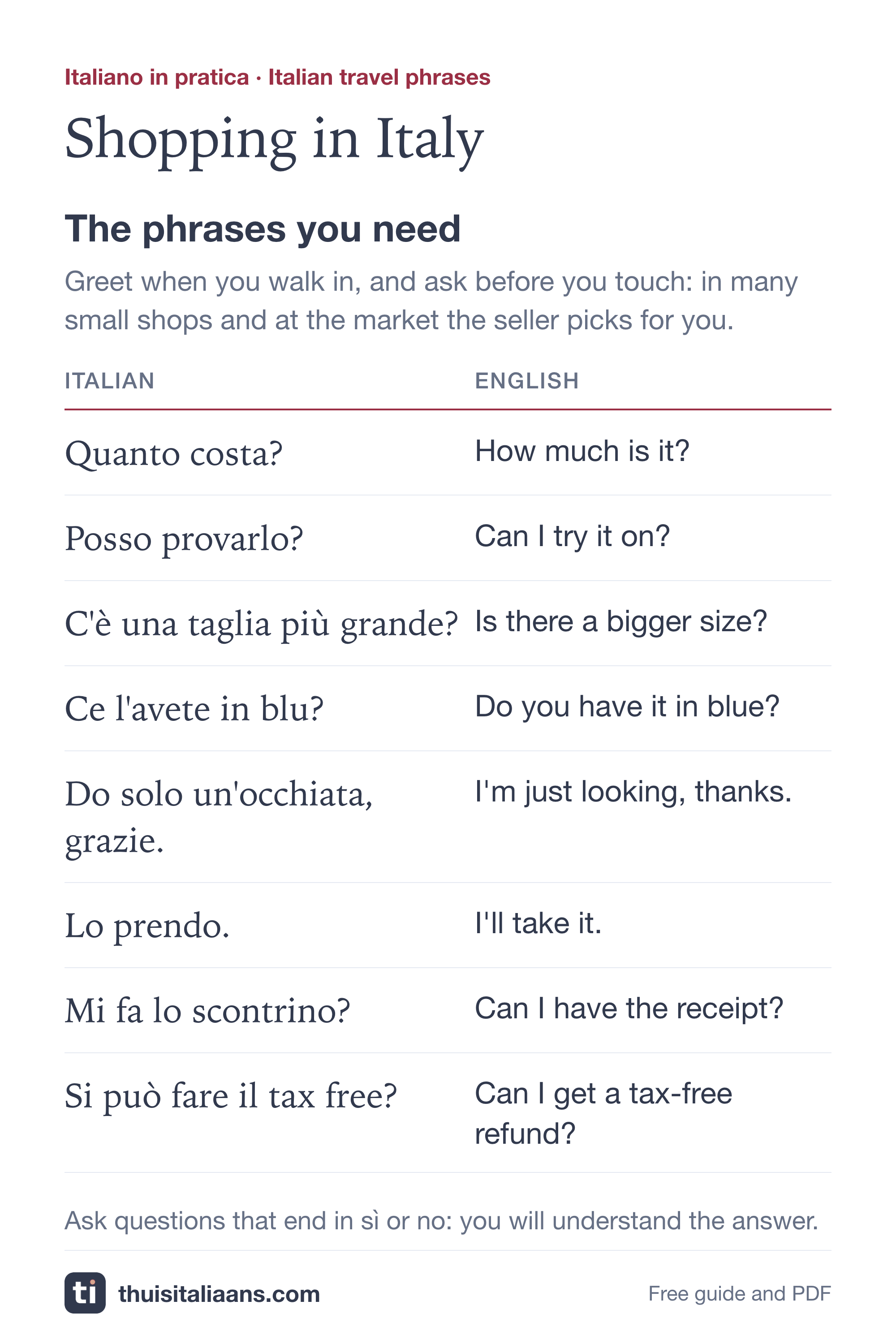 Italian phrases: Shopping in Italy
«Quanto costa?» for one item, «quanto costano?» for several.
Not in shops: prices are fixed. At flea markets and some souvenir stalls a polite «Mi fa uno sconto?» is acceptable.
100 grams. Italians order ham, cheese and salami by the etto: «un etto e mezzo» is 150 grams.
Residents of non-EU countries can claim back VAT on purchases above a minimum amount, made in one shop on one day. Ask for the tax-free form when you pay and have it validated at customs as you leave the EU.
«I saldi» start in early January and early July, on dates set by each region.