Italiano in pratica
by Alessio · teacher of Italian for foreigners, ITALS master’s in teaching Italian abroad (Ca’ Foscari University, Venice) and a master’s in teaching Italian as a second language (Giustino Fortunato University, Benevento)
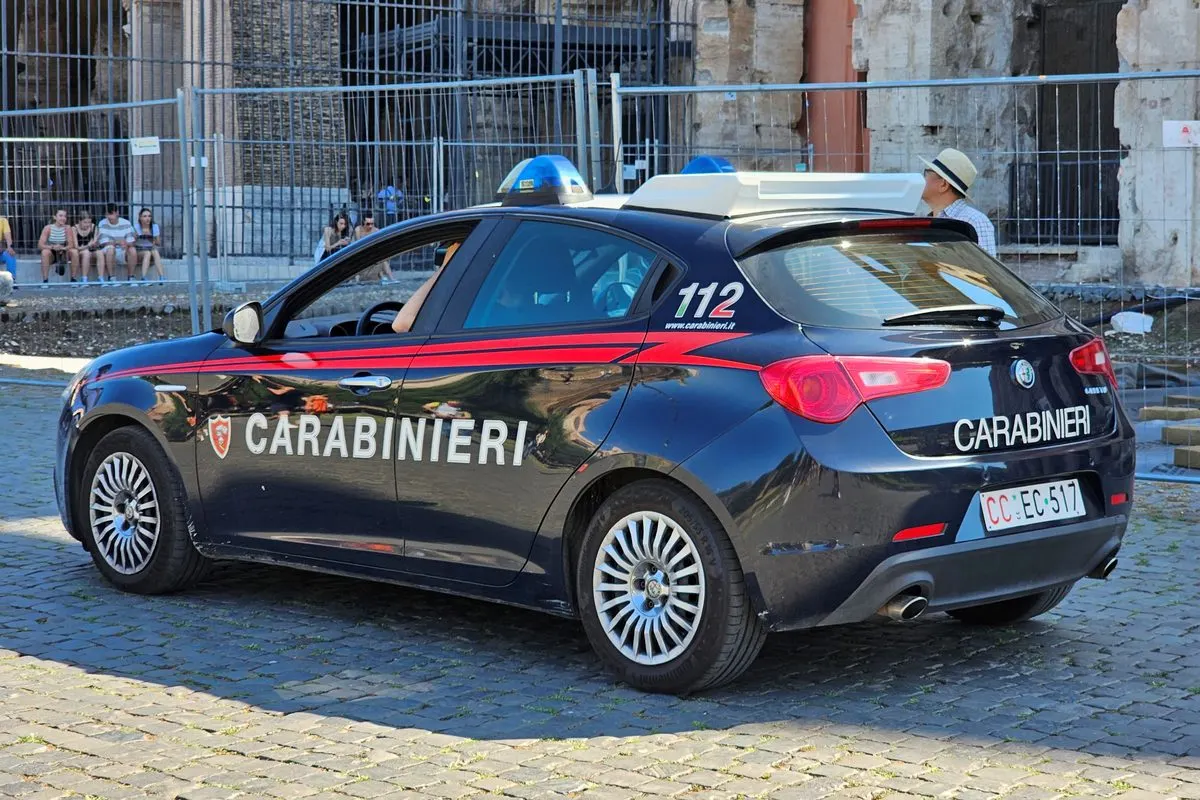
In an emergency call 112, the European emergency number: it reaches ambulance, police and fire brigade, free from any phone. Say where you are first. To report a theft or a lost passport, go to the Carabinieri or the police and say you want to make a report, fare una denuncia.
Nobody wants to need this page. But if something happens, a fall, an accident, a stolen bag, the right words in the first minute matter more than anything else, and there are fewer of them than you'd think.
Here they are: how to call for help, what to say on the phone, the questions the operator asks, and how to report a theft. When you're stressed, short questions with short answers are what work, so the yes/no questions are here too.
| Italian | English |
|---|---|
| Aiuto! | Help! |
| Chiami un'ambulanza! | Call an ambulance! |
| C'è un medico? | Is there a doctor?answer: sì or no |
| Mi hanno rubato il portafoglio. | My wallet has been stolen. |
| Ho perso il passaporto. | I've lost my passport. |
| Dov'è la polizia? | Where are the police? |
| Parla inglese? | Do you speak English?answer: sì or no |
| Devo fare una denuncia. | I need to report it. |
Read the Italian out loud once before you need it. The questions marked sì or no get a one-word answer you can understand.
112, the single European emergency number. It's free from any mobile or landline, and the operator sends an ambulance, the police or the fire brigade. The older numbers still work: 113 for the police, 118 for an ambulance, 115 for the fire brigade.
Operators can often speak English; if not, the sentences below are enough. If you can't talk, stay on the line.
| You say | English |
|---|---|
| È un'emergenza. | It's an emergency. |
| C'è un ferito. | Someone is injured. |
| Serve un'ambulanza. | We need an ambulance. |
| Parla inglese? | Do you speak English?sì or no |
| You hear | English |
|---|---|
| Qual è l'emergenza? | What's the emergency? |
| Dove si trova? | Where are you?say the address or a landmark |
| Resti in linea. | Stay on the line. |
Where you are, then what happened. The address or a landmark: sono in via Roma 12, sono davanti al Duomo, sono sull'autostrada A1, direzione Firenze. Then one sentence about what happened.
The operator will ask closed questions: is the person conscious, breathing, bleeding. Answer sì or no; you don't need more.
| You say | English |
|---|---|
| Sono in via Roma, numero dodici. | I'm at number 12, via Roma. |
| Sono davanti alla stazione. | I'm in front of the station. |
| C'è stato un incidente. | There's been an accident. |
| È caduto e non si alza. | He's fallen and can't get up.caduta for a woman |
| You hear | English |
|---|---|
| È cosciente? | Is he or she conscious?sì or no |
| Respira? | Is he or she breathing?sì or no |
| Perde sangue? | Is he or she bleeding?sì or no |
| Arriviamo subito. | We're on our way. |

Shout aiuto!, help!, then give one person a precise request: chiami un'ambulanza!, call an ambulance! In a crowd, looking at one person and asking directly works better than shouting to everyone.
If someone snatches your bag, the shout is al ladro!, stop thief!
| You say | English |
|---|---|
| Aiuto! | Help! |
| Chiami un'ambulanza! | Call an ambulance! |
| C'è un medico? | Is there a doctor?sì or no |
| Mi può aiutare? | Can you help me?sì |
| Al ladro! | Stop thief! |
| Al fuoco! | Fire! |
| You hear | English |
|---|---|
| Sto chiamando. | I'm calling. |
| Si sieda qui. | Sit down here. |
| Non si muova. | Don't move. |

In the  amo Italian app you practise inside real-life pathways: il bar, il ristorante, i trasporti, la casa and more, with listening, dialogues and the grammar explained in English. This page gives you the phrases; the app trains your ear.
Half the A1 course free, no sign-up
★★★★★(22)by Alessio, teacher since 2018
Downloadamo Italian for iPhone ↗︎Search for amo Italian
Go to the nearest Carabinieri station, la stazione dei Carabinieri, or a police station, il commissariato or la questura, and say devo fare una denuncia, I need to make a report. You'll get a copy: you need it for your insurance and, for a passport, for your embassy or consulate.
Bring an ID if you still have one. In big cities some police stations have staff who speak English.
| You say | English |
|---|---|
| Devo fare una denuncia. | I need to make a report. |
| Mi hanno rubato il portafoglio. | My wallet has been stolen.literally: they stole my wallet |
| Ho perso il passaporto. | I've lost my passport. |
| Mi serve una copia per l'assicurazione. | I need a copy for the insurance. |
| Posso chiamare il mio consolato? | Can I call my consulate?sì |
| You hear | English |
|---|---|
| Dove è successo? | Where did it happen? |
| A che ora? | At what time? |
| Cosa c'era nel portafoglio? | What was in the wallet? |
| Firmi qui. | Sign here. |

Block your cards first, by phone or in your bank's app. Then contact your embassy or consulate for an emergency travel document: embassies are in Rome, with consulates in Milan, Florence, Naples and other cities.
Meanwhile, a closed question at your hotel desk gets you a phone and a printer: posso usare il telefono?, posso stampare un documento?
| You say | English |
|---|---|
| Posso usare il telefono? | Can I use the phone?sì or no |
| Posso stampare un documento? | Can I print a document?sì or no |
| Dov'è il consolato britannico? | Where's the British consulate? |
| You hear | English |
|---|---|
| Le serve una mano? | Do you need a hand?sì or no |
| Il consolato è in centro. | The consulate is in the centre. |
Italy has more than one police force, and visitors often wonder which one to turn to. The Carabinieri are a military force under the Ministry of Defence, with a station in almost every town; the Polizia di Stato is the civilian national police under the Ministry of the Interior; the Guardia di Finanza deals with tax and customs; and the local police, polizia locale or municipale, handle traffic and city rules. For a theft or a lost passport both the Carabinieri and the Polizia take reports, so go to whichever is nearer.

For emergencies there is one number: 112. Region by region, Italy has been moving to single answering centres, where an operator takes the call, finds out what is needed and passes it to the ambulance, the police or the fire brigade. Where that system isn't in place yet, 112 still works and reaches the Carabinieri. The old numbers still exist too: 113 for the police, 118 for an ambulance, 115 for the fire brigade and 1530 for emergencies at sea.
For a visitor the most common emergency is a stolen bag or wallet, mostly in crowded tourist spots, on busy buses and at stations. A report, la denuncia, is a formal document: it takes time, but you need the copy for your insurance and to replace a passport at your consulate. It helps to keep a photo of your passport on your phone, and your bag in front of you in a crowd.
Read next: How does healthcare work in Italy, and what does it mean for visitors? · Why do Italians spell words with city names?
Italians rarely answer with a bare sì or no. These are the forms you will actually hear, so you know which way the answer went.
| You hear | English | It means |
|---|---|---|
| Sì, certo. | Yes, of course. | yes |
| Certo! | Sure! | yes |
| Come no! | Of course! (literally: how not?) | yes |
| Volentieri. | Gladly. | yes |
| Va bene. | Fine, OK. | yes |
| Prego. | Go ahead / please do. | yes |
| No, mi dispiace. | No, I'm sorry. | no |
| Purtroppo no. | Unfortunately not. | no |
| Non c'è. | There isn't any. | no |
| È finito. | It's sold out / all gone. | no |
| Non si può. | That's not allowed. | no |
| Non ancora. | Not yet. | no |
Six real replies. Tap Yes or No for each one.
The grammar behind them
This guide as two printable pages, in English: the phrases to say, the yes/no questions and what you will hear.
All 43 phrase PDFs · €9Already included in the full course · €39 a year.
Or keep the eight phrases as an image, to save on your phone or pin:
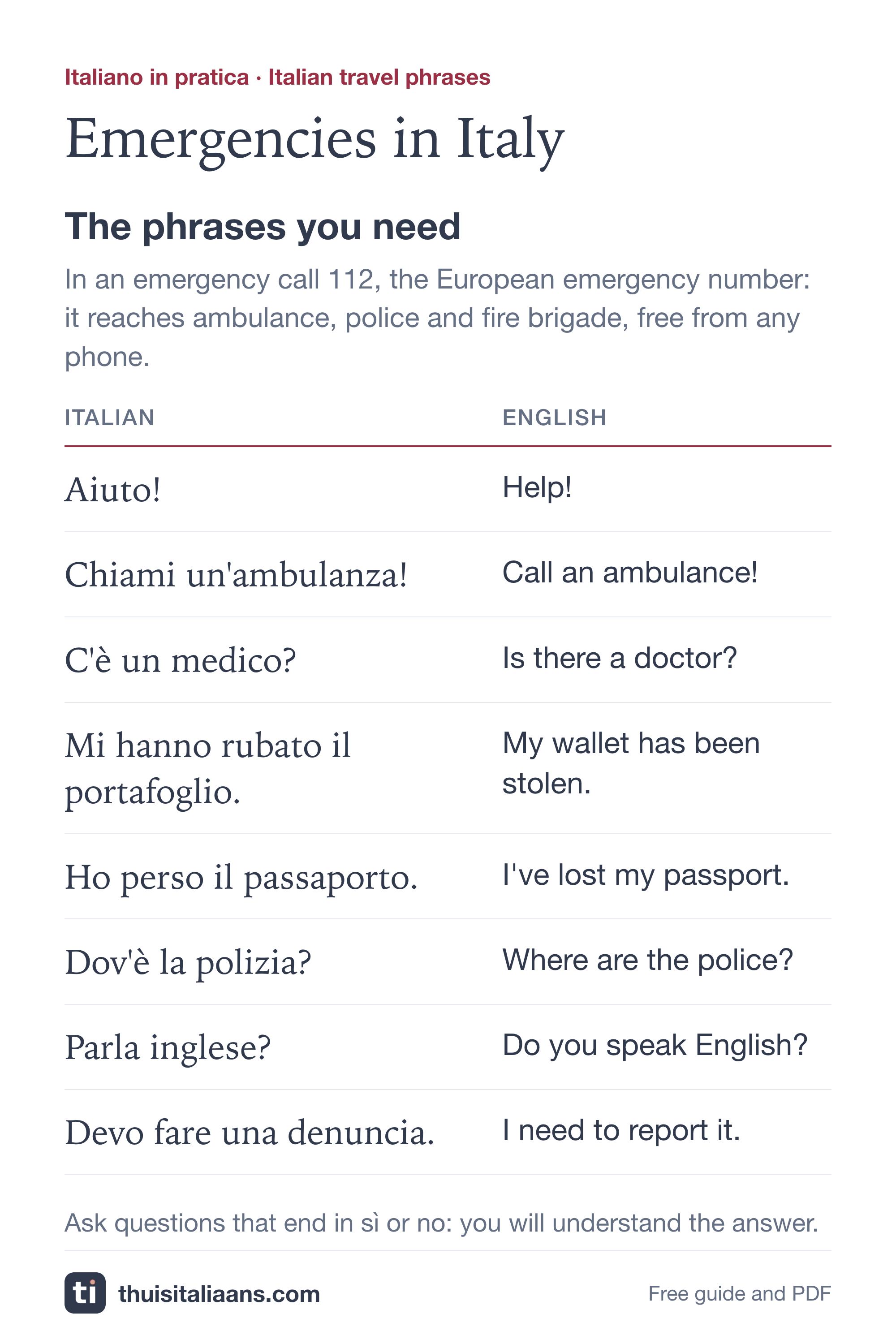 Italian phrases: Emergencies in Italy
112, the European emergency number, free from any phone. 113 (police), 118 (ambulance) and 115 (fire brigade) still work.
«Aiuto!». To ask someone to call an ambulance: «Chiami un'ambulanza!».
Go to a Carabinieri station or a police station and say «Devo fare una denuncia». Keep the copy of the report for your insurance.
Report the loss to the Carabinieri or the police, then contact your embassy or consulate with the copy of the report to get an emergency travel document.