Italiano in pratica
by Alessio · teacher of Italian for foreigners, ITALS master’s in teaching Italian abroad (Ca’ Foscari University, Venice) and a master’s in teaching Italian as a second language (Giustino Fortunato University, Benevento)
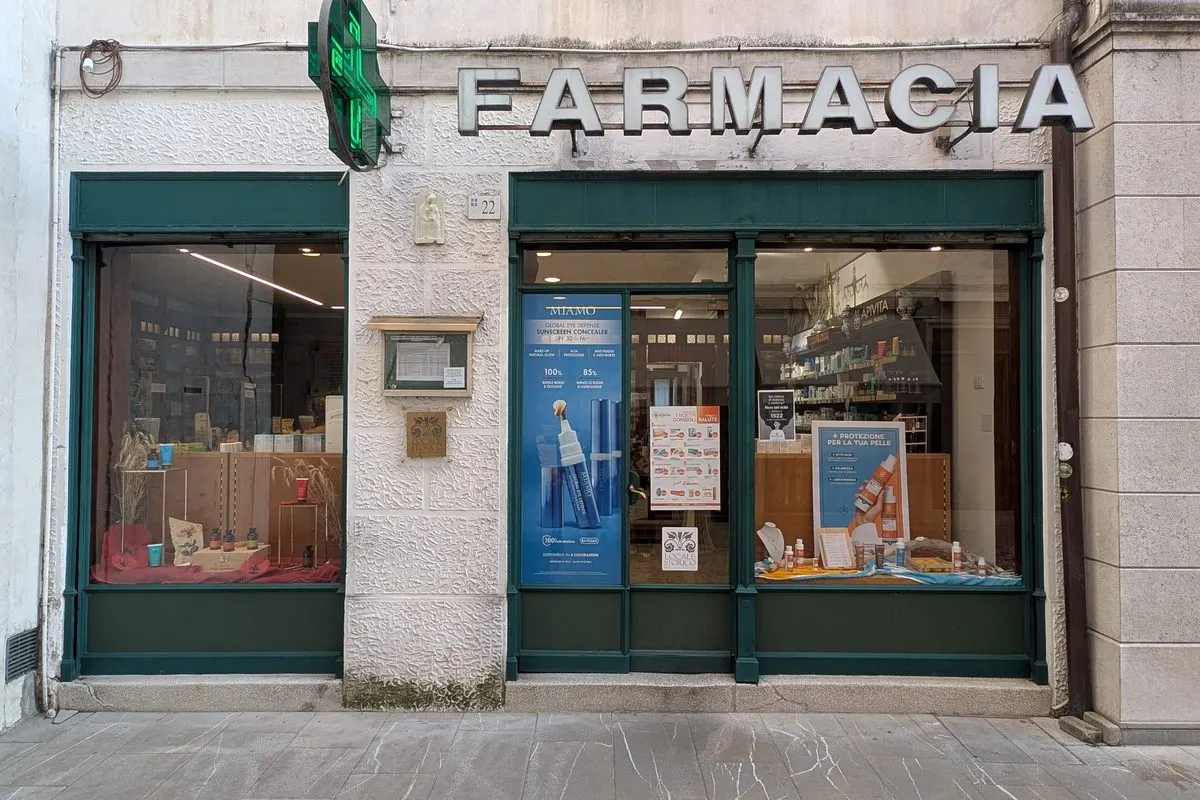
For most holiday ailments the Italian pharmacy, under the green cross, is the first stop: the pharmacist can advise you and sell many medicines without a prescription. Say buongiorno, then ho mal di plus the body part. At night there's always a farmacia di turno open.
A sore throat, a sunburnt back, a mosquito bite that has doubled in size. In Italy you don't need a doctor for that: you walk in under the green cross, explain, and the pharmacist asks three or four questions before handing you something.
Here are the sentences to explain what's wrong, the questions you'll hear back, the instructions that come with the box, and what to do on a Sunday night when everything is shut.
| Italian | English |
|---|---|
| Buongiorno, ho mal di gola. | Hello, I have a sore throat. |
| Ha qualcosa per la tosse? | Do you have something for a cough?answer: sì |
| Mi fa male qui. | It hurts here.pointing |
| Ci vuole la ricetta? | Do I need a prescription?answer: sì or no |
| È per un bambino. | It's for a child. |
| Sono allergico alla penicillina. | I'm allergic to penicillin.allergica for a woman |
| Una compressa ogni otto ore? | One tablet every eight hours?check: sì or no |
| Me lo può scrivere? | Could you write it down for me?answer: sì |
Read the Italian out loud once before you need it. The questions marked sì or no get a one-word answer you can understand.
Greet first, then one sentence: ho mal di testa, I have a headache, or avrei bisogno di qualcosa per il mal di gola, I'd need something for a sore throat. Pointing and saying mi fa male qui, it hurts here, covers any word you're missing.
Italian pharmacists have a university degree and are used to giving advice: for a sore throat, a fever, sunburn or an insect bite you can start at the pharmacy rather than at a doctor's.
| You say | English |
|---|---|
| Buongiorno, ho mal di testa. | Hello, I have a headache. |
| Avrei bisogno di qualcosa per il mal di gola. | I'd need something for a sore throat.the polite form Italians use |
| Ha qualcosa per la tosse? | Do you have something for a cough?sì |
| Mi fa male qui. | It hurts here. |
| Non mi sento bene. | I don't feel well. |
| Mi può consigliare qualcosa? | Can you recommend something?sì |
| You hear | English |
|---|---|
| Mi dica. | How can I help?your turn |
| Che disturbi ha? | What symptoms do you have? |

Most pains follow one pattern: ho mal di plus the body part, with no article. Ho mal di testa, ho mal di stomaco, ho mal di denti. For a fever, a cold and a cough the article comes back: ho la febbre, ho il raffreddore, ho la tosse.
Anything else takes a whole sentence, but always a short one.
| You say | English |
|---|---|
| mal di testa · di gola · di stomaco | headache · sore throat · stomach ache |
| mal di pancia · di denti · di schiena | tummy ache · toothache · backache |
| Ho la febbre. · Ho il raffreddore. | I have a fever. · I have a cold. |
| Ho la tosse secca. | I have a dry cough.tosse grassa: a chesty cough |
| Mi sono scottato al sole. | I've got sunburnt.scottata for a woman |
| Ho una puntura di zanzara. | I have a mosquito bite. |
| Ho la nausea. · Ho la diarrea. | I feel sick. · I have diarrhoea. |
| Mi sono fatto male alla caviglia. | I've hurt my ankle.fatta for a woman |
Almost always the same few questions: since when, whether it's for an adult or a child, whether you take other medicines and whether you have allergies. Most can be answered with sì, no or a number.
Antibiotics and many other medicines need a doctor's prescription, la ricetta. For anything you take regularly, bring the active ingredient, not the brand name: paracetamolo, ibuprofene and amoxicillina are understood everywhere.
| You say | English |
|---|---|
| Da ieri. | Since yesterday. |
| Da tre giorni. | For three days. |
| No, nessun altro farmaco. | No, no other medicines. |
| Sono allergico alla penicillina. | I'm allergic to penicillin.allergica for a woman |
| Ci vuole la ricetta? | Do I need a prescription?sì or no |
| You hear | English |
|---|---|
| Da quanto tempo? | For how long?answer: da... |
| Per un adulto o per un bambino? | For an adult or a child?a choice of two |
| Prende altri farmaci? | Do you take other medicines?sì or no |
| È allergico a qualcosa? | Are you allergic to anything?sì or no |
| Ha la ricetta? | Do you have a prescription?sì or no |

In the  amo Italian app you practise inside real-life pathways: il bar, il ristorante, i trasporti, la casa and more, with listening, dialogues and the grammar explained in English. This page gives you the phrases; the app trains your ear.
Half the A1 course free, no sign-up
★★★★★(22)by Alessio, teacher since 2018
Downloadamo Italian for iPhone ↗︎Search for amo Italian
They come in three short phrases: how much, how often and when. Una compressa ogni otto ore, dopo i pasti, per tre giorni: one tablet every eight hours, after meals, for three days. Repeat it back as a question to check.
Medicines come as compresse, tablets, bustine, sachets to dissolve in water, sciroppo, syrup, gocce, drops, or pomata, ointment. If it went too fast, ask the pharmacist to write it on the box.
| You say | English |
|---|---|
| Una compressa ogni otto ore? | One tablet every eight hours?sì or no |
| Dopo i pasti? | After meals?sì or no |
| Va bene anche per un bambino? | Is it OK for a child too?sì or no |
| Me lo può scrivere, per favore? | Could you write it down for me, please?sì |
| You hear | English |
|---|---|
| Due volte al giorno. | Twice a day. |
| A stomaco pieno. | On a full stomach.not on an empty stomach |
| Da sciogliere in acqua. | To dissolve in water. |
| Finché non sta meglio. | Until you feel better. |

One pharmacy is always open, la farmacia di turno: the list is posted on the door of every pharmacy. For a doctor out of hours, call the guardia medica; in summer many tourist areas run a guardia medica turistica for visitors.
In an emergency call 112, the European emergency number. EU travellers should bring their European Health Insurance Card. A parafarmacia sells over-the-counter products but not prescription medicines.
| You say | English |
|---|---|
| Dov'è la farmacia di turno? | Where's the duty pharmacy? |
| C'è una guardia medica turistica? | Is there a medical service for tourists?sì or no |
| Ho bisogno di un medico. | I need a doctor. |
| Questa farmacia è aperta? | Is this pharmacy open?sì or no |
| You hear | English |
|---|---|
| La lista è sulla porta. | The list is on the door. |
| Torno subito. | Back soon.a sign on the door |
| Chiuso per turno. | Closed today, see the duty list. |
In Britain or the US you might pick up paracetamol from a supermarket shelf with the rest of your shopping. In Italy medicines are sold across a counter, by a pharmacist. Since 2006 medicines that need no prescription can also be sold in parafarmacie and in supermarket corners, but only with a qualified pharmacist present. You don't browse: you explain, and you get advice with the box.

Italian pharmacists study for five years at university, and they are trusted in a way visitors from some countries don't expect: for a sore throat, sunburn, an upset stomach or an insect bite, Italians go to the pharmacy before they think of a doctor. The number of pharmacies is planned according to population, one is always on duty at night and on holidays, and many now measure blood pressure, run quick tests and book appointments in the public health service.
Brand names are a small trap. Italians often ask for medicines by brand: Tachipirina is the best known paracetamol, Moment and Brufen are ibuprofen. If you need something you take at home, give the active ingredient, il principio attivo, rather than your brand, which may not exist in Italy. And read the word next to the green cross: a farmacia sells everything, a parafarmacia only medicines that need no prescription.
Read next: How does healthcare work in Italy, and what does it mean for visitors? · Carabinieri or Polizia: who does what in Italy?
Italians rarely answer with a bare sì or no. These are the forms you will actually hear, so you know which way the answer went.
| You hear | English | It means |
|---|---|---|
| Sì, certo. | Yes, of course. | yes |
| Certo! | Sure! | yes |
| Come no! | Of course! (literally: how not?) | yes |
| Volentieri. | Gladly. | yes |
| Va bene. | Fine, OK. | yes |
| Prego. | Go ahead / please do. | yes |
| No, mi dispiace. | No, I'm sorry. | no |
| Purtroppo no. | Unfortunately not. | no |
| Non c'è. | There isn't any. | no |
| È finito. | It's sold out / all gone. | no |
| Non si può. | That's not allowed. | no |
| Non ancora. | Not yet. | no |
Six real replies. Tap Yes or No for each one.
The grammar behind them
This guide as two printable pages, in English: the phrases to say, the yes/no questions and what you will hear.
All 43 phrase PDFs · €9Already included in the full course · €39 a year.
Or keep the eight phrases as an image, to save on your phone or pin:
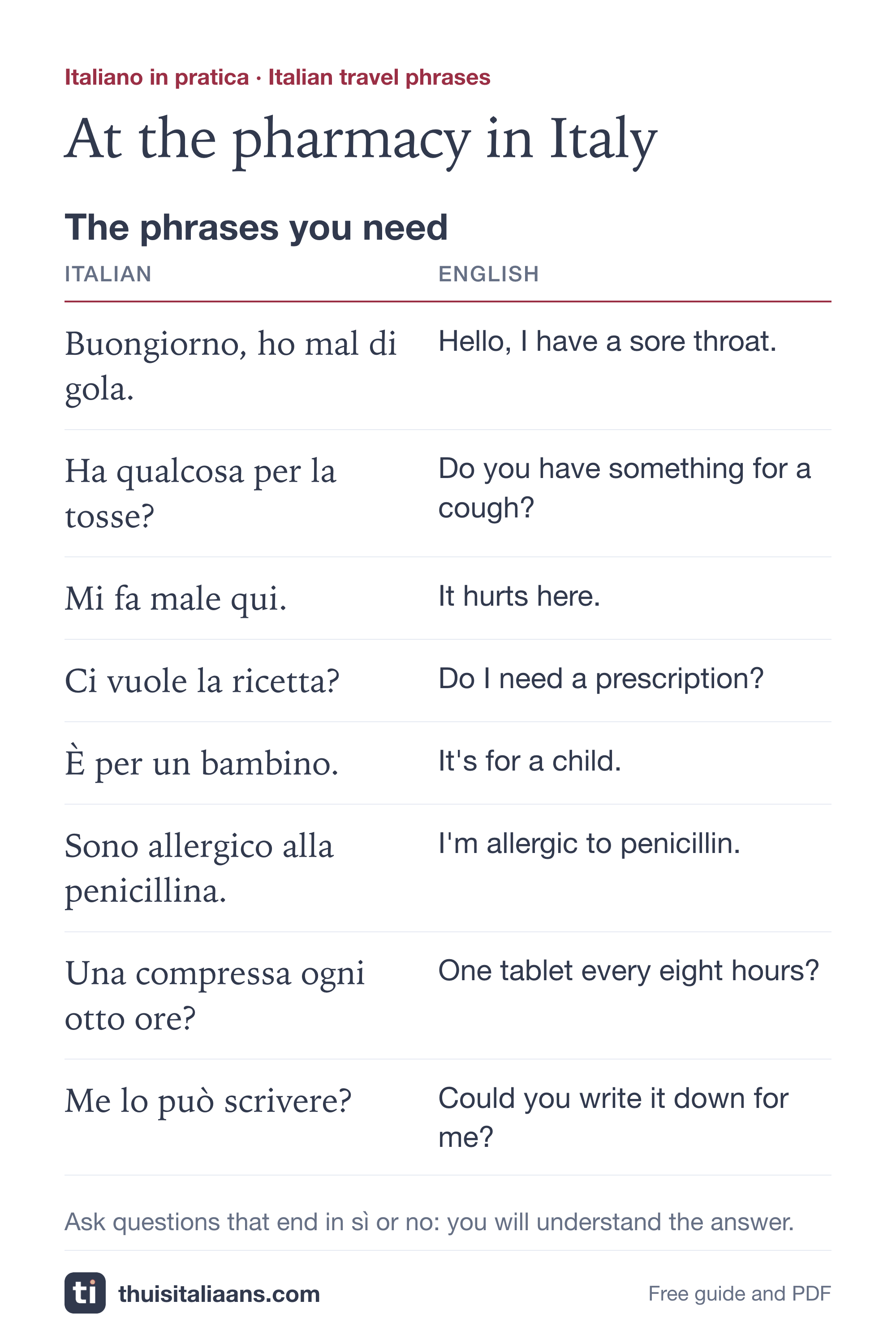 Italian phrases: At the pharmacy in Italy
Many common medicines, such as paracetamol and ibuprofen, are sold without a prescription, in pharmacies and with the pharmacist's advice. Antibiotics need a prescription.
«Ho mal di testa». The same pattern works for other pains: mal di gola, mal di stomaco, mal di denti.
The pharmacy on duty at night, on Sundays and on public holidays. Every pharmacy posts the list of duty pharmacies on its door.
A parafarmacia sells over-the-counter medicines and care products, but no prescription medicines. Both may show a green cross: read the word.
112, the European emergency number, for ambulance, police and fire brigade.