Italiano in pratica
by Alessio · teacher of Italian for foreigners, ITALS master’s in teaching Italian abroad (Ca’ Foscari University, Venice) and a master’s in teaching Italian as a second language (Giustino Fortunato University, Benevento)
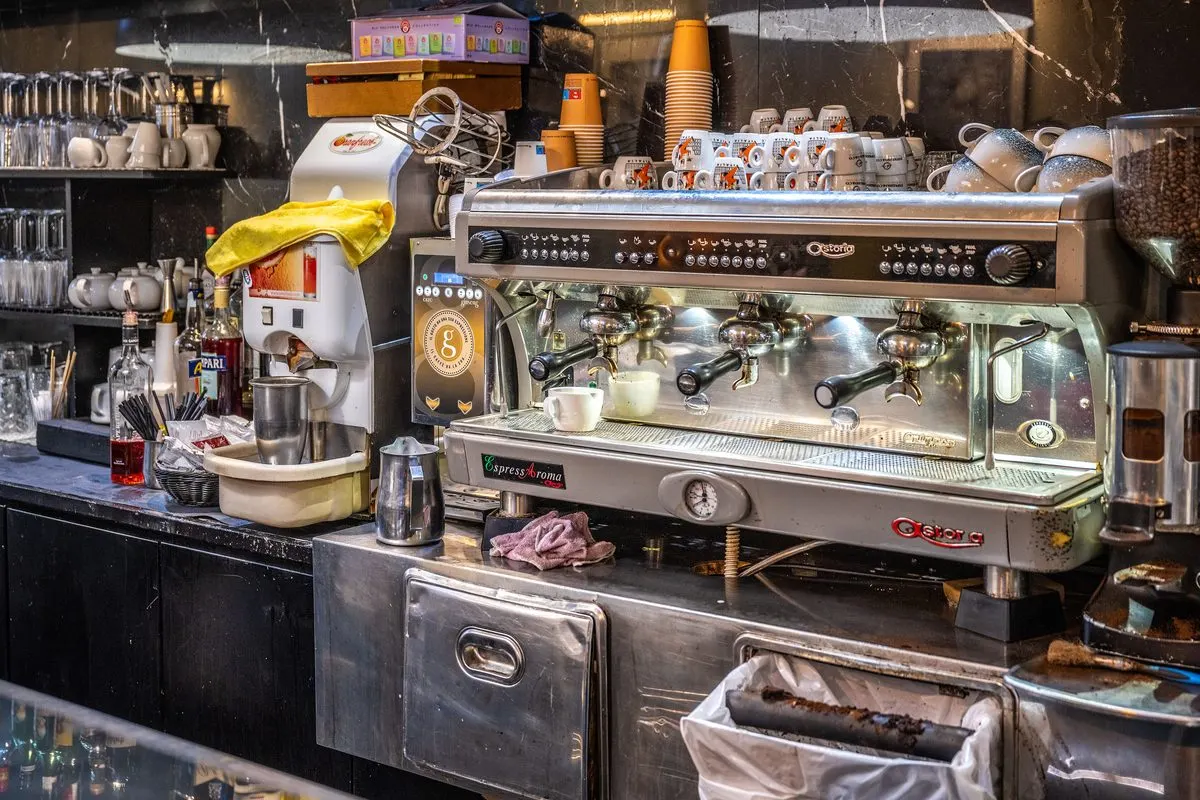
In an Italian bar you order at the counter, often after paying at the till, and you drink standing up. Un caffè is an espresso. Ask questions that end in sì or no, and you will always understand the reply.
You walk into a bar in Naples at eight in the morning. Nobody sits down, everybody says one word, and thirty seconds later the cup is on the counter. It works like this every day, in every town, and it is easier than it looks. You only need to know the order of things, and a handful of phrases.
The trick on this page is simple: whenever you need something, ask it as a question that can only be answered sì or no. You may not catch the whole reply, but you will catch that.
| Italian | English |
|---|---|
| Un caffè, per favore. | An espresso, please. |
| Un cappuccino e un cornetto. | A cappuccino and a croissant. |
| Lo prendo al banco. | I'll have it at the counter.cheaper than sitting down |
| Pago prima? | Do I pay first?answer: sì or no |
| Avete il latte di soia? | Do you have soy milk?answer: sì or no |
| C'è il bagno? | Is there a toilet?answer: sì or no |
| Posso pagare con la carta? | Can I pay by card?answer: sì or no |
| Basta così, grazie. | That's all, thanks. |
Read the Italian out loud once before you need it. The questions marked sì or no get a one-word answer you can understand.
In busy city bars you pay first at the till, la cassa, get a receipt, lo scontrino, and show it at the counter. In small or village bars you order first and pay on your way out.
If you can't tell which kind of bar you are in, don't guess: ask. It is a perfectly normal question, and the answer is one word.
| You say | English |
|---|---|
| Pago prima? | Do I pay first?sì: go to the till first |
| Pago dopo? | Do I pay afterwards?sì or no |
| Un caffè e un cornetto, per favore. | An espresso and a croissant, please.said at the till, then again at the counter |
| You hear | English |
|---|---|
| Ha lo scontrino? | Do you have the receipt?yes/no: show it |
| Paga alla cassa. | Pay at the till.you're in a pay-first bar |
Yes. A coffee al banco, standing at the counter, costs less than the same coffee al tavolo, seated with table service. In tourist squares sitting down can cost two or three times as much.
That is not a trick: bars have to display their prices, and the table price is on the list too. It is why you will see Italians drinking their espresso standing up next to empty chairs.
| You say | English |
|---|---|
| Lo prendo al banco. | I'll have it at the counter. |
| Possiamo sederci? | Can we sit down?sì or no |
| Al tavolo costa di più? | Does it cost more at a table?almost always: sì |
| You hear | English |
|---|---|
| Al banco o al tavolo? | At the counter or at a table?answer with one of the two |
| Si accomodi. | Take a seat. |

Un caffè is an espresso, always. Un latte is a glass of milk. A caffè macchiato is an espresso with a drop of milk, and a latte macchiato is a glass of hot milk with a shot of espresso.
These four are the words that catch people out. The rest of the menu is easier, and you can always point at the machine and ask a yes/no question.
| You say | English |
|---|---|
| un caffè | an espressonever «an espresso, please»: just un caffè |
| un caffè lungo · un caffè ristretto | a longer · a shorter espresso |
| un caffè americano | an espresso topped up with hot water |
| un caffè macchiato | an espresso with a drop of milkcaldo or freddo: hot or cold milk |
| un latte macchiato | hot milk with a shot of espresso |
| un caffè corretto | an espresso with a dash of grappa |
| un deca | a decafshort for decaffeinato |

In the  amo Italian app you practise inside real-life pathways: il bar, il ristorante, i trasporti, la casa and more, with listening, dialogues and the grammar explained in English. This page gives you the phrases; the app trains your ear.
Half the A1 course free, no sign-up
★★★★★(22)by Alessio, teacher since 2018
Downloadamo Italian for iPhone ↗︎Search for amo Italian
Turn every need into a closed question. Instead of asking what kind of milk they have, ask avete il latte di soia? The answer can only be yes or no, and you will understand it.
In Italian a yes/no question is just a statement said with a rising voice: c'è il bagno (there is a toilet) becomes c'è il bagno? (is there a toilet?). No word order to change.
| You say | English |
|---|---|
| Avete il latte senza lattosio? | Do you have lactose-free milk?sì or no |
| Avete il latte di soia? | Do you have soy milk?sì or no |
| È senza glutine? | Is it gluten-free?sì or no |
| È alla crema? | Is it filled with custard?about a cornetto |
| C'è il bagno? | Is there a toilet?sì or no |
| Il bagno è per i clienti? | Is the toilet for customers only?often sì: buy something first |
| C'è il wifi? | Is there wifi?sì or no |
| È libero? | Is this free?about a seat or a stool |
| You hear | English |
|---|---|
| Sì, certo. | Yes, of course.yes |
| Purtroppo no. | Unfortunately not.no |
| È finito. | It's sold out.no, not today |
| Solo contanti. | Cash only.no card |

Usually one short question, and most of them are a choice between two things or a yes/no. Expect al banco o al tavolo?, normale o macchiato? and, at the end, altro?
To altro?, anything else, the full answer is no, basta così, grazie. Three words and you're done.
| You say | English |
|---|---|
| No, basta così, grazie. | No, that's all, thanks. |
| Sì, anche una spremuta. | Yes, a fresh orange juice too. |
| You hear | English |
|---|---|
| Normale o macchiato? | Plain or with a drop of milk?a choice of two |
| Caldo o freddo? | Hot or cold?about the milk |
| In tazza grande? | In a big cup?sì or no |
| Altro? | Anything else?sì or no |
| Prego? | Yes? What can I get you?your turn: just order |
You can, and nobody will stop you. Most Italians simply don't: milky coffee is for the morning, and after a meal they drink an espresso.
In a tourist town nobody will blink. In a small bar the barista might look up for a second. That's all. If you want to blend in after lunch, the order is un caffè.
An Italian bar is not a café where you settle in with a laptop for the afternoon. It is a stop on the way to somewhere else, used once, twice or three times a day: an espresso at the counter takes two minutes and a few words with the barista, and then you leave. The price follows the same logic. In 2025 an espresso at the counter cost between about €1.20 and €1.45 depending on the city, far less than a coffee in a chain in London or New York, because you pay for the coffee and not for the chair.

The rules about milk come from the same habits. Cappuccino and caffellatte belong to breakfast, which in Italy is small, sweet and quick: a coffee and a cornetto, often at the same counter. After lunch or dinner Italians drink an espresso, because a big cup of milk on a full stomach feels heavy to them. Coffee to take away exists, but walking down the street with a paper cup is still unusual: coffee is drunk where it is made. In Naples and much of the south a small glass of water comes with the espresso, to drink before the coffee.
The bar is also where the neighbourhood meets. Regulars go to the same one every morning, and the barista starts their coffee as they walk in. The same counter serves sandwiches at lunch, an aperitif at six and an ice cream to a child after school. Naples has a custom that says a lot about the place: the caffè sospeso, a coffee paid for in advance and left for whoever comes in next and can't afford one.
Read next: Gelato or ice cream: what is actually different? · Why does nobody bring you the bill in an Italian restaurant?
Italians rarely answer with a bare sì or no. These are the forms you will actually hear, so you know which way the answer went.
| You hear | English | It means |
|---|---|---|
| Sì, certo. | Yes, of course. | yes |
| Certo! | Sure! | yes |
| Come no! | Of course! (literally: how not?) | yes |
| Volentieri. | Gladly. | yes |
| Va bene. | Fine, OK. | yes |
| Prego. | Go ahead / please do. | yes |
| No, mi dispiace. | No, I'm sorry. | no |
| Purtroppo no. | Unfortunately not. | no |
| Non c'è. | There isn't any. | no |
| È finito. | It's sold out / all gone. | no |
| Non si può. | That's not allowed. | no |
| Non ancora. | Not yet. | no |
Six real replies. Tap Yes or No for each one.
The grammar behind them
This guide as two printable pages, in English: the phrases to say, the yes/no questions and what you will hear.
All 43 phrase PDFs · €9Already included in the full course · €39 a year.
Or keep the eight phrases as an image, to save on your phone or pin:
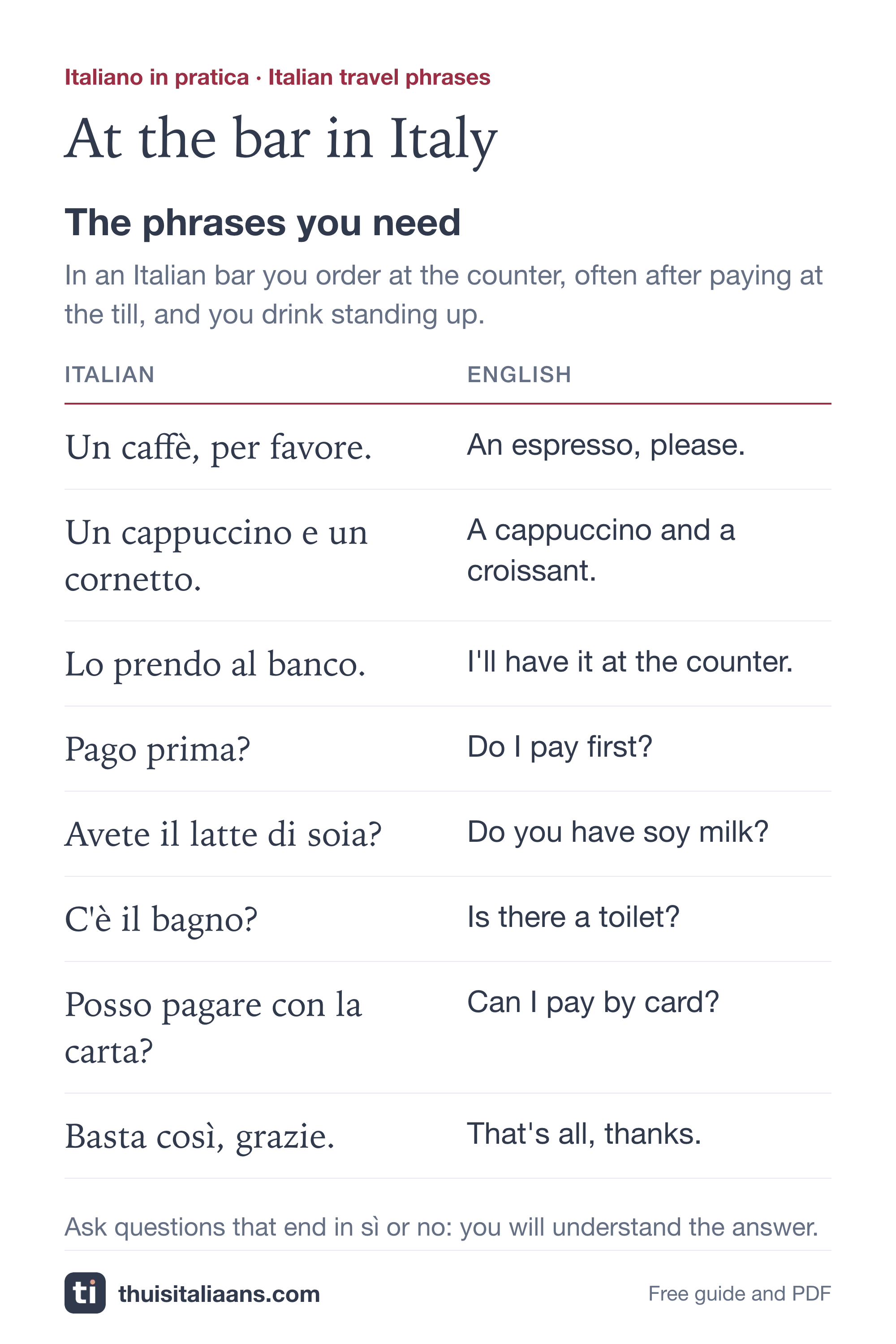 Italian phrases: At the bar in Italy
Tipping is not expected at the counter. Some people leave a few coins of change, and some bars have a small tip jar, but nobody will be offended if you don't.
No. Sitting is fine, it just costs more: the table price includes service. If you want the cheaper price, drink at the counter.
The most natural forms are «Mi dà...?» (will you give me) and «Vorrei...» (I would like). At the counter many people simply name the drink: «Un caffè, per favore».
In everyday Italian there is little difference: «il bar» is the place where you have coffee, a pastry, a sandwich or an aperitif, at any time of day.
Say the sentence with a rising voice at the end. «C'è il bagno» is «there is a toilet»; «C'è il bagno?» is «is there a toilet?». The words stay the same.