

Grammar · A2
The imperative
by Alessio · teacher of Italian as a foreign language, ITALS master’s

The imperative gives instructions and advice: prendi queste gocce, beva molta acqua. It has two registers: direct tu for friends and family, polite Lei for the doctor, the counter, the world.
- 5min reading
- 15min exercises
- A2level
What you learn
- -ere (prendere), -ire (dormire), -ire in -isc (finire)
- When to use the imperative
- The most common mistakes
- Vocabulary: dal medico
Italian and English side by side
English imperatives are just the bare verb: speak!, don't speak! Italian changes form for tu in -are verbs (parla!) and uses the infinitive for the negative: non parlare! Pronouns attach to the end: chiamalo, dimmi.
Take this page with you
This chapter’s sheet as a free printable PDF (tables in Italian): rules, typical mistakes and the quiz with answers. A teacher’s tip: grammar sticks by reviewing it often, not by studying it once.


The words on this page
Drag each Italian word onto its definition, or tap a word first, then its box.
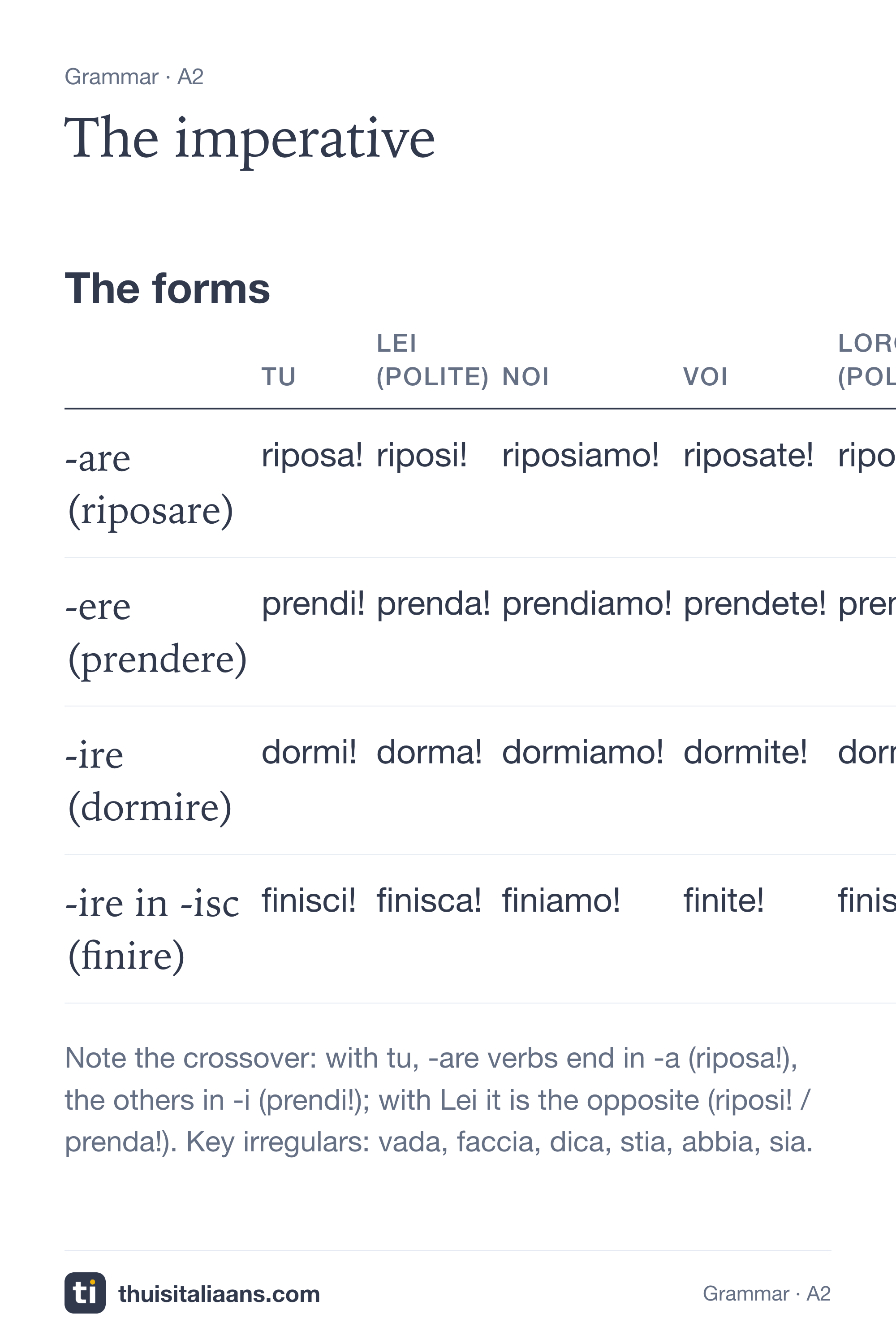
The forms
| tu | Lei (polite) | noi | voi | Loro (polite) | |
|---|---|---|---|---|---|
| -are (riposare) | riposa! | riposi! | riposiamo! | riposate! | riposino! |
| -ere (prendere) | prendi! | prenda! | prendiamo! | prendete! | prendano! |
| -ire (dormire) | dormi! | dorma! | dormiamo! | dormite! | dormano! |
| -ire in -isc (finire) | finisci! | finisca! | finiamo! | finite! | finiscano! |
At the doctor’s
| Register | Example |
|---|---|
| il medico a Lei | si accomodi, respiri profondamente, dica trentatré |
| il medico, negativo | non prenda antibiotici da solo, non esageri |
| a un amico | riposati, bevi tanta acqua, non ti preoccupare |
| negativo con tu | non + infinito: non uscire stasera, non toccare |
The most common mistakes
dottore, prendi il mio referto→ prenda il mio referto (with Lei: -a for -ere verbs)non prendi queste pastiglie (a un amico)→ non prendere queste pastiglie (negative tu: non + infinitive)signora, va' allo sportello 3→ vada allo sportello 3 (polite imperative)
Did you know?
Read and understand
This chapter’s grammar. Example: the swimming pool sign.
PISCINA COMUNALE
Regole per i visitatori
Ingressofate la doccia prima di entrare
Vasca grandenuotate sempre a destra
Bordo vascanon correte: il pavimento è bagnato
Cuffiaportate la cuffia, è obbligatoria
Armadiettichiudete l'armadietto e tenete la chiave al polso
Bambininon lasciate i bambini da soli
Per le lezioni, chiedete in segreteria. Buon bagno!
Questions
Che cosa è obbligatorio in piscina?
Perché non si può correre a bordo vasca?
«Fate», «chiudete», «tenete»: il cartello parla…
Il cartello dice «non correte». E a un solo bambino, che cosa dici?

Exercises
Five exercises in order of difficulty. The last ones bring back what you have already seen.
01 Tu, noi, voi
Complete with the imperative. Careful with -are verbs: tu parla!
- (tu / parlare) più piano!
- (tu / scrivere) qui il tuo nome.
- (tu / dormire) un po’!
- (noi / andare) !
- (voi / ascoltare) bene.
- (voi / aprire) i libri.
02 I brevi irregolari
Five verbs have a short form with tu. Complete.
- (tu / andare) a casa!
- (tu / dare) qua!
- (tu / fare) presto!
- (tu / stare) zitto!
- (tu / dire) la verità!
- (tu / essere) gentile!
03 Il negativo
With tu the negative uses the infinitive: non parlare! Transform.
- Parla! →
- Scrivi! →
- Andate! →
- Fai così! →
- Andiamo! →
- Di’ niente! →
04 Con i pronomi attaccati
The pronoun attaches to the end: chiamalo! Rewrite.
- Chiama Marco! →
- Scrivi a me! →
- Prendi le chiavi! →
- Dai il libro a lui! →
- Fai questo! →
- Alzati! (tu) →
05 Consigli a un amico
Complete with the imperative, the pronouns and the prepositions.
Review verbi riflessivi · pronomi diretti · preposizioni articolate
- Sei stanco? (riposarsi) un po’!
- Non capisci? (chiedere) professore. (a)
- Il libro è utile: (leggere) !
- Non (preoccuparsi) : ce la farai.
- (scrivere) quando arrivi. (a me)
- E (non dimenticare) le chiavi!
These five are a taste. There are over seven hundred on the site, free and with no sign-up. All the exercises →

Every topic, a world
In the  amo Italian app, grammar is practised inside thematic pathways with field-specific vocabulary: il bar, i trasporti, il calcio, la moda, la burocrazia and seventeen more. Choose your world and the grammar comes along by itself, explained in your language too.
Half the path free, no sign-up
★★★★★(11)by Alessio, teacher since 2018
Downloadamo Italian for iPhone ↗︎Search for amo Italian

Read and understand
This chapter’s grammar. Example: grandma's recipe in a chat.
ultimo accesso 16:15
Questions
Qual è il segreto del ragù?
Per quanto tempo non si deve aprire la pentola?
«Non aprire», «non chiamare»: perché c'è l'infinito?
La nonna parla a un solo nipote. E a due nipoti, come direbbe «gira»?
Want another text on this topic? Grandma's recipe · The supermarket flyer
One more go
Choose the right imperative:
- Dottore a paziente: " profondamente, per favore."
- A un amico: " e tanta acqua."
- In farmacia: " una compressa dopo i pasti."
- A tuo fratello: "Non con questa febbre!"
- Il medico: " trentatré."
Frequently asked questions
How do I make a negative command with tu?
With non + infinitive: non andare!, non ti preoccupare!, non toccare! It is the imperative’s strangest rule: the positive form disappears and the infinitive takes over. With Lei and voi, instead, just add non: non si preoccupi, non andate.
Is there a “let’s…” form?
Yes: the noi imperative, identical to the present: andiamo! (let’s go), proviamo, facciamo così. Context and intonation turn the statement into a proposal: it is the friendliest imperative in the language.
How do Italians soften a command?
With pure: dica pure (go ahead, tell me), si accomodi pure, prendi pure. It grants permission and removes all pressure. Add prego and per favore and even an order sounds like hospitality.
 The forms