Italiano in pratica
by Alessio · teacher of Italian for foreigners, ITALS master’s in teaching Italian abroad (Ca’ Foscari University, Venice) and a master’s in teaching Italian as a second language (Giustino Fortunato University, Benevento)
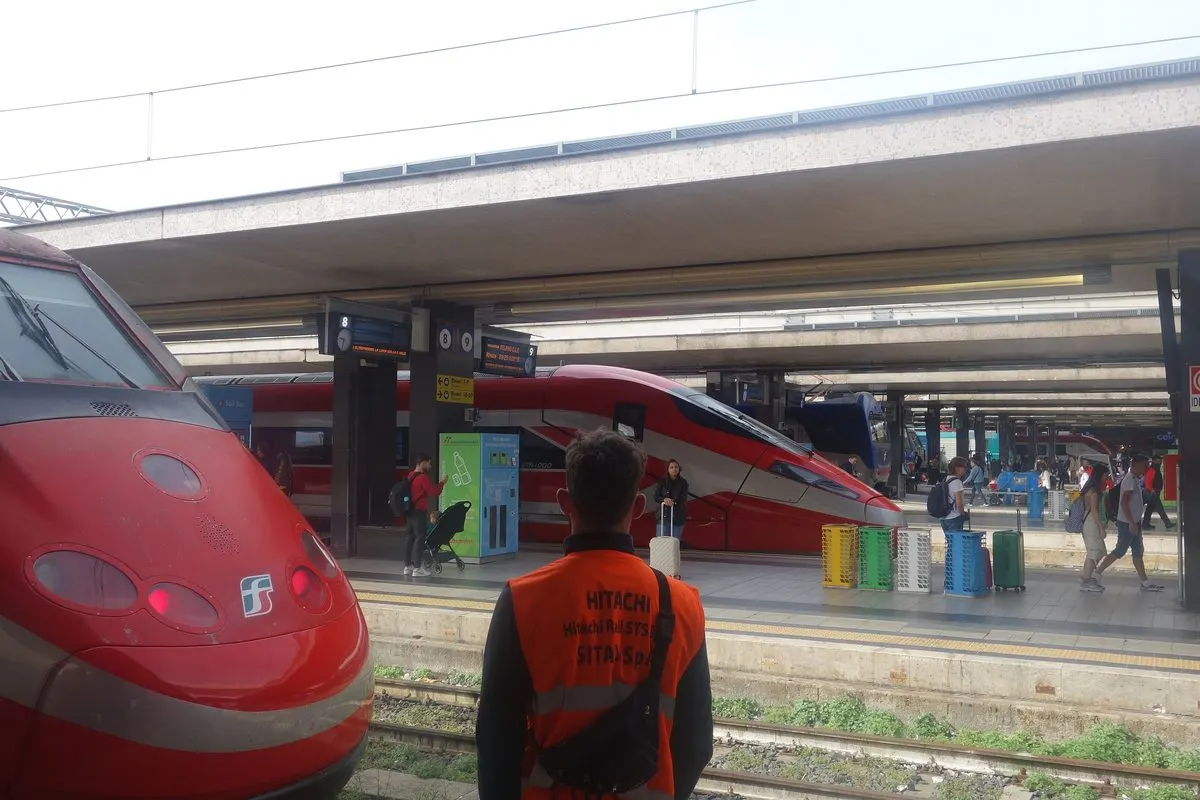
Italy has two kinds of train ticket: regional tickets, valid on regional trains, and high-speed tickets for one specific train and seat. Paper regional tickets must be stamped in the machine on the platform before you board; digital tickets don't need it.
You're standing in Firenze Santa Maria Novella with a ticket in your hand, and none of the trains on the board seems to go where you're going. Ten minutes before departure the platform changes, and an announcement you don't understand is clearly about your train.
Train travel in Italy is cheap, comfortable and mostly smooth. What makes it tricky is a handful of words nobody teaches you, which turn up at exactly the wrong moment. And when in doubt, there is always a question that ends in sì or no.
| Italian | English |
|---|---|
| Un biglietto per Bologna, per favore. | A ticket to Bologna, please. |
| Andata e ritorno. | Return.solo andata: one way |
| Questo treno ferma a Prato? | Does this train stop in Prato?answer: sì or no |
| È il binario per Firenze? | Is this the platform for Florence?answer: sì or no |
| Devo convalidare il biglietto? | Do I have to validate the ticket?answer: sì or no |
| Il treno è in ritardo? | Is the train late?answer: sì or no |
| È libero? | Is this seat free?answer: sì or no |
| Scusi, questo è il mio posto. | Excuse me, this is my seat. |
Read the Italian out loud once before you need it. The questions marked sì or no get a one-word answer you can understand.
A regionale is the slower train: no seat booking, and the ticket is not tied to one specific train. High-speed trains, the Frecciarossa and Italo, and the Intercity are sold for one specific train, with carriage and seat.
Trenitalia and Italo are two different companies, and their tickets are not interchangeable. At the counter the question you will hear is simply regionale o alta velocità?
| You say | English |
|---|---|
| Un biglietto per Bologna, per favore. | A ticket to Bologna, please. |
| È un regionale? | Is it a regional train?sì or no |
| Serve la prenotazione? | Do I need a seat reservation?sì on high-speed trains |
| You hear | English |
|---|---|
| Regionale o alta velocità? | Regional or high-speed?a choice of two |
| Solo andata o andata e ritorno? | One way or return?a choice of two |
| Finestrino o corridoio? | Window or aisle?a choice of two |

Only paper regional tickets: stamp them in the green or white machine on the platform, l'obliteratrice, before you board. Digital tickets don't need it: since 21 September 2024 Trenitalia's digital regional tickets validate themselves at the departure time. High-speed tickets never need stamping.
Forgot to stamp a paper ticket? Find the conductor before the conductor finds you, and say so first: people who report it themselves usually just get it stamped by hand.
| You say | English |
|---|---|
| Devo convalidare il biglietto? | Do I have to validate the ticket?sì for paper regional tickets |
| Scusi, non ho convalidato il biglietto. | Excuse me, I didn't validate my ticket.say it before the check |
| You hear | English |
|---|---|
| Biglietti, prego. | Tickets, please. |
| Documenti di viaggio. | Travel documents.same thing, more formal |
Partenze are departures and arrivi arrivals. The word you will see most is ritardo, delay; the one that really matters is soppresso, which means the train is cancelled.
Twenty minutes' delay on a regional train is an ordinary Tuesday. Soppresso is not: that train simply isn't running.
| You say | English |
|---|---|
| il binario | the platform |
| in orario | on time |
| il ritardo | the delay |
| soppresso | cancelledthe train is not running |
| la coincidenza | the connection |
| la carrozza | the carriage |
| il posto | the seat |

In the  amo Italian app you practise inside real-life pathways: il bar, il ristorante, i trasporti, la casa and more, with listening, dialogues and the grammar explained in English. This page gives you the phrases; the app trains your ear.
Half the A1 course free, no sign-up
★★★★★(22)by Alessio, teacher since 2018
Downloadamo Italian for iPhone ↗︎Search for amo Italian
They always follow the same pattern: the time of the train, where it comes from, where it is going, and then one of three endings: a delay, the platform it is arriving at, or soppresso.
Il treno regionale delle ore quindici e dieci, proveniente da Pisa e diretto a Firenze, viaggia con quaranta minuti di ritardo. The 15:10 regional train from Pisa to Florence is running forty minutes late. The phrase that sends people running is cambio di binario, change of platform.
| You say | English |
|---|---|
| È questo il treno per Roma? | Is this the train to Rome?sì or no |
| Il treno per Roma parte da qui? | Does the train to Rome leave from here?sì or no |
| You hear | English |
|---|---|
| Viaggia con dieci minuti di ritardo. | It's running ten minutes late. |
| È in arrivo al binario tre. | It's arriving at platform three. |
| Cambio di binario. | Change of platform.check the board again |

Two closed questions solve almost everything on board: è libero? for a seat, and questo treno ferma a...? to check your stop. If someone is in your booked seat, one polite sentence is enough.
On a regional train every seat is free unless it has a sign: riservato means reserved, and some seats are kept for people with disabilities and pregnant women.
| You say | English |
|---|---|
| È libero? | Is this seat free?sì or no |
| Questo treno ferma a Prato? | Does this train stop in Prato?sì or no |
| Scusi, credo che questo sia il mio posto. | Excuse me, I think this is my seat. |
| You hear | English |
|---|---|
| Sì, prego. | Yes, go ahead.the seat is free |
| È occupato. | It's taken.no |
Rail strikes, scioperi, are announced in advance, and even during a strike a list of guaranteed trains, treni garantiti, still runs. If a delay makes you miss a connection with the same company, you are normally put on the next train.
Ask at the counter the day before: two closed questions can save you a ruined day.
| You say | English |
|---|---|
| Domani c'è sciopero? | Is there a strike tomorrow?sì or no |
| Questo treno è garantito? | Is this train guaranteed?sì or no |
| Ho perso la coincidenza. | I missed my connection. |
| Posso prendere il prossimo treno? | Can I take the next train?usually sì |
| You hear | English |
|---|---|
| Sì, è garantito. | Yes, it's guaranteed.yes |
| Prenda il prossimo. | Take the next one. |
Since the high-speed line from Turin and Milan through Bologna, Florence and Rome to Naples was completed in 2009, the train has become the normal way to cross the country. Rome to Milan takes about three hours, centre to centre, and on that route most people now take the train rather than fly. Italy is also one of the few countries where two companies compete on the same high-speed tracks: the state-owned Trenitalia and the private Italo, which started running in 2012. If you book ahead, the competition keeps fares low.

Regional trains are another world: slower, often older, full of commuters and students, with fares fixed by distance that don't rise on the day you travel, unlike walk-up fares in Britain. A delay of ten or twenty minutes is part of the deal, and Italians plan around it with a shrug.
So are strikes, scioperi, which follow rules visitors rarely know. By law a transport strike must be announced at least ten days ahead and appears on an official public calendar, and during a rail strike some trains still run: those listed as guaranteed, and regional trains in the protected morning and evening bands, typically from six to nine. A strike is rarely a surprise if you look before you travel. The big stations, Roma Termini and Milano Centrale above all, are part of city life too: shopping centres and meeting points as much as places to catch a train.
Read next: Why can't you buy a ticket on the bus, or hail a taxi? · Why does Italy stop in August?
Italians rarely answer with a bare sì or no. These are the forms you will actually hear, so you know which way the answer went.
| You hear | English | It means |
|---|---|---|
| Sì, certo. | Yes, of course. | yes |
| Certo! | Sure! | yes |
| Come no! | Of course! (literally: how not?) | yes |
| Volentieri. | Gladly. | yes |
| Va bene. | Fine, OK. | yes |
| Prego. | Go ahead / please do. | yes |
| No, mi dispiace. | No, I'm sorry. | no |
| Purtroppo no. | Unfortunately not. | no |
| Non c'è. | There isn't any. | no |
| È finito. | It's sold out / all gone. | no |
| Non si può. | That's not allowed. | no |
| Non ancora. | Not yet. | no |
Six real replies. Tap Yes or No for each one.
The grammar behind them
This guide as two printable pages, in English: the phrases to say, the yes/no questions and what you will hear.
All 43 phrase PDFs · €9Already included in the full course · €39 a year.
Or keep the eight phrases as an image, to save on your phone or pin:
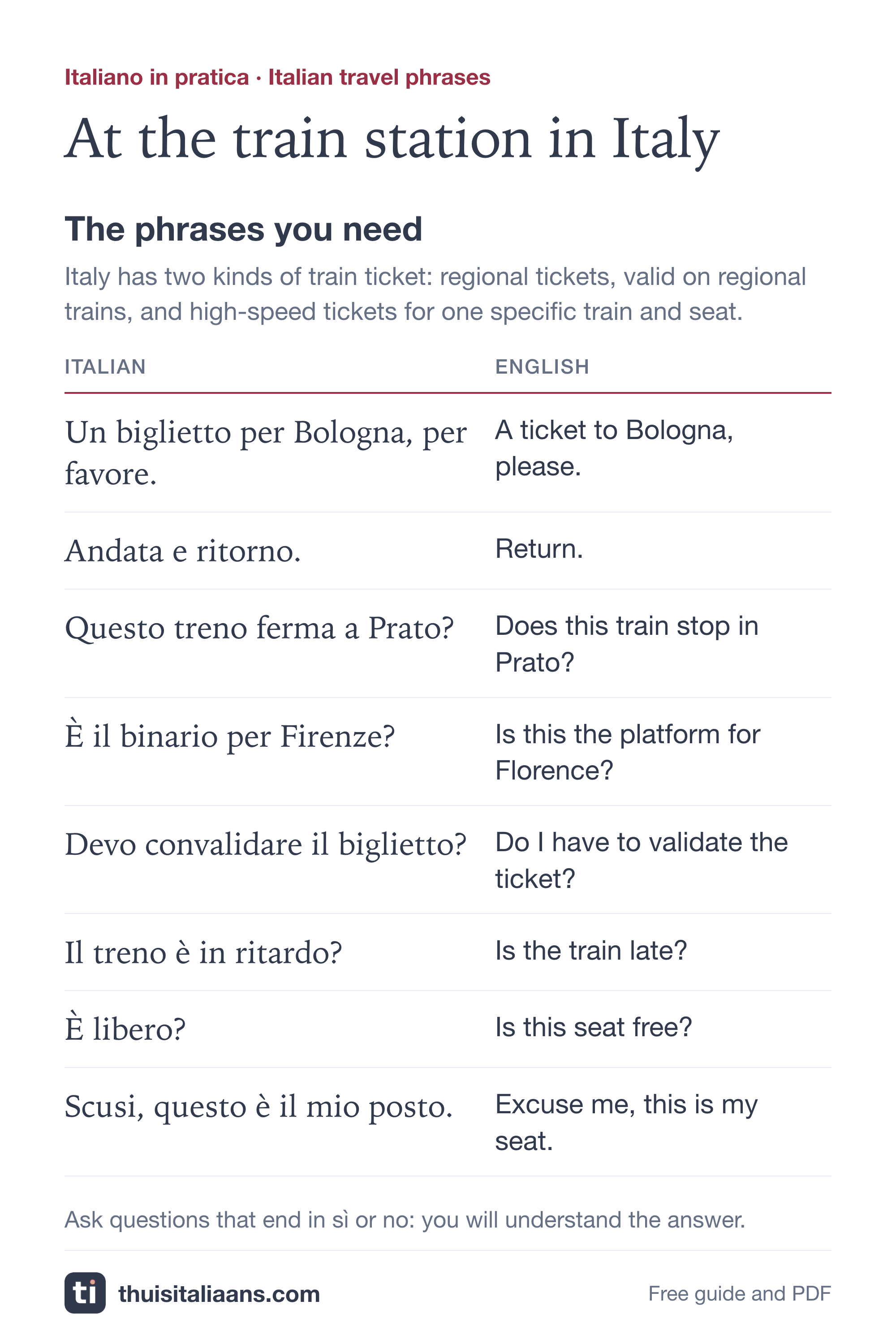 Italian phrases: At the train station in Italy
No. Since 21 September 2024 Trenitalia's digital regional tickets are validated automatically at the scheduled departure time. Only paper regional tickets must be stamped before boarding.
An unstamped paper regional ticket is formally not valid and can mean a fine. Tell the conductor before the check: «Scusi, non ho convalidato il biglietto».
It means the train is cancelled and will not run.
Yes. Strikes are announced in advance and a list of guaranteed trains, «treni garantiti», still runs.
No. They are two different companies, and a ticket from one is not valid on the other's trains.