Italiano in pratica
by Alessio · teacher of Italian for foreigners, ITALS master’s in teaching Italian abroad (Ca’ Foscari University, Venice) and a master’s in teaching Italian as a second language (Giustino Fortunato University, Benevento)
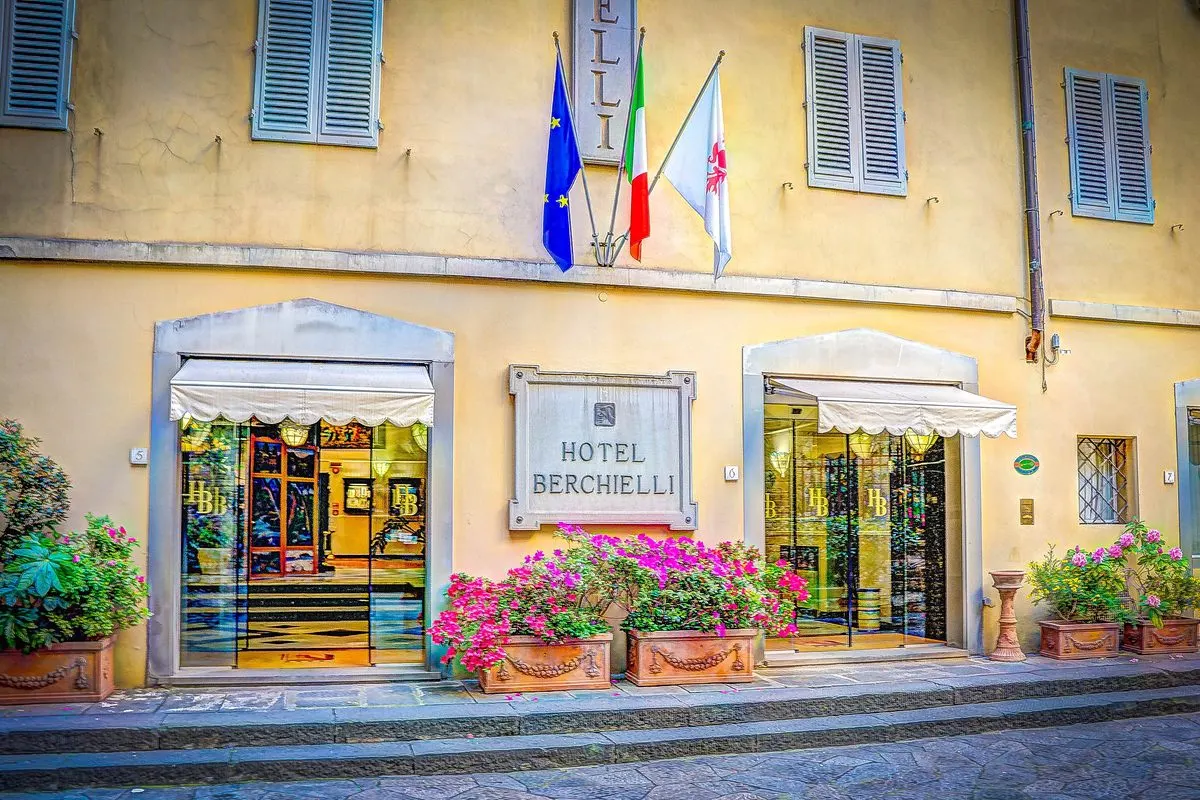
At check-in in Italy you will be asked for an ID document: every place you stay has to register its guests with the police. Expect a city tourist tax, la tassa di soggiorno, charged per person per night and often not included in the price you paid online.
You arrive after six hours on the road, and the first thing that happens is that someone asks for your passport and does something with it behind the desk. It isn't distrust and it takes two minutes: it is the law, from a hotel in Rome to a three-room B&B in Umbria.
Here is what is said at check-in, during your stay and at check-out, in the order it comes. Most of what you need can be asked with a question that ends in sì or no.
| Italian | English |
|---|---|
| Ho una prenotazione a nome Smith. | I have a booking under the name Smith. |
| La tassa di soggiorno è inclusa? | Is the tourist tax included?answer: sì or no |
| La colazione è inclusa? | Is breakfast included?answer: sì or no |
| C'è il parcheggio? | Is there parking?answer: sì or no |
| C'è qualcuno alla reception di notte? | Is someone at reception at night?answer: sì or no |
| L'aria condizionata non funziona. | The air conditioning doesn't work. |
| Posso lasciare i bagagli fino alle cinque? | Can I leave my luggage until five?answer: almost always sì |
| Grazie di tutto! | Thanks for everything! |
Read the Italian out loud once before you need it. The questions marked sì or no get a one-word answer you can understand.
Because the law requires every hotel, B&B, campsite and holiday rental to register its guests with the police within 24 hours of arrival. An ID card is enough, and you should get it back straight away.
If someone wants to keep your document until you leave, that is not the rule, and you can say so politely.
| You say | English |
|---|---|
| Me lo ridà subito? | Will you give it back right away?sì |
| Va bene la carta d'identità? | Is an ID card OK?sì |
| You hear | English |
|---|---|
| Mi serve un documento. | I need an ID document. |
| Anche per i bambini. | For the children too.children are registered as well |

La tassa di soggiorno is a municipal tourist tax charged per person per night, usually between one and five euros, up to ten in a few big cities. It is often not included in the price you paid online and is collected on the spot, sometimes in cash.
Children under a certain age are usually exempt, and after a number of nights the count stops. It varies from town to town, so asking is completely normal, and the best moment is at check-in, not at check-out.
| You say | English |
|---|---|
| La tassa di soggiorno è inclusa? | Is the tourist tax included?sì or no |
| Si paga in contanti? | Is it paid in cash?sì or no |
| I bambini pagano? | Do the children pay?sì or no |
| You hear | English |
|---|---|
| Sono due euro a persona a notte. | It's two euros per person per night. |
| Si paga alla partenza. | It's paid when you leave. |
Una camera matrimoniale has one double bed. Una camera doppia is a room for two that usually has two single beds. If you want one big bed, the word to use is matrimoniale.
This is exactly where bookings go wrong. A few more words get you the room you want instead of the one that happens to be free.
| You say | English |
|---|---|
| È una matrimoniale? | Is it a room with a double bed?sì or no |
| C'è un letto in più per il bambino? | Is there an extra bed for the child?sì or no |
| C'è una culla? | Is there a cot?sì or no |
| La camera ha il balcone? | Does the room have a balcony?sì or no |
| È vista mare? | Does it have a sea view?sì or no |
| You hear | English |
|---|---|
| È al terzo piano. | It's on the third floor. |
| L'ascensore è in fondo. | The lift is at the end. |

In the  amo Italian app you practise inside real-life pathways: il bar, il ristorante, i trasporti, la casa and more, with listening, dialogues and the grammar explained in English. This page gives you the phrases; the app trains your ear.
Half the A1 course free, no sign-up
★★★★★(22)by Alessio, teacher since 2018
Downloadamo Italian for iPhone ↗︎Search for amo Italian
Usually the same three or four things: what time you want breakfast, whether you came by car, and whether you want your room cleaned every day.
The car question hides an important warning: many historic centres are a ZTL, a limited traffic zone you can't drive into without a permit. If you have a car, ask where to park before you drive in.
| You say | English |
|---|---|
| Sì, abbiamo la macchina. Dove possiamo parcheggiare? | Yes, we have a car. Where can we park? |
| No, grazie, non serve. | No, thanks, there's no need.to daily cleaning |
| You hear | English |
|---|---|
| A che ora fate colazione? | What time will you have breakfast?answer with a time |
| Avete la macchina? | Do you have a car?sì or no |
| Volete la pulizia ogni giorno? | Do you want cleaning every day?sì or no |
| Attenzione alla ZTL. | Watch out for the limited traffic zone. |

One construction covers almost everything: name the thing and add non funziona. Il wifi non funziona, la doccia non funziona. For hot water the phrase is non c'è acqua calda.
For small things that are missing, ask a yes/no question that starts with potrei avere, could I have.
| You say | English |
|---|---|
| Il wifi non funziona. | The wifi doesn't work. |
| Non c'è acqua calda. | There's no hot water. |
| Potrei avere un altro asciugamano? | Could I have another towel?sì |
| Possiamo cambiare camera? | Can we change rooms?sì or no |
| Qual è la password del wifi? | What's the wifi password? |
| Me la scrive? | Could you write it down for me?sì |
| You hear | English |
|---|---|
| Mando subito qualcuno. | I'll send someone right away. |
| Le cambio la camera. | I'll change your room. |
In small hotels and B&Bs there isn't always someone at the desk at night. Ask at arrival, not at midnight: c'è qualcuno alla reception di notte? If not, you will get a door code or a key for the gate.
At check-out, leaving your luggage for a few hours is almost always possible, and it saves you an afternoon dragging a suitcase. With a key box at a rented apartment, if the code fails send a photo of the box with your message: most of the time you are at the wrong box.
| You say | English |
|---|---|
| C'è qualcuno alla reception di notte? | Is someone at reception at night?sì or no |
| Il codice non funziona. | The code doesn't work. |
| Posso lasciare i bagagli fino alle cinque? | Can I leave my luggage until five?almost always sì |
| Posso lasciare la camera più tardi? | Can I check out later?sì or no |
| You hear | English |
|---|---|
| La camera va lasciata entro le dieci. | The room must be vacated by ten. |
| Il portone si chiude a mezzanotte. | The main door closes at midnight. |
It starts at the desk, with your passport. Every hotel, B&B and holiday rental in Italy must register its guests with the police, through a system called Alloggiati Web, within 24 hours of arrival, and within six hours for very short stays. It is a public security rule with a long history, and Italians are used to it: they carry an identity card everywhere and hand it over without a second thought.

Stars don't mean the same everywhere either. Hotel classification is decided by each of Italy's regions rather than nationally, so a three-star hotel in one region can offer more, or less, than a three-star in the next. Many hotels are small and run by families, sometimes for generations, and it shows at breakfast: usually sweet, with pastries, yoghurt and a cappuccino, while a cooked breakfast is rare outside large international hotels. A kettle in the room is rarer still.
The bathroom has one fixture that puzzles many visitors: the bidet. A 1975 ministerial decree lists it, together with the toilet, the washbasin and a bath or shower, among the fittings every Italian home must have, so it turns up almost everywhere, hotels included. It is for washing, not a second toilet. Expect, too, a city tourist tax, the tassa di soggiorno, often paid at the desk on top of what you paid online.
Read next: What does an Italian home expect of you? · Why do Italians spell words with city names?
Italians rarely answer with a bare sì or no. These are the forms you will actually hear, so you know which way the answer went.
| You hear | English | It means |
|---|---|---|
| Sì, certo. | Yes, of course. | yes |
| Certo! | Sure! | yes |
| Come no! | Of course! (literally: how not?) | yes |
| Volentieri. | Gladly. | yes |
| Va bene. | Fine, OK. | yes |
| Prego. | Go ahead / please do. | yes |
| No, mi dispiace. | No, I'm sorry. | no |
| Purtroppo no. | Unfortunately not. | no |
| Non c'è. | There isn't any. | no |
| È finito. | It's sold out / all gone. | no |
| Non si può. | That's not allowed. | no |
| Non ancora. | Not yet. | no |
Six real replies. Tap Yes or No for each one.
The grammar behind them
This guide as two printable pages, in English: the phrases to say, the yes/no questions and what you will hear.
All 43 phrase PDFs · €9Already included in the full course · €39 a year.
Or keep the eight phrases as an image, to save on your phone or pin:
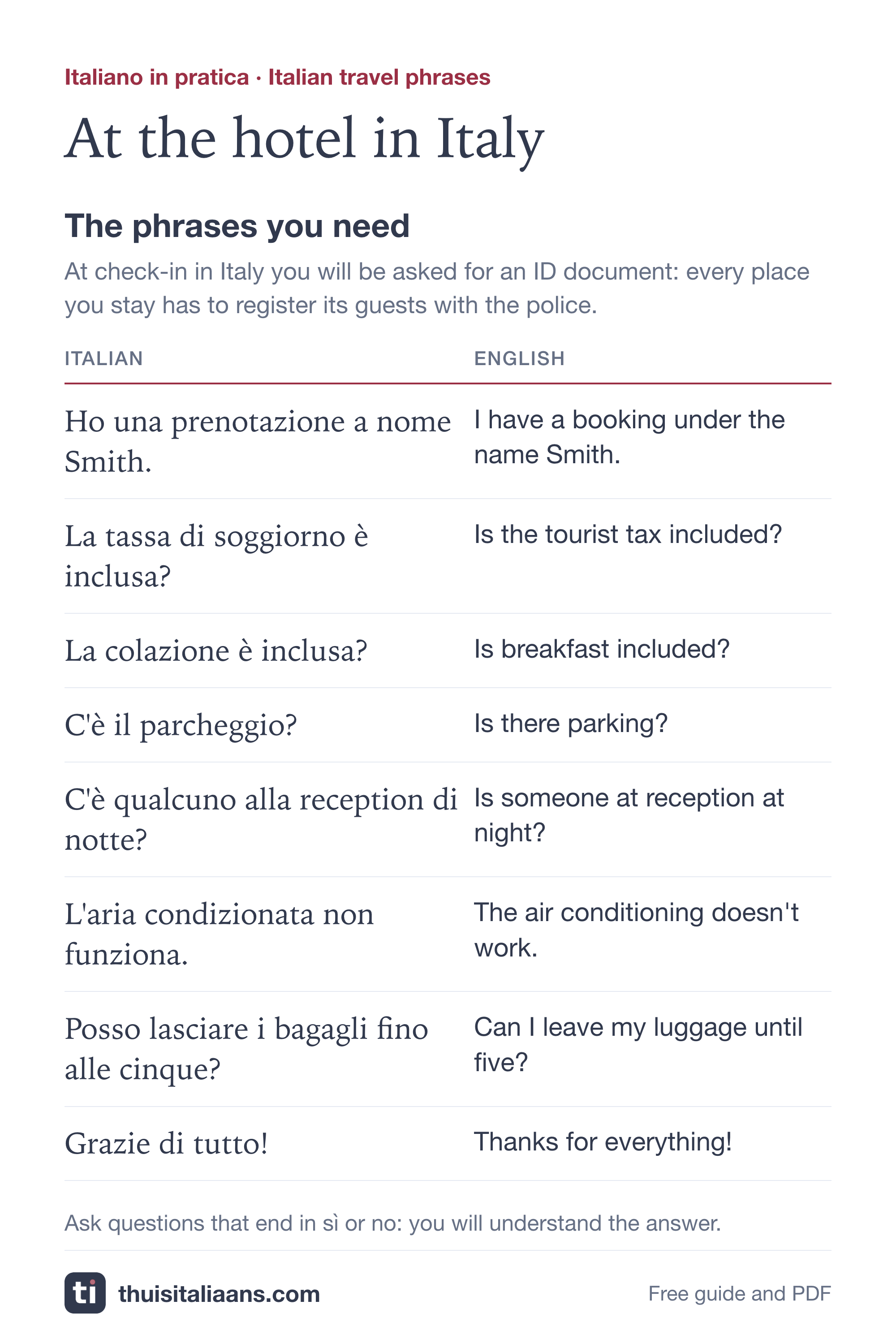 Italian phrases: At the hotel in Italy
Often not. La tassa di soggiorno is a municipal tax that many places collect on the spot, at check-in or check-out, sometimes in cash. Ask at arrival: «La tassa di soggiorno è inclusa?»
They need to register your details with the police, but they should give the document back straight away. Keeping it until departure is not the rule.
A matrimoniale has one double bed; a doppia is for two people and usually has two single beds.
A «zona a traffico limitato», a limited traffic zone, usually the historic centre. Driving in without a permit gets you a fine, so ask your hotel where to park.