Italiano in pratica
by Alessio · teacher of Italian for foreigners, ITALS master’s in teaching Italian abroad (Ca’ Foscari University, Venice) and a master’s in teaching Italian as a second language (Giustino Fortunato University, Benevento)
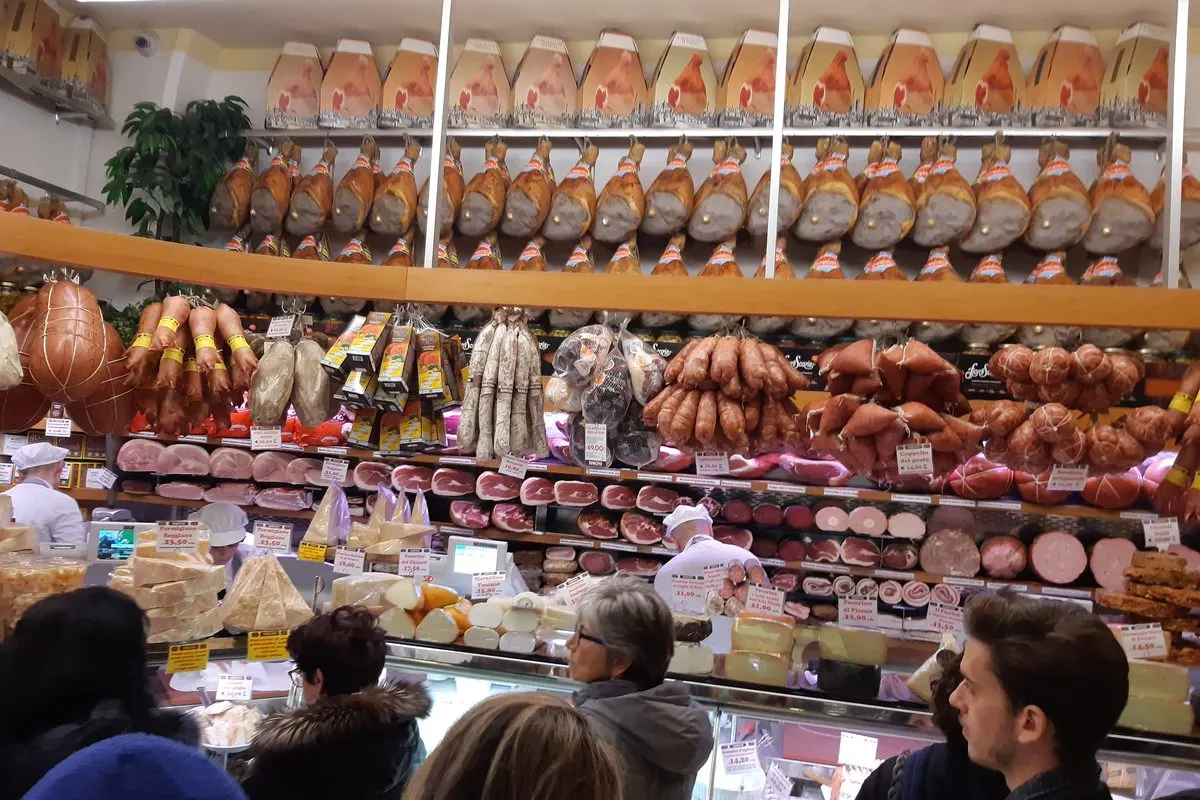
Say buongiorno until early afternoon and buonasera after, use salve when in doubt, and keep ciao for people you know. With strangers use the polite forms: scusi, per favore, grazie. When you get lost, ask a yes/no question: parla inglese?
In Italy you greet before you ask. Walking into a shop, a pharmacy or a lift without a buongiorno feels ruder to Italians than any grammar mistake. The good news: five or six words cover most of the day.
This page gives you those words, the polite forms you use with strangers, and the questions that rescue a conversation when it goes too fast. They are all questions that end in sì or no.
| Italian | English |
|---|---|
| Buongiorno! | Good morning! / Hello!until early afternoon |
| Buonasera! | Good evening! / Hello!from late afternoon |
| Scusi, parla inglese? | Excuse me, do you speak English?answer: sì or no |
| Può parlare più lentamente, per favore? | Could you speak more slowly, please?answer: sì |
| Può ripetere? | Could you say that again?answer: sì |
| Non ho capito. | I didn't understand. |
| Grazie mille! | Thanks a lot! |
| Arrivederci! | Goodbye! |
Read the Italian out loud once before you need it. The questions marked sì or no get a one-word answer you can understand.
Buongiorno works from the morning until early afternoon; buonasera from about four or five o'clock, for some people as soon as lunch is over. If you are not sure, salve is neutral and polite at any hour.
Buonanotte is only for going to bed or leaving late at night, never a greeting on arrival. And when you leave a shop, a bar or a pharmacy, say goodbye too: arrivederci, or buona giornata, have a nice day.
| You say | English |
|---|---|
| Buongiorno! | Good morning! / Hello!until early afternoon |
| Buonasera! | Good evening! / Hello!from late afternoon |
| Salve! | Hello!neutral, any time |
| Arrivederci! | Goodbye! |
| Buona giornata! · Buona serata! | Have a nice day! · Have a nice evening!when you leave |
| You hear | English |
|---|---|
| Buongiorno, mi dica. | Hello, what can I do for you?your turn to speak |
| Altrettanto! | Same to you!the answer to buona giornata |
No. Ciao is for friends, family, children and people your own age in a relaxed setting. To a shopkeeper, a waiter or an older stranger, say buongiorno, buonasera or salve.
If someone greets you with ciao first, you can say it back. Italian also has two ways to say «you»: tu for friends and Lei for strangers. You don't need to master it: set phrases like scusi and può ripetere? are already in the polite form.
| You say | English |
|---|---|
| Ciao! | Hi! / Bye!only with people you know |
| Ci diamo del tu? | Shall we use tu?sì or no: an invitation to be informal |
| You hear | English |
|---|---|
| Dammi del tu! | Call me tu!you can be informal now |
| Ciao, come va? | Hi, how's it going?answer: bene, grazie |
Use scusi to get a stranger's attention or to apologise for something small, and permesso to get past someone or to step into a room. Mi dispiace is «I'm sorry» when something is really your fault, or when you share bad news.
On a crowded bus, permesso opens the way better than any push. With friends the forms are scusa and scusami. If someone thanks you, answer prego; if someone apologises, non fa niente, it doesn't matter.
| You say | English |
|---|---|
| Scusi! | Excuse me! / Sorry!to a stranger |
| Permesso. | Excuse me, may I get through?getting past someone, entering a house |
| Mi scusi, è colpa mia. | I'm sorry, it's my fault. |
| Mi dispiace. | I'm sorry.real regret |
| You hear | English |
|---|---|
| Prego. | You're welcome. / Go ahead. |
| Non fa niente. | It doesn't matter.no harm done |
| Si figuri! | Not at all!polite, after thanks or sorry |

In the  amo Italian app you practise inside real-life pathways: il bar, il ristorante, i trasporti, la casa and more, with listening, dialogues and the grammar explained in English. This page gives you the phrases; the app trains your ear.
Half the A1 course free, no sign-up
★★★★★(22)by Alessio, teacher since 2018
Downloadamo Italian for iPhone ↗︎Search for amo Italian
Say so straight away, in one short sentence: non ho capito, I didn't understand. Then ask a closed question: può ripetere?, può parlare più lentamente?, parla inglese? Each one gets a yes or a no.
Even better: repeat the bit you think you understood, as a question. A destra? To the right? Alle otto? At eight? The answer is a one-word sì or no, and you know you got it right.
| You say | English |
|---|---|
| Non ho capito. | I didn't understand. |
| Può ripetere, per favore? | Could you repeat that, please?sì |
| Può parlare più lentamente? | Could you speak more slowly?sì |
| Parla inglese? | Do you speak English?sì or no |
| Me lo può scrivere? | Could you write it down for me?sì |
| Alle otto? | At eight?repeat what you heard, as a question |
| You hear | English |
|---|---|
| Un po'. | A little.about their English |
| Sì, certo. | Yes, of course.yes |
| Purtroppo no. | Unfortunately not.no |

Per favore is please; grazie is thank you, and grazie mille thanks a lot. The answer to grazie is prego.
In shops and bars Italians often skip the please when they order and put the warmth in the tone instead: mi dà un caffè? sounds friendly, not rude. You can't go wrong adding per favore, though, and a grazie at the end of every exchange.
| You say | English |
|---|---|
| Per favore. | Please.also: per cortesia |
| Grazie. · Grazie mille. | Thank you. · Thanks a lot. |
| Grazie, molto gentile. | Thank you, that's very kind. |
| Va bene, grazie. | OK, thanks. |
| You hear | English |
|---|---|
| Prego. | You're welcome. |
| Di niente. · Di nulla. | Don't mention it. |
Two sentences are enough: piacere, sono Anna, nice to meet you, I'm Anna, and sono inglese, or wherever you are from. Italians shake hands when they first meet; friends greet each other with a kiss on each cheek.
Expect a closed question back, usually about where you come from or whether it is your first time in Italy.
| You say | English |
|---|---|
| Piacere, sono Tom. | Nice to meet you, I'm Tom. |
| Sono inglese. · Sono americana. | I'm English. · I'm American.-o for a man, -a for a woman: americano, americana |
| Sono qui in vacanza. | I'm here on holiday. |
| You hear | English |
|---|---|
| È la prima volta in Italia? | Is it your first time in Italy?sì or no |
| Di dov'è? · Di dove sei? | Where are you from?polite · informal |
| Parla bene l'italiano! | You speak Italian well!answer: grazie, sto imparando |
In Britain, the United States or the Netherlands you can walk into a shop, look around and say your first words at the till. In Italy the greeting comes first, and it goes to the whole room: buongiorno as you come in, arrivederci or buona giornata as you leave, even in a pharmacy with a queue. The same happens in lifts, waiting rooms and at the doctor's: whoever walks in says hello, and the others answer. Leaving it out doesn't read as shyness. It reads as treating the people inside as if they weren't there.

The second difference is grammatical, and it shapes every conversation with a stranger. English uses one «you» for everybody. Italian has two: tu for friends, family, children and people your own age, and Lei for strangers, older people and anyone you meet in a formal setting. German speakers know the system from du and Sie, the French from tu and vous, the Dutch from jij and u. The move from Lei to tu is offered, usually by the older person: diamoci del tu, let's say tu to each other. Young Italians skip the formal stage with each other almost at once.
Then there is the greeting itself. A first meeting means a handshake with eye contact. Between friends and relatives, of any gender, it is two light kisses, one on each cheek, more a touch of cheeks than a real kiss. The Dutch give three, the French anything from one to four depending on the region, and in Japan or Korea nobody touches at all. As a visitor you don't have to start the kisses: offer your hand, and if the other person leans in, lean in too.
Read next: Why does Italian small talk feel so different? · Why do Italian shopkeepers serve you instead of letting you browse?
Italians rarely answer with a bare sì or no. These are the forms you will actually hear, so you know which way the answer went.
| You hear | English | It means |
|---|---|---|
| Sì, certo. | Yes, of course. | yes |
| Certo! | Sure! | yes |
| Come no! | Of course! (literally: how not?) | yes |
| Volentieri. | Gladly. | yes |
| Va bene. | Fine, OK. | yes |
| Prego. | Go ahead / please do. | yes |
| No, mi dispiace. | No, I'm sorry. | no |
| Purtroppo no. | Unfortunately not. | no |
| Non c'è. | There isn't any. | no |
| È finito. | It's sold out / all gone. | no |
| Non si può. | That's not allowed. | no |
| Non ancora. | Not yet. | no |
Six real replies. Tap Yes or No for each one.
The grammar behind them
This guide as two printable pages, in English: the phrases to say, the yes/no questions and what you will hear.
All 43 phrase PDFs · €9Already included in the full course · €39 a year.
Or keep the eight phrases as an image, to save on your phone or pin:
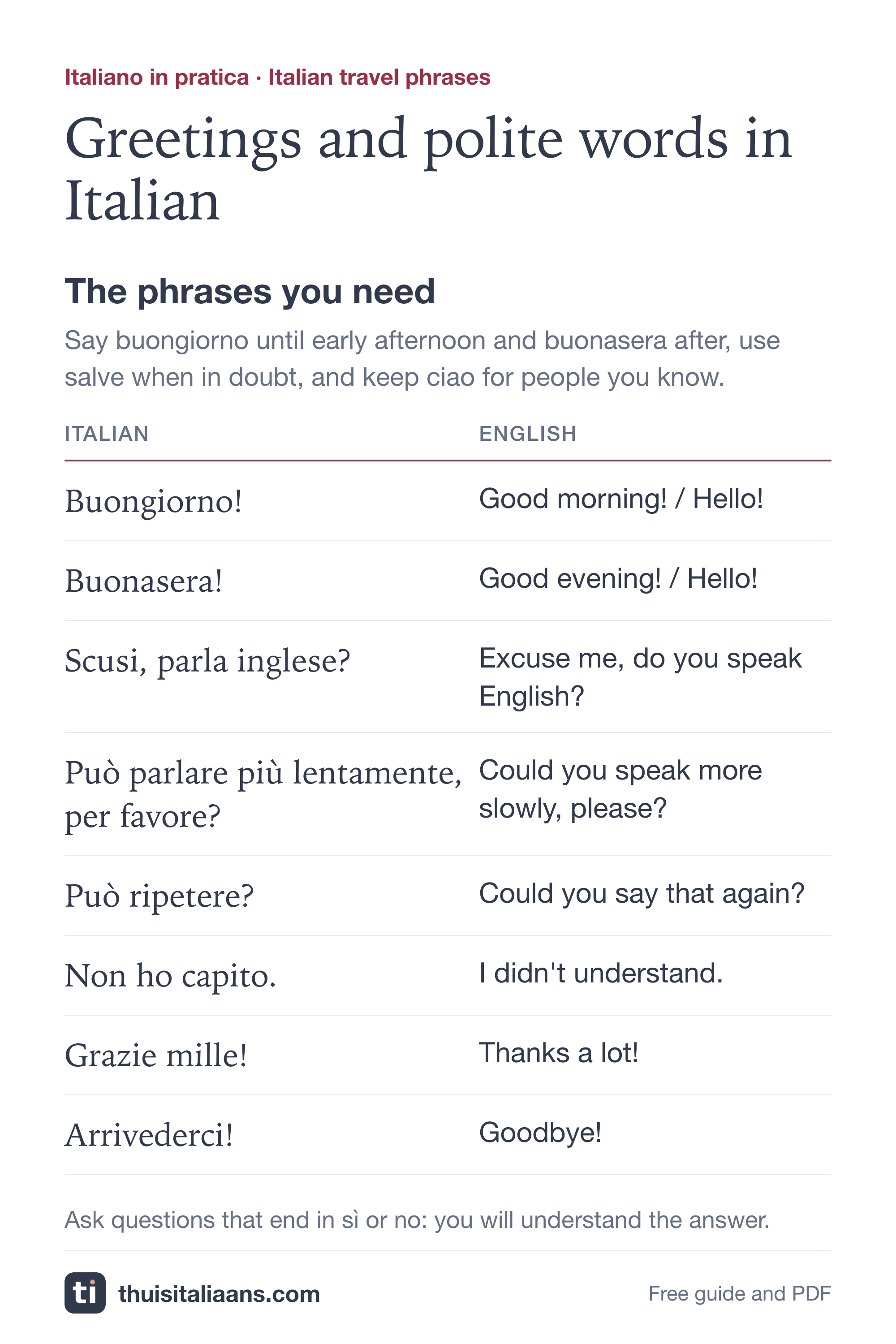 Italian phrases: Greetings and polite words in Italian
Not rude, but too familiar with strangers. Use ciao with friends and with people who greet you with it first; with shop staff, waiters and older people, say buongiorno, buonasera or salve.
Usually around four or five in the afternoon, though some people switch right after lunch. Salve works at any time if you're not sure.
It means «may I?»: it's what you say to get past people, to step into someone's home or office, or to get off a crowded bus.
Scusi is the polite form, for strangers; scusa is informal, for friends, family and children.
Say «Può parlare più lentamente, per favore?». To a friend: «Puoi parlare più piano?».