

Grammar · A2
Stare + gerund
by Alessio · teacher of Italian as a foreign language, ITALS master’s

To say something is happening right now, Italian uses stare + gerund: sto guardando la partita. It is the language’s live commentary: the action as it unfolds.
- 5min reading
- 16min exercises
- A2level
What you learn
- stare al presente, gerundio -are, gerundio -ere / -ire, irregolari
- When to use stare + gerund
- From the sofa to the stadium
- Vocabulary: il calcio
Italian and English side by side
This one maps almost perfectly onto the English continuous: sto mangiando = I am eating. The catch is that Italian uses it far less. For habits and general truths the simple present is enough: lavoro in banca, not sto lavorando in banca.
Take this page with you
This chapter’s sheet as a free printable PDF (tables in Italian): rules, typical mistakes and the quiz with answers. A teacher’s tip: grammar sticks by reviewing it often, not by studying it once.
Stare + gerund lasts, but only around now: sto mangiando. The simple present also covers habits.


The words on this page
Drag each Italian word onto its definition, or tap a word first, then its box.
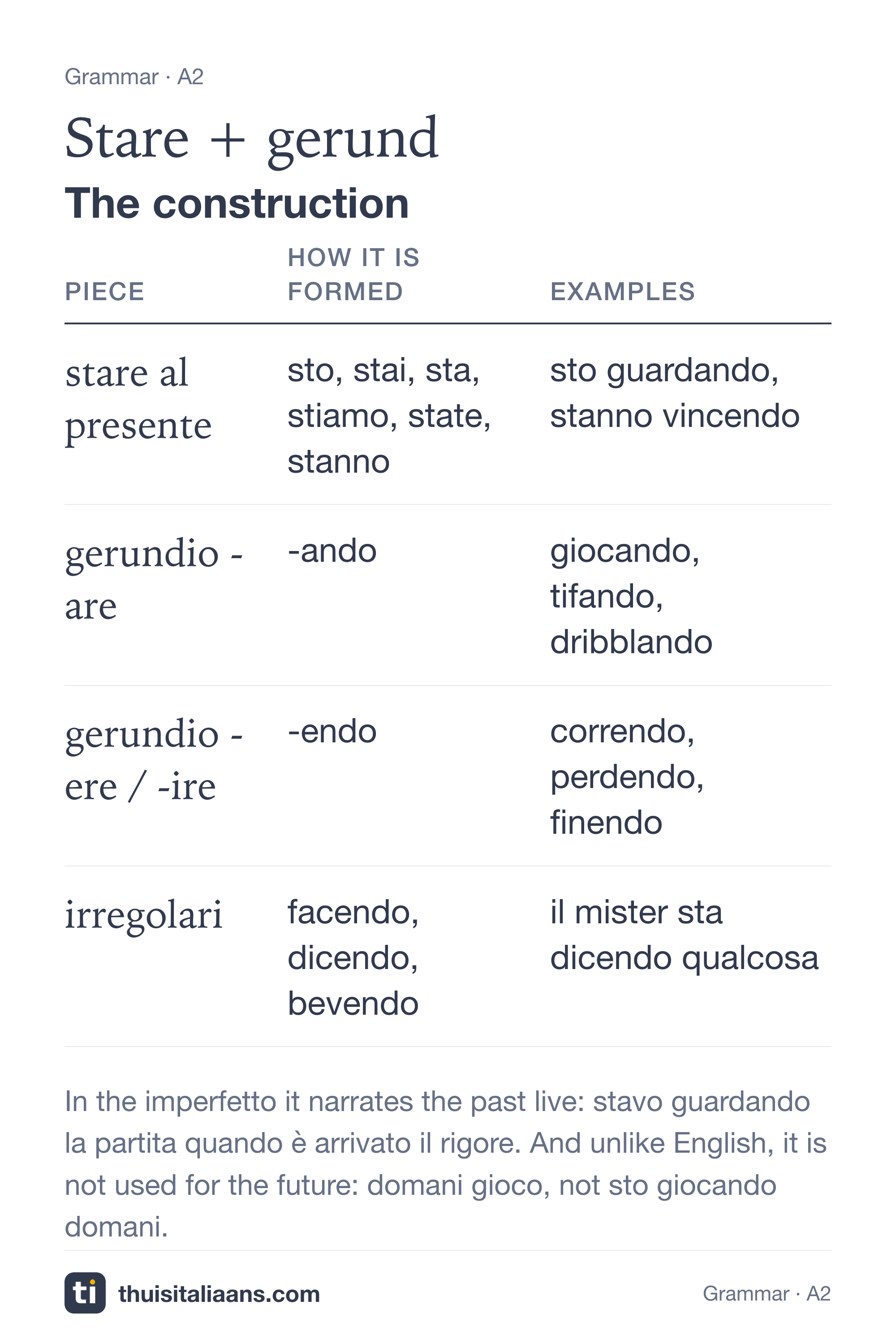
The construction
| Piece | How it is formed | Examples |
|---|---|---|
| stare al presente | sto, stai, sta, stiamo, state, stanno | sto guardando, stanno vincendo |
| gerundio -are | -ando | giocando, tifando, dribblando |
| gerundio -ere / -ire | -endo | correndo, perdendo, finendo |
| irregolari | facendo, dicendo, bevendo | il mister sta dicendo qualcosa |
From the sofa to the stadium
| Sentence | Moment |
|---|---|
| stanno entrando in campo | adesso, sotto i tuoi occhi |
| il portiere sta parando tutto | azione che continua |
| stavamo festeggiando quando hanno pareggiato | diretta nel passato |
The most common mistakes
sto gioco a calcio ogni sabato→ gioco a calcio ogni sabato (habits take the simple present)stanno vincendo ieri sera→ stavano vincendo ieri sera (in the past: stare in the imperfetto)sto bevendo un caffè domani→ domani bevo un caffè (no stare + gerund for the future)
Did you know?
Read and understand
This chapter’s grammar. Example: a chat between friends.
online
Questions
Che cosa sta facendo Leo?
Da quanto tempo dorme?
«Sto cucinando» significa che cucino…
Completa: «Non posso parlare adesso: ___» (io, guidare).

Exercises
Five exercises in order of difficulty. The last ones bring back what you have already seen.
01 Il gerundio
Write the gerund.
- parlare →
- leggere →
- dormire →
- fare →
- bere →
- dire →
02 Sto facendo
Complete with stare + gerund.
- (io / mangiare) adesso.
- (tu / studiare) ?
- Marco (dormire) .
- (noi / uscire) proprio ora.
- (voi / fare) i compiti?
- I bambini (giocare) in giardino.
03 Presente semplice o stare + gerundio?
Stare + gerund is only for what is happening right now. Choose.
- Ogni giorno (io / lavorare) otto ore.
- Non posso parlare: (lavorare) .
- Di solito (noi / mangiare) alle otto.
- Richiamo dopo: (noi / mangiare) .
- Marco (studiare) medicina da tre anni.
- Zitti! Marco (studiare) .
04 Al passato
Stavo facendo: the action in progress in the past. Complete.
- (io / dormire) quando hai chiamato.
- (noi / uscire) quando è cominciato a piovere.
- Che cosa (tu / fare) ieri alle otto?
- (loro / cenare) quando siamo arrivati.
- (lei / leggere) e non mi ha sentito.
- (io / pensare) proprio a te!
05 Messaggi
Complete with stare + gerund, present or past, and the pronouns.
Review passato prossimo · imperfetto · pronomi diretti · verbi riflessivi
- — Ciao! Che (tu / fare) ? — (io / preparare) la cena.
- — (io / arrivare) fra dieci minuti.
- — Ieri (io / provare) a chiamarti ma non (tu / rispondere) .
- — Scusa, (io / guidare) e non ho sentito. (il telefono)
- — Di solito (io / spegnere) il telefono in macchina.
- — Va bene, (noi / vedersi) dopo.
These five are a taste. There are over seven hundred on the site, free and with no sign-up. All the exercises →

Every topic, a world
In the  amo Italian app, grammar is practised inside thematic pathways with field-specific vocabulary: il bar, i trasporti, il calcio, la moda, la burocrazia and seventeen more. Choose your world and the grammar comes along by itself, explained in your language too.
Half the path free, no sign-up
★★★★★(11)by Alessio, teacher since 2018
Downloadamo Italian for iPhone ↗︎Search for amo Italian

Read and understand
This chapter’s grammar. Example: an app's news page.
Che cosa stiamo preparando
In queste settimane stiamo lavorando a tre cose grandi.
Stiamo riscrivendo gli esercizi di lettura: testi veri, domande vere. In duecento li state già provando.
Il capitolo dei verbi sta crescendo: stiamo aggiungendo le storie a fumetti, una per tempo verbale.
E sta arrivando la classifica degli amici. Ultima cosa: state leggendo questa pagina invece di studiare. Tornate agli esercizi!
Questions
A quante cose grandi stanno lavorando?
In quanti stanno già provando i nuovi esercizi?
«Sta crescendo»: il gerundio di crescere finisce in -endo perché…
Completa: «Non ora! ___ i compiti» (io, finire).
Want another text on this topic? A birthday card
One more go
Build stare + gerund:
- Zitto, il rigore!
- I tifosi da un’ora.
- Che cosa ? Inizia il secondo tempo!
- due a zero quando hanno pareggiato.
- L’arbitro il VAR.
Frequently asked questions
Can I say sto sapendo or sto avendo?
Better not: state verbs like sapere, avere, essere, volere resist the progressive, exactly as in English (“I am knowing”). Use the plain present: lo so, ho fame. The progressive is for actions you could film, not for states.
Where does the pronoun go: mi sto lavando or sto lavandomi?
Both are correct: the pronoun either climbs before stare or attaches to the gerund. Mi sto vestendo and sto vestendomi are the same sentence in two outfits: spoken Italian slightly prefers the climbing version.
What does stare per mean?
“To be about to”: sto per uscire (I’m about to leave), il treno sta per partire. Do not confuse the two: sto uscendo is already in motion, sto per uscire is one instant before. Together they cover the whole edge of an action.
 The construction