Italiano in pratica
by Alessio · teacher of Italian for foreigners, ITALS master’s in teaching Italian abroad (Ca’ Foscari University, Venice) and a master’s in teaching Italian as a second language (Giustino Fortunato University, Benevento)
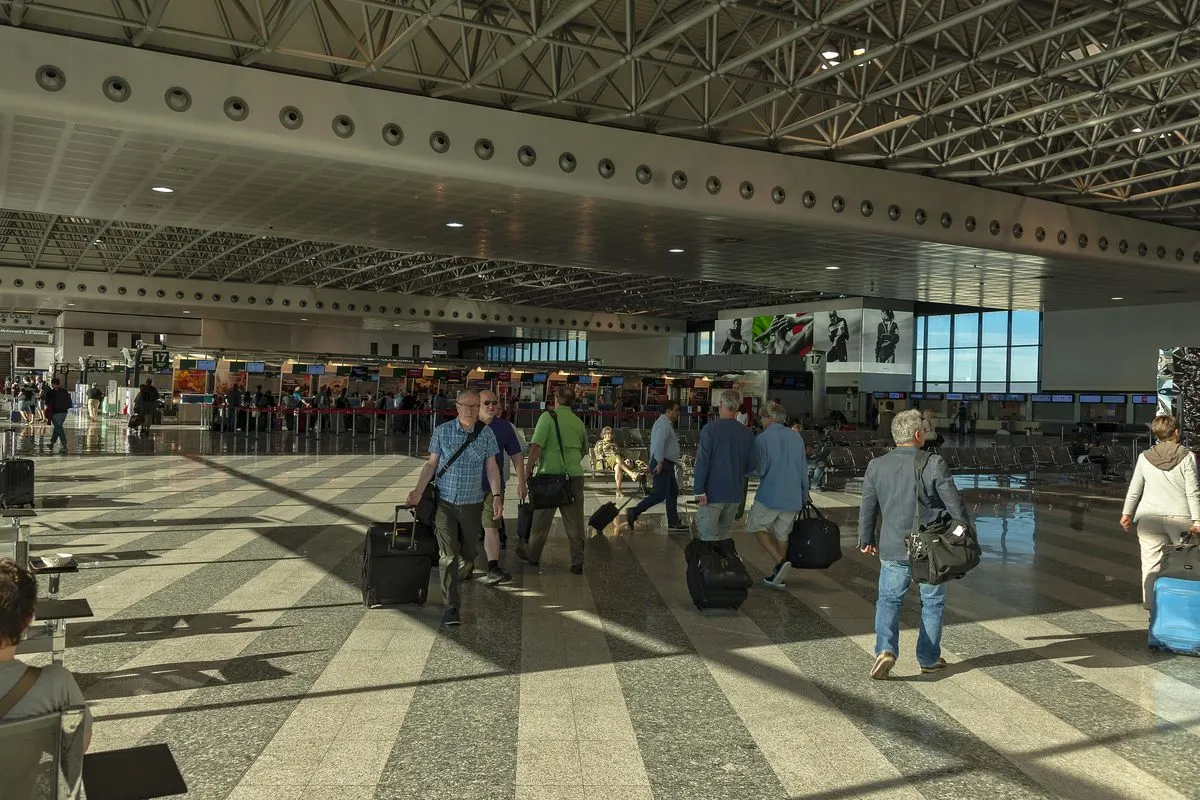
Airport signs in Italy are in Italian and English, but announcements and staff questions are often Italian first. The words to know are imbarco (boarding), uscita (gate), ritardo (delay) and cancellato (cancelled). If your suitcase doesn't arrive, report it before you leave the baggage hall.
Airports look the same everywhere, until the gate changes, the flight shows a delay, or the carousel stops and your suitcase isn't on it. That's when the useful Italian is a handful of words on the board and three or four closed questions at the desk.
Here they are in the order you need them, from check-in to the exit, with the questions that get a sì or a no.
| Italian | English |
|---|---|
| Devo fare il check-in qui? | Do I check in here?answer: sì or no |
| Posso portare questo come bagaglio a mano? | Can I take this as hand luggage?answer: sì or no |
| Devo togliere i liquidi? | Do I need to take out the liquids?answer: sì or no |
| Il volo è in ritardo? | Is the flight delayed?answer: sì or no |
| È questa l'uscita per Napoli? | Is this the gate for Naples?answer: sì or no |
| La mia valigia non è arrivata. | My suitcase hasn't arrived. |
| Dov'è l'ufficio bagagli smarriti? | Where's the lost luggage office? |
| C'è un treno per il centro? | Is there a train to the centre?answer: sì or no |
Read the Italian out loud once before you need it. The questions marked sì or no get a one-word answer you can understand.
Show your passport or ID and the booking, then ask your doubts as closed questions: whether you check in here, whether your bag can go as hand luggage, whether it is overweight. Bag drop is consegna bagagli; hold luggage is bagaglio da stiva.
Most airlines expect you to check in online and only drop the bag at the desk. If the queue is long and your flight is soon, say so: il mio volo parte tra quaranta minuti.
| You say | English |
|---|---|
| Devo fare il check-in qui? | Do I check in here?sì or no |
| Posso portare questo come bagaglio a mano? | Can I take this as hand luggage?sì or no |
| La valigia pesa troppo? | Is the suitcase too heavy?sì or no |
| Il mio volo parte tra quaranta minuti. | My flight leaves in forty minutes. |
| You hear | English |
|---|---|
| Passaporto, prego. | Passport, please. |
| Bagaglio da stiva? | Any hold luggage?sì or no |
| Finestrino o corridoio? | Window or aisle?a choice of two |
| Deve pagare il supplemento. | You have to pay the extra charge. |
Bags, jackets and belts go in the trays, laptops often too. Liquid rules depend on the scanners each airport uses, so ask the staff with a closed question instead of guessing: devo togliere i liquidi?, devo togliere il computer?
If the alarm goes off you'll hear alzi le braccia, raise your arms, and possibly a check with a hand scanner. It's routine.
| You say | English |
|---|---|
| Devo togliere i liquidi? | Do I need to take out the liquids?sì or no |
| Devo togliere il computer? | Do I need to take out the laptop?sì or no |
| Anche le scarpe? | The shoes too?usually no |
| You hear | English |
|---|---|
| Cinture, giacche e telefoni nella vaschetta. | Belts, jackets and phones in the tray. |
| Ha liquidi? | Do you have any liquids?sì or no |
| Alzi le braccia. | Raise your arms. |
| Questa è sua? | Is this yours?sì or no: about a bag |
Partenze are departures, arrivi arrivals. Imbarco is boarding, uscita the gate, in orario on time, ritardo delay and cancellato cancelled. Ultima chiamata, last call, means run.
Gates in Italian airports change often: check the board again after security. Announcements usually come in Italian first and then English.
| You say | English |
|---|---|
| imbarco · uscita | boarding · gate |
| in orario · in ritardo | on time · delayed |
| cancellato | cancelled |
| ultima chiamata | last call |
| È questa l'uscita per Napoli? | Is this the gate for Naples?sì or no |
| Il volo è in ritardo? | Is the flight delayed?sì or no |
| You hear | English |
|---|---|
| L'imbarco è al gate B12. | Boarding is at gate B12. |
| Cambio di uscita. | Gate change.check the board again |
| Si prega di presentarsi all'imbarco. | Please go to the gate for boarding. |

In the  amo Italian app you practise inside real-life pathways: il bar, il ristorante, i trasporti, la casa and more, with listening, dialogues and the grammar explained in English. This page gives you the phrases; the app trains your ear.
Half the A1 course free, no sign-up
★★★★★(22)by Alessio, teacher since 2018
Downloadamo Italian for iPhone ↗︎Search for amo Italian
Flights from inside the Schengen area usually have no passport control on arrival. From outside, the officer may ask one or two questions: why you're here and how long you'll stay. Answer short: in vacanza, una settimana.
At baggage claim, il nastro is the carousel, and the screen tells you its number next to your flight.
| You say | English |
|---|---|
| Sono qui in vacanza. | I'm here on holiday. |
| Per una settimana. | For a week. |
| È questo il nastro del volo da Londra? | Is this the carousel for the London flight?sì or no |
| You hear | English |
|---|---|
| Motivo del viaggio? | Purpose of your trip?vacanza, lavoro |
| Quanto tempo resta? | How long are you staying?say how long |
| Nastro numero quattro. | Carousel number four. |

Go to the lost luggage desk, ufficio bagagli smarriti or lost and found, before you leave the baggage hall, and file a report. Keep the copy and the reference number: you need them to track the bag and to claim.
Describe the suitcase in two words, colour and size, and give the address where you're staying so they can deliver it.
| You say | English |
|---|---|
| La mia valigia non è arrivata. | My suitcase hasn't arrived. |
| La valigia è rotta. | The suitcase is broken. |
| È una valigia blu, grande. | It's a big blue suitcase. |
| Me la portate in albergo? | Will you deliver it to my hotel?sì or no |
| Mi dà il numero della pratica? | Can I have the reference number? |
| You hear | English |
|---|---|
| Ha la carta d'imbarco? | Do you have the boarding pass?show it, with the baggage tag |
| Di che colore è? | What colour is it? |
| Gliela consegniamo domani. | We'll deliver it to you tomorrow. |

Rome Fiumicino and Milan Malpensa have express trains to the city centre; most airports have buses and a taxi rank. Rome has a flat taxi fare from its airports to the historic centre. Ask with a closed question: c'è un treno per il centro?
Train tickets are sold at machines and counters in the arrivals hall; for the bus, ask where the stop is.
| You say | English |
|---|---|
| C'è un treno per il centro? | Is there a train to the centre?sì or no |
| Dov'è la fermata dell'autobus? | Where's the bus stop? |
| Il taxi ha la tariffa fissa? | Does the taxi have a flat fare?sì or no |
| You hear | English |
|---|---|
| Il treno parte ogni quindici minuti. | The train leaves every fifteen minutes. |
| I taxi sono all'uscita. | The taxis are at the exit. |
The queue, first of all. In Britain a queue is a straight line and jumping it is close to a crime. In Italy, at a desk or a boarding gate, the queue is often a loose group, and people keep track of who came before whom rather than standing in single file. When the gate staff appear, half the passengers stand up at once. Nobody means to be rude, and if someone does slip in front of you, a calm scusi, c'ero prima io, excuse me, I was here first, is the normal answer, and it usually works.

Documents matter more than you may be used to. Italians carry an identity card as a matter of course, and as a visitor you will be asked for a passport or ID more often than at home: at every hotel check-in, when you buy a SIM card, when you rent a car. Inside the Schengen area EU citizens can fly with a national ID card instead of a passport, and there is no passport control on arrival.
The ride into town has its own rules. From Rome's two airports, licensed white taxis charge a fixed fare to anywhere inside the Aurelian Walls, the old city walls: since the city's 2024 update, €55 from Fiumicino and €40 from Ciampino. Ask tariffa fissa? before you set off. And don't accept a lift from someone who approaches you in the arrivals hall: the official rank is outside, and the drivers waiting there are the ones with licences.
Read next: How do trains fit into everyday life in Italy? · Why can't you buy a ticket on the bus, or hail a taxi?
Italians rarely answer with a bare sì or no. These are the forms you will actually hear, so you know which way the answer went.
| You hear | English | It means |
|---|---|---|
| Sì, certo. | Yes, of course. | yes |
| Certo! | Sure! | yes |
| Come no! | Of course! (literally: how not?) | yes |
| Volentieri. | Gladly. | yes |
| Va bene. | Fine, OK. | yes |
| Prego. | Go ahead / please do. | yes |
| No, mi dispiace. | No, I'm sorry. | no |
| Purtroppo no. | Unfortunately not. | no |
| Non c'è. | There isn't any. | no |
| È finito. | It's sold out / all gone. | no |
| Non si può. | That's not allowed. | no |
| Non ancora. | Not yet. | no |
Six real replies. Tap Yes or No for each one.
The grammar behind them
This guide as two printable pages, in English: the phrases to say, the yes/no questions and what you will hear.
All 43 phrase PDFs · €9Already included in the full course · €39 a year.
Or keep the eight phrases as an image, to save on your phone or pin:
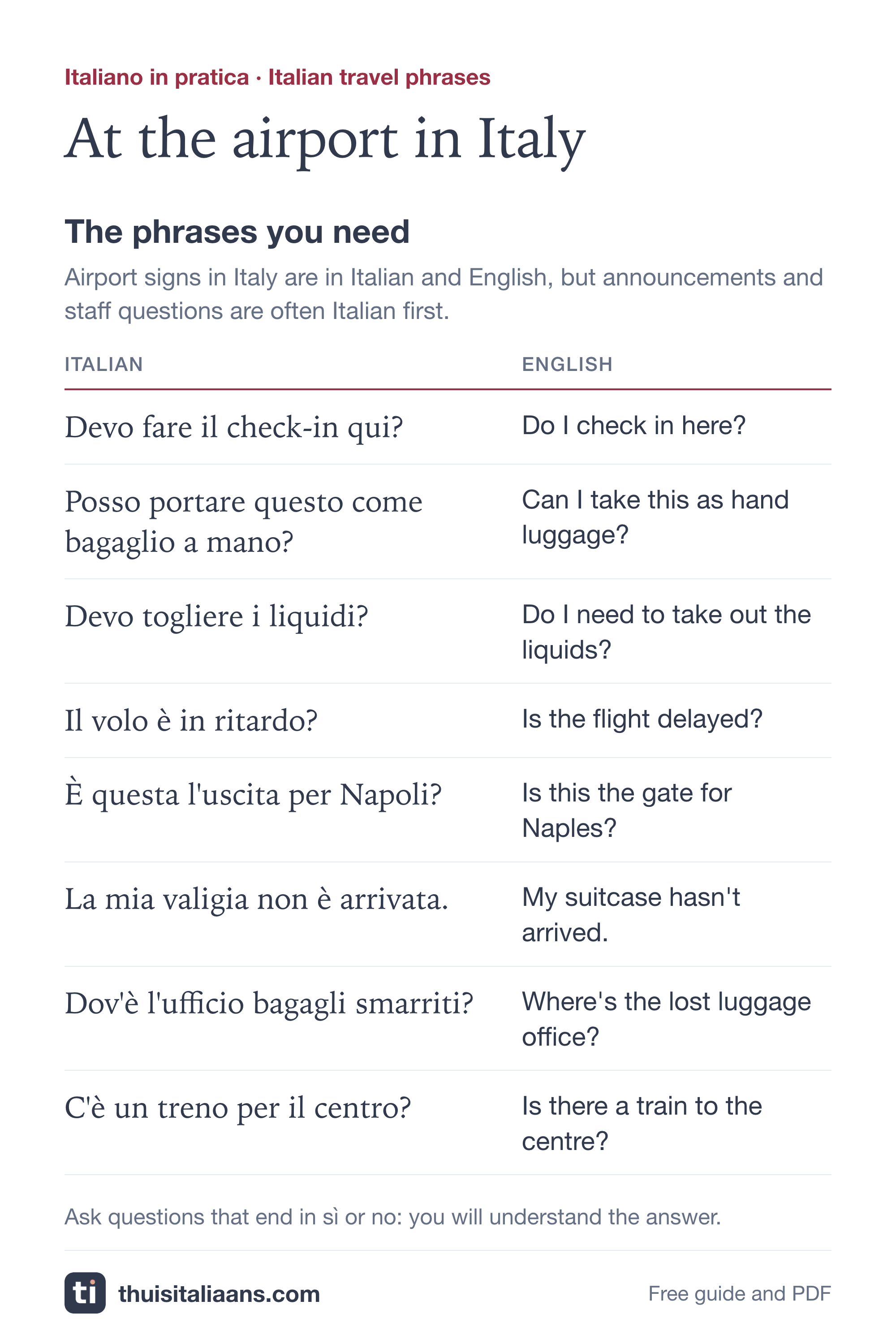 Italian phrases: At the airport in Italy
Boarding. «Uscita» is the gate, «ritardo» delay and «cancellato» cancelled.
Go to the lost luggage desk before you leave the baggage hall and file a report. Keep the copy and the reference number to track the bag and make a claim.
It depends on the scanners each airport uses. Ask the staff: «Devo togliere i liquidi?»
Fiumicino and Malpensa have express trains to the centre, and Rome has a flat taxi fare from its airports to the historic centre.