

Grammar · A1
Essere and avere
by Alessio · teacher of Italian as a foreign language, ITALS master’s

Essere says who you are and how the world is; avere says what you own, but also age, hunger, thirst and hurry. They are the two most used verbs in the language, and later they will become the auxiliaries of the past tense.
- 5min reading
- 19min exercises
- A1level
What you learn
- tu, lui / lei, noi, voi, loro
- When to use essere and avere
- When Italian uses avere (and other languages do not)
- Vocabulary: la famiglia
Italian and English side by side
The split is roughly the same as English to be and to have, but the borders move. Italian uses avere for age, hunger, thirst, cold and fear: ho trent'anni, ho fame, literally I have thirty years, I have hunger. Translating I am thirty as sono trenta is the single most recognisable beginner mistake, and an easy one to leave behind.
Take this page with you
This chapter’s sheet as a free printable PDF (tables in Italian): rules, typical mistakes and the quiz with answers. A teacher’s tip: grammar sticks by reviewing it often, not by studying it once.


The words on this page
Drag each Italian word onto its definition, or tap a word first, then its box.
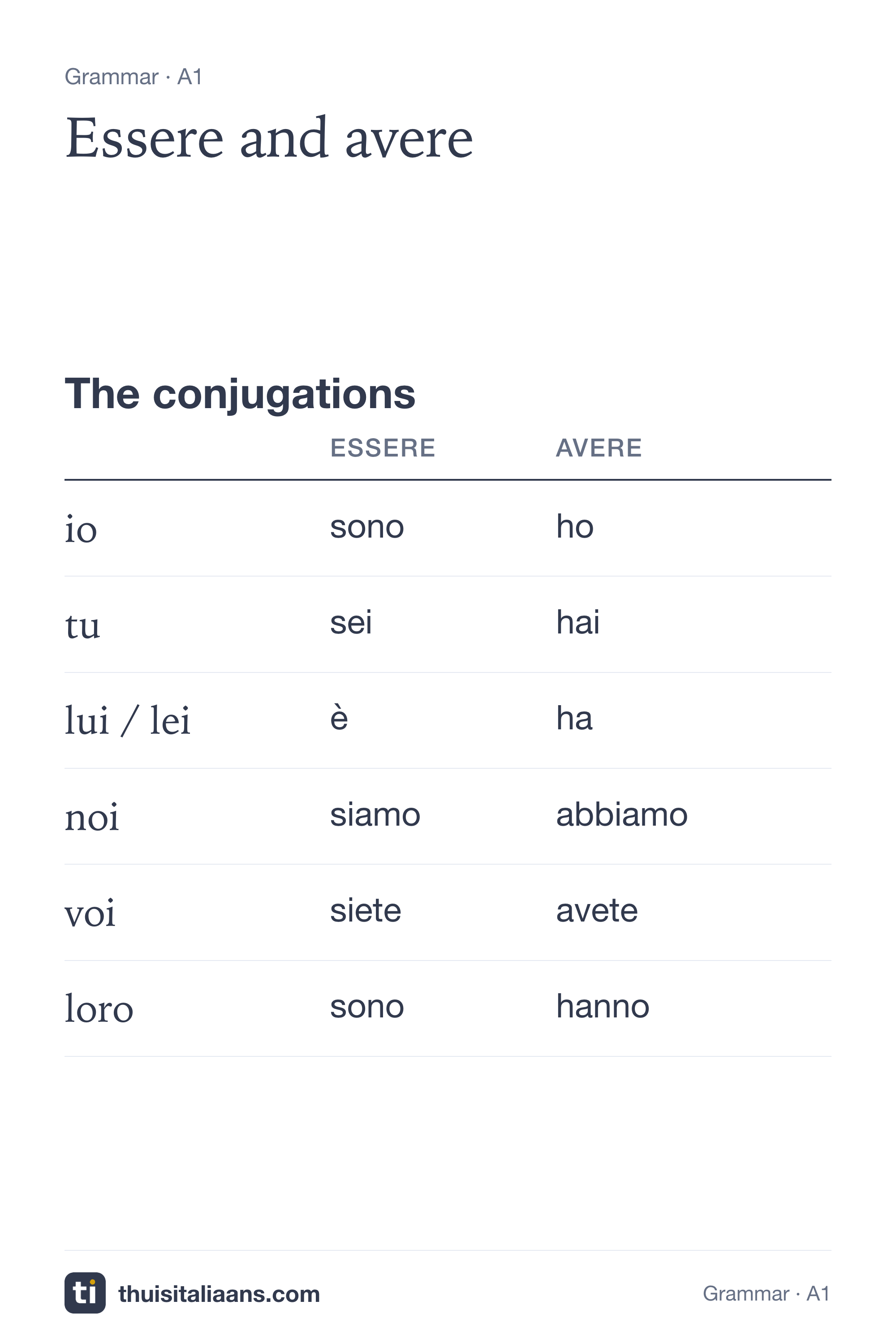
The conjugations
| essere | avere | |
|---|---|---|
| io | sono | ho |
| tu | sei | hai |
| lui / lei | è | ha |
| noi | siamo | abbiamo |
| voi | siete | avete |
| loro | sono | hanno |
When Italian uses avere (and other languages do not)
| Expression | Example |
|---|---|
| avere + anni | mia nonna ha ottant’anni |
| avere fame / sete | ho fame: si mangia? |
| avere caldo / freddo | in Sardegna d’estate abbiamo caldo |
| avere fretta / paura / sonno | ho fretta, ho paura, ho sonno |
| avere bisogno di | ho bisogno di un consiglio |
The most common mistakes
sono trent’anni→ ho trent’anni (age takes avere)sono fame→ ho fame (hunger, thirst, sleepiness take avere)mia madre a due sorelle→ mia madre ha due sorelle (ha is the verb, a is the preposition)
Did you know?
Read and understand
This chapter’s grammar. Example: a family email.
Le tue radici sarde
daNonna Rosa <rosa.rossi@libero.it>
aanne.bakker@mail.nl
datamar 12 mar, 09:14
Cara Anne,
sono contenta della tua lettera. Sì, siamo parenti: tua bisnonna e mio padre erano fratelli.
Io ho ottantanove anni e sono nata a Nuoro. Ho ancora le fotografie di famiglia.
Quanti anni hai? E sei già stata in Sardegna? Noi abbiamo una casa vicino al mare, siamo in tre.
Ho il tuo numero, ma non ho l'indirizzo. Me lo mandi?
Un abbraccio,
Rosa
Questions
Quante persone vivono nella casa vicino al mare?
«Siamo in tre» usa il verbo…
Completa: «Marco ___ vent'anni».

Exercises
Five exercises in order of difficulty. The last ones bring back what you have already seen.
01 Essere
Complete with the verb essere.
- io
- tu
- lui
- noi
- voi
- loro
02 Avere
Complete with the verb avere. Remember the silent h.
- io
- tu
- lei
- noi
- voi
- loro
03 Le espressioni con avere
In Italian many sensations are expressed with avere, not with essere. Complete.
- Marco vent’anni.
- (io) fame, mangiamo?
- (noi) freddo, chiudi la finestra?
- (tu) sete?
- Loro paura dei cani.
- (io) bisogno di aiuto.
04 Essere o avere?
Choose the right verb and conjugate it.
- Anna italiana.
- Anna una macchina rossa.
- (noi) stanchi.
- (noi) sonno.
- Quanti anni tuo fratello?
- Di dove voi?
- I bambini caldo e in giardino.
05 Chi sono, che cosa hanno
Complete with essere/avere in the present and make the adjectives agree.
Review aggettivi · presente indicativo · pronomi soggetto
- Sofia una studentessa spagnol.
- (lei) due fratell più grand.
- I suoi amici simpatic e sempre fame.
- Noi in classe con lei: una lezione alle nove.
- E voi, tempo domani? liber?
- Io trent’anni e di Napoli.
These five are a taste. There are over seven hundred on the site, free and with no sign-up. All the exercises →

Every topic, a world
In the  amo Italian app, grammar is practised inside thematic pathways with field-specific vocabulary: il bar, i trasporti, il calcio, la moda, la burocrazia and seventeen more. Choose your world and the grammar comes along by itself, explained in your language too.
Half the path free, no sign-up
★★★★★(11)by Alessio, teacher since 2018
Downloadamo Italian for iPhone ↗︎Search for amo Italian

Read and understand
This chapter’s grammar. Example: a civil registry page.
Registro delle famiglie
Rosa Rossi è nata a Nuoro nel 1935. Ha tre figli e sette nipoti.
Suo padre era pastore, sua madre aveva un piccolo negozio.
Oggi la famiglia è sparsa: sono in Sardegna, a Torino e in Olanda.
«Abbiamo le stesse mani», dice Rosa. «E siamo tutti testardi».
Questions
Quanti nipoti ha Rosa?
Perché «è nata» e non «ha nata»?
Completa: «I miei nonni ___ di Nuoro».
Want another text on this topic? An enrolment email · Filling in a form
One more go
Essere or avere?
- I miei nonni di un paese vicino a Nuoro.
- Mio fratello ventidue anni.
- Noi una casa in Sardegna.
- (Io) sete: c’è dell’acqua?
- Voi italiani o italoamericani?
Frequently asked questions
How do I say “it’s me” at the door or on the phone?
Sono io: the verb agrees with who you are, not with “it”. So è lei, siamo noi, sono loro. On the phone you will also hear Chi parla? — Sono Marco.
What is the difference between essere and stare?
Essere gives identity and qualities (sono italiano, è alta); stare covers health and how things are going (come stai? sto bene), staying somewhere (stasera sto a casa) and set phrases. If you speak Spanish, careful: the border runs differently than ser/estar, and essere covers much more.
Is c’è a different verb?
No: it is essere with the particle ci, and it means “there is”: c’è un problema. It is so useful it has its own chapter: c’è and ci sono.
 The conjugations