

Grammar · A2
Indirect object pronouns
by Alessio · teacher of Italian as a foreign language, ITALS master’s

Indirect pronouns answer «to whom?»: gli scrivo (to him), le telefono (to her). They are the engine of piacere: mi piace il progetto means the project is pleasing to me.
- 5min reading
- 15min exercises
- A2level
What you learn
- mi / ti, gli, le, ci / vi, gli
- When to use indirect object pronouns
- Verbs that take the indirect pronoun
- Vocabulary: il lavoro in ufficio
Italian and English side by side
English does not distinguish I call him from I speak to him in form: both are him. Italian does: lo chiamo (direct) but gli parlo (indirect). Ask whether the verb takes to in English: if it does, you probably need gli or le.
Take this page with you
This chapter’s sheet as a free printable PDF (tables in Italian): rules, typical mistakes and the quiz with answers. A teacher’s tip: grammar sticks by reviewing it often, not by studying it once.


The words on this page
Drag each Italian word onto its definition, or tap a word first, then its box.
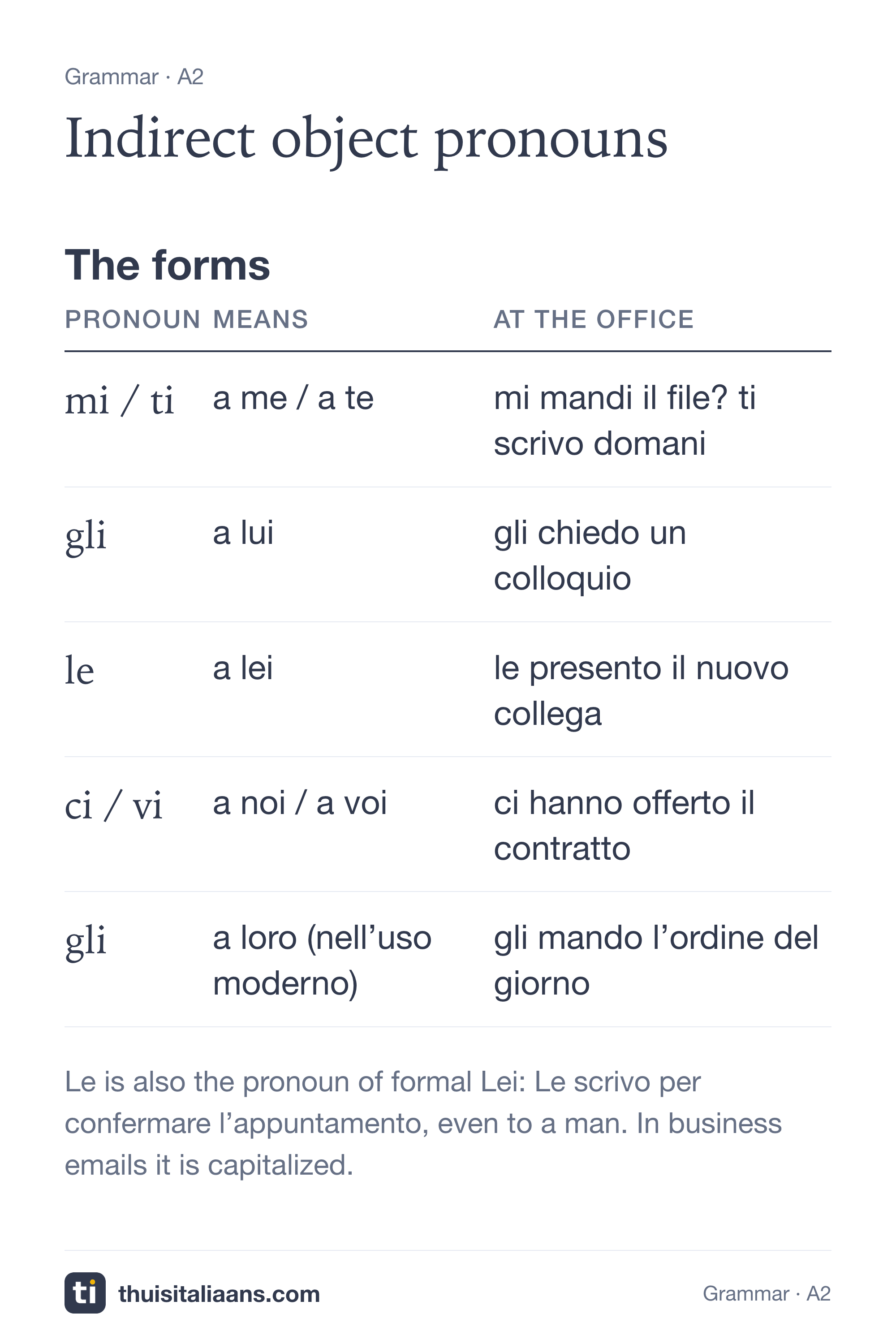
The forms
| Pronoun | Means | At the office |
|---|---|---|
| mi / ti | a me / a te | mi mandi il file? ti scrivo domani |
| gli | a lui | gli chiedo un colloquio |
| le | a lei | le presento il nuovo collega |
| ci / vi | a noi / a voi | ci hanno offerto il contratto |
| gli | a loro (nell’uso moderno) | gli mando l’ordine del giorno |
Verbs that take the indirect pronoun
| Verb | Example |
|---|---|
| piacere / interessare | mi piace questo ruolo, ti interessa l’offerta? |
| scrivere / telefonare / rispondere a | le telefono nel pomeriggio, gli rispondo subito |
| chiedere / dire / dare a | gli chiedo un aumento, le do una mano |
| sembrare / servire | mi sembra un’ottima idea, ci serve più tempo |
The most common mistakes
lo telefono stasera (a Marco)→ gli telefono stasera (telefonare a takes the indirect)mi piacciono lavorare qui→ mi piace lavorare qui (with an infinitive, piacere stays singular)le ho chiesto a Marco un consiglio→ gli ho chiesto un consiglio (to Marco: gli)
Did you know?
Read and understand
This chapter’s grammar. Example: a chat about presents.
online
Questions
Che cosa piace a Sara?
Perché vogliono fare un regalo anche a Tommaso?
«Le piacciono i gialli»: «le» significa…
Completa: «Telefono a Marco e ___ chiedo l'indirizzo».

Exercises
Five exercises in order of difficulty. The last ones bring back what you have already seen.
01 Le forme
Complete with the indirect object pronoun.
- a me →
- a te →
- a lui →
- a lei →
- a noi →
- a voi →
- a loro →
02 Diretto o indiretto?
Ask yourself: does the verb take “who/what” or “to whom”? Choose.
- chiamo domani. (Marco)
- telefono domani. (a Marco)
- vedo stasera. (Anna)
- scrivo stasera. (ad Anna)
- aspetto qui. (voi)
- rispondo subito. (a voi)
03 I verbi che vogliono l’indiretto
Dire, parlare, telefonare, rispondere, chiedere, regalare. Complete.
- ho detto tutto. (a lei)
- regalo un libro. (a te)
- chiedo un favore. (a voi)
- rispondo domani. (a loro)
- parlo io. (a lui)
- telefoni tu? (a me)
04 Piacere e simili
With piacere the pronoun is indirect and the verb follows the thing that pleases. Complete.
- piace il caffè. (a me)
- piacciono i dolci. (a lui)
- piace viaggiare? (a te)
- è piaciuta la festa. (a noi)
- servono due ore. (a lei)
- manca casa. (a loro)
05 Il compleanno
Complete with direct and indirect pronouns, in the right tense.
Review pronomi diretti · passato prossimo
- Domani è il compleanno di Luca: regalo un libro.
- ho comprato ieri in libreria.
- Ho invitato anche le sue sorelle: ho scritto un messaggio.
- piace molto la torta al cioccolato, quindi faccio io.
- — Vieni anche tu? aspetto alle otto. (te)
- — Certo, telefono quando esco. (a te)
These five are a taste. There are over seven hundred on the site, free and with no sign-up. All the exercises →

Every topic, a world
In the  amo Italian app, grammar is practised inside thematic pathways with field-specific vocabulary: il bar, i trasporti, il calcio, la moda, la burocrazia and seventeen more. Choose your world and the grammar comes along by itself, explained in your language too.
Half the path free, no sign-up
★★★★★(11)by Alessio, teacher since 2018
Downloadamo Italian for iPhone ↗︎Search for amo Italian

Read and understand
This chapter’s grammar. Example: an email from a hotel.
Le confermiamo la prenotazione
daHotel Belvedere <info@hotelbelvedere.it>
aj.smit@mail.nl
datagio 12 giu, 11:40
Gentile signora Smit,
Le scriviamo per confermare la camera dal 3 al 7 luglio. Le abbiamo riservato una matrimoniale con vista mare, al terzo piano.
Come richiesto, Le lasceremo una culla in camera. Se Le serve il parcheggio, ci risponda entro lunedì: i posti sono pochi.
Il giorno dell'arrivo vi aspettiamo dalle 14: il primo caffè ve lo offriamo noi.
Cordiali saluti,
la reception
Questions
A che piano è la camera?
Entro quando bisogna rispondere per il parcheggio?
«Le scriviamo», con la maiuscola: qui «Le» significa…
Completa: «Ho incontrato Paola e ___ ho dato il libro».
Want another text on this topic? The concert ticket
One more go
Direct or indirect? Choose:
- Il capo? ho scritto un’email stamattina.
- La collega nuova? presento il team oggi.
- piacciono i progetti internazionali.
- Dottoressa, mando il contratto entro venerdì.
- I clienti? rispondo sempre in giornata.
Frequently asked questions
Can I use gli to mean “to them”?
Yes: gli for “to them” is fully established and accepted by modern grammars and the Accademia della Crusca: ho visto i tuoi: gli ho detto di salutarti. The alternative loro after the verb (ho detto loro) survives in formal writing.
Why is it mi piacciono i libri, with a plural verb?
Because the grammatical subject is the thing that pleases: the books do the pleasing, so the verb goes plural. Mi piace il libro, mi piacciono i libri. If you keep translating “I like” word by word, the verb will betray you: think “the books please me”.
Which common verbs take a + person in Italian but not in English?
Telefonare a, chiedere a, rispondere a, credere a: all indirect in Italian. So: le telefono (I phone her), gli chiedo (I ask him). English “phone her / ask him” hides the a that Italian grammar needs.
 The forms