Italiano in pratica
by Alessio · teacher of Italian for foreigners, ITALS master’s in teaching Italian abroad (Ca’ Foscari University, Venice) and a master’s in teaching Italian as a second language (Giustino Fortunato University, Benevento)
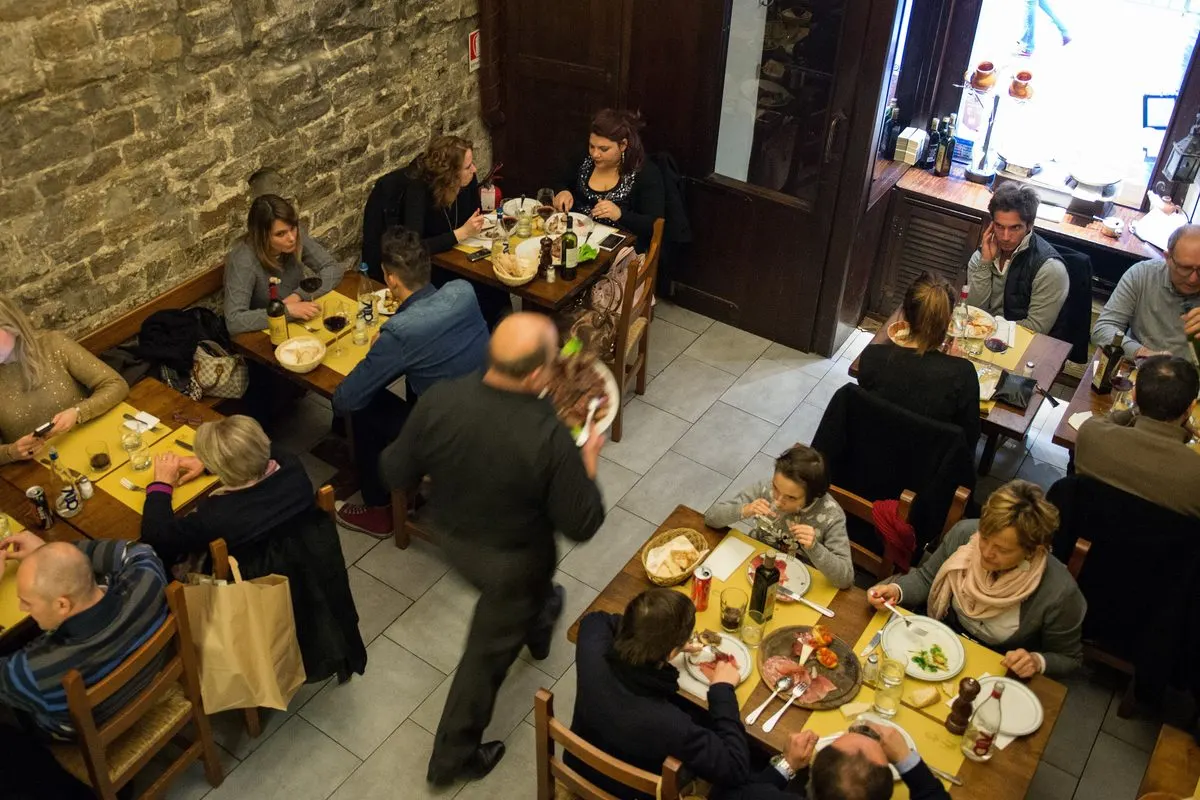
An Italian meal follows a fixed order: antipasto, primo, secondo with contorno, dolce, caffè. You don't have to order every course. And the bill never comes until you ask for it: il conto, per favore.
In an Italian restaurant nobody rushes you, and that is exactly what confuses visitors: the waiter won't bring the bill until you ask, won't pile all the courses on the table at once, and may come back three times before you have decided.
Here is the whole evening in the order it happens, with the phrases you will say and the questions you will hear. Wherever you need something specific, ask it so the answer is sì or no.
| Italian | English |
|---|---|
| Avete un tavolo per due? | Do you have a table for two?answer: sì or no |
| Abbiamo prenotato a nome Rossi. | We booked under the name Rossi. |
| Possiamo vedere il menù? | Can we see the menu? |
| È piccante? | Is it spicy?answer: sì or no |
| Per me la carbonara. | The carbonara for me. |
| Un litro d'acqua naturale. | A litre of still water. |
| Il servizio è incluso? | Is service included?answer: sì or no |
| Il conto, per favore. | The bill, please. |
Read the Italian out loud once before you need it. The questions marked sì or no get a one-word answer you can understand.
In person or by phone, with one closed question: avete un tavolo per quattro, stasera alle otto? Do you have a table for four, tonight at eight? The answer is yes, no, or another time.
Italians eat late: in many places the kitchen opens at half past seven and fills up after eight. In summer the question everybody asks is whether there is room outside.
| You say | English |
|---|---|
| Avete un tavolo per quattro, stasera alle otto? | Do you have a table for four, tonight at eight?sì or no |
| C'è posto fuori? | Is there room outside?sì or no |
| Va bene anche alle nove? | Is nine o'clock all right too?sì or no |
| You hear | English |
|---|---|
| A che nome? | Under what name?just say your surname |
| Per quante persone? | For how many people?say the number |
| Dentro o fuori? | Inside or outside?a choice of two |
| Siamo al completo. | We're fully booked.no |
The order is antipasto, primo (pasta, risotto or soup), secondo (meat or fish) with a contorno (side dish, ordered separately), then dolce and caffè. You don't have to order everything: one primo each, or one secondo and a shared antipasto, is completely normal.
The one surprise is the contorno: a secondo usually arrives alone on the plate, and vegetables or potatoes are ordered on their own.
| You say | English |
|---|---|
| Si può prendere solo un primo? | Can we just have a first course?sì |
| Il contorno è compreso? | Is a side dish included?usually no |
| Possiamo dividere un antipasto? | Can we share a starter?sì or no |
| You hear | English |
|---|---|
| Il secondo lo prendete? | Will you have a main course?sì or no |
| Come contorno? | What side dish?pick one from the menu |

Ask about one ingredient at a time: c'è carne?, ci sono noci?, è senza glutine? Each question gets a clear yes or no, which is far safer than asking what is in a dish.
Italian restaurants know coeliac disease well: sono celiaco (or celiaca for a woman) is understood everywhere. Menus also have to mark frozen products, usually with an asterisk; if you see one and want to know, ask è fresco?
| You say | English |
|---|---|
| C'è carne? | Is there meat in it?sì or no |
| Ci sono noci? | Are there nuts in it?sì or no |
| È senza glutine? | Is it gluten-free?sì or no |
| È vegetariano? | Is it vegetarian?sì or no |
| È piccante? | Is it spicy?sì or no |
| È fresco? | Is it fresh (not frozen)?sì or no |
| Sono allergico alle noci. | I'm allergic to nuts.allergica for a woman |
| You hear | English |
|---|---|
| Sì, c'è il guanciale. | Yes, there's pork cheek in it.yes |
| No, è senza. | No, it's without.no |
| Glielo faccio senza. | I'll make it without for you.they can leave it out |

In the  amo Italian app you practise inside real-life pathways: il bar, il ristorante, i trasporti, la casa and more, with listening, dialogues and the grammar explained in English. This page gives you the phrases; the app trains your ear.
Half the A1 course free, no sign-up
★★★★★(22)by Alessio, teacher since 2018
Downloadamo Italian for iPhone ↗︎Search for amo Italian
The same five questions in almost every restaurant: whether you have decided, what you'd like to drink, still or sparkling water, whether everything is fine, and whether you'd like coffee.
To tutto bene? the answer is sì, tutto buonissimo. To avete deciso?, if you need more time, say non ancora, grazie.
| You say | English |
|---|---|
| Non ancora, grazie. | Not yet, thank you. |
| Sì, tutto buonissimo. | Yes, everything is delicious. |
| Un quartino di rosso della casa. | A quarter litre of house red.house wine comes in carafes: un quartino, mezzo litro, un litro |
| You hear | English |
|---|---|
| Avete deciso? | Have you decided?sì or non ancora |
| Da bere? | To drink? |
| Naturale o frizzante? | Still or sparkling?about the water |
| Tutto bene? | Is everything fine?sì |
| Il caffè? | Coffee?sì or no |
| Altro? | Anything else?sì or no |

Il coperto is a per-person cover charge for bread and the table setting, usually a couple of euros, and it has to be on the menu. Il servizio is a service charge some restaurants add as a percentage; if it is on the bill, you don't need to tip on top.
Tipping in Italy is never compulsory. Rounding up, or leaving a few euros after a good meal, is appreciated and that is all.
| You say | English |
|---|---|
| Il servizio è incluso? | Is service included?sì or no |
| Il coperto è a persona? | Is the cover charge per person?sì |
| You hear | English |
|---|---|
| Pane e coperto. | Bread and cover charge.a line on the bill, not a mistake |
Ask for it: il conto, per favore. Bringing the bill unasked would mean rushing you out, so the waiter waits for you. Then ask your payment questions as yes/no questions.
Splitting the bill item by item is not common in small places. Pagare alla romana means splitting the total equally, and that is what most groups do.
| You say | English |
|---|---|
| Il conto, per favore. | The bill, please. |
| Possiamo pagare con la carta? | Can we pay by card?sì or no |
| Possiamo pagare separatamente? | Can we pay separately?sometimes no: then split it equally |
| Facciamo alla romana. | Let's split it equally. |
| You hear | English |
|---|---|
| Insieme o separati? | Together or separately?a choice of two |
| Bancomat o carta di credito? | Debit card or credit card? |
In the United States a server who brings the check before you ask is being efficient, and a table may turn over two or three times in an evening. In Italy the table is yours for the night. Bringing the bill unasked would mean «it's time for you to go», so the waiter waits until you ask, however long that takes. What feels like slow service to a visitor is meant as respect. Italian waiters are paid a wage, and tips are a small extra rather than the core of their income, so nobody has a reason to hurry you towards the door.

The clock is different too. Restaurants usually serve lunch from about half past twelve to half past two and dinner from half past seven, later in the south and in summer, and many kitchens close in between. A plate of pasta is a course, not a main meal; salad comes as a side dish with the second course; bread is there to finish the sauce, not to eat with butter before the meal. Water is a choice you will be asked about: Italians drink more bottled water than anyone else in Europe, over 200 litres per person a year, so naturale o frizzante? is normal even though tap water is safe and you can ask for it.
The bill has its own logic. A cover charge, il coperto, pays for bread and the table setting; in Rome and the rest of Lazio a regional law doesn't allow it, which is why bills there sometimes show a line for bread instead. A tip is never compulsory: rounding up or leaving a few euros after a good meal is plenty. And when a group pays, Italians tend to split the total equally, alla romana, rather than working out who had what.
Read next: Why do Italians eat a whole pizza each? · Why do Italians still pay in cash so often?
Italians rarely answer with a bare sì or no. These are the forms you will actually hear, so you know which way the answer went.
| You hear | English | It means |
|---|---|---|
| Sì, certo. | Yes, of course. | yes |
| Certo! | Sure! | yes |
| Come no! | Of course! (literally: how not?) | yes |
| Volentieri. | Gladly. | yes |
| Va bene. | Fine, OK. | yes |
| Prego. | Go ahead / please do. | yes |
| No, mi dispiace. | No, I'm sorry. | no |
| Purtroppo no. | Unfortunately not. | no |
| Non c'è. | There isn't any. | no |
| È finito. | It's sold out / all gone. | no |
| Non si può. | That's not allowed. | no |
| Non ancora. | Not yet. | no |
Six real replies. Tap Yes or No for each one.
The grammar behind them
This guide as two printable pages, in English: the phrases to say, the yes/no questions and what you will hear.
All 43 phrase PDFs · €9Already included in the full course · €39 a year.
Or keep the eight phrases as an image, to save on your phone or pin:
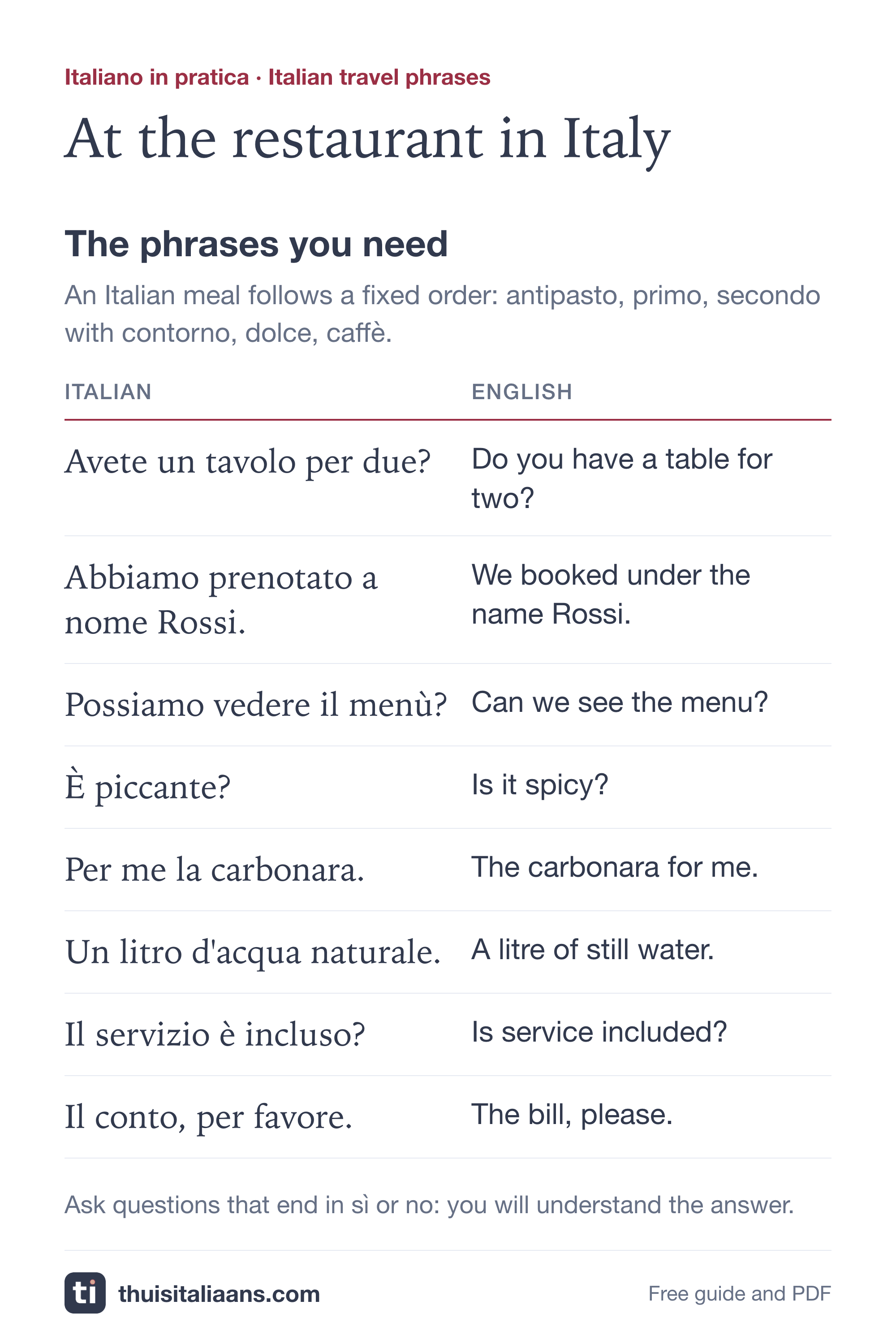 Italian phrases: At the restaurant in Italy
No, it's expected. Waiters don't bring the bill until you ask, because bringing it unasked would feel like rushing you. Say «Il conto, per favore».
No. Ordering one course each, or sharing a starter and having a main, is normal. The full sequence is for long Sunday lunches and special occasions.
It is the cover charge, il coperto: a per-person fee for bread and the table setting. It must be stated on the menu.
Tipping is not compulsory. If «servizio» is already on the bill, you don't need to add more; otherwise rounding up or leaving a few euros is a kind gesture.
«Pagare alla romana» means splitting the bill equally among everyone at the table.