

Grammar · B1
The present conditional
by Alessio · teacher of Italian as a foreign language, ITALS master’s

The conditional is politeness turned into grammar: vorrei un appuntamento sounds soft where voglio sounds blunt. It is used to ask, advise, wish and hypothesise, and its stems are the same as the future’s.
- 5min reading
- 15min exercises
- B1level
What you learn
- tu, lui / lei, noi, voi, loro
- When to use the present conditional
- The most common mistakes
- Vocabulary: dal medico
Italian and English side by side
English builds the conditional with would. Italian has its own endings: vorrei, partirei. Beyond politeness, Italian uses it for unconfirmed news: il treno arriverebbe alle otto is what English says with is said to arrive.
Take this page with you
This chapter’s sheet as a free printable PDF (tables in Italian): rules, typical mistakes and the quiz with answers. A teacher’s tip: grammar sticks by reviewing it often, not by studying it once.
The conditional does not sit on the line of what is real: it branches off. It says what would happen, not what does.


The words on this page
Drag each Italian word onto its definition, or tap a word first, then its box.
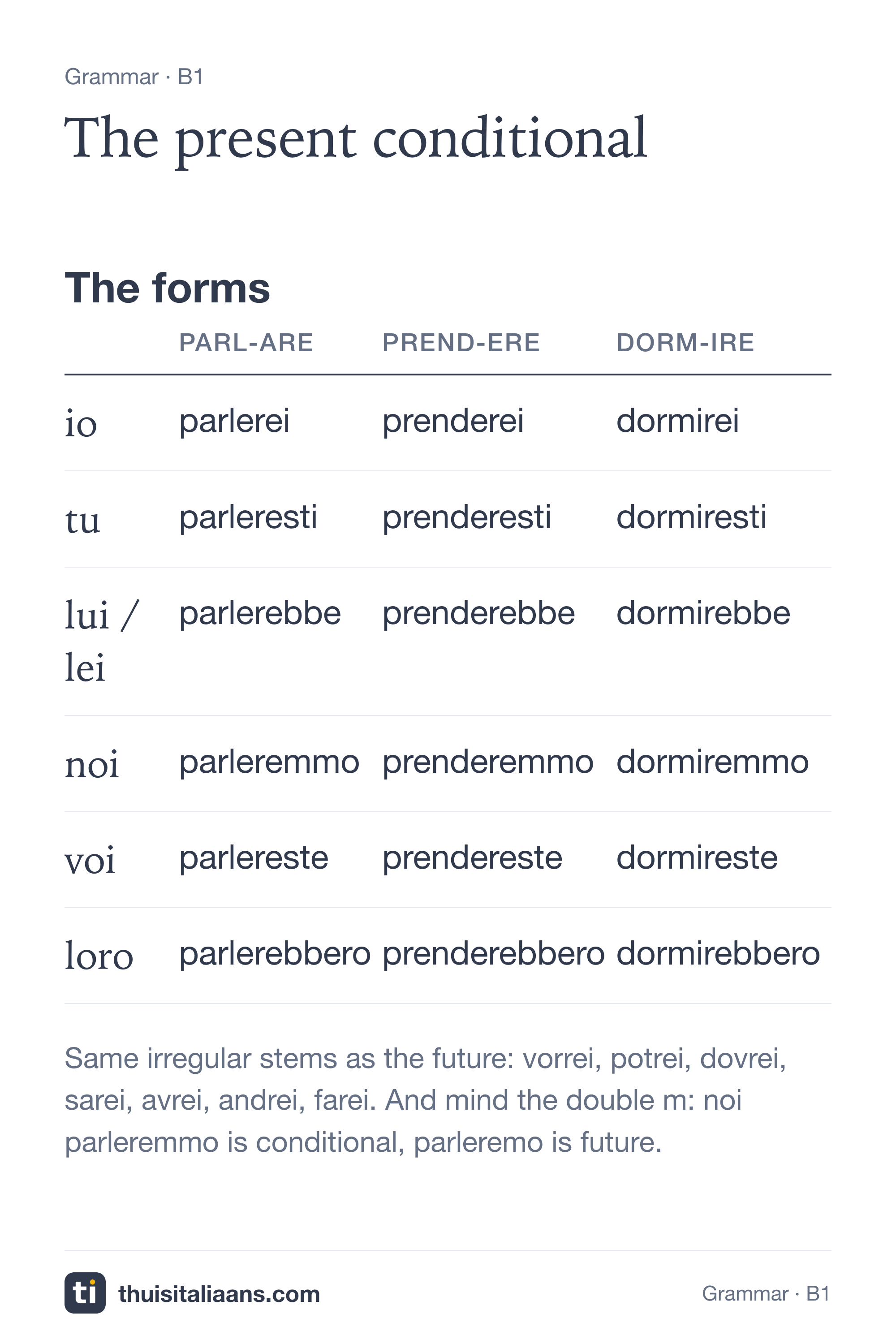
The forms
| parl-ARE | prend-ERE | dorm-IRE | |
|---|---|---|---|
| io | parlerei | prenderei | dormirei |
| tu | parleresti | prenderesti | dormiresti |
| lui / lei | parlerebbe | prenderebbe | dormirebbe |
| noi | parleremmo | prenderemmo | dormiremmo |
| voi | parlereste | prendereste | dormireste |
| loro | parlerebbero | prenderebbero | dormirebbero |
The four jobs
| Use | At the doctor’s |
|---|---|
| chiedere con cortesia | vorrei prenotare una visita, potrebbe ricevermi domani? |
| consigliare | dovresti riposare, al posto suo farei le analisi |
| desiderare | mi piacerebbe dormire una notte intera |
| notizia non confermata | il nuovo farmaco sarebbe già disponibile |
The most common mistakes
voglio un appuntamento per domani→ vorrei un appuntamento: polite requests use the conditionalpotevi darmi qualcosa per il mal di testa? (al medico, ora)→ potrebbe darmi qualcosa? (present request: conditional, and with Lei)noi prenderemo volentieri un consiglio, se possibile→ prenderemmo volentieri: the polite hypothesis needs the double m
Did you know?
Read and understand
This chapter’s grammar. Example: a chat about a concert.
online
Questions
Perché l'amico non può dire subito di sì?
Che cosa offre Davide, oltre al biglietto?
«Mi piacerebbe, ma…»: qui il condizionale serve a…
Completa la richiesta gentile: «___ chiudere la finestra?» (tu, potere).
Exercises
Five exercises in order of difficulty. The last ones bring back what you have already seen.
01 Le forme
Complete with the present conditional.
- io (parlare)
- tu (prendere)
- lei (finire)
- noi (lavorare)
- voi (scrivere)
- loro (partire)
02 Gli irregolari
They are the same as the future. Complete.
- io (essere)
- tu (avere)
- lui (fare)
- noi (andare)
- voi (venire)
- loro (potere)
- io (volere)
- tu (dovere)
03 Chiedere con garbo
Rewrite the request in the conditional, more politely.
- Mi dai una mano? →
- Voglio un caffè. →
- Puoi aprire la finestra? →
- Mi presti la macchina? →
- Devi parlargli. →
- Ci accompagni tu? →
04 Desiderio, consiglio, notizia incerta
Write D (wish), C (advice) or N (unconfirmed news).
- Mi piacerebbe vivere in Italia. →
- Dovresti dormire di più. →
- Secondo il giornale, il treno arriverebbe alle otto. →
- Vorrei cambiare lavoro. →
- Al posto tuo non lo farei. →
- L’azienda assumerebbe cento persone. →
05 La mail al proprietario
Complete with the conditional and the right tenses.
Review A2: futuro semplice · pronomi indiretti
- Buongiorno, (io / volere) chiederLe una cosa.
- (Lei / potere) dirmi quando arriva il tecnico?
- (noi / avere) bisogno di riparare il riscaldamento prima dell’inverno.
- Se possibile, (io / preferire) un appuntamento di mattina.
- (Lei / essere) così gentile da confermarmi la data?
- La (io / ringraziare) molto. Cordiali saluti.
These five are a taste. There are over seven hundred on the site, free and with no sign-up. All the exercises →

Every topic, a world
In the  amo Italian app, grammar is practised inside thematic pathways with field-specific vocabulary: il bar, i trasporti, il calcio, la moda, la burocrazia and seventeen more. Choose your world and the grammar comes along by itself, explained in your language too.
Half the path free, no sign-up
★★★★★(11)by Alessio, teacher since 2018
Downloadamo Italian for iPhone ↗︎Search for amo Italian
Read and understand
This chapter’s grammar. Example: an email to a residence.
Vorrei qualche informazione per settembre
daTomas Berg <t.berg@mail.nl>
ainfo@residenzagiardino.it
datamer 2 lug, 10:15
Gentile direzione,
vorrei prenotare un bilocale per tutto settembre, per me e mia moglie. Sarebbe possibile avere un piano alto?
Avremmo bisogno anche di un posto auto coperto: la macchina è nuova e mia moglie non me lo perdonerebbe mai.
Potreste indicarmi il prezzo finale, pulizie incluse? E sapreste dirmi se a settembre la piscina è ancora aperta?
Un'ultima cosa: ci piacerebbe portare il nostro gatto. È anziano e dormirebbe tutto il giorno, garantito.
Cordiali saluti,
Tomas Berg
Questions
Per quanto tempo vorrebbe prenotare?
Come descrive il suo gatto?
«Potreste indicarmi il prezzo?»: perché il condizionale e non «potete»?
Completa: «Al posto tuo io non ___ quella casa» (comprare).
Want another text on this topic? Booking a doctor's appointment · The weekly horoscope
One more go
Put into the conditional:
- Buongiorno, prenotare una visita.
- Dottore, prescrivermi qualcosa di leggero?
- Al posto tuo subito le analisi.
- Mi dormire otto ore, una volta tanto.
- (Noi) tutti camminare di più.
Frequently asked questions
Why do newspapers say il ministro sarebbe pronto a dimettersi?
It is the conditional of reported, unverified information: “the minister is allegedly ready to resign”. Italian journalism uses it to mark claims the writer has not confirmed: one tense does the work of “reportedly, apparently, sources say”. Extremely useful for reading the news critically.
How do I translate the English habitual “would”, as in “we would play for hours”?
Not with the conditional: that “would” is a past habit, so Italian wants the imperfetto: da bambini giocavamo per ore. The conditional only covers the hypothetical “would”: giocherei, se avessi tempo. Two English “would”s, two different Italian tenses.
How do I give advice with the conditional?
The kit: dovresti + infinitive (dovresti riposarti), potresti for suggestions (potresti provare così), and the classic openers al posto tuo… and io farei… (al posto tuo accetterei). Advice in the conditional proposes; advice in the imperative commands.
 The forms