

Grammar · A2
Reflexive verbs
by Alessio · teacher of Italian as a foreign language, ITALS master’s

In reflexive verbs the action comes back to the doer: mi alzo, ti riposi, si diverte. The pronoun changes with the person, goes before the verb, and in the past the auxiliary is always essere.
- 5min reading
- 16min exercises
- A2level
What you learn
- tu, lui / lei, noi, voi, loro
- When to use reflexive verbs
- The most common mistakes
- Vocabulary: la routine e il tempo libero
Italian and English side by side
English marks reflexives with -self and often drops them: I wash, I get up. Italian marks them with a pronoun that moves before the verb (mi lavo, mi alzo) and in the past always takes essere, with the participle agreeing: si è alzata.
Take this page with you
This chapter’s sheet as a free printable PDF (tables in Italian): rules, typical mistakes and the quiz with answers. A teacher’s tip: grammar sticks by reviewing it often, not by studying it once.


The words on this page
Drag each Italian word onto its definition, or tap a word first, then its box.
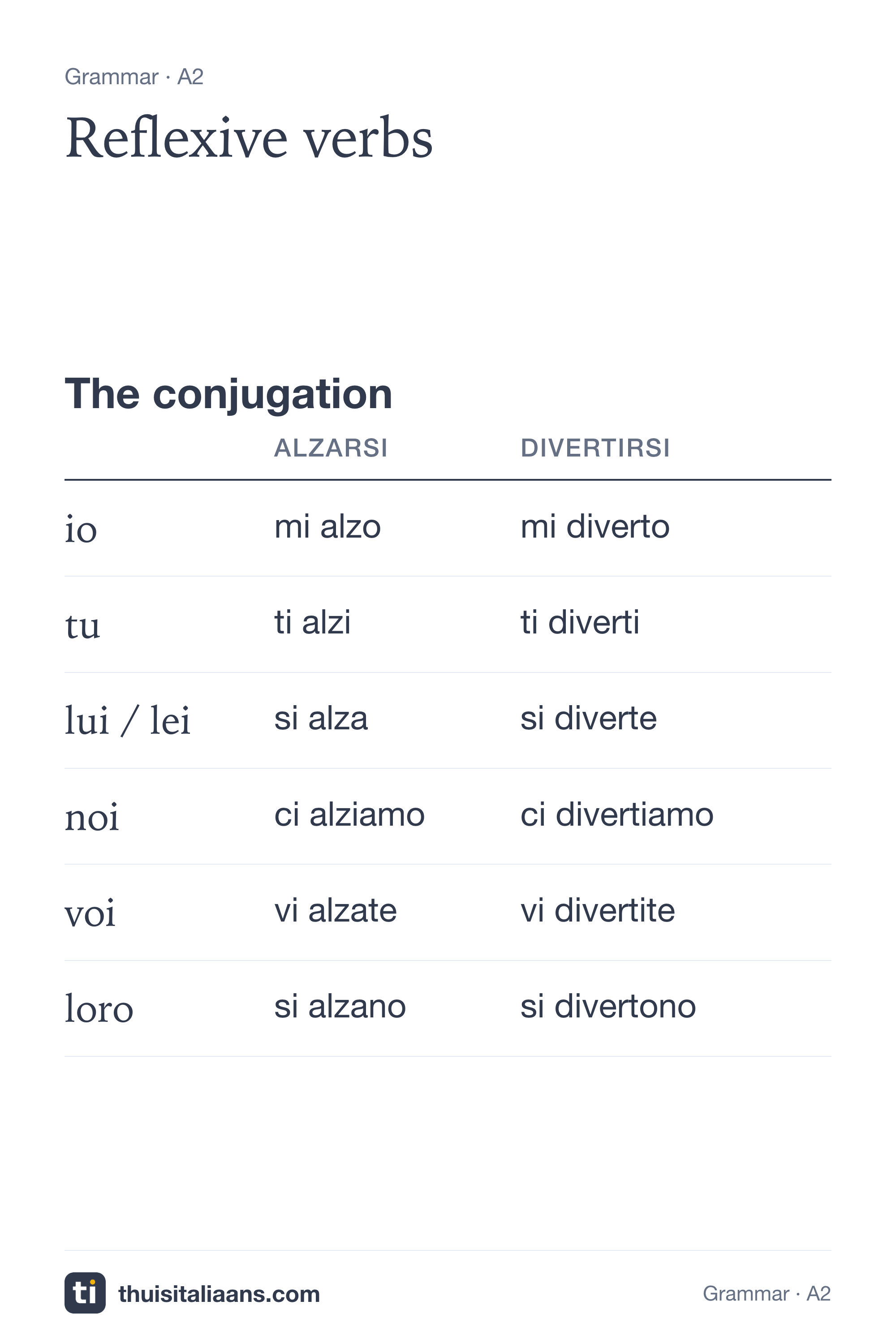
The conjugation
| alzarsi | divertirsi | |
|---|---|---|
| io | mi alzo | mi diverto |
| tu | ti alzi | ti diverti |
| lui / lei | si alza | si diverte |
| noi | ci alziamo | ci divertiamo |
| voi | vi alzate | vi divertite |
| loro | si alzano | si divertono |
Free-time reflexives
| Verb | Example |
|---|---|
| rilassarsi | il sabato mi rilasso al parco |
| divertirsi | ci divertiamo un mondo alle feste |
| riposarsi | la domenica ci si riposa |
| allenarsi | mi alleno tre volte a settimana |
| incontrarsi | ci incontriamo in piazza alle sei |
The most common mistakes
io alzo alle sette→ mi alzo alle sette (alzarsi needs its pronoun)ci abbiamo divertito molto→ ci siamo divertiti molto (reflexives take essere)Anna si è allenato→ Anna si è allenata (feminine agreement)
Did you know?
Read and understand
This chapter’s grammar. Example: a commuter's email.
La mia nuova vita da pendolare
daChiara Bellini <chiara.bellini@mail.it>
asofie@mail.nl
datalun 6 ott, 21:32
Cara Sofie,
il lavoro nuovo è bello, la sveglia no: mi alzo alle sei, mi preparo in mezz'ora e prendo il treno delle sette.
In ufficio ci troviamo bene, i colleghi sono simpatici. A pranzo ci vediamo al parco, quando non piove.
La sera mi addormento sul divano davanti alla tv, lo ammetto. Il weekend però mi riposo e mi diverto: sabato concerto!
E tu? Come ti trovi nella casa nuova?
Un abbraccio,
Chiara
Questions
A che ora si alza Chiara?
Dove si vedono i colleghi a pranzo?
«Mi alzo», «ti trovi», «ci vediamo»: la piccola parola cambia perché…
Completa: «La sera Marco ___ presto» (addormentarsi).

Exercises
Five exercises in order of difficulty. The last ones bring back what you have already seen.
01 Le forme
Complete with the reflexive present.
- io (svegliarsi)
- tu (alzarsi)
- lui (lavarsi)
- noi (vestirsi)
- voi (chiamarsi)
- loro (riposarsi)
02 La giornata
Complete with the reflexives in the present.
- (io / svegliarsi) alle sette.
- Poi (alzarsi) e (farsi) la doccia.
- Mia sorella (truccarsi) per mezz’ora.
- (noi / prepararsi) insieme.
- La sera (io / addormentarsi) presto.
- E tu, a che ora (alzarsi) ?
03 Al passato: sempre essere
The participle agrees with the subject. Complete.
- Anna (svegliarsi) tardi.
- (noi / divertirsi) molto.
- I bambini (addormentarsi) subito.
- (tu, Sara) (arrabbiarsi) ?
- (io) (dimenticarsi) le chiavi.
- Le ragazze (vestirsi) in fretta.
04 Riflessivo o no?
The meaning changes: choose the right form.
- (io) lavo la macchina.
- (io) lavo le mani.
- La mamma sveglia i bambini.
- La mamma sveglia alle sei.
- chiamo un taxi.
- chiamo Marco. (il mio nome)
05 Una domenica
Complete with reflexives, auxiliaries and pronouns.
Review passato prossimo · pronomi diretti
- Domenica (noi / alzarsi) tardi.
- (io / farsi) un caffè e ho bevuto sul balcone.
- Poi (noi / prepararsi) e (uscire) .
- (noi / incontrare) Marco: abbiamo salutato da lontano.
- La sera (i bambini / addormentarsi) sul divano.
- (noi / divertirsi) senza fare niente di speciale.
These five are a taste. There are over seven hundred on the site, free and with no sign-up. All the exercises →

Every topic, a world
In the  amo Italian app, grammar is practised inside thematic pathways with field-specific vocabulary: il bar, i trasporti, il calcio, la moda, la burocrazia and seventeen more. Choose your world and the grammar comes along by itself, explained in your language too.
Half the path free, no sign-up
★★★★★(11)by Alessio, teacher since 2018
Downloadamo Italian for iPhone ↗︎Search for amo Italian

Read and understand
This chapter’s grammar. Example: a gym advert.
Sport e benessere
Ti alzi già stanco?
Se la mattina ti svegli senza energia e la sera ti addormenti sul divano, non serve un altro caffè: serve movimento.
Da Onda ti alleni in gruppi piccoli, con calma. I nostri soci si conoscono tutti per nome.
Il corso delle sette è per chi lavora: ti cambi, quaranta minuti di lezione, doccia, e alle otto e mezza sei in ufficio.
Vieni sabato: ci presentiamo, provi una lezione e poi ti decidi con tutta la calma del mondo.
Palestra Onda · via Roma 8 · prova gratuita
Questions
Per chi è pensato il corso delle sette?
Che cosa si può fare sabato?
«I nostri soci si conoscono tutti per nome»: qui «si» significa…
Completa: «Domenica noi ___ tardi» (svegliarsi).
Want another text on this topic? A baker's day
One more go
Conjugate the reflexive:
- La domenica (io) tardi.
- A che ora al parco?
- Ieri sera (noi) tantissimo.
- Mia sorella in piscina.
- Dopo il lavoro voglio un po'.
Frequently asked questions
How do I say “we see each other”?
With the same pronouns, in reciprocal mode: ci vediamo domani (see you tomorrow), vi conoscete? (do you know each other?), si amano. In the plural, context tells you whether the action is mirrored (each other) or truly reflexive (themselves).
Which verbs are reflexive in Italian but not in English?
Many everyday ones: svegliarsi (wake up), ricordarsi (remember), sentirsi (feel), fermarsi (stop), laurearsi (graduate), sposarsi (get married). Learn them with their pronoun as complete words: the dictionary form already ends in -si.
Why mi lavo le mani and not lavo le mie mani?
With body parts and clothes, the reflexive pronoun already says whose they are, so the possessive would be redundant: mi lavo le mani, si mette la giacca, ti sei tagliato i capelli. It is one of the clearest signals of natural Italian.
 The conjugation