

Grammar · A1
Subject pronouns
by Alessio · teacher of Italian as a foreign language, ITALS master’s

In Italian the verb already tells you who is speaking: parlo can only be io. That is why subject pronouns are often dropped, and using them constantly sounds odd: you add them for clarity or emphasis.
- 5min reading
- 17min exercises
- A1level
What you learn
- 1a sing., 2a sing., 3a sing., 1a plur., 2a plur., 3a plur.
- When to use subject pronouns
- The most common mistakes
- Vocabulary: gli italiani famosi
Italian and English side by side
English cannot drop the subject: you must say I speak. Italian normally does drop it, because the verb ending already carries the person: parlo can only be I speak. Using io in every sentence is not wrong, but it sounds insistent, as if you were contrasting yourself with someone else. Keep the pronoun for emphasis: io pago, tu offri il prossimo.
Take this page with you
This chapter’s sheet as a free printable PDF (tables in Italian): rules, typical mistakes and the quiz with answers. A teacher’s tip: grammar sticks by reviewing it often, not by studying it once.


The words on this page
Drag each Italian word onto its definition, or tap a word first, then its box.
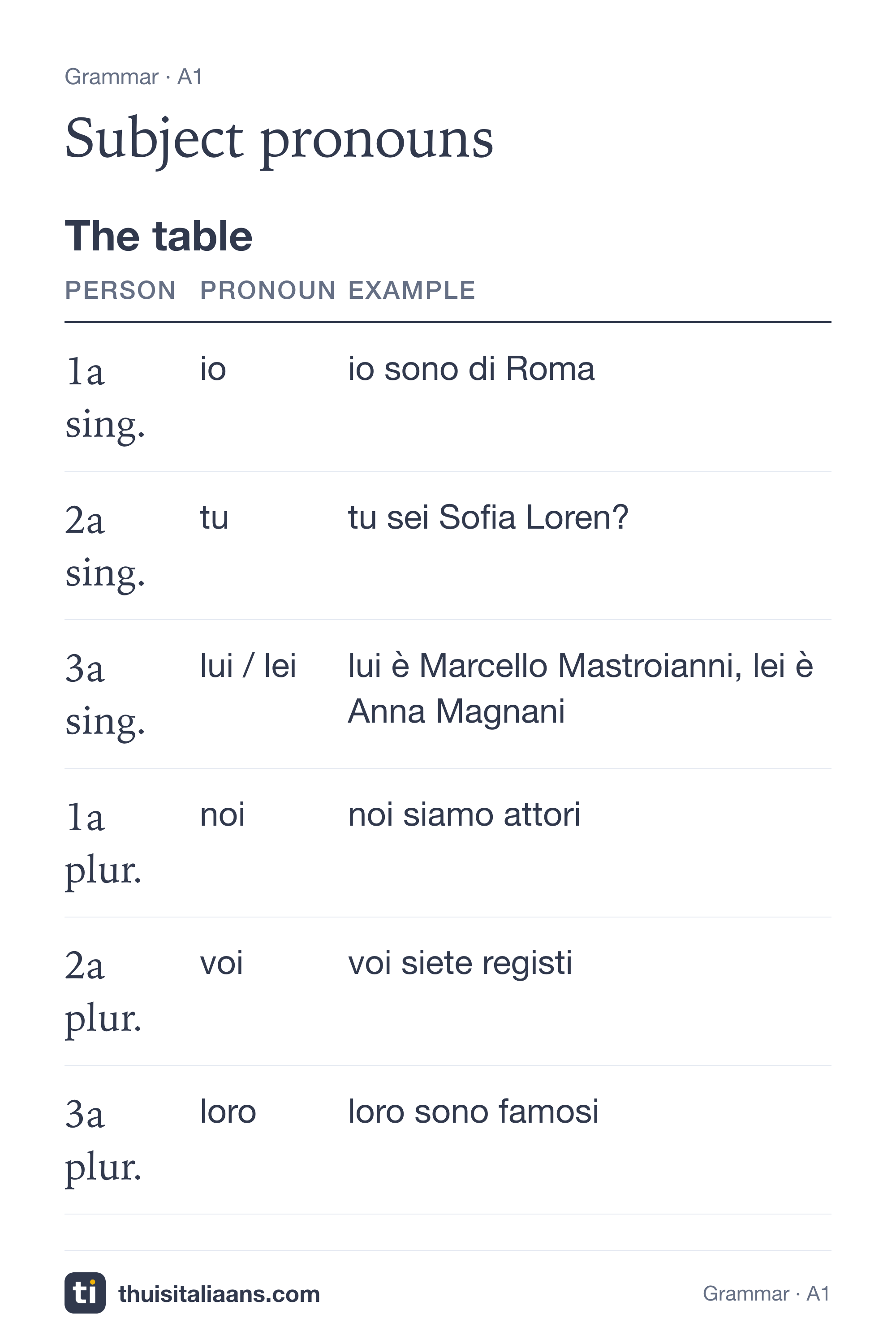
The table
| Person | Pronoun | Example |
|---|---|---|
| 1a sing. | io | io sono di Roma |
| 2a sing. | tu | tu sei Sofia Loren? |
| 3a sing. | lui / lei | lui è Marcello Mastroianni, lei è Anna Magnani |
| 1a plur. | noi | noi siamo attori |
| 2a plur. | voi | voi siete registi |
| 3a plur. | loro | loro sono famosi |
When to use them
| Case | Example |
|---|---|
| Contrasto | io prendo il caffè, lui il tè |
| Enfasi | l’ha detto lei, non io |
| Dopo anche / neanche | anche noi amiamo Fellini |
| Da soli, senza verbo | Chi è stato? Io. |
The most common mistakes
io parlo, io mangio, io vado ogni frase→ in Italian the pronoun is dropped: parlo, mangio, vadoLui è venuto? (parlando col dottore)→ Lei è venuto?, formal address uses the third person
Did you know?
Read and understand
This chapter’s grammar. Example: a museum website.
Tre vite italiane
Lui è Guglielmo Marconi, bolognese. Lui inventa la radio a vent'anni.
Lei è Grazia Deledda, sarda: lei vince il Nobel nel 1926.
Loro sono i fratelli Lumière? No, loro sono francesi.
E tu? Noi raccontiamo, tu ascolti: la sala è al primo piano.
Questions
Chi vince il premio Nobel?
Perché in italiano si può dire solo «inventa», senza «lui»?
Quando si mette «lui» o «lei» davanti al verbo?

Exercises
Five exercises in order of difficulty. The last ones bring back what you have already seen.
01 Chi è?
Replace the name with the subject pronoun.
- Marco →
- Anna →
- Marco e Anna →
- tu e Sara →
- io e Marco →
- le mie amiche →
02 Tu o Lei?
Choose the right form for each situation.
- Parli con un amico al bar: (tu / Lei) →
- Parli con il medico: (tu / Lei) →
- Parli con un bambino: (tu / Lei) →
- Scrivi un’email a un professore: (tu / Lei) →
- Parli con due colleghi giovani: (voi / Loro) →
- Parli con la signora del negozio: (tu / Lei) →
03 Serve o non serve?
In Italian the pronoun is often dropped. Write sì if it is worth keeping (contrast, clarity), no if it is better left out.
- sono italiano, e tu?
- mangio una pizza.
- Io lavoro, studia.
- abitiamo a Roma.
- Chi paga? !
- parlano italiano molto bene.
04 Persona giusta
Complete with the pronoun that matches the verb form.
- parliamo italiano.
- parlate inglese?
- parlano spagnolo.
- parlo francese.
- parli tedesco?
- parla arabo.
05 Presentazioni
Complete the dialogue with the right pronouns, articles and adjectives.
Review articoli · aggettivi
- — Ciao! sono Marta. E ?
- — sono Kim. Sono corean.
- — Queste sono Lena e Ana: sono spagnol.
- — E due, siete studenti?
- — Sì, studiamo italiano.
- — Il signor Rossi? è nostro professore.
These five are a taste. There are over seven hundred on the site, free and with no sign-up. All the exercises →

Every topic, a world
In the  amo Italian app, grammar is practised inside thematic pathways with field-specific vocabulary: il bar, i trasporti, il calcio, la moda, la burocrazia and seventeen more. Choose your world and the grammar comes along by itself, explained in your language too.
Half the path free, no sign-up
★★★★★(11)by Alessio, teacher since 2018
Downloadamo Italian for iPhone ↗︎Search for amo Italian

Read and understand
This chapter’s grammar. Example: an article on two famous Italians.
Il Corriere del Quartiere
venerdì 15 marzo · pagina 3
Storie
Lei vinse il Nobel, lui inventò la radio
di Paola Renzi
Lei è Grazia Deledda, di Nuoro. Lei scrisse trenta romanzi.
Lui è Guglielmo Marconi, di Bologna. Aveva vent'anni quando cominciò.
Loro due non si conobbero mai, ma noi li leggiamo e li ascoltiamo ancora.
E tu, quale dei due conoscevi già?
Questions
Quanti romanzi scrisse Grazia Deledda?
«Aveva vent'anni quando cominciò»: chi cominciò?
Completa: «___ sono i miei amici. ___ abitano a Pisa».
Want another text on this topic? A school's «about us» page · Introducing yourself
One more go
Is the pronoun needed? Choose:
- amo i film di Sophia Loren.
- Chi ha scelto il ristorante? , come sempre.
- prendo la pizza, la pasta: gusti diversi.
- Scusi, è il professor Rossi?
Frequently asked questions
When do I use tu and when Lei?
Tu with family, friends, children, and generally among younger people; Lei with strangers, in shops and offices, and with anyone older or in a professional role. When in doubt, start with Lei: the other person will offer the switch with diamoci del tu.
My textbook has egli and ella: do people say that?
No: egli, ella, esso, essa belong to literary and bureaucratic writing. Spoken and normal written Italian uses lui, lei, loro as subjects: lui arriva domani. You should recognise egli in old books, not produce it.
Is voi ever used as a polite form?
As a plural, voi is simply “you all”, always correct. As a polite singular it survives in parts of the South and in old-fashioned commercial letters, but the modern standard for formal address is Lei.
 The table