

Grammar · A1
Negation and questions
by Alessio · teacher of Italian as a foreign language, ITALS master’s

Italian negation is a single word: non, always before the verb. And the simplest question does not even change word order: intonation is enough. Prendi un caffè?
- 5min reading
- 20min exercises
- A1level
What you learn
- non + verbo, non… mai, non… niente / nessuno, non… più
- When to use negation and questions
- The most common mistakes
- Vocabulary: il bancone del bar
Italian and English side by side
Two English rules disappear. To negate, put non before the verb and nothing else: non parlo, with no do and no doesn't. And Italian keeps the double negative that English forbids: non ho visto nessuno, literally I haven't seen nobody, is the correct form. Questions need no inversion either: same word order, just a rising voice and a question mark.
Take this page with you
This chapter’s sheet as a free printable PDF (tables in Italian): rules, typical mistakes and the quiz with answers. A teacher’s tip: grammar sticks by reviewing it often, not by studying it once.


The words on this page
Drag each Italian word onto its definition, or tap a word first, then its box.
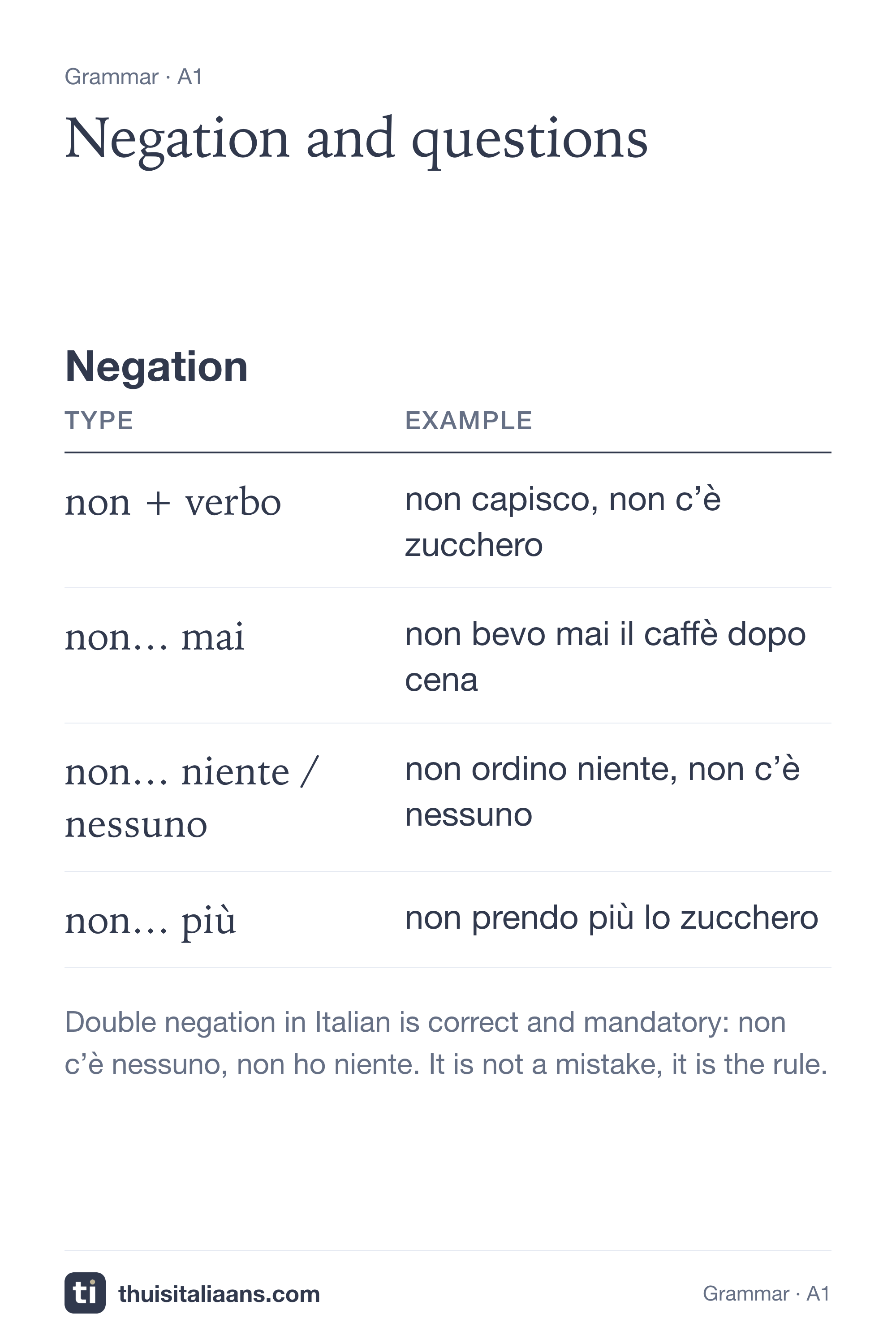
Negation
| Type | Example |
|---|---|
| non + verbo | non capisco, non c’è zucchero |
| non… mai | non bevo mai il caffè dopo cena |
| non… niente / nessuno | non ordino niente, non c’è nessuno |
| non… più | non prendo più lo zucchero |
Question words
| Word | Bar example |
|---|---|
| chi | chi paga oggi? |
| che cosa / cosa | che cosa prendi? |
| dove | dove sono i tavolini? |
| quando | quando chiudete? |
| perché | perché il gelato qui è così buono? |
| come | come si dice «flat white» in italiano? |
| quanto / quanti | quanto costa? quanti cornetti avete? |
The most common mistakes
io no capisco→ non capisco (negation is non, before the verb)c’è non zucchero→ non c’è zucchero (non goes before the verb)cosa tu prendi?→ cosa prendi? (no inversion: the question word is enough)
Did you know?
Read and understand
This chapter’s grammar. Example: a post-it on the fridge.
Per il turno di domani:
Non c'è più niente nel frigo del bar.
Non abbiamo nessun cornetto: chiama il forno!
Il caffè lo prendi amaro, vero?
Non aprire prima delle sette!
A domani ♥
Questions
Com'è il frigo del bar?
«Vero?» alla fine della frase serve a…
«Non c'è niente» ha due parole negative. È corretto?

Exercises
Five exercises in order of difficulty. The last ones bring back what you have already seen.
01 Metti il non
Turn into the negative.
- Parlo tedesco. →
- Marco è a casa. →
- Abbiamo tempo. →
- Vengono domani. →
- C’è il pane. →
- Sono le tre. →
02 Due negazioni sono giuste
In Italian non stays even with niente, nessuno, mai. Complete.
- mangio . (zero cose)
- c’è in casa. (zero persone)
- vado al cinema. (zero volte)
- ho tempo. (zero volte)
- conosco qui. (zero persone)
- capisco . (zero cose)
03 Fai la domanda sì/no
In Italian the word order does not change: the question mark is enough. Transform.
- Parli italiano. →
- Marco è a casa. →
- Avete fame. →
- C’è un problema. →
- Vieni con noi. →
- Il treno parte alle otto. →
04 La parola giusta per chiedere
Complete with chi, che cosa, dove, quando, come, perché, quanto.
- è quella ragazza? · È mia sorella.
- fai stasera? · Niente di speciale.
- abiti? · A Torino.
- parte il treno? · Alle otto.
- stai? · Bene, grazie.
- studi italiano? · Perché mi piace.
- costa? · Dodici euro.
05 Al telefono
Complete the dialogue: questions, negatives, verbs, articles, times. This is the whole A1 in one go.
Review tutto l’A1
- — Pronto, parla?
- — Sono Elena. (tu / essere) a casa?
- — No, (io / essere) a casa: in ufficio.
- — (tu / finire) di lavorare?
- — 18:00. Ma stasera (io / avere) tempo: ho lezione.
- — Va bene. Allora ci vediamo sabato: (esserci) una festa Marta.
These five are a taste. There are over seven hundred on the site, free and with no sign-up. All the exercises →

Every topic, a world
In the  amo Italian app, grammar is practised inside thematic pathways with field-specific vocabulary: il bar, i trasporti, il calcio, la moda, la burocrazia and seventeen more. Choose your world and the grammar comes along by itself, explained in your language too.
Half the path free, no sign-up
★★★★★(11)by Alessio, teacher since 2018
Downloadamo Italian for iPhone ↗︎Search for amo Italian

Read and understand
This chapter’s grammar. Example: the café shifts chat.
3 partecipanti
Questions
Che cosa non ha ancora Luca?
«Non arriva nemmeno il fornaio»: «nemmeno» significa…
Completa: «Stamattina non vedo ___».
Want another text on this topic? A note on the fridge · The park sign
One more go
Negate or ask:
- prendo zucchero, grazie.
- costa un cornetto?
- Non c’è in fila: che fortuna.
- sono i bagni, per favore?
- Non bevo il cappuccino dopo pranzo.
Frequently asked questions
Do I need to change the word order to ask a question?
No: Italian has no inversion and no auxiliary like English “do”. Prendi un caffè? is statement word order with question intonation. If there is a subject, it often slides to the end: Viene anche Marco?
What is the difference between no and non?
No is the standalone answer: Vieni? — No. Non negates a verb and never stands alone: non vengo. English uses “no/not”; Italian splits the same jobs between no and non.
How do I answer a negative question like Non vieni?
Italian answers the fact, not the grammar: Sì, vengo (I am coming) or No, non vengo (I’m not). There is no trap like English “yes I am / no I’m not” agreement: say what is true and the answer is right.
 Negation