

Grammar · C1
Formal register
by Alessio · teacher of Italian as a foreign language, ITALS master’s

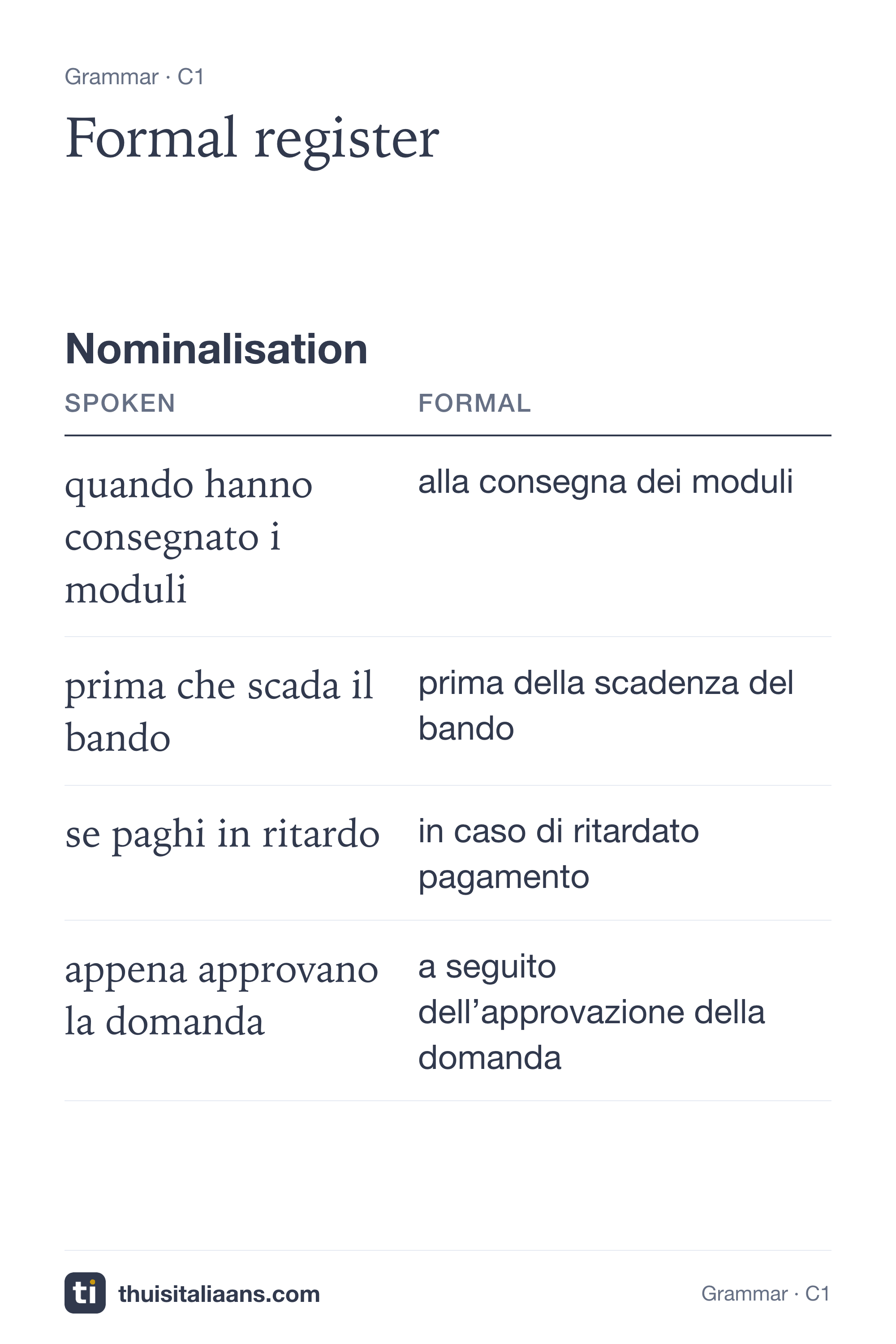
Formal Italian turns verbs into nouns: «hanno consegnato i documenti» becomes la consegna dei documenti. This mechanism powers official letters, calls and minutes: nominalisation, plus vocabulary that climbs one step (recarsi, effettuare, pervenire).
- 5min reading
- 15min exercises
- C1level
What you learn
- se paghi in ritardo
- When to use formal register
- Vocabulary that steps up
- Vocabulary: la burocrazia
Italian and English side by side
Formal English shortens: please confirm. Formal Italian lengthens and depersonalises: si prega di confermare, resto in attesa di un Suo riscontro. Translating an English business email word for word produces Italian that reads brusque, not efficient.
Take this page with you
This chapter’s sheet as a free printable PDF (tables in Italian): rules, typical mistakes and the quiz with answers. A teacher’s tip: grammar sticks by reviewing it often, not by studying it once.


The words on this page
Drag each Italian word onto its definition, or tap a word first, then its box.
Nominalisation
| Spoken | Formal |
|---|---|
| quando hanno consegnato i moduli | alla consegna dei moduli |
| prima che scada il bando | prima della scadenza del bando |
| se paghi in ritardo | in caso di ritardato pagamento |
| appena approvano la domanda | a seguito dell’approvazione della domanda |
Vocabulary that steps up
| Everyday | Formal | In a notice |
|---|---|---|
| andare | recarsi | recarsi allo sportello 5 |
| fare | effettuare | effettuare il versamento |
| arrivare | pervenire | le domande devono pervenire entro il 30 |
| dare | rilasciare | l’ufficio rilascia la ricevuta |
| chiedere | richiedere / istanza | presentare istanza di rinnovo |
The most common mistakes
vi scrivo per chiedervi se potete rinnovarmi il permesso→ scrivo per richiedere il rinnovo del permesso (nominalisation)dovete andare all’ufficio anagrafe→ è necessario recarsi all’ufficio anagrafe (vocabulary and impersonal)si procederà all’effettuazione del controllo del possesso dei requisiti→ si verificherà il possesso dei requisiti (formal, not bloated)
Did you know?
Exercises
Five exercises in order of difficulty. The last ones bring back what you have already seen.
01 Dal parlato allo scritto
Riscrivi in registro formale.
- Ti mando i documenti. →
- Ti scrivo per chiederti una cosa. →
- Scusa il ritardo. →
- Fammi sapere. →
- Ho bisogno di sapere quando. →
- Grazie mille. →
02 Le formule della lettera
Completa con la formula adatta.
- Dottoressa Rossi, (apertura formale)
- Con la presente comunicarLe che… (verbo)
- a disposizione per ogni chiarimento.
- saluti (chiusura neutra)
- osservanza (chiusura molto formale)
- In di un Suo riscontro, La ringrazio.
03 Il lessico si alza
Sostituisci la parola con il corrispondente formale.
- dare →
- chiedere →
- dire →
- finire →
- cominciare →
- mandare →
- parlare di →
04 Costruzioni impersonali
Il formale evita l’io. Riscrivi con si, passivo o forma impersonale.
- Abbiamo deciso di rinviare. →
- Vi comunichiamo la data. →
- Ho allegato il modulo. →
- Chiediamo di rispondere entro venerdì. →
- Abbiamo ricevuto la domanda. →
- Faremo sapere l’esito. →
05 La richiesta all’ufficio
Completa la lettera in registro formale. Attenzione alle maiuscole di cortesia.
Review forme implicite · B2: forma passiva
- Dottore,
- la presente per richiedere copia del certificato di residenza.
- Come da telefonici, allego la documentazione richiesta.
- pregarLa di confermarmi l’avvenuta ricezione.
- Resto a disposizione e ringrazio per la cortese attenzione.
- saluti,
These five are a taste. There are over seven hundred on the site, free and with no sign-up. All the exercises →

Every topic, a world
In the  amo Italian app, grammar is practised inside thematic pathways with field-specific vocabulary: il bar, i trasporti, il calcio, la moda, la burocrazia and seventeen more. Choose your world and the grammar comes along by itself, explained in your language too.
Half the path free, no sign-up
★★★★★(11)by Alessio, teacher since 2018
Downloadamo Italian for iPhone ↗︎Search for amo Italian
One more go
Step up the register:
- Le domande devono entro il 31 marzo.
- Per il ritiro è necessario personalmente allo sportello.
- smarrimento, presentare denuncia.
- L’ufficio l’attestato entro trenta giorni.
- Prima del contratto, inviare disdetta.
Frequently asked questions
Why the capital letters inside words, like informarLa?
It is the courtesy capital: in formal letters, all forms referring to the addressee may be capitalised, even glued inside a verb: La ringrazio, Le scrivo per informarLa. It is optional and fading, but still standard in business and institutional Italian: read it as a bow in the spelling.
Is Voi still used in formal writing?
To one person, barely: it survives in some commercial correspondence and traditional Southern usage. To a company as a collective, however, Voi is standard: Vi scriviamo in merito al Vostro preventivo. Individual = Lei, organisation = Voi: that pair covers modern practice.
How do I open and close a formal email today?
Openers, by rising formality: Gentile Dottoressa Bianchi, Egregio Avvocato, Spettabile Ditta (for companies). Closers: Cordiali saluti (neutral), Distinti saluti (colder, more formal), In attesa di un Suo riscontro, porgo cordiali saluti (complete ceremony). Matching opener and closer is half the register.
 Nominalisation