Italiano in pratica
by Alessio · teacher of Italian for foreigners, ITALS master’s in teaching Italian abroad (Ca’ Foscari University, Venice) and a master’s in teaching Italian as a second language (Giustino Fortunato University, Benevento)
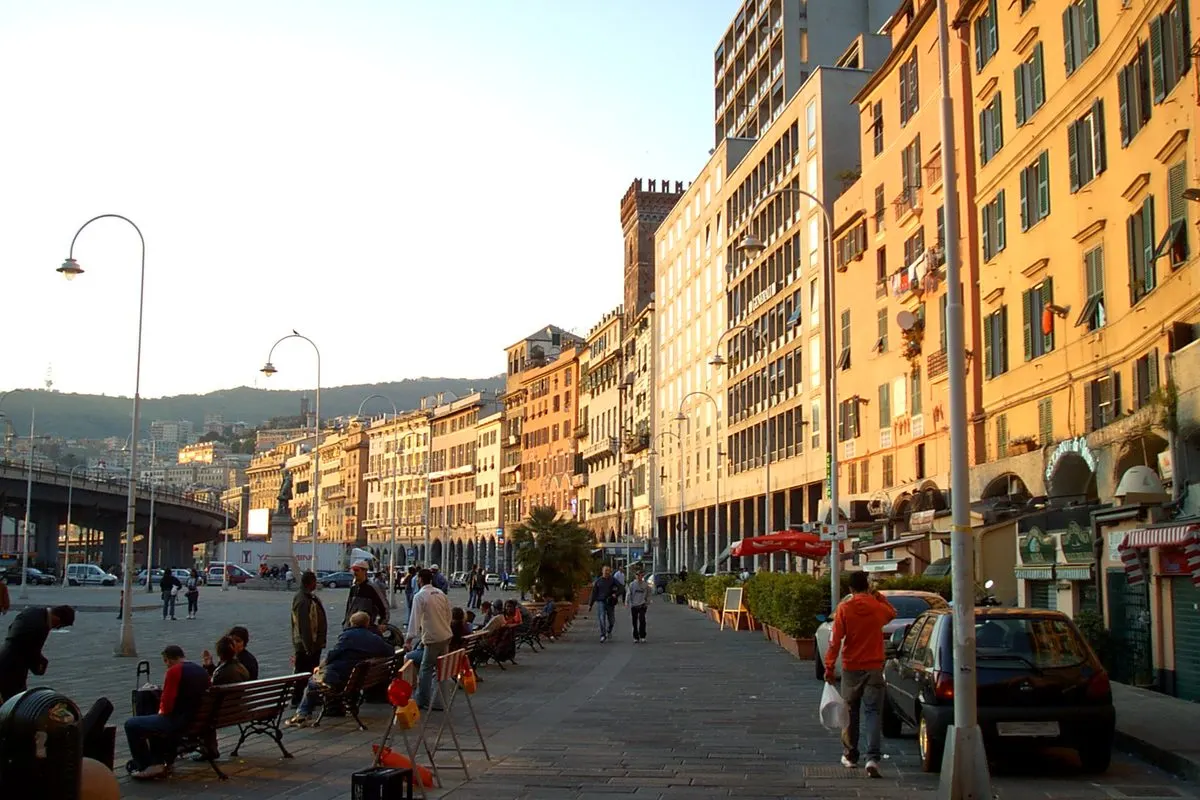
Italians chat easily: at the bar, at the bus stop, with the person next to you at the market. The safe topics are the weather, food, where you're from and the place you're visiting. Answer short, and send a closed question back: anche lei è di qui?
Someone at the counter says che caldo oggi! and looks at you. It's not a question, it's an invitation. Answer with three words and you're in a conversation; stay silent and you've missed one.
Here are the phrases for those two-minute chats, about the weather and everything else, with easy questions you can ask back. Most of them get a sì or a no.
| Italian | English |
|---|---|
| Che caldo oggi! | It's so hot today! |
| Fa freddo, eh? | It's cold, isn't it?answer: sì |
| Domani piove? | Is it going to rain tomorrow?answer: sì or no |
| Sono inglese, di Londra. | I'm English, from London. |
| È la prima volta che vengo qui. | It's my first time here. |
| Lei è di qui? | Are you from here?answer: sì or no |
| È bellissimo qui! | It's beautiful here! |
| Buona giornata! | Have a nice day!to end the chat |
Read the Italian out loud once before you need it. The questions marked sì or no get a one-word answer you can understand.
With fa plus an adjective, fa caldo, fa freddo, fa bel tempo, or with a verb: piove, it's raining, c'è il sole, it's sunny, c'è vento, it's windy. Exclamations start with che: che caldo!
To ask about tomorrow, a closed question: domani piove?, domani fa bello? The answer often comes with a shrug and a forecast app.
| You say | English |
|---|---|
| Che caldo oggi! | It's so hot today! |
| Fa freddo, eh? | It's cold, isn't it?sì |
| Piove da stamattina. | It's been raining since this morning. |
| Domani piove? | Is it going to rain tomorrow?sì or no |
| Che bella giornata! | What a beautiful day! |
| You hear | English |
|---|---|
| Che afa! | How muggy! |
| Dicono che domani cambia. | They say it'll change tomorrow. |
| Si sta bene oggi. | It's nice out today. |
Sono plus the nationality, sono inglese, sono americana, or sono di plus the city: sono di Londra. Then why: sono in vacanza, I'm on holiday, sono qui per lavoro, I'm here for work.
Expect a follow-up closed question: whether it's your first time in Italy, whether you like it. The answer to the second one is always sì.
| You say | English |
|---|---|
| Sono inglese, di Londra. | I'm English, from London. |
| Sono qui in vacanza. | I'm here on holiday. |
| È la prima volta che vengo qui. | It's my first time here. |
| Ci torno ogni anno. | I come back every year. |
| You hear | English |
|---|---|
| Di dov'è? | Where are you from? |
| È la prima volta in Italia? | Is it your first time in Italy?sì or no |
| Le piace l'Italia? | Do you like Italy?sì |
| Quanto si ferma? | How long are you staying? |
Compliment the food, the place and the town: si mangia benissimo qui, the food is great here, è bellissimo qui, it's beautiful here. Italians are proud of where they live, and these sentences open almost any conversation.
To a shopkeeper or a cook: complimenti! is a full sentence.
| You say | English |
|---|---|
| Si mangia benissimo qui! | The food is wonderful here! |
| È bellissimo qui! | It's beautiful here! |
| Complimenti! | Well done! Compliments! |
| Che bella città! | What a beautiful town! |
| You hear | English |
|---|---|
| Grazie, troppo gentile! | Thank you, you're too kind! |
| Deve assaggiare anche... | You must also try...a tip is coming |

In the  amo Italian app you practise inside real-life pathways: il bar, il ristorante, i trasporti, la casa and more, with listening, dialogues and the grammar explained in English. This page gives you the phrases; the app trains your ear.
Half the A1 course free, no sign-up
★★★★★(22)by Alessio, teacher since 2018
Downloadamo Italian for iPhone ↗︎Search for amo Italian
Send a closed question back. Lei è di qui?, are you from here?, è sempre così affollato?, is it always this crowded?, c'è qualcosa da vedere qui vicino?, is there anything to see nearby? Short answers are fine; interest is what counts.
Topics that work: food, the town, the weather, football if you dare. Topics to leave to later: politics and money.
| You say | English |
|---|---|
| Lei è di qui? | Are you from here?sì or no |
| È sempre così affollato? | Is it always this crowded?sì or no |
| C'è qualcosa da vedere qui vicino? | Is there anything to see nearby?sì or no |
| Mi consiglia un ristorante? | Can you recommend a restaurant? |
| You hear | English |
|---|---|
| Sì, sono nato qui. | Yes, I was born here. |
| D'estate sì, d'inverno no. | In summer yes, in winter no. |
| Deve andare a vedere... | You must go and see... |

With a wish: buona giornata, have a nice day, buona serata, have a nice evening, buona continuazione, enjoy the rest of your day. Add è stato un piacere, it was a pleasure, if you talked for a while.
The answer to all of these is altrettanto, same to you, or grazie, anche a lei.
| You say | English |
|---|---|
| Buona giornata! | Have a nice day! |
| Buona continuazione! | Enjoy the rest of your day! |
| È stato un piacere. | It was a pleasure. |
| You hear | English |
|---|---|
| Altrettanto! | Same to you! |
| Buona vacanza! | Enjoy your holiday! |
In much of northern Europe, and on the London Underground, you talk to strangers only when you must. In Italy short conversations with people you don't know are part of the day: at the bar counter, at the bus stop, in the queue at the market, in a waiting room. A comment about the heat or the late bus is an opening, and answering it costs nothing. Silence, on the other hand, can come across as cold, or as a sign that you are offended.

The sound of it can mislead you. Italians often speak loudly and over one another, and in a lively exchange two or three people talk at once. To an English, Scandinavian or Japanese ear a discussion about where to buy the best tomatoes can sound like a quarrel; to Italians it means everybody is interested. People also stand closer than in Britain or North America, touch an arm to make a point and talk with their hands. The best known gesture, the fingertips pinched together and shaken, means roughly «what on earth do you want?», and it became an emoji in 2020.
Questions come quickly that might feel personal at home: whether you are married, whether you have children, what you do for a living. It is curiosity, not nosiness, and a short answer with a question back is the natural reply. Food is the safest topic of all, and also the most heated: ask three Italians how to make a carbonara and you will get four answers. One small thing for when you count or order with your fingers: Italians start from the thumb, so a raised thumb and index finger means two.
Read next: How are Italian greetings different from greetings at home? · Why do Italians go out so late, and drink so little?
Italians rarely answer with a bare sì or no. These are the forms you will actually hear, so you know which way the answer went.
| You hear | English | It means |
|---|---|---|
| Sì, certo. | Yes, of course. | yes |
| Certo! | Sure! | yes |
| Come no! | Of course! (literally: how not?) | yes |
| Volentieri. | Gladly. | yes |
| Va bene. | Fine, OK. | yes |
| Prego. | Go ahead / please do. | yes |
| No, mi dispiace. | No, I'm sorry. | no |
| Purtroppo no. | Unfortunately not. | no |
| Non c'è. | There isn't any. | no |
| È finito. | It's sold out / all gone. | no |
| Non si può. | That's not allowed. | no |
| Non ancora. | Not yet. | no |
Six real replies. Tap Yes or No for each one.
The grammar behind them
All the phrases from this page on two printable pages, the yes/no questions included. Print it, or keep it on your phone for when you are there.
Or keep the eight phrases as an image, to save on your phone or pin:
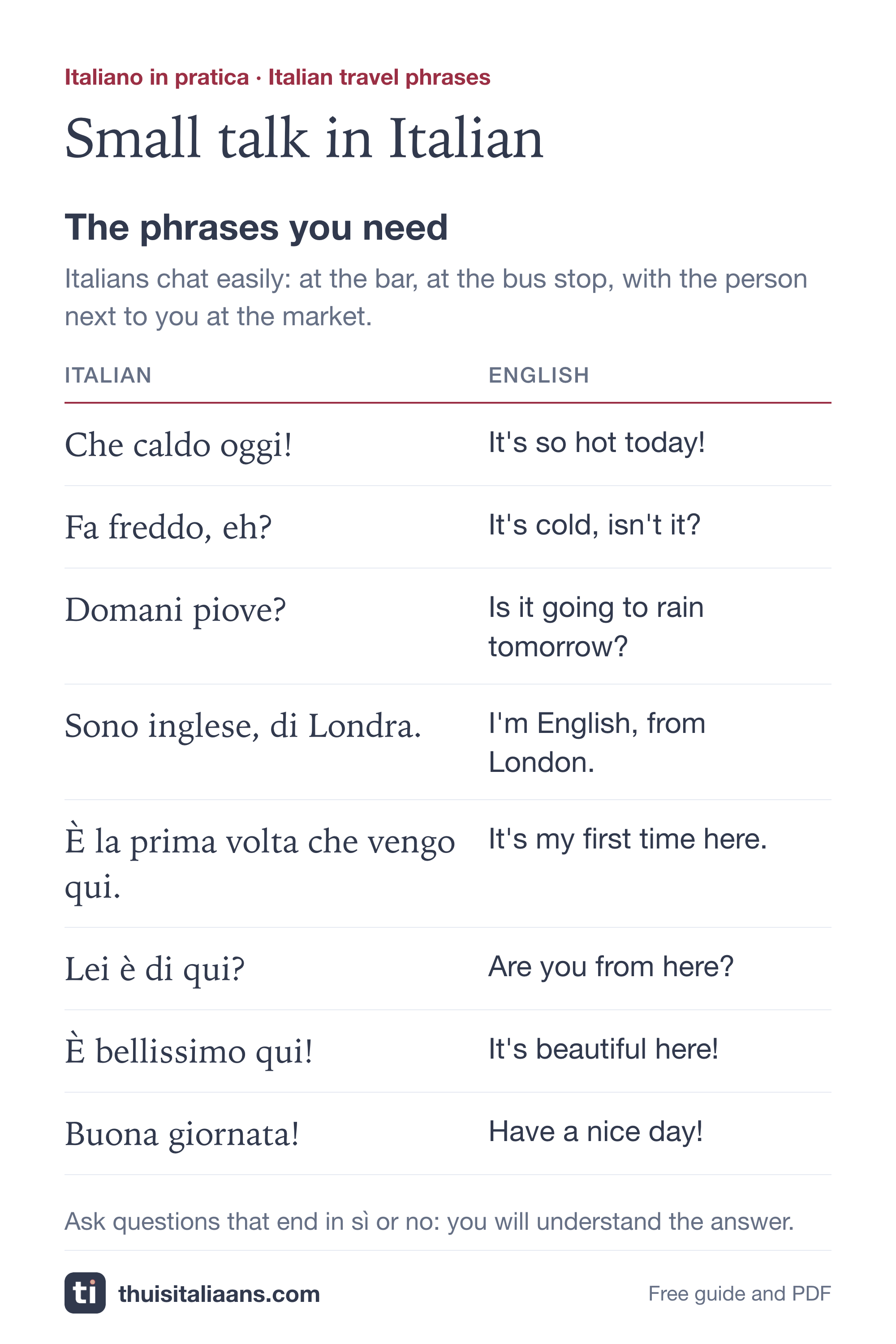 Italian phrases: Small talk in Italian
«Fa caldo». As an exclamation: «Che caldo!».
«Domani piove?». The present tense is normal for the near future.
The weather, food, the town you're in and where you come from. Politics and money are better left for later.
«Altrettanto!» (same to you) or «Grazie, anche a lei».