

Grammar · A1
The present tense
by Alessio · teacher of Italian as a foreign language, ITALS master’s

Three verb families, three sets of endings, and with the present tense you order, ask, pay, live. It is the tense that carries ninety percent of your first conversations.
- 5min reading
- 17min exercises
- A1level
What you learn
- tu, lui / lei, noi, voi, loro
- When to use the present tense
- The six irregulars you use every day
- Vocabulary: la colazione al bar
Italian and English side by side
English needs a helper for questions and negatives (do you speak?, I don't speak) and marks only the third person with -s. Italian marks all six persons with a different ending and needs no helper at all: parli?, non parlo. Also, one Italian present covers three English ones: lavoro is I work, I am working and I do work.
Take this page with you
This chapter’s sheet as a free printable PDF (tables in Italian): rules, typical mistakes and the quiz with answers. A teacher’s tip: grammar sticks by reviewing it often, not by studying it once.
The present tense covers what is happening now and what happens always.


The words on this page
Drag each Italian word onto its definition, or tap a word first, then its box.
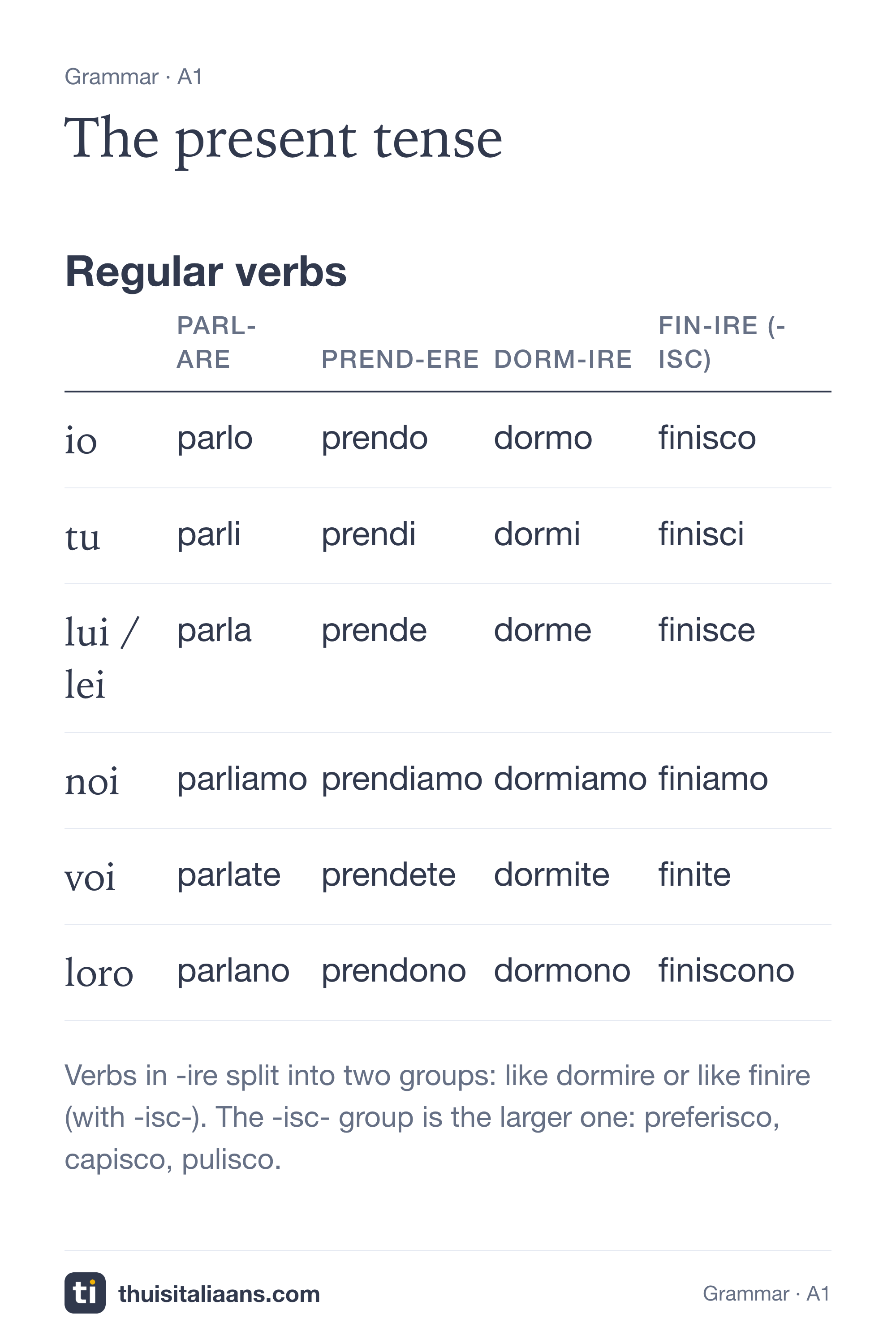
Regular verbs
| parl-ARE | prend-ERE | dorm-IRE | fin-IRE (-isc) | |
|---|---|---|---|---|
| io | parlo | prendo | dormo | finisco |
| tu | parli | prendi | dormi | finisci |
| lui / lei | parla | prende | dorme | finisce |
| noi | parliamo | prendiamo | dormiamo | finiamo |
| voi | parlate | prendete | dormite | finite |
| loro | parlano | prendono | dormono | finiscono |
The six irregulars you use every day
| Verb | Present | At the bar |
|---|---|---|
| essere | sono, sei, è, siamo, siete, sono | il caffè è pronto |
| avere | ho, hai, ha, abbiamo, avete, hanno | avete un tavolo fuori? |
| andare | vado, vai, va, andiamo, andate, vanno | vado al bancone |
| fare | faccio, fai, fa, facciamo, fate, fanno | faccio colazione qui |
| stare | sto, stai, sta, stiamo, state, stanno | come stai? |
| venire | vengo, vieni, viene, veniamo, venite, vengono | vieni al bar con me? |
The most common mistakes
tu parlare italiano?→ parli italiano? (the verb is always conjugated)noi preferimo il tè→ noi preferiamo il tè (preferire is an -isc verb, but not for noi/voi)loro fa colazione→ loro fanno colazione (third person plural)
Did you know?
Read and understand
This chapter’s grammar. Example: a postcard from Bologna.
Cara mamma,
ogni mattina entro nello stesso bar. Ordino un caffè, il barista mi chiede come va, io rispondo «bene» e lui ride.
Bevo in piedi come tutti: paghiamo alla cassa e usciamo in due minuti. Capisco quasi tutto, parlo ancora poco.
Domani parto per Firenze. Ti chiamo quando arrivo.
Un bacio, Sanne
ITALIANE
C.P.
Prinsengracht 44
1015 DK Amsterdam
Questions
Dove beve il caffè Sanne?
«Capisco» viene dal verbo…
«Domani parto» è al presente. Perché?

Exercises
Five exercises in order of difficulty. The last ones bring back what you have already seen.
01 I verbi in -are
Complete with the present tense.
- io (parlare)
- tu (lavorare)
- lui (mangiare)
- noi (abitare)
- voi (studiare)
- loro (comprare)
02 -ere e -ire
Complete with the present tense.
- io (prendere)
- tu (scrivere)
- lei (leggere)
- noi (dormire)
- voi (aprire)
- loro (vivere)
03 Quelli con -isc-
Finire, capire, preferire, pulire add -isc- in four persons out of six. Complete.
- io (capire)
- tu (finire)
- lui (preferire)
- noi (capire)
- voi (finire)
- loro (pulire)
04 Gli irregolari di tutti i giorni
Complete. These are the six verbs you will use most.
- io (andare) a casa.
- tu (fare) colazione?
- lei (venire) con noi.
- noi (stare) bene.
- voi (uscire) stasera?
- loro (dare) una mano.
- io (fare) il caffè.
05 Una giornata
Complete the text with the present tense. Mind the articles and the agreement too.
Review pronomi soggetto · articoli · aggettivi
- La mattina (io / svegliarsi tardi) e (fare) colazione.
- Poi (andare) in ufficio con metropolitana.
- Marta e Luca (lavorare) con me: (loro / essere) molto simpatic.
- All’una noi (mangiare) insieme.
- La sera (io / preferire) stare a casa: (leggere) un libro.
- E tu, cosa (fare) di solito?
These five are a taste. There are over seven hundred on the site, free and with no sign-up. All the exercises →

Every topic, a world
In the  amo Italian app, grammar is practised inside thematic pathways with field-specific vocabulary: il bar, i trasporti, il calcio, la moda, la burocrazia and seventeen more. Choose your world and the grammar comes along by itself, explained in your language too.
Half the path free, no sign-up
★★★★★(11)by Alessio, teacher since 2018
Downloadamo Italian for iPhone ↗︎Search for amo Italian

Read and understand
This chapter’s grammar. Example: a café group chat.
2 partecipanti
Questions
A che ora chiude il bar la sera?
«Prendo» e «prendi»: che cosa cambia tra le due forme?
Completa: «Noi ___ il caffè al banco» (bere).
Want another text on this topic? A postcard from Bologna · The week planner
One more go
Conjugate in the present:
- Ogni mattina (io) un cappuccino.
- A che ora il bar?
- Noi il tavolo fuori.
- I miei amici qui ogni domenica.
- Tu che cosa di bello oggi?
Frequently asked questions
How do I say “I have been studying Italian for two years”?
With the present: studio l’italiano da due anni. Where English needs a perfect tense, Italian uses present + da: the action started in the past and is still running, so for Italian it is simply present. One of the language’s best shortcuts.
Can the present talk about the future?
Yes, constantly: domani parto, stasera mangiamo fuori. With a time expression, the present covers planned or near events, exactly like English “I’m leaving tomorrow”. The future tense is for what is more distant or less certain.
Is there a rule to know which -ire verbs take -isc-?
No reliable one: it is a property of each verb. Learn the frequent non-isc verbs as a small closed list: dormire, partire, sentire, aprire, offrire, seguire. Almost everything else in -ire behaves like finire: when in doubt, -isc- is the safer bet.
 Regular verbs