

Grammar · B1
Impersonal si
by Alessio · teacher of Italian as a foreign language, ITALS master’s

When the subject is «people in general», Italian uses si + verb: in Italia si cena tardi, d’estate si vive fuori. It is the grammar of the dolce vita: no one in particular, everyone in general.
- 6min reading
- 17min exercises
- B1level
What you learn
- senza oggetto, oggetto singolare, oggetto plurale
- When to use impersonal si
- The dolce vita in six sentences
- Vocabulary: le vacanze
Italian and English side by side
English has several impersonal forms: you, one, they, the passive. Italian concentrates them into si: in Italia si cena tardi. And the verb goes plural if a plural follows: si mangiano molti tipi di pasta.
Take this page with you
This chapter’s sheet as a free printable PDF (tables in Italian): rules, typical mistakes and the quiz with answers. A teacher’s tip: grammar sticks by reviewing it often, not by studying it once.


The words on this page
Drag each Italian word onto its definition, or tap a word first, then its box.
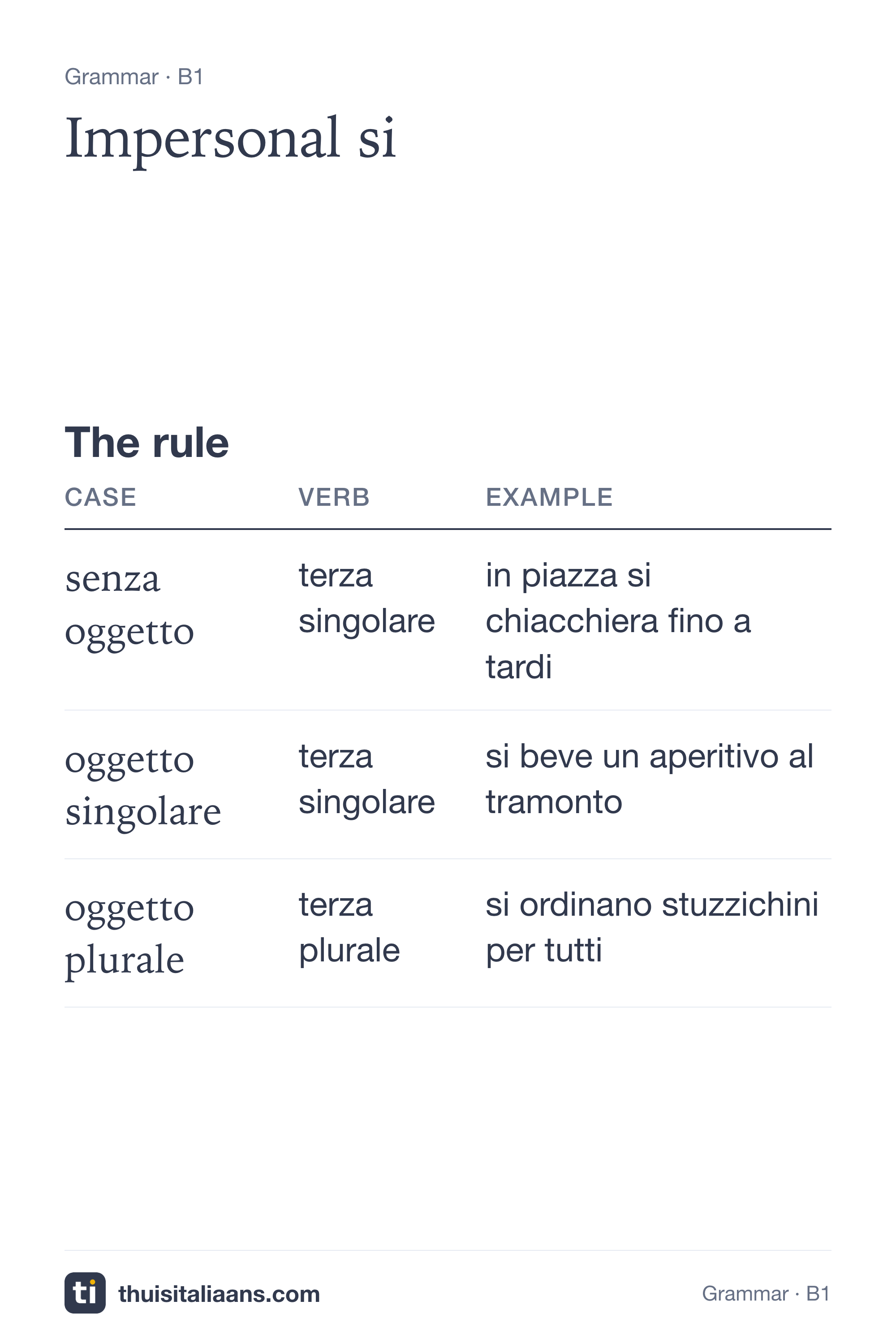
The rule
| Case | Verb | Example |
|---|---|---|
| senza oggetto | terza singolare | in piazza si chiacchiera fino a tardi |
| oggetto singolare | terza singolare | si beve un aperitivo al tramonto |
| oggetto plurale | terza plurale | si ordinano stuzzichini per tutti |
The dolce vita in six sentences
| Sentence | Why so |
|---|---|
| si cena alle nove | abitudine collettiva, verbo singolare |
| si prendono due spritz | oggetto plurale: verbo plurale |
| al mare si sta benissimo | stare senza oggetto: singolare |
| non si lavora ad agosto | la negazione precede il si |
The most common mistakes
si ordina due caffè→ si ordinano due caffè (plural object: plural verb)quando si è stanco, si dorme→ quando si è stanchi, si dorme (plural adjective)la gente si mangia bene qui→ qui si mangia bene (or: la gente mangia bene, without si)
Did you know?
Read and understand
This chapter’s grammar. Example: a holiday home sign.
CASA VACANZE IL GELSO
Come funziona qui
Ingressosi entra senza scarpe: le pantofole sono nel cesto
Cucinasi può usare tutto, ma poi si lava quello che si sporca
Silenziodopo le 23 si parla piano: i muri sono del 1700
Fumoin casa non si fuma; in giardino sì
Rifiutisi fa la raccolta differenziata: i bidoni sono spiegati sul frigo
Partenzasi paga alla partenza e si parte entro le 10
Per tutto il resto: si chiede! Siamo al piano di sotto.
Questions
Dove sono le pantofole?
Dove si può fumare?
«Si entra», «si paga»: chi fa queste azioni?
Completa: «In Italia ___ molto caffè» (bere).
Exercises
Five exercises in order of difficulty. The last ones bring back what you have already seen.
01 La forma base
Rewrite with impersonal si, as in the example: La gente mangia bene → Si mangia bene.
- In Italia la gente cena tardi. →
- Qui non è permesso fumare. →
- Come si dice questo? →
- In questo bar si beve un buon caffè. →
- D’estate la gente esce più tardi. →
- Al Sud la gente parla più forte. →
02 Il verbo va al plurale?
If a plural follows, the verb follows it too. Complete.
- In Italia (mangiare) molta pasta.
- In Italia (mangiare) molti tipi di pasta.
- Qui (vendere) il pane fresco.
- Qui (vendere) libri usati.
- In classe (fare) un esercizio al giorno.
- In classe (fare) molti esercizi.
03 Con gli aggettivi
With impersonal si the adjective goes to the masculine plural. Complete.
- Quando si è (stanco) , si dorme male.
- Da giovani si è (impaziente) .
- Se si è (preparato) , l’esame è facile.
- Si diventa (bravo) con la pratica.
- Quando si è (solo) , si legge di più.
- Si resta (sorpreso) davanti a quel panorama.
04 Al passato: sempre essere
In the past, si takes essere; the participle goes plural with verbs that normally take essere. Complete.
- Ieri (mangiare) benissimo.
- (andare) tutti al mare.
- (partire) presto la mattina.
- (bere) un ottimo vino.
- (rimanere) fino a tardi.
- (vedere) un bel film.
05 Guida per chi arriva
Complete with impersonal si, the right agreement and the right tenses.
Review comparativi · A2: preposizioni articolate · passato prossimo
- A Bologna (girare) a piedi: il centro è piccolo.
- (mangiare) bene ovunque, ma (spendere) meno fuori dal centro.
- La sera (uscire) tardi e (tornare) ancora più tardi.
- Quando (essere) stranieri, (fare) più fatica i primi mesi.
- Ieri (andare) sotto i portici e (vedere) tutta la città senza ombrello.
- Insomma: (stare) bene, se (accettare) i ritmi di qui.
These five are a taste. There are over seven hundred on the site, free and with no sign-up. All the exercises →

Every topic, a world
In the  amo Italian app, grammar is practised inside thematic pathways with field-specific vocabulary: il bar, i trasporti, il calcio, la moda, la burocrazia and seventeen more. Choose your world and the grammar comes along by itself, explained in your language too.
Half the path free, no sign-up
★★★★★(11)by Alessio, teacher since 2018
Downloadamo Italian for iPhone ↗︎Search for amo Italian
Read and understand
This chapter’s grammar. Example: a lifestyle article.
La Gazzetta della Domenica
domenica 2 agosto · pagina 9
Costume
Ad agosto si vive a un'altra velocità
di Chiara Bonetti
Nelle città d'agosto si cammina piano e si parla a voce bassa. Si cena tardi, si dorme con le finestre aperte.
Al mare è il contrario: si è sempre in ritardo per qualcosa. L'ombrellone, il traghetto, la cena delle otto.
Poi c'è la regola non scritta: in vacanza si diventa tutti più gentili. O almeno ci si prova.
A settembre si torna di corsa, si sa. Ma questa è un'altra storia.
Questions
Come si dorme nelle città d'agosto?
Qual è la regola non scritta delle vacanze?
«Si diventa tutti più gentilI»: perché l'aggettivo è al plurale?
Completa: «In biblioteca ___ in silenzio» (stare).
Want another text on this topic? Reading a job ad · Reading a wine label
One more go
Impersonal, singular or plural?
- In Italia più tardi che nel Nord Europa.
- D’estate feste in spiaggia.
- La domenica a pranzo dai parenti.
- Quando si è , si dorme poco e si vive tanto.
- Qui non il coperto.
Frequently asked questions
How do I make a reflexive verb impersonal: “one gets up early”?
With ci si: ci si alza presto, ci si abitua a tutto, d’estate ci si veste leggeri. Two si in a row (si si alza) are forbidden, so the first becomes ci. It looks exotic, but it is one fixed piece: ci si + third person singular.
What do the signs vendesi and affittasi mean?
“For sale” and “to rent”: they are si vende and si affitta with the pronoun glued after the verb, an older word order that survives on signs and listings. You will also meet the plural: vendonsi appartamenti. Estate agents are keeping medieval syntax alive.
How do I choose between si, uno and generic tu?
Three registers for “people in general”: si is the neutral written and spoken standard (si mangia bene); uno is conversational (uno non sa mai cosa dire); generic tu is the most informal (tu entri e non capisci niente). All correct: pick by context.
 The rule