Italiano in pratica
by Alessio · teacher of Italian for foreigners, ITALS master’s in teaching Italian abroad (Ca’ Foscari University, Venice) and a master’s in teaching Italian as a second language (Giustino Fortunato University, Benevento)
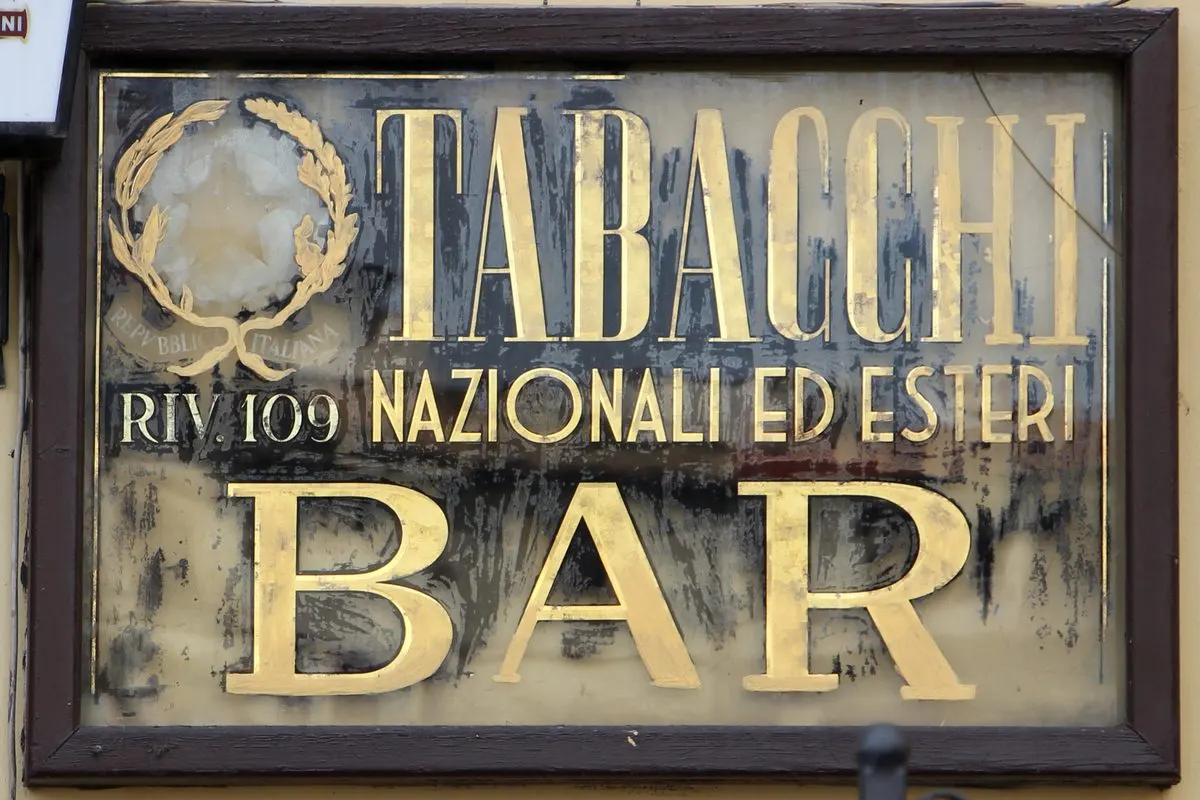
With a SIM from another EU country you pay what you pay at home: no Italian SIM needed. From outside the EU, an Italian SIM or an eSIM is often cheaper. To buy a SIM bring your passport: in Italy every SIM is registered to an ID document. Top-ups are ricariche.
You land, switch on the phone, and the first message is a price list for roaming. Whether you need an Italian SIM depends on where your contract is from, and buying one takes ten minutes in any phone shop, with the right document.
Here's what to bring, what to ask, and the Italian you need when the phone actually rings. With closed questions, as on every page here.
| Italian | English |
|---|---|
| Vorrei una SIM per un mese. | I'd like a SIM for a month. |
| Basta il passaporto? | Is the passport enough?answer: sì or no |
| Sono compresi i giga? | Is data included?answer: sì or no |
| Funziona anche all'estero? | Does it work abroad too?answer: sì or no |
| Una ricarica da dieci euro. | A ten-euro top-up. |
| Qual è la password del wifi? | What's the wifi password? |
| Pronto? | Hello?answering the phone |
| Può richiamare più tardi? | Could you call back later?answer: sì |
Read the Italian out loud once before you need it. The questions marked sì or no get a one-word answer you can understand.
Not if your SIM is from another EU country: roaming in the EU costs what you pay at home, within your plan's limits. From the UK, the US or elsewhere, check your plan: an Italian SIM or an eSIM is often much cheaper for data.
eSIMs can be bought online before you leave and activated when you land. A physical SIM is sold in phone shops in airports, stations and town centres.
| You say | English |
|---|---|
| Funziona anche all'estero? | Does it work abroad too?sì or no |
| Avete l'eSIM? | Do you have eSIMs?sì or no |
At a phone shop, with your passport: every SIM in Italy has to be registered to an identity document, and the shop does it on the spot. Say how long you're staying and ask closed questions about the offer: data, i giga, calls, and the price per month.
Offers are monthly and renew automatically if the credit allows it. Ask whether there's an activation fee, il costo di attivazione, and whether it's included.
| You say | English |
|---|---|
| Vorrei una SIM per un mese. | I'd like a SIM for a month. |
| Basta il passaporto? | Is the passport enough?sì or no |
| Sono compresi i giga? | Is data included?sì or no |
| Si rinnova da sola? | Does it renew automatically?sì or no |
| L'attivazione è compresa? | Is activation included?sì or no |
| You hear | English |
|---|---|
| Mi serve un documento. | I need an ID document. |
| Quanti giga le servono? | How much data do you need?say a number |
| Il primo mese è compreso. | The first month is included. |

Online, in the operator's app, or at a tabaccheria and many bars and newsagents with a top-up terminal: say the operator, the amount and the phone number. A top-up is una ricarica.
Keep the receipt until the credit shows on your phone; it usually arrives within minutes.
| You say | English |
|---|---|
| Una ricarica da dieci euro. | A ten-euro top-up. |
| Per questo numero. | For this number.show it on the screen |
| È arrivata la ricarica? | Has the top-up gone through?sì or no |
| You hear | English |
|---|---|
| Che gestore? | Which operator?say the name |
| Mi detta il numero? | Can you read me the number? |

In the  amo Italian app you practise inside real-life pathways: il bar, il ristorante, i trasporti, la casa and more, with listening, dialogues and the grammar explained in English. This page gives you the phrases; the app trains your ear.
Half the A1 course free, no sign-up
★★★★★(22)by Alessio, teacher since 2018
Downloadamo Italian for iPhone ↗︎Search for amo Italian
Pronto? is how Italians answer the phone. If you don't understand, ask for it slower, or ask them to call back or write: può scrivermi un messaggio? Closed questions again.
Calls from a hotel, a restaurant or a delivery are usually short and practical: a time, a name, a confirmation. Repeat what you heard as a question to check it: alle otto?
| You say | English |
|---|---|
| Pronto? | Hello? |
| Chi parla? | Who's speaking? |
| Può parlare più lentamente? | Could you speak more slowly?sì |
| Può scrivermi un messaggio? | Could you send me a text?sì or no |
| Può richiamare più tardi? | Could you call back later?sì |
| You hear | English |
|---|---|
| Parlo con il signor Smith? | Am I speaking to Mr Smith?sì or no |
| La chiamo per confermare. | I'm calling to confirm. |
| La linea è disturbata. | The line is bad. |

Ask whether there is Wi-Fi, c'è il wifi?, and then for the password. No signal is non c'è campo: you'll hear it in the mountains and in old buildings with thick walls.
In bars, the Wi-Fi password is often on the receipt or on a sign by the till.
| You say | English |
|---|---|
| C'è il wifi? | Is there wifi?sì or no |
| Qual è la password del wifi? | What's the wifi password? |
| Qui c'è campo? | Is there signal here?sì or no |
| You hear | English |
|---|---|
| La password è sullo scontrino. | The password is on the receipt. |
| Qui non c'è campo. | There's no signal here.no |
Spell your surname on the phone in Britain or the US and you might use Alpha, Bravo, Charlie. Italians use their cities instead: A come Ancona, B come Bologna, C come Como, D come Domodossola, E come Empoli, F come Firenze, G come Genova, and on through the alphabet. There is no official list, but everybody knows it, and hotel staff, doctors and call centres will spell your name back to you this way. Letters that are not part of the Italian alphabet have names of their own: J is i lunga, K kappa, W doppia vu, X ics, Y ipsilon.

The phone itself is used differently too. Italians message more than they call, and WhatsApp is the default for almost everything: booking a table, confirming a haircut, talking to the host of your apartment. Voice messages are common, sometimes several minutes long, and it is perfectly fine to answer in writing. When Italians do pick up a call, they say pronto, literally «ready».
Buying a SIM card is where Italian rules show. Every line has to be registered to an identity document, so there are no anonymous SIMs: bring your passport, or your ID card if you are an EU citizen. If your contract is from another EU country you may not need one at all: since June 2017 roaming within the EU has cost the same as at home, within the limits of your plan.
Read next: Why does an Italian hotel feel different from one at home? · Why do Italians still pay in cash so often?
Italians rarely answer with a bare sì or no. These are the forms you will actually hear, so you know which way the answer went.
| You hear | English | It means |
|---|---|---|
| Sì, certo. | Yes, of course. | yes |
| Certo! | Sure! | yes |
| Come no! | Of course! (literally: how not?) | yes |
| Volentieri. | Gladly. | yes |
| Va bene. | Fine, OK. | yes |
| Prego. | Go ahead / please do. | yes |
| No, mi dispiace. | No, I'm sorry. | no |
| Purtroppo no. | Unfortunately not. | no |
| Non c'è. | There isn't any. | no |
| È finito. | It's sold out / all gone. | no |
| Non si può. | That's not allowed. | no |
| Non ancora. | Not yet. | no |
Six real replies. Tap Yes or No for each one.
The grammar behind them
This guide as two printable pages, in English: the phrases to say, the yes/no questions and what you will hear.
All 43 phrase PDFs · €9Already included in the full course · €39 a year.
Or keep the eight phrases as an image, to save on your phone or pin:
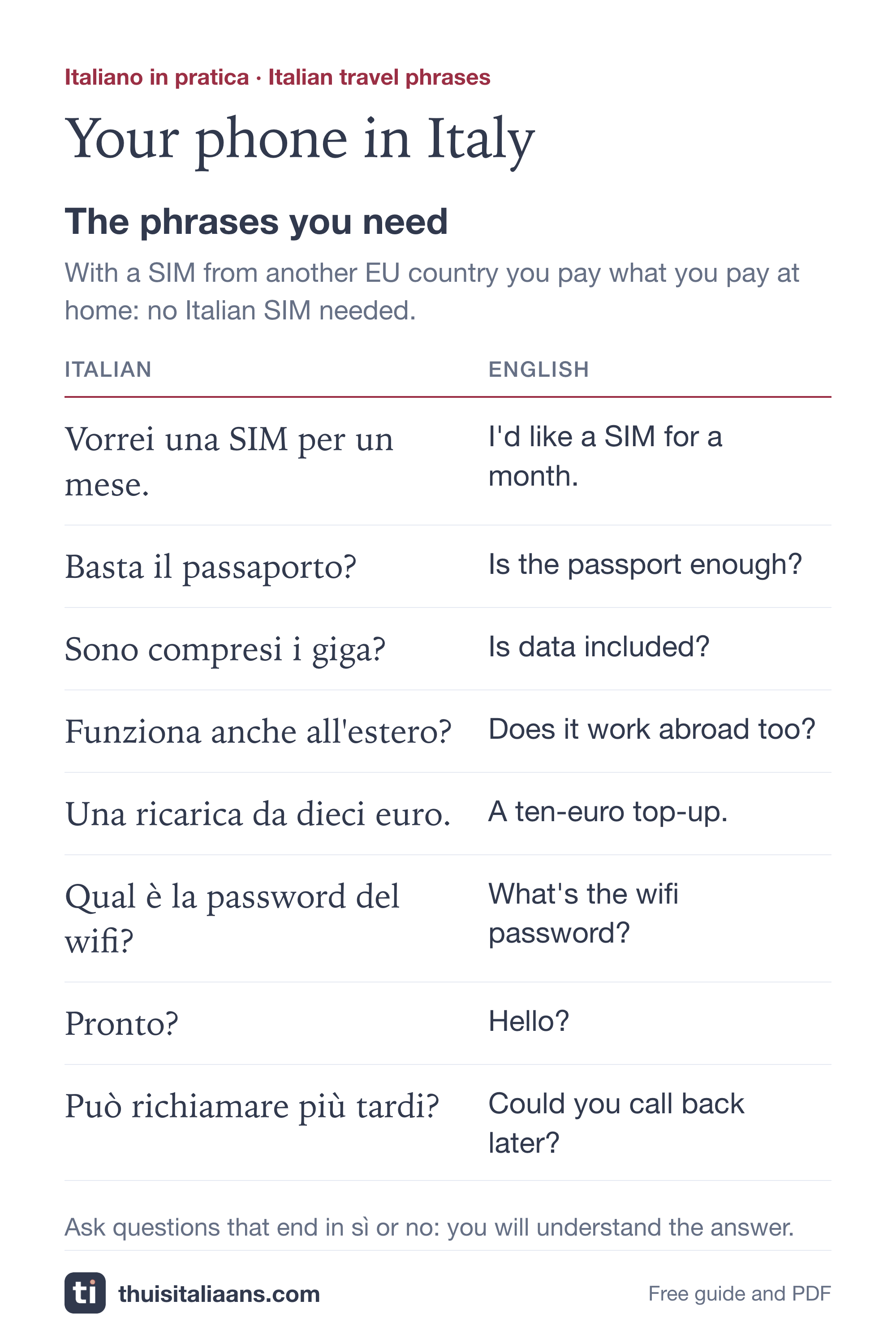 Italian phrases: Your phone in Italy
No. With a SIM from another EU country, roaming in Italy costs what you pay at home, within your plan's limits.
Your passport or an EU ID card: every SIM in Italy is registered to an identity document, and the phone shop does it on the spot.
«Pronto?». It's how Italians answer every call.
There's no signal.