

Grammar · A2
The passato prossimo
by Alessio · teacher of Italian as a foreign language, ITALS master’s

The passato prossimo tells the facts: what you did, where you went, what happened. It is built from two pieces: an auxiliary in the present (avere or essere) and the past participle.
- 5min reading
- 18min exercises
- A2level
What you learn
- participio regolare, con avere, con essere
- When to use the passato prossimo
- The irregular participles to know right away
- Vocabulary: il viaggio in treno
Italian and English side by side
English has one past for most purposes: I ate. Italian splits the job in two, and the passato prossimo is the one for finished events: ho mangiato. It looks like the English present perfect, but it is not. Italian uses it where English uses the simple past too: ieri ho mangiato, yesterday I ate.
Take this page with you
This chapter’s sheet as a free printable PDF (tables in Italian): rules, typical mistakes and the quiz with answers. A teacher’s tip: grammar sticks by reviewing it often, not by studying it once.
The passato prossimo tells a finished event: it sits behind now, but stays connected to the present.


The words on this page
Drag each Italian word onto its definition, or tap a word first, then its box.
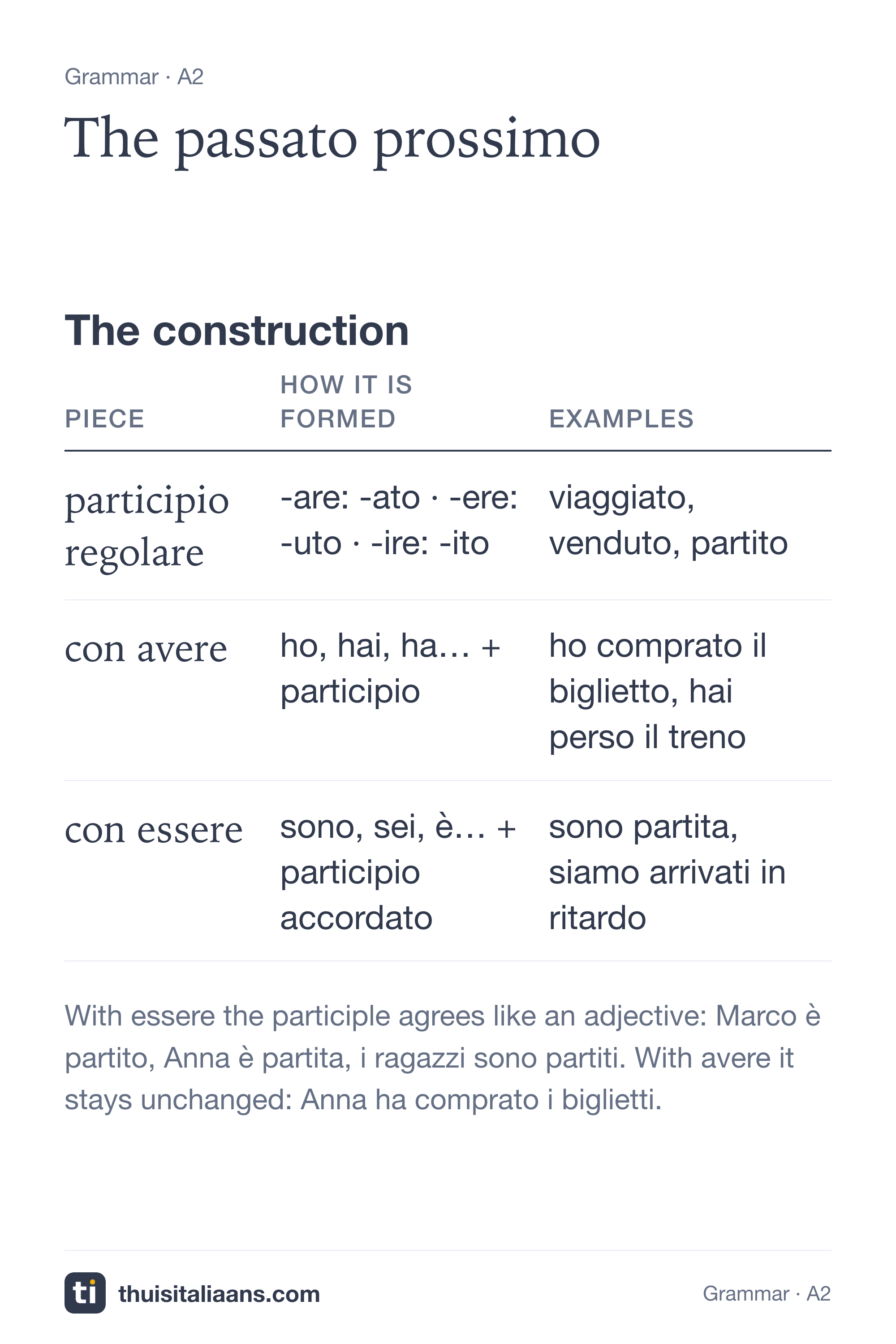
The construction
| Piece | How it is formed | Examples |
|---|---|---|
| participio regolare | -are: -ato · -ere: -uto · -ire: -ito | viaggiato, venduto, partito |
| con avere | ho, hai, ha… + participio | ho comprato il biglietto, hai perso il treno |
| con essere | sono, sei, è… + participio accordato | sono partita, siamo arrivati in ritardo |
The irregular participles to know right away
| Verb | Participle | On the road |
|---|---|---|
| fare | fatto | ho fatto il biglietto online |
| prendere | preso | abbiamo preso il regionale |
| perdere | perso | ho perso la coincidenza |
| scendere | sceso | siamo scesi alla fermata sbagliata |
| venire | venuto | è venuta a prendermi in stazione |
| dire / leggere / scrivere | detto / letto / scritto | ho letto gli orari, ho scritto ad Anna |
The most common mistakes
ho andato a Roma→ sono andato a Roma (andare takes essere)Anna è comprato i biglietti→ Anna ha comprato i biglietti (comprare takes avere)abbiamo prenduto il treno→ abbiamo preso il treno (irregular participle)le ragazze sono partito→ le ragazze sono partite (with essere it agrees)
Did you know?
Read and understand
This chapter’s grammar. Example: a post-it at home.
Ciao amore, io esco.
Ho pagato la bolletta della luce.
Sono passata in farmacia: le gocce sono sul tavolo.
Ho prenotato il ristorante per sabato, alle otto.
Non ho trovato il regalo per papà. Idee?
Marco ha chiamato: la partita è finita 2 a 1, ha vinto la sua squadra.
Torno alle sette ♥
Questions
Dove sono le gocce della farmacia?
Per quando è prenotato il ristorante?
Perché «ho pagato» ma «sono passata»?
Completa: «Ieri Anna ___ a casa presto» (tornare).

Exercises
Five exercises in order of difficulty. The last ones bring back what you have already seen.
01 Il participio regolare
Write the past participle.
- parlare →
- credere →
- dormire →
- mangiare →
- vendere →
- capire →
02 Con avere
Complete with the passato prossimo.
- Ieri (io / mangiare) una pizza.
- (tu / studiare) molto?
- Marco (dormire) dieci ore.
- (noi / vedere) un bel film.
- (voi / finire) i compiti?
- Loro (comprare) una casa.
03 I participi irregolari
These are the most frequent ones: learn them by heart. Write the participle.
- fare →
- dire →
- prendere →
- scrivere →
- leggere →
- aprire →
- venire →
- essere →
04 Con essere: il participio si accorda
Complete and make the participle agree with the subject.
- Maria (andare) al mare.
- I ragazzi (partire) ieri.
- (noi, due amiche) (uscire) insieme.
- Luca (tornare) tardi.
- (tu, Anna) (rimanere) a casa?
- Le mie sorelle (nascere) a Roma.
05 Il weekend di Sara
Complete the story in the passato prossimo, choosing essere or avere.
Review A1: presente, essere e avere, accordo dell’aggettivo
- Sabato Sara (svegliarsi) presto e (fare) colazione al bar.
- Poi (andare) in centro e (incontrare) due amiche.
- (loro / entrare) in un negozio e (comprare) due maglioni.
- A mezzogiorno (mangiare) insieme: (prendere) una pizza.
- La sera Sara (tornare) a casa e (leggere) un po’.
- (essere) una bella giornata.
These five are a taste. There are over seven hundred on the site, free and with no sign-up. All the exercises →

Every topic, a world
In the  amo Italian app, grammar is practised inside thematic pathways with field-specific vocabulary: il bar, i trasporti, il calcio, la moda, la burocrazia and seventeen more. Choose your world and the grammar comes along by itself, explained in your language too.
Half the path free, no sign-up
★★★★★(11)by Alessio, teacher since 2018
Downloadamo Italian for iPhone ↗︎Search for amo Italian

Read and understand
This chapter’s grammar. Example: an email from the Cinque Terre.
Il weekend alle Cinque Terre
daMartina Riva <martina.riva@mail.it>
ailse.devries@mail.nl
datalun 15 set, 22:05
Cara Ilse,
che weekend! Sabato all'alba siamo partite io e Lucia per le Cinque Terre. Abbiamo camminato quattro ore, da Monterosso a Vernazza.
A pranzo ho mangiato il pesto migliore della mia vita. Le foto? Le ho fatte tutte col telefono di Lucia: il mio è rimasto a casa, ovviamente.
Domenica il mare era troppo freddo: ci siamo sedute al porto e abbiamo guardato le barche per un'ora, senza parlare.
Sei mai stata in Liguria? Ti piacerebbe tanto.
Un abbraccio,
Martina
Questions
Con chi è partita Martina?
Perché ha usato il telefono di Lucia per le foto?
«Siamo partitE», con la e finale: che cosa ci dice?
Completa: «Le chiavi? ___ sul tavolo» (io, lasciare).
Want another text on this topic? A voicemail message · A CV in Italian
One more go
Build the passato prossimo:
- Ieri (io) il treno delle 7.
- Anna in ritardo.
- Noi la coincidenza a Bologna.
- A che ora dal treno?
- I ragazzi i biglietti online.
Frequently asked questions
Can I use the passato prossimo with ieri?
Yes, and you should: ieri ho lavorato fino a tardi. Unlike English, where “I have worked yesterday” is impossible, the passato prossimo happily combines with finished-time expressions: ieri, l’anno scorso, due giorni fa. It covers both “I did” and “I have done”.
Where do già, mai, ancora go?
Usually between auxiliary and participle: ho già mangiato, non sono mai stato a Venezia, non ho ancora finito. It is the natural home of these little adverbs, and putting them there instantly makes your past tense sound native.
How do I know whether to use avere or essere?
The short compass: avere for most verbs, essere for movement, change of state and reflexives. It deserves its own chapter: essere or avere?
 The construction