

Grammar · A1
C’è and ci sono
by Alessio · teacher of Italian as a foreign language, ITALS master’s

To say that something exists or is somewhere, Italian uses c’è with the singular and ci sono with the plural. Two forms, one rule, and you can already describe an entire room.
- 5min reading
- 18min exercises
- A1level
What you learn
- c’è, ci sono
- When to use c’è and ci sono
- Questions and negation
- Vocabulary: la casa e il quartiere
Italian and English side by side
English has one form, there is / there are, and Italian works the same way: c'è for one thing, ci sono for several. The difference is what it competes with: c'è announces that something exists somewhere, while è describes something already known. C'è un ristorante in piazza introduces it; il ristorante è in piazza locates one you both know.
Take this page with you
This chapter’s sheet as a free printable PDF (tables in Italian): rules, typical mistakes and the quiz with answers. A teacher’s tip: grammar sticks by reviewing it often, not by studying it once.


The words on this page
Drag each Italian word onto its definition, or tap a word first, then its box.
The rule
| Form | With | Examples around the house |
|---|---|---|
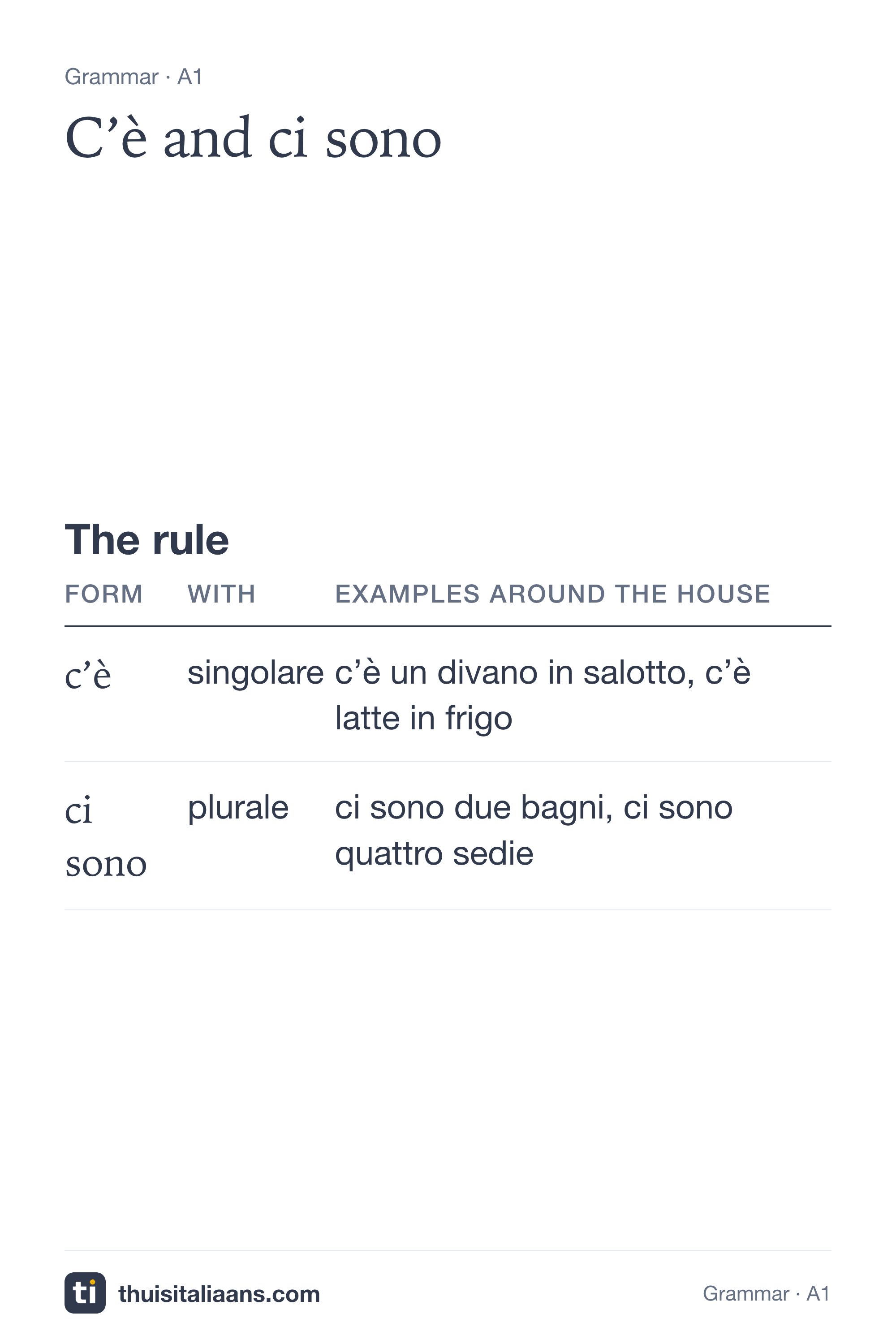
| c’è | singolare | c’è un divano in salotto, c’è latte in frigo |
| ci sono | plurale | ci sono due bagni, ci sono quattro sedie |
Questions and negation
| Type | Example |
|---|---|
| Domanda | c’è l’ascensore? ci sono balconi? |
| Negazione | non c’è il garage, non ci sono armadi |
| Risposta corta | Sì, c’è. / No, non ci sono. |
The most common mistakes
ce due camere→ ci sono due camere (plural, and c’è needs its apostrophe)c’è molti negozi qui→ ci sono molti negozi qui (molti negozi is plural)non è un ascensore nel palazzo→ non c’è un ascensore nel palazzo (existence needs c’è)
Did you know?
Read and understand
This chapter’s grammar. Example: a neighbourhood news item.
Il Corriere del Quartiere
giovedì 14 marzo · pagina 7
Mercato
Da sabato c'è un banco in più
di Paola Renzi
In piazza Vittoria ci sono adesso ventidue banchi. C'è anche un fioraio, che prima non c'era.
«Ci vuole pazienza», dice il presidente. «Ci sono volute tre riunioni, ma alla fine ce l'abbiamo fatta».
Il mercato c'è il sabato dalle sette all'una.
Questions
Quanti banchi ci sono adesso in piazza Vittoria?
Perché «ci sono ventidue banchi» ma «c'è un fioraio»?
«Ci vuole pazienza» significa…

Exercises
Five exercises in order of difficulty. The last ones bring back what you have already seen.
01 Uno o più di uno
Complete with c’è or ci sono.
- In piazza una fontana.
- In piazza due bar.
- un problema.
- molte persone.
- Sul tavolo il tuo libro.
- In frigo le uova.
02 Al negativo
Turn into the negative.
- C’è il pane. →
- Ci sono i biglietti. →
- C’è un problema. →
- Ci sono studenti in aula. →
- C’è tempo. →
- Ci sono novità. →
03 C’è o è?
C’è says that something exists somewhere; è says what or where something already known is.
- un ristorante qui vicino?
- Il ristorante vicino alla stazione.
- Dov’ la mia borsa?
- una borsa sulla sedia.
- Marco in ufficio.
- qualcuno in ufficio?
04 Fai la domanda
Write the question with c’è or ci sono, as in the example: una farmacia → C’è una farmacia qui vicino?
- un supermercato →
- bagni →
- una stazione →
- posti liberi →
- un tavolo per due →
- altre domande →
05 La mia città
Complete with c’è / ci sono, essere or avere, and make everything agree.
Review essere e avere · aggettivi · articoli
- Nel mio quartiere due parc grand.
- anche un mercato: aperto il sabato.
- Le strade strett, ma molt negozi.
- Io una bicicletta e contento così.
- Vicino a casa tre bar: sempre pien.
- E da te, un cinema?
These five are a taste. There are over seven hundred on the site, free and with no sign-up. All the exercises →

Every topic, a world
In the  amo Italian app, grammar is practised inside thematic pathways with field-specific vocabulary: il bar, i trasporti, il calcio, la moda, la burocrazia and seventeen more. Choose your world and the grammar comes along by itself, explained in your language too.
Half the path free, no sign-up
★★★★★(11)by Alessio, teacher since 2018
Downloadamo Italian for iPhone ↗︎Search for amo Italian

Read and understand
This chapter’s grammar. Example: a property ad.
Case e stanze
Monolocale in centro
C'è una stanza grande e c'è anche un piccolo ripostiglio.
Ci sono due finestre e ci sono le tende nuove.
Non c'è l'ascensore, ma ci sono solo due piani.
Per arrivare in centro ci vogliono dieci minuti a piedi.
Visite su appuntamento · 340 22 55 118
Questions
Che cosa non c'è nel palazzo?
Perché «ci sono due finestre» e non «c'è due finestre»?
Completa: «___ un'ora per arrivare a Pisa».
Want another text on this topic? A local news item
One more go
C’è or ci sono?
- In cucina un tavolo grande.
- due balconi con vista.
- Non l’ascensore, mi dispiace.
- posto per la lavatrice?
- Nel quartiere tre supermercati.
Frequently asked questions
What is the difference between c’è and è?
C’è introduces existence or presence: c’è una farmacia qui vicino? (“is there…”). È links a subject to a description: la farmacia è qui vicino (“the pharmacy is…”). If English needs “there”, Italian needs ci.
How do I say “there was” and “there were”?
C’era and c’erano: c’era molta gente, c’erano due messaggi per te. Same rule as the present: singular with singular, plural with plural. It is also the classic fairy-tale opening: c’era una volta, “once upon a time”.
Can I ask C’è nessuno? Isn’t nessuno negative?
In questions, nessuno and niente work like “anyone / anything”: c’è nessuno? (“anybody there?”), serve niente?. They turn negative only with non in the answer: non c’è nessuno.
 The rule