Italiano in pratica
by Alessio · teacher of Italian for foreigners, ITALS master’s in teaching Italian abroad (Ca’ Foscari University, Venice) and a master’s in teaching Italian as a second language (Giustino Fortunato University, Benevento)
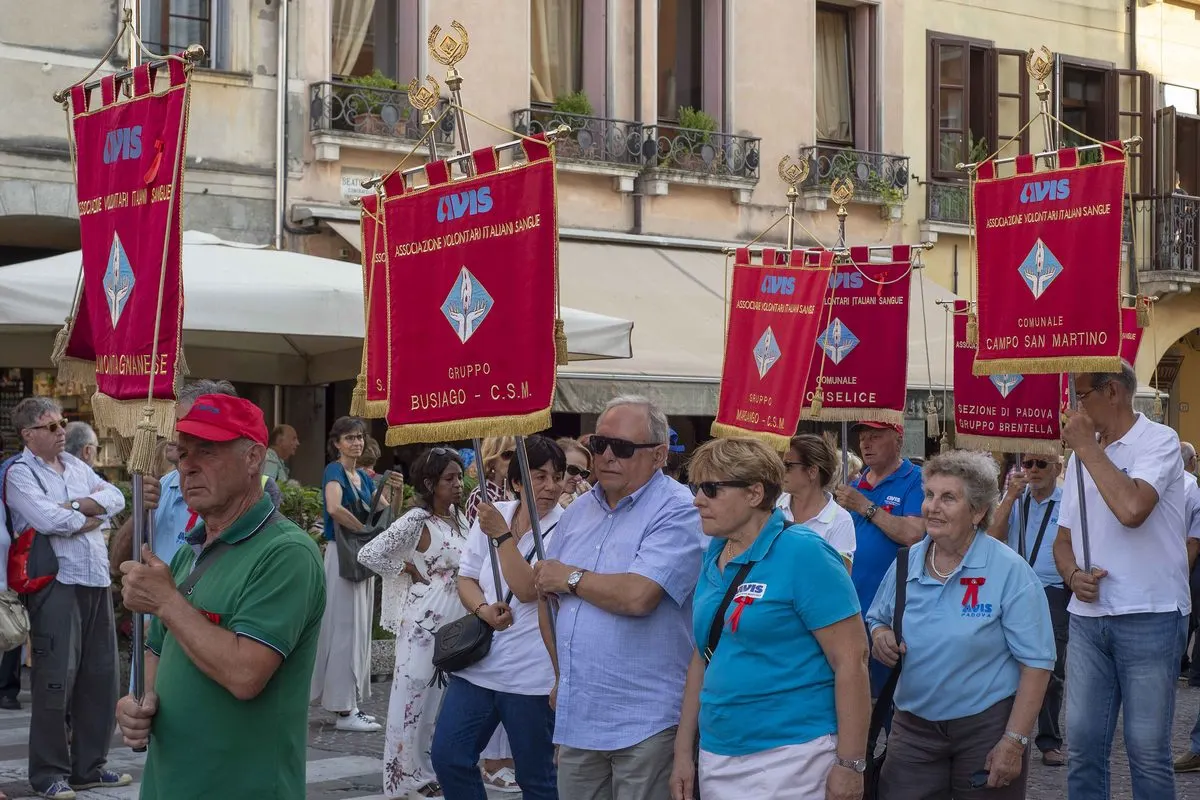
Italy has 13 national public holidays, including 4 October, San Francesco, again a holiday from 2026. Each town also stops for its patron saint. In August many small businesses close for a week or two, chiuso per ferie. On holidays, ask: domani siete aperti?
You plan a day trip to the market and find every shutter down: it's the town's patron saint. Holidays and closures are part of the Italian calendar, and knowing them saves a wasted morning.
Here are the dates, the signs on the doors, and the closed questions that tell you what's open.
| Italian | English |
|---|---|
| Domani siete aperti? | Are you open tomorrow?answer: sì or no |
| Oggi è festa? | Is today a holiday?answer: sì or no |
| Il museo è aperto a Ferragosto? | Is the museum open on 15 August?answer: sì or no |
| Fino a quando siete chiusi? | Until when are you closed? |
| C'è un supermercato aperto oggi? | Is there a supermarket open today?answer: sì or no |
| I treni viaggiano normalmente? | Are the trains running normally?answer: sì or no |
| Buone feste! | Happy holidays! |
| Buon Ferragosto! | Happy 15 August! |
Read the Italian out loud once before you need it. The questions marked sì or no get a one-word answer you can understand.
1 January, 6 January (Epiphany), Easter Sunday and Easter Monday (Pasquetta), 25 April (Liberation Day), 1 May, 2 June (Republic Day), 15 August (Ferragosto), 4 October (San Francesco, again a holiday from 2026), 1 November, 8 December, 25 and 26 December.
When a holiday falls on a Tuesday or Thursday, many people take the day in between off too: it's a ponte, a bridge, and trains and roads fill up.
| You say | English |
|---|---|
| Oggi è festa? | Is today a holiday?sì or no |
| Domani c'è il ponte? | Is there a long weekend tomorrow?sì or no |
| Buone feste! | Happy holidays! |
| You hear | English |
|---|---|
| Lunedì è Pasquetta. | Monday is Easter Monday. |
| Il primo maggio è tutto chiuso. | On 1 May everything is closed. |
Every town celebrates its patron saint with a local holiday: shops and offices close and there are processions and fairs. Rome stops on 29 June, Milan on 7 December, Florence on 24 June, Naples on 19 September, Venice on 25 April.
It's a good day to see the town at its best, and a bad day for errands. Ask at your hotel: c'è qualche festa in questi giorni?
| You say | English |
|---|---|
| C'è qualche festa in questi giorni? | Is there any festival these days?sì or no |
| A che ora è la processione? | What time is the procession? |
| I negozi sono chiusi? | Are the shops closed?sì or no |
| You hear | English |
|---|---|
| È il santo patrono. | It's the patron saint's day. |
| Stasera ci sono i fuochi d'artificio. | There are fireworks tonight. |
Chiuso per ferie means closed for the holidays. In August, especially in the week of Ferragosto (15 August), many small shops, bars, restaurants and workshops in cities close for one to three weeks. Supermarkets, museums and tourist areas stay open.
The sign usually gives the dates: chiuso dal 10 al 25 agosto. Seaside and mountain towns, on the other hand, are at their busiest.
| You say | English |
|---|---|
| Fino a quando siete chiusi? | Until when are you closed? |
| Riaprite a settembre? | Do you reopen in September?sì or no |
| You hear | English |
|---|---|
| Chiuso per ferie dal 10 al 25 agosto. | Closed for the holidays from 10 to 25 August. |
| Riapriamo lunedì 26. | We reopen on Monday the 26th. |

In the  amo Italian app you practise inside real-life pathways: il bar, il ristorante, i trasporti, la casa and more, with listening, dialogues and the grammar explained in English. This page gives you the phrases; the app trains your ear.
Half the A1 course free, no sign-up
★★★★★(22)by Alessio, teacher since 2018
Downloadamo Italian for iPhone ↗︎Search for amo Italian
In cities many shops and supermarkets open on Sunday, often with shorter hours; in small towns most are closed. Many state museums close on Monday, and many hairdressers and some restaurants too. Small shops outside the centre often close for lunch.
The two words on the door: feriali, weekdays, and festivi, Sundays and holidays, each with its own hours.
| You say | English |
|---|---|
| Domani siete aperti? | Are you open tomorrow?sì or no |
| È aperto anche la domenica? | Is it open on Sundays too?sì or no |
| C'è un supermercato aperto oggi? | Is there a supermarket open today?sì or no |
| You hear | English |
|---|---|
| Festivi: chiuso. | Closed on Sundays and holidays.on signs |
| La domenica solo la mattina. | On Sundays mornings only. |

Trains run on holidays, often with a holiday timetable; local buses run less. Many museums open on holidays but close on 25 December and 1 January. There's always a farmacia di turno, a duty pharmacy, open.
Ask closed questions the day before: i treni viaggiano normalmente?, il museo è aperto a Ferragosto?
| You say | English |
|---|---|
| I treni viaggiano normalmente? | Are the trains running normally?sì or no |
| Il museo è aperto a Ferragosto? | Is the museum open on 15 August?sì or no |
| Dov'è la farmacia di turno? | Where's the duty pharmacy? |
| You hear | English |
|---|---|
| Orario festivo. | Holiday timetable. |
| Il 25 dicembre siamo chiusi. | We're closed on 25 December. |
August in Italy is not an ordinary month. Around the 15th, Ferragosto, cities empty, many small shops, workshops and restaurants close for one to three weeks, and the beaches and mountains fill up. The name comes from the Latin Feriae Augusti, a summer rest traditionally credited to the emperor Augustus in 18 BC, although historians argue over the details. The Church later made the 15th the feast of the Assumption, and in the twentieth century cheap holiday trains turned it into the great national day out.

Each town also has a day of its own. The patron saint's feast closes offices and many shops: Rome on 29 June, Florence, Genoa and Turin on 24 June, Palermo on 15 July, Naples on 19 September, Milan on 7 December. Rome's is the only one written into national law as a civil holiday; elsewhere the closure comes from custom and local agreements. Venice's patron, San Marco, falls on 25 April, which is already a national holiday. And from 2026 Italy has a new national holiday, 4 October, the feast of Saint Francis, patron saint of Italy.
The week has its rhythm too. Sunday is for family lunch, which in many homes still lasts until the middle of the afternoon, and in small towns almost everything is closed. In the south the hours after lunch are quiet in summer: shops close and streets empty until the heat drops. None of this is laziness. It is a calendar built around the family table and the climate, and it is easier to enjoy than to fight.
Read next: Why do Italian shopkeepers serve you instead of letting you browse? · How do trains fit into everyday life in Italy?
Italians rarely answer with a bare sì or no. These are the forms you will actually hear, so you know which way the answer went.
| You hear | English | It means |
|---|---|---|
| Sì, certo. | Yes, of course. | yes |
| Certo! | Sure! | yes |
| Come no! | Of course! (literally: how not?) | yes |
| Volentieri. | Gladly. | yes |
| Va bene. | Fine, OK. | yes |
| Prego. | Go ahead / please do. | yes |
| No, mi dispiace. | No, I'm sorry. | no |
| Purtroppo no. | Unfortunately not. | no |
| Non c'è. | There isn't any. | no |
| È finito. | It's sold out / all gone. | no |
| Non si può. | That's not allowed. | no |
| Non ancora. | Not yet. | no |
Six real replies. Tap Yes or No for each one.
The grammar behind them
This guide as two printable pages, in English: the phrases to say, the yes/no questions and what you will hear.
All 43 phrase PDFs · €9Already included in the full course · €39 a year.
Or keep the eight phrases as an image, to save on your phone or pin:
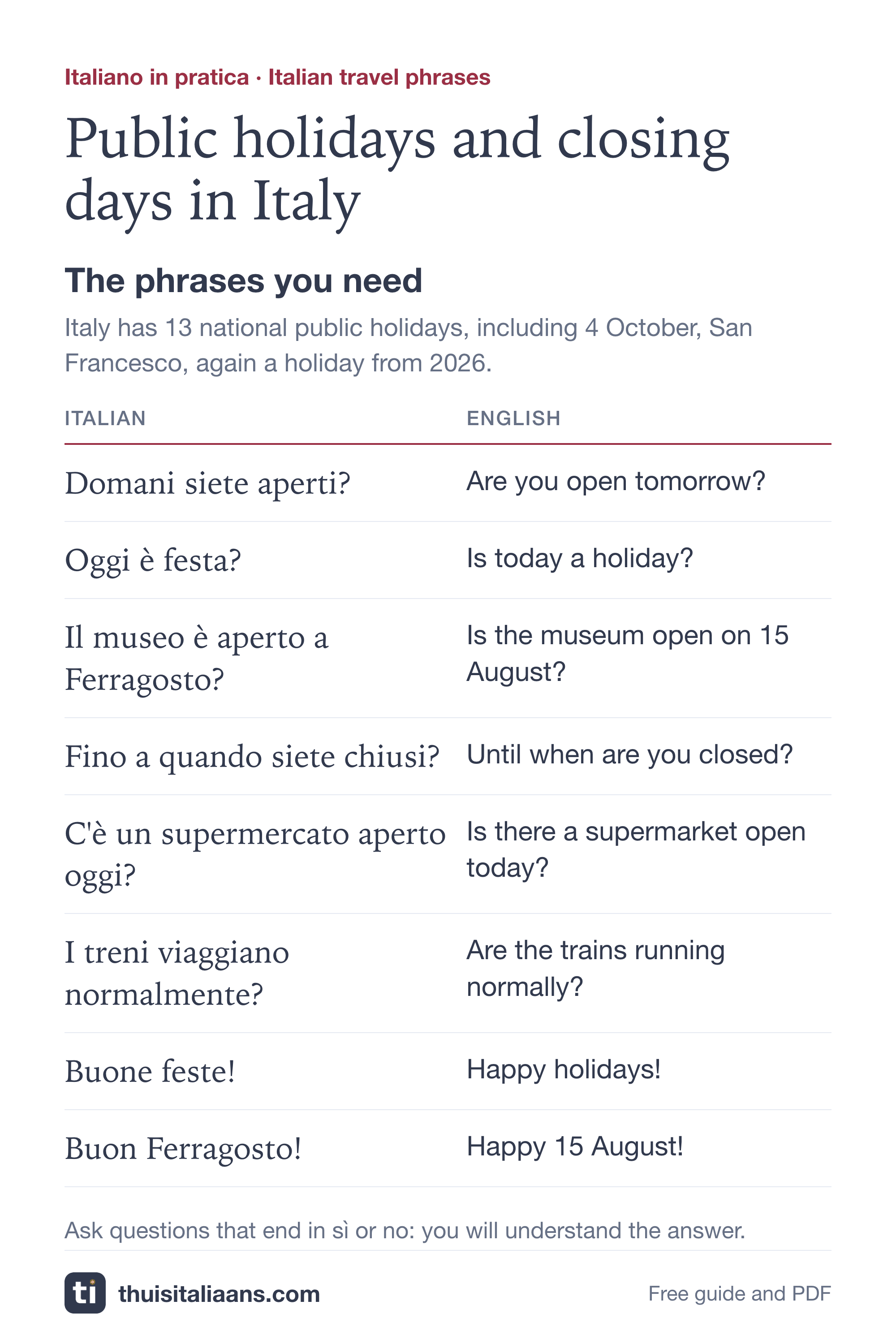 Italian phrases: Public holidays and closing days in Italy
1 and 6 January, Easter Sunday and Monday, 25 April, 1 May, 2 June, 15 August, 4 October (from 2026), 1 November, 8 December, 25 and 26 December, plus each town's patron saint's day.
Yes, again from 2026: the feast of San Francesco d'Assisi was restored as a national holiday by Law 151/2025.
Closed for the holidays. In August many small businesses close for one to three weeks, especially around 15 August.
A long weekend created by taking a day off between a public holiday and the weekend.