Italiano in pratica
by Alessio · teacher of Italian for foreigners, ITALS master’s in teaching Italian abroad (Ca’ Foscari University, Venice) and a master’s in teaching Italian as a second language (Giustino Fortunato University, Benevento)
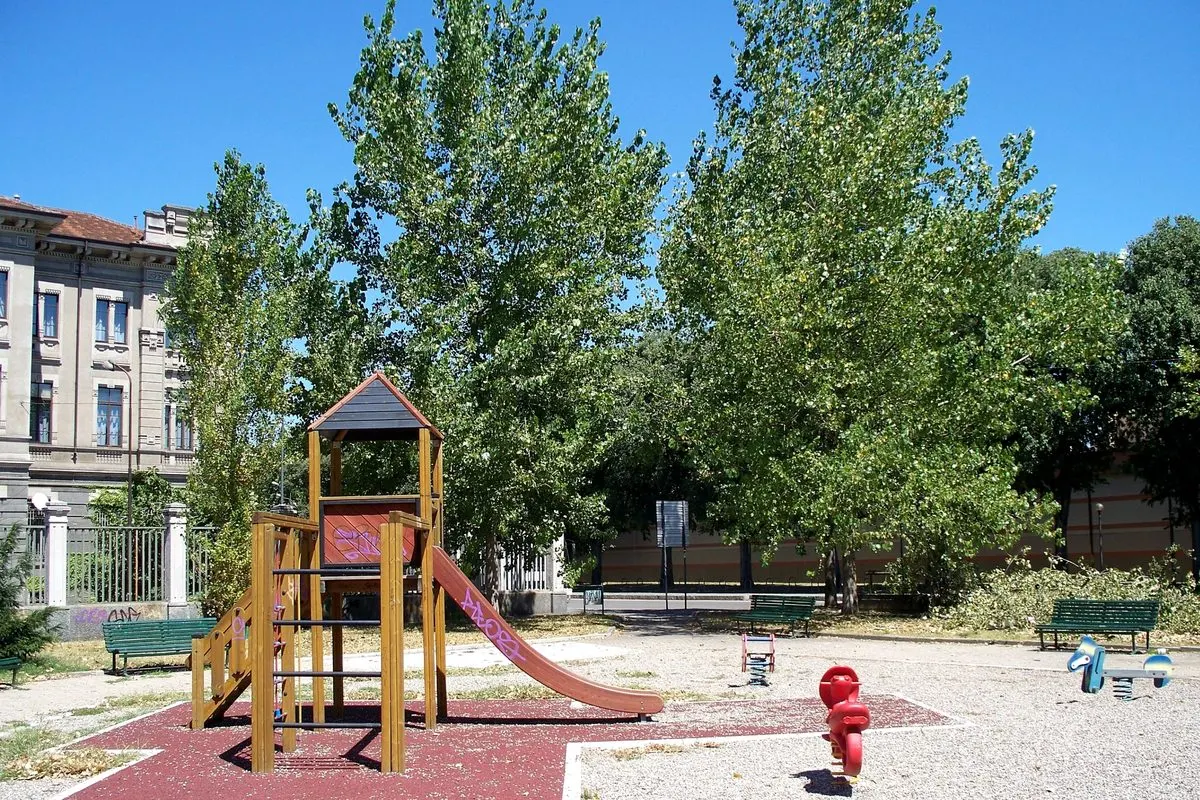
Children are welcome almost everywhere in Italy, late dinners included. Ask for a seggiolone (high chair) and a mezza porzione (half portion) rather than a kids' menu. On Trenitalia trains children under 4 travel free without a seat, and state museums are free for under-18s.
Italians love children, loudly: expect a waiter who makes faces at your toddler and a stranger on the train who offers a biscuit. What you need is a handful of practical words, for the high chair, the pushchair, the changing table and the pharmacy.
Here they are, with the closed questions that get a sì or a no.
| Italian | English |
|---|---|
| Avete un seggiolone? | Do you have a high chair?answer: sì or no |
| Si può fare una mezza porzione? | Can you do a half portion?answer: sì or no |
| C'è un fasciatoio? | Is there a changing table?answer: sì or no |
| I bambini pagano? | Do children pay?answer: sì or no |
| Posso entrare con il passeggino? | Can I come in with the pushchair?answer: sì or no |
| Ha qualcosa per la febbre per bambini? | Do you have something for a child's fever?at the pharmacy |
| Ha cinque anni. | He's five. / She's five. |
| C'è un parco giochi qui vicino? | Is there a playground near here?answer: sì or no |
Read the Italian out loud once before you need it. The questions marked sì or no get a one-word answer you can understand.
Ask for a high chair, un seggiolone, and order a half portion of a normal dish, una mezza porzione, instead of looking for a kids' menu, which many places don't have. Plain pasta with tomato or butter, pasta al pomodoro or in bianco, is made everywhere.
Families eat late in Italy, and children at the table at nine in the evening are normal. In summer, restaurants with a garden are a gift.
| You say | English |
|---|---|
| Avete un seggiolone? | Do you have a high chair?sì or no |
| Si può fare una mezza porzione? | Can you do a half portion?sì or no |
| Una pasta in bianco per il bambino. | Plain pasta with butter for the child. |
| Può scaldare il latte? | Could you warm up the milk?sì or no |
| You hear | English |
|---|---|
| Quanti anni ha? | How old is he / she?say the number |
| Per il piccolo cosa facciamo? | What shall we make for the little one? |
On Trenitalia trains, children under 4 travel free if they don't take a seat; on national trains children from 4 to 15 get a discount on the standard fare. Regional trains and city buses have local rules, often free under a certain age or height: ask i bambini pagano?
On high-speed trains, ask for seats together when you book; with a pushchair, regional trains with step-free carriages are marked with the wheelchair symbol.
| You say | English |
|---|---|
| I bambini pagano? | Do children pay?sì or no |
| Ha tre anni, non occupa il posto. | He's three, he won't take a seat. |
| Possiamo stare vicini? | Can we sit together?sì or no |
| You hear | English |
|---|---|
| Sotto i quattro anni è gratis. | Under four it's free. |
| Serve il biglietto ridotto. | You need a reduced ticket. |
Italian state museums are free for under-18s, and many have family activities. Pushchairs are usually allowed but sometimes must be left at the cloakroom: ask posso entrare con il passeggino?
Short visits work better than long ones: a piazza with a gelato after two rooms of paintings is a good Italian compromise.
| You say | English |
|---|---|
| Posso entrare con il passeggino? | Can I come in with the pushchair?sì or no |
| Ci sono attività per bambini? | Are there activities for children?sì or no |
| C'è l'ascensore? | Is there a lift?sì or no |
| You hear | English |
|---|---|
| Il passeggino va lasciato al guardaroba. | The pushchair must be left in the cloakroom. |
| Sotto i diciotto anni è gratuito. | It's free for under-18s. |

In the  amo Italian app you practise inside real-life pathways: il bar, il ristorante, i trasporti, la casa and more, with listening, dialogues and the grammar explained in English. This page gives you the phrases; the app trains your ear.
Half the A1 course free, no sign-up
★★★★★(22)by Alessio, teacher since 2018
Downloadamo Italian for iPhone ↗︎Search for amo Italian
Ask for a changing table, un fasciatoio, in restaurants, museums and service areas. Nappies are pannolini, sold in supermarkets and pharmacies; the pharmacy also has baby food, milk formula and medicines for children.
For a child's fever, the pharmacist will ask age and weight: have them ready. Pesa quindici chili, he or she weighs fifteen kilos.
| You say | English |
|---|---|
| C'è un fasciatoio? | Is there a changing table?sì or no |
| Dove trovo i pannolini? | Where do I find nappies? |
| Ha qualcosa per la febbre per bambini? | Do you have something for a child's fever? |
| Pesa quindici chili. | He / she weighs fifteen kilos. |
| You hear | English |
|---|---|
| Quanto pesa? | How much does he / she weigh? |
| Sciroppo o supposte? | Syrup or suppositories?a choice of two |

Most towns have a playground, un parco giochi, and in the evening the main square fills with children playing while parents chat. Ask a closed question: c'è un parco giochi qui vicino?
Two phrases your child can use with Italian children: come ti chiami?, what's your name?, and giochiamo?, shall we play?
| You say | English |
|---|---|
| C'è un parco giochi qui vicino? | Is there a playground near here?sì or no |
| Come ti chiami? | What's your name?child to child |
| Giochiamo? | Shall we play?child to child |
| You hear | English |
|---|---|
| Che bel bambino! | What a lovely child! |
| Quanti anni hai? | How old are you?to the child |
Children in Italy are part of public life rather than something kept out of it. They come to restaurants in the evening, play in the square at ten at night in summer, and are greeted, admired and now and then pinched on the cheek by strangers. A waiter pulling faces at your toddler, or a grandmother on the train offering a biscuit, is ordinary. Part of the reason is that children have become rare: in 2025 Italy recorded about 355,000 births and 1.14 children per woman, one of the lowest rates in Europe.

Grandparents, i nonni, are the backbone of Italian childcare, and you will see them at every school gate and playground. Family meals mix generations, and children are expected to sit through long lunches; restaurants respond with half portions and plain pasta rather than separate children's menus. The afternoon snack, la merenda, is a fixed ritual, often bread with something on it or a slice of cake.
Some rules are stricter than at home. Anyone driving in Italy with a child under four must use an anti-abandonment device, an alarm that warns you if the child is left in the car, so ask the rental company for a child seat that has one. On the other hand, a lot is free: children under four travel free on Trenitalia trains if they don't take a seat, and state museums are free for everyone under 18.
Read next: Why does nobody bring you the bill in an Italian restaurant? · Why is so much of Italy's art outside its museums?
Italians rarely answer with a bare sì or no. These are the forms you will actually hear, so you know which way the answer went.
| You hear | English | It means |
|---|---|---|
| Sì, certo. | Yes, of course. | yes |
| Certo! | Sure! | yes |
| Come no! | Of course! (literally: how not?) | yes |
| Volentieri. | Gladly. | yes |
| Va bene. | Fine, OK. | yes |
| Prego. | Go ahead / please do. | yes |
| No, mi dispiace. | No, I'm sorry. | no |
| Purtroppo no. | Unfortunately not. | no |
| Non c'è. | There isn't any. | no |
| È finito. | It's sold out / all gone. | no |
| Non si può. | That's not allowed. | no |
| Non ancora. | Not yet. | no |
Six real replies. Tap Yes or No for each one.
The grammar behind them
This guide as two printable pages, in English: the phrases to say, the yes/no questions and what you will hear.
All 43 phrase PDFs · €9Already included in the full course · €39 a year.
Or keep the eight phrases as an image, to save on your phone or pin:
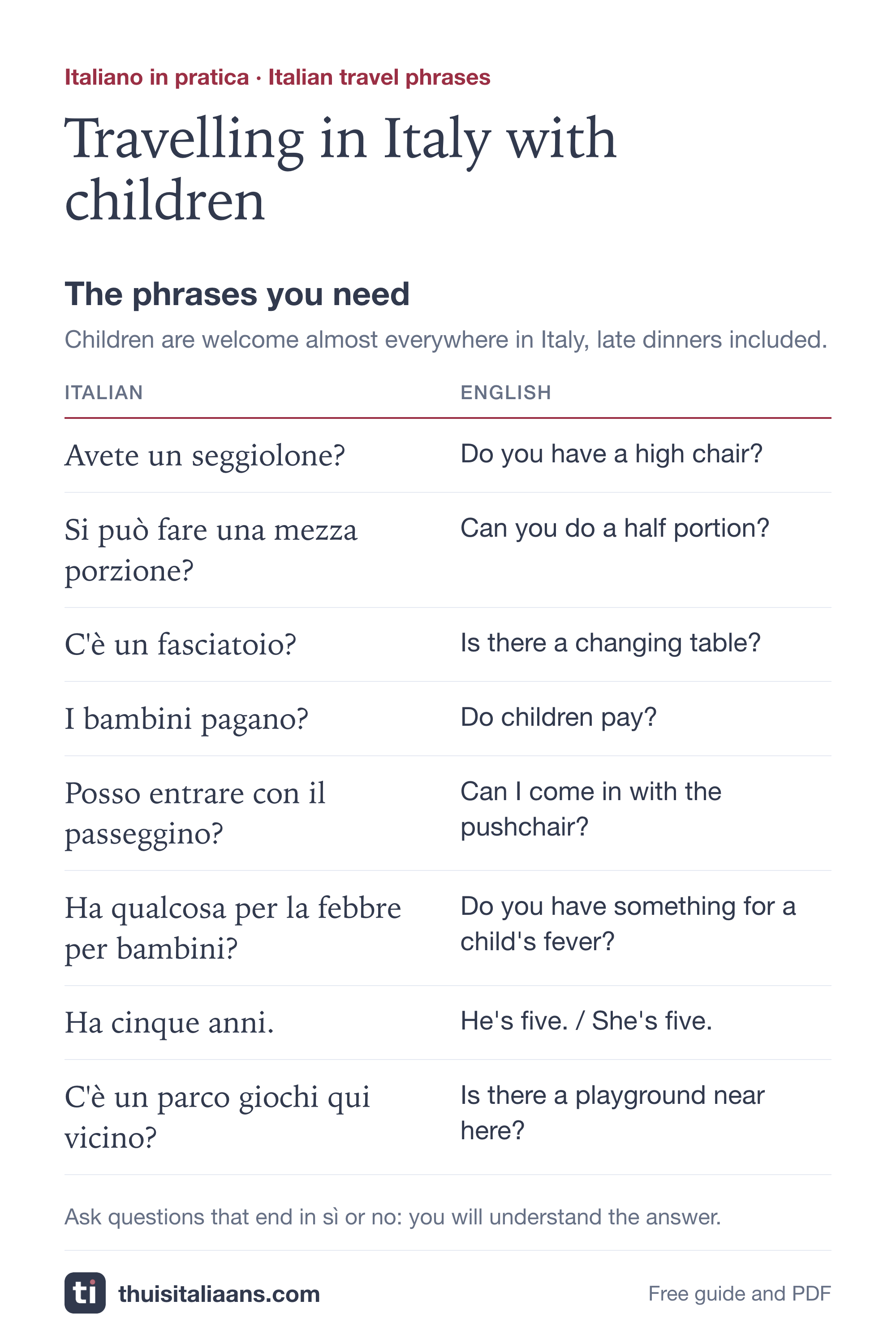 Italian phrases: Travelling in Italy with children
Many don't. Ask for «una mezza porzione», a half portion of a normal dish, and a «seggiolone», a high chair.
On Trenitalia trains, children under 4 travel free if they don't take a seat, and children 4 to 15 get a discount on national trains. Regional trains follow local rules.
State museums are free for under-18s.
«Il seggiolone». A pushchair is «il passeggino» and a changing table «il fasciatoio».