

Grammar · A2
Articulated prepositions
by Alessio · teacher of Italian as a foreign language, ITALS master’s

When di, a, da, in, su meet the article, they merge: in + il = nel, su + la = sulla. It is not an extra rule: it is the same article choice you already know, with the preposition in front.
- 5min reading
- 18min exercises
- A2level
What you learn
- a, da, in, su
- When to use articulated prepositions
- The most common mistakes
- Vocabulary: la natura
Italian and English side by side
English has no combined forms: of the, to the stay separate. Italian fuses preposition and article into one word: di + il = del, a + la = alla, in + i = nei. There is no choice involved: if the noun takes an article, the fusion is obligatory.
Take this page with you
This chapter’s sheet as a free printable PDF (tables in Italian): rules, typical mistakes and the quiz with answers. A teacher’s tip: grammar sticks by reviewing it often, not by studying it once.


The words on this page
Drag each Italian word onto its definition, or tap a word first, then its box.
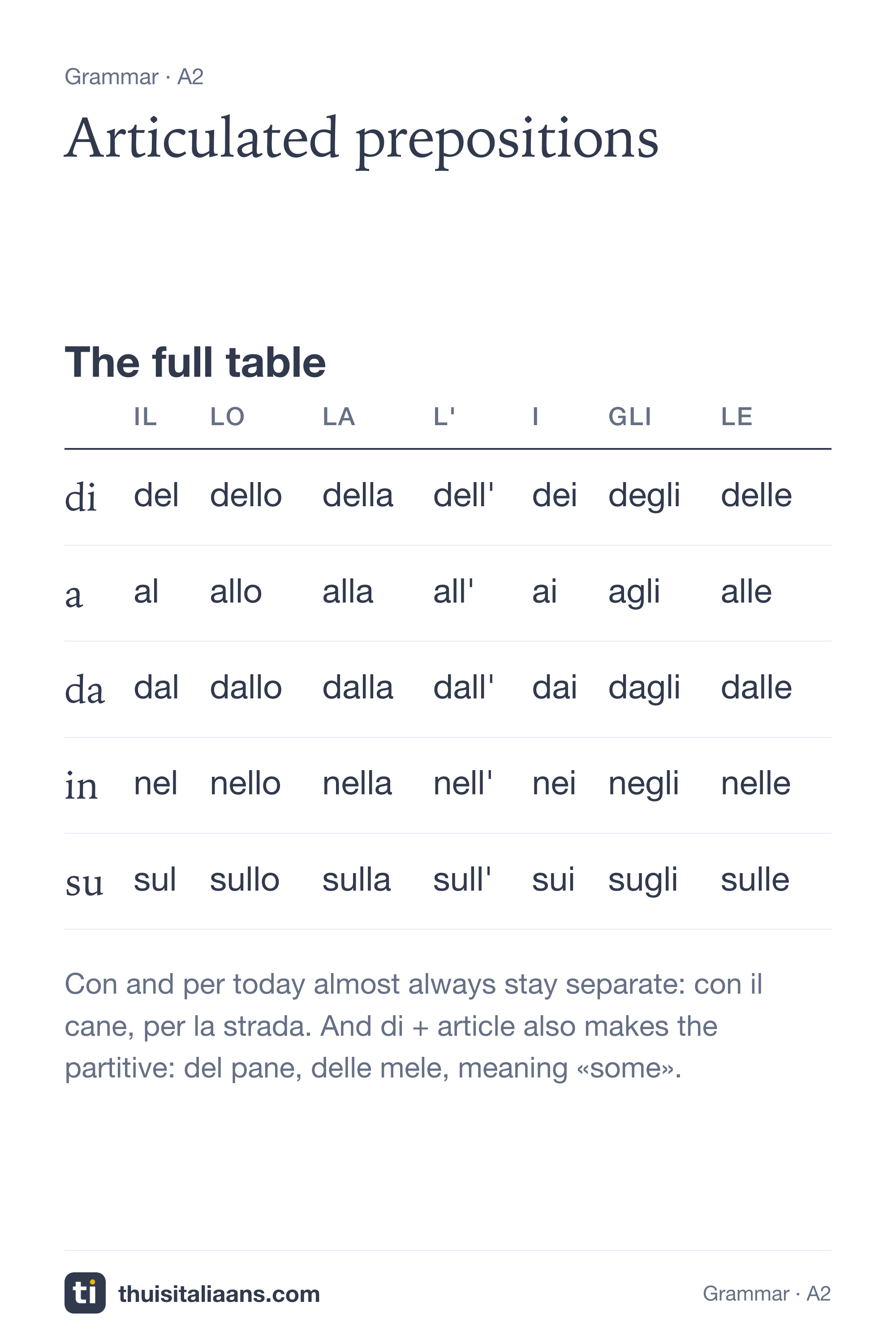
The full table
| il | lo | la | l' | i | gli | le | |
|---|---|---|---|---|---|---|---|
| di | del | dello | della | dell' | dei | degli | delle |
| a | al | allo | alla | all' | ai | agli | alle |
| da | dal | dallo | dalla | dall' | dai | dagli | dalle |
| in | nel | nello | nella | nell' | nei | negli | nelle |
| su | sul | sullo | sulla | sull' | sui | sugli | sulle |
Out in nature
| Sentence | Merge |
|---|---|
| camminiamo nel bosco | in + il |
| il rifugio è sulla cima | su + la |
| torniamo dal lago al tramonto | da + il |
| il sentiero parte dagli alberi grandi | da + gli |
| l’acqua della cascata è gelida | di + la |
The most common mistakes
vado a il mare→ vado al mare (a + il = al)il sentiero passa in il bosco→ passa nel bosco (in + il = nel)sullo spiaggia→ sulla spiaggia (la spiaggia is feminine)
Did you know?
Read and understand
This chapter’s grammar. Example: the library sign.
BIBLIOTECA CIVICA
Orari e servizi
Aperturadal lunedì al venerdì, dalle 9.00 alle 19.00
Sabatosolo la mattina, fino all'una
Sala studioal primo piano, in silenzio
Bambininella sala piccola; sullo scaffale basso i nuovi arrivi
Prestitotre libri alla volta, per un mese
Nel mese di agosto la biblioteca resta chiusa.
Questions
Fino a che ora è aperta il sabato?
Quanti libri si possono prendere in prestito?
«Dalle 9.00 alle 19.00»: «dalle» è…
Completa: «I libri nuovi sono ___ scaffale» (su + lo).

Exercises
Five exercises in order of difficulty. The last ones bring back what you have already seen.
01 La tabella
Join preposition and article.
- a + il →
- di + la →
- in + i →
- da + lo →
- su + le →
- a + l’ →
- di + gli →
- in + la →
02 Dove sono le cose
Complete with the combined preposition.
- Il libro è tavolo. (su)
- Le chiavi sono borsa. (in)
- Il gatto è divano. (su)
- I bicchieri sono armadio. (in)
- La macchina è garage. (in)
- I quaderni sono zaini. (in)
03 Andare, venire, tornare
Complete with a / in, simple or combined.
- Vado cinema.
- Vado Roma.
- Torno ufficio.
- Torno ufficio di Marco.
- Vengo stazione.
- Andiamo montagna.
04 Di chi, di che cosa
Complete with di, simple or combined.
- È il libro professore.
- È un libro storia.
- La casa mie amiche è grande.
- Parliamo vacanze.
- Parliamo lavoro.
- Il colore occhi.
05 Istruzioni per arrivare
Complete with simple and combined prepositions, and the verbs in the future.
Review futuro semplice · A1: preposizioni semplici
- (tu / scendere) terza fermata.
- Poi (andare) dritto fino semaforo.
- La casa è destra, accanto farmacia.
- Il codice portone è 1974.
- (io / aspettarti) secondo piano.
- Se (tu / perdersi) , (chiamarmi) .
These five are a taste. There are over seven hundred on the site, free and with no sign-up. All the exercises →

Every topic, a world
In the  amo Italian app, grammar is practised inside thematic pathways with field-specific vocabulary: il bar, i trasporti, il calcio, la moda, la burocrazia and seventeen more. Choose your world and the grammar comes along by itself, explained in your language too.
Half the path free, no sign-up
★★★★★(11)by Alessio, teacher since 2018
Downloadamo Italian for iPhone ↗︎Search for amo Italian

Read and understand
This chapter’s grammar. Example: an article on the flower festival.
La Gazzetta della Domenica
sabato 3 maggio · pagina 12
In città
Torna la festa dei fiori
di Marco Belli
Dal 10 al 12 maggio il centro si riempie di banchi e profumi. Si comincia venerdì alle 16 nei giardini bassi, con i vivai della costa.
Sabato i banchi salgono sul corso: cento espositori, dall'alba al tramonto.
Domenica il gran finale nella piazza grande: alle 18 la pioggia di petali dai balconi del municipio.
Questions
Quando comincia la festa?
Da dove scende la pioggia di petali?
«Dai balconi»: «dai» è…
Completa: «Il treno parte ___ binario tre» (da + il).
Want another text on this topic? The museum ticket · Italian opening hours
One more go
Merge preposition and article:
- Facciamo un picnic parco.
- Il rifugio è montagna più alta.
- Torniamo lago prima del buio.
- Le foglie alberi stanno cambiando colore.
- C’è ancora acqua nella borraccia? Anzi: acqua.
Frequently asked questions
Are col and coi correct?
Yes: col (con + il) and coi (con + i) are accepted and common, especially in speech and informal writing: col treno, coi bambini. The other fusions of con (collo, colla, cogli) are archaic: write them separated.
How do I say “in 1990” or “in the nineties”?
With in + il: nel 1990, negli anni Novanta. Years always carry the article, so the preposition merges: nel Duemila, nell'85. Same logic for centuries: nel Novecento (in the twentieth century).
What does dal panettiere mean?
“At/to the baker’s”: da + a person or profession means their place: vado dal medico, sono dal parrucchiere, ceniamo da Gino. With a name, no article (da Gino); with a profession, article merged (dal, dalla).
 The full table