

Grammar · A1
Numbers, dates and time
by Alessio · teacher of Italian as a foreign language, ITALS master’s

Numbers, dates and time open every counter window: a form, an appointment, a revenue stamp. The rules are few; the traps are ventuno, where venti drops its i, and clock times taking a plural verb.
- 5min reading
- 20min exercises
- A1level
What you learn
- Numbers from one to a thousand, and the ordinals
- Dates and clock times the Italian way
- The numbers you need right away
- Vocabulary: la burocrazia
Italian and English side by side
Two habits to unlearn. Dates run day-month-year, so 4/5 is the fourth of May, not the fifth of April, and the first of the month is the only ordinal: il primo maggio, then il due, il tre. The clock uses the twenty-four hour system and a plural verb: sono le quattordici, with è only for l'una, mezzogiorno and mezzanotte.
Take this page with you
This chapter’s sheet as a printable PDF (in English, with the Italian explanation as an appendix): rules, typical mistakes and the quiz with answers. It comes with the full course, or with all 61 sheets in one purchase. This page stays free, exercises included.
With the full course, all 61 sheets are already included.
See the sheet previews →


The words on this page
Drag each Italian word onto its definition, or tap a word first, then its box.
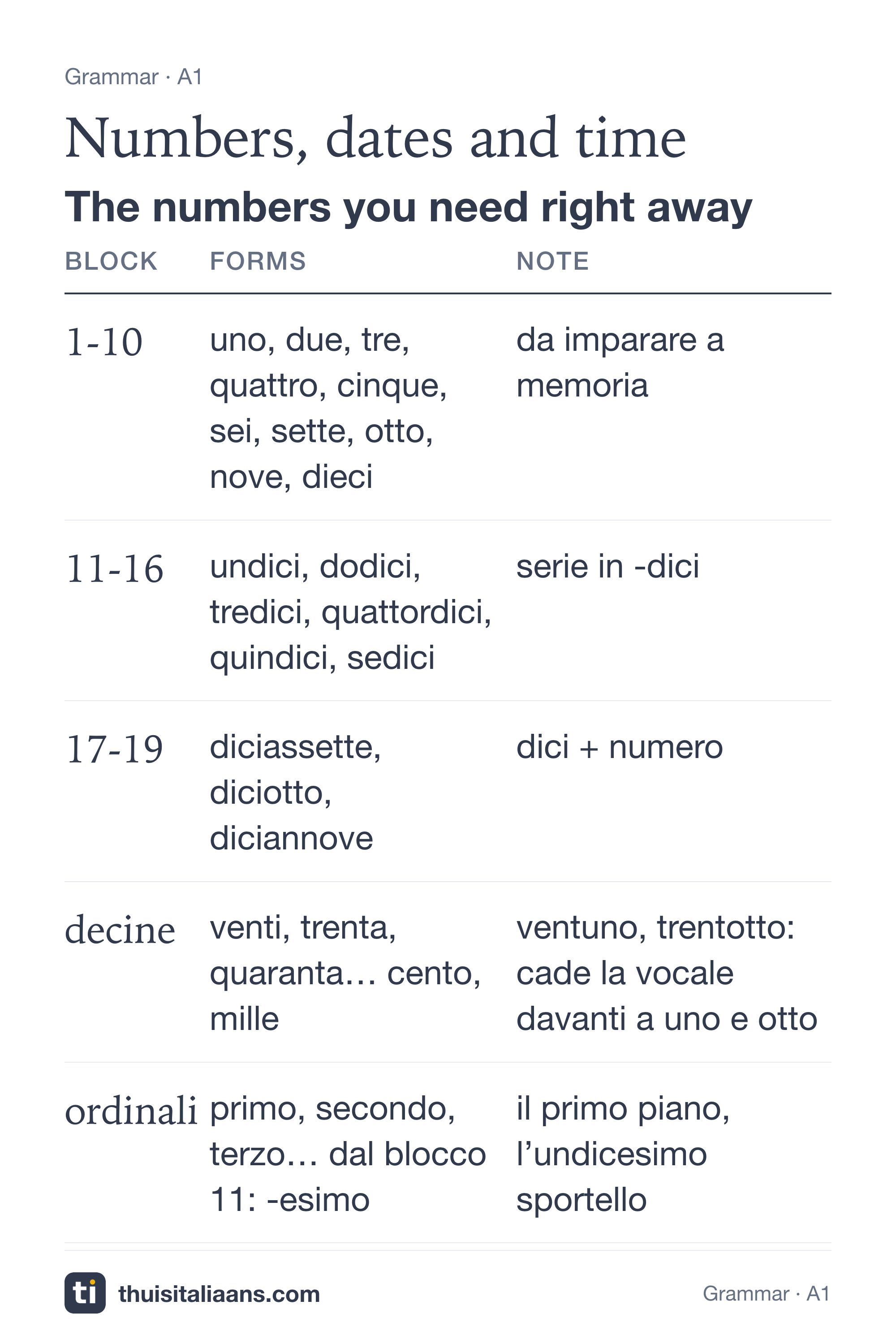
The numbers you need right away
| Block | Forms | Note |
|---|---|---|
| 1-10 | uno, due, tre, quattro, cinque, sei, sette, otto, nove, dieci | learn them by heart |
| 11-16 | undici, dodici, tredici, quattordici, quindici, sedici | the -dici series |
| 17-19 | diciassette, diciotto, diciannove | dici + number |
| tens | venti, trenta, quaranta… cento, mille | ventuno, trentotto: the vowel drops before uno and otto |
| ordinals | primo, secondo, terzo… from 11 on: -esimo | il primo piano, l’undicesimo sportello |
Telling the time
| Time | You say |
|---|---|
| 8:00 | sono le otto |
| 8:15 / 8:30 / 8:45 | le otto e un quarto, le otto e mezza, le nove meno un quarto |
| 13:00 | è l’una |
| 12:00 / 24:00 | è mezzogiorno / è mezzanotte |
At what time? The small words
Offices give times with one little word, and each one means something different. They are worth ten seconds.
| Word | Meaning | Example |
|---|---|---|
| alle | at | l’ufficio apre alle nove |
| verso le | around | arrivo verso le otto |
| entro le | by, no later than | consegni il modulo entro le dodici |
| dalle… alle… | from… to… | aperto dalle nove alle tredici |
| fino alle | until | siamo aperti fino alle diciotto |
| dopo le | after | non rispondo dopo le dieci |
The most common mistakes
ventiuno euro→ ventun euro / ventuno: before uno the tens drop their vowelè le otto→ sono le otto (plural hours take sono)il due di Maggio→ il 2 maggio (no di, month in lowercase)
Did you know?
Read and understand
This chapter’s grammar. Example: a museum sign.
Museo Civico
Orari e biglietti
lunedìchiuso
da martedì a venerdì9.00 – 18.30
sabato e domenica10.00 – 20.00
intero8 euro
ridotto5 euro
Ultimo ingresso alle 19.30. Il 1° maggio e il 25 dicembre il museo è chiuso. Gratis sotto i diciotto anni.
Questions
Quando è chiuso il museo?
Il biglietto «ridotto» è un biglietto che…
Come si dice «13.00» parlando?

Exercises
Five exercises in order of difficulty. The last ones bring back what you have already seen.
01 Scrivi il numero
Write it out in words.
- 7 →
- 15 →
- 21 →
- 33 →
- 100 →
- 1.000 →
- 2.500 →
02 Che giorno è
Write the date the way Italian says it.
- 1/1 →
- 3/3 →
- 8/8 →
- 11/11 →
- 25/12 →
- oggi →
03 Che ore sono
Write the time. Careful: it is almost always sono le, but three cases are exceptions.
- 3:00 →
- 1:00 →
- 12:00 (giorno) →
- 00:00 →
- 7:30 →
- 9:45 →
04 Quanto costa, quanti anni
Complete with numbers and verbs.
- Il caffè (costare) 1,20 €:
- (io / avere) 28 anni.
- Il mio numero 340 12 34 567.
- L’appartamento 65 metri quadri.
- Siamo 2026.
- Il treno alle 14:20.
05 La settimana di Luca
Complete with times, dates, prepositions and verbs in the present.
Review simple prepositions · present tense · essere and avere
- Luca (lavorare) lunedì venerdì.
- (lui / cominciare) 9:00 e (finire) 18:00.
- Il martedì lezione di italiano 19:30.
- 15 marzo (lui / partire) Roma.
- sabato (loro / andare) al mare: tre amici.
- La domenica non niente da fare: a casa.
These five are a taste. There are over seven hundred on the site, free and with no sign-up. Pick your next exercise →

Every topic, a world
In the  amo Italian app, grammar is practised inside thematic pathways with field-specific vocabulary: il bar, i trasporti, il calcio, la moda, la burocrazia and seventeen more. Choose your world and the grammar comes along by itself, explained in your language too.
Half the A1 course free, no sign-up
★★★★★(29)by Alessio, teacher since 2018
Downloadamo Italian for iPhone ↗︎Search for amo Italian

Read and understand
This chapter’s grammar. Example: a receipt with numbers and times.
COMUNE DI BOLOGNA
Ufficio anagrafe · sportello 4
14/03/2026 09.15TICKET N. A 042
Sportelli aperti4
Persone in attesa11
Attesa stimata25 minuti
Chiusura sportelli12.30
Diritti di segreteria16,00
Il 1° gennaio e il 25 dicembre gli uffici sono chiusi. Sportello prioritario per over 65.
Questions
Quante persone sono in attesa?
«Il 1° gennaio» si legge…
Sono le 12.45: puoi ancora prendere un ticket?
Want another text on this topic? Train times at the station · The cinema ticket
One more go
Fill in:
- Lo sportello apre otto e mezza.
- le undici: l’ufficio chiude tra un’ora.
- L’appuntamento è 3 maggio.
- La marca da bollo costa euro.
- Prenda il numero: è il della fila.
Frequently asked questions
Why ventuno and ventotto, but ventidue?
How do I read a year out loud?
Why do Italian prices use a comma: € 9,50?
How do Italians read out a phone number?
Do Italians say a.m. and p.m.?
How do I say “on Monday”? And are the days masculine?
Why due euro and not due euros?
What is il Trecento?
 The numbers you need right away
Sources and method
This chapter is written from classroom practice and follows level A1 of the Common European Framework of Reference. For further reading:
- Treccani, La grammatica italiana: Italian reference grammar, online
- Council of Europe, CEFR Companion Volume (2020): level descriptions

Alessio
- ITALS master’s, Università Ca’ Foscari Venezia
- Master’s in Italian as a second language, Università Giustino Fortunato (Benevento)
- Teaching since 2018 · 45 reviews