

Grammar · A2
The simple future
by Alessio · teacher of Italian as a foreign language, ITALS master’s

The future says what will happen: l’anno prossimo cambierò lavoro. It has the same endings for every conjugation, a handful of irregular stems, and a second job: making guesses (sarà in riunione).
- 5min reading
- 17min exercises
- A2level
What you learn
- tu, lui / lei, noi, voi, loro
- When to use the simple future
- The most common mistakes
- Vocabulary: il lavoro e la carriera
Italian and English side by side
English usually says the future with will or going to. Italian has a real future tense with its own endings: partirò. It also uses it for guesses about the present, which English does with must be: saranno le tre means it must be three o'clock.
Take this page with you
This chapter’s sheet as a free printable PDF (tables in Italian): rules, typical mistakes and the quiz with answers. A teacher’s tip: grammar sticks by reviewing it often, not by studying it once.
The futuro looks ahead of now: domani partirò.


The words on this page
Drag each Italian word onto its definition, or tap a word first, then its box.
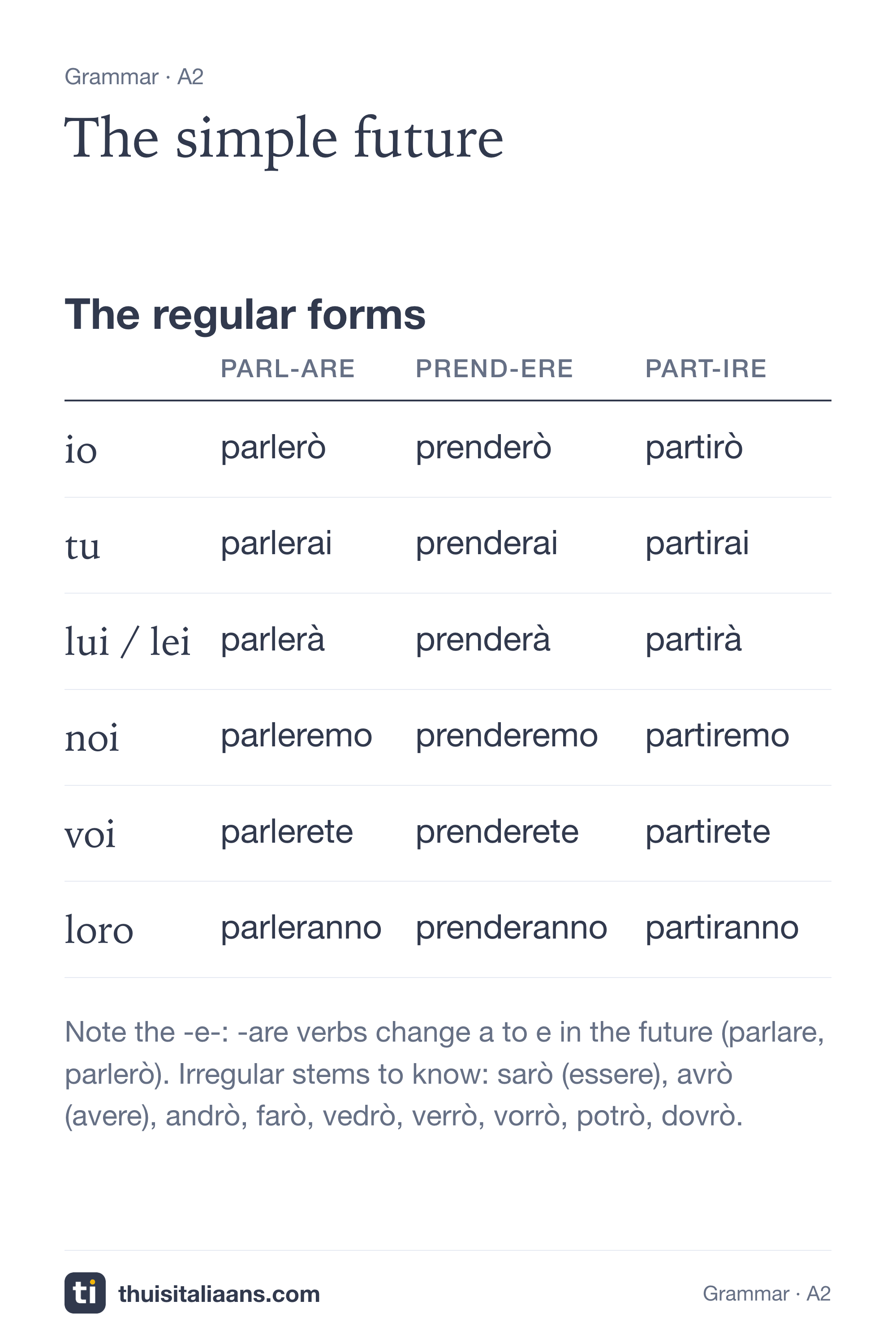
The regular forms
| parl-ARE | prend-ERE | part-IRE | |
|---|---|---|---|
| io | parlerò | prenderò | partirò |
| tu | parlerai | prenderai | partirai |
| lui / lei | parlerà | prenderà | partirà |
| noi | parleremo | prenderemo | partiremo |
| voi | parlerete | prenderete | partirete |
| loro | parleranno | prenderanno | partiranno |
The future’s two jobs
| Use | Work example |
|---|---|
| piani e promesse | il mese prossimo inizierò il nuovo lavoro |
| previsioni | il colloquio andrà benissimo, vedrai |
| ipotesi sul presente | il capo non risponde: sarà in riunione |
| dopo se e quando (futuro doppio) | quando avrò l’offerta, deciderò |
The most common mistakes
domani parlarò con il capo→ domani parlerò con il capo (the a becomes e)l’anno prossimo andarò a Milano→ andrò a Milano (irregular stem)quando avrò i risultati, decido→ quando avrò i risultati, deciderò (future in both clauses)
Did you know?
Read and understand
This chapter’s grammar. Example: a weather website.
Che tempo farà
Domani sarà una giornata instabile: la mattina pioverà sulla città, ma nel pomeriggio il cielo si aprirà.
Le temperature saliranno fino a 21 gradi. Il vento soffierà debole da est.
Nel weekend tornerà il sole: sabato avremo cielo pieno e domenica farà quasi caldo, 26 gradi.
Il consiglio: l'ombrello domani servirà solo la mattina.
Questions
Quando pioverà, domani?
Che tempo farà nel weekend?
«Saliranno» è il futuro di…
Metti al futuro: «Domenica noi ___ al mare» (andare).

Exercises
Five exercises in order of difficulty. The last ones bring back what you have already seen.
01 Le tre coniugazioni
Complete with the future. Careful: -are becomes -erò.
- io (parlare)
- tu (prendere)
- lui (dormire)
- noi (lavorare)
- voi (scrivere)
- loro (partire)
02 Gli irregolari più usati
Complete.
- io (essere)
- tu (avere)
- lei (fare)
- noi (andare)
- voi (venire)
- loro (potere)
- io (volere)
- tu (dovere)
03 Progetti
Complete with the future.
- L’anno prossimo (io / cambiare) casa.
- (noi / andare) in Italia a giugno.
- (tu / venire) con noi?
- Marco (finire) l’università a ottobre.
- (esserci) molta gente alla festa.
- (loro / arrivare) domani sera.
04 Il futuro che indovina
In Italian the future is also used to guess about the present. Complete.
- Che ore sono? — (essere) le tre.
- Quanti anni ha? — (avere) trent’anni.
- Dov’è Marco? — (essere) ancora al lavoro.
- Quanto costa? — (costare) venti euro.
- Perché non risponde? — (dormire) .
- Chi è? — (essere) il postino.
05 Il viaggio dell’anno prossimo
Complete with the future, pronouns and possessives.
Review possessivi · pronomi diretti · pronomi indiretti
- L’anno prossimo (noi / partire) per la Sicilia.
- (io / prenotare) i biglietti a gennaio: compro online.
- mie sorelle (venire) con noi.
- (noi / stare) da loro amici a Palermo.
- (a loro) (piacere) molto avere ospiti.
- (essere) due settimane belle, spero.
These five are a taste. There are over seven hundred on the site, free and with no sign-up. All the exercises →

Every topic, a world
In the  amo Italian app, grammar is practised inside thematic pathways with field-specific vocabulary: il bar, i trasporti, il calcio, la moda, la burocrazia and seventeen more. Choose your world and the grammar comes along by itself, explained in your language too.
Half the path free, no sign-up
★★★★★(11)by Alessio, teacher since 2018
Downloadamo Italian for iPhone ↗︎Search for amo Italian

Read and understand
This chapter’s grammar. Example: the newspaper horoscope.
La Gazzetta della Domenica
domenica 22 marzo · pagina 31
Oroscopo
La settimana che verrà
di Stella Levante
Lavoro: una collega vi farà una proposta strana. Non rispondete subito: la risposta giusta arriverà da sola giovedì.
Amore: chi è solo conoscerà una persona interessante in un luogo pieno di libri. Chi è in coppia dovrà avere pazienza fino a sabato.
Soldi: spenderete troppo per una cosa che non serve. Lo sapete già.
Fortuna: le stelle saranno dalla vostra parte, ma solo dopo il caffè.
Questions
Quando arriverà la risposta giusta, sul lavoro?
Dove potrà succedere l'incontro interessante?
«Dovrà» è il futuro di…
Completa: «Tra dieci anni le città ___ più verdi» (essere).
Want another text on this topic? The weather forecast · The electricity bill
One more go
Put into the future:
- L’anno prossimo (io) lavoro.
- Il colloquio bene, vedrai.
- Quando la risposta, chiamami.
- (Noi) un brindisi per la promozione.
- I colleghi alla festa di addio.
Frequently asked questions
How do I ask someone to do something, like “will you open the door?”
Not with the future: Italian asks in the present: mi apri la porta? mi passi il sale? The English “will” of requests has no Italian mirror: using the future there (mi aprirai la porta?) sounds like a prophecy, not a favour.
After quando, do I use the present or the future?
The future, in both halves: quando arriverò, ti chiamerò. English hides the future after “when” (“when I arrive”); Italian shows it twice. Same with appena (as soon as): appena saprò qualcosa, ti scrivo.
What is the futuro anteriore?
The “will have done” tense: future of the auxiliary + participle: alle otto avrò finito (by eight I’ll have finished), appena sarò arrivato, ti chiamo. It marks what will already be complete before another future moment: useful, and built from pieces you already own.
 The regular forms