Italiano in pratica
by Alessio · teacher of Italian for foreigners, ITALS master’s in teaching Italian abroad (Ca’ Foscari University, Venice) and a master’s in teaching Italian as a second language (Giustino Fortunato University, Benevento)
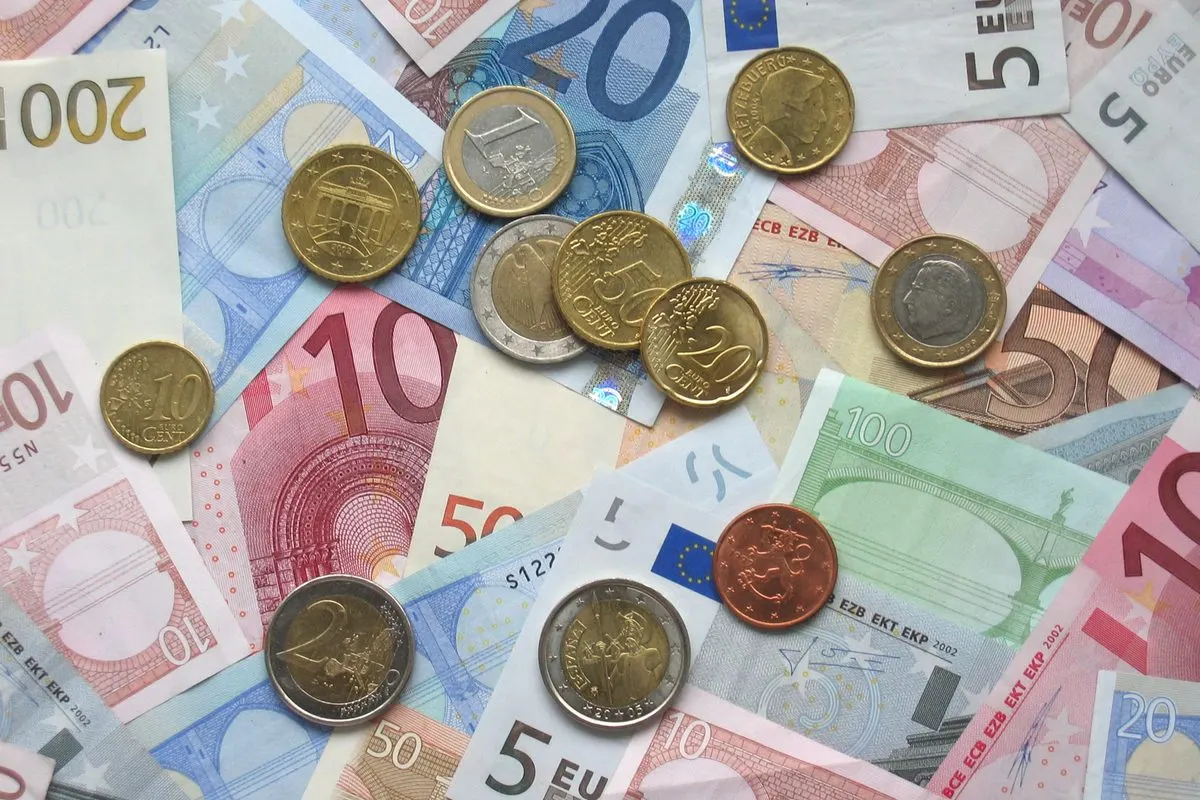
Cards are accepted almost everywhere, and shops are required to take them, but small places still prefer cash for small amounts. At a cash machine or card terminal that offers to charge you in your own currency, choose euro: the conversion offered is usually worse. Big notes, €100 or more, are often refused for small purchases.
Paying is the one thing you do twenty times a day on holiday. In Italy it's mostly easy, with a few habits that catch visitors out: the question about the card, the cash machine that offers you a "guaranteed" exchange rate, and the bar that looks at your €50 note for a coffee.
Here's how to pay, what to choose at the machine, and the closed questions that avoid surprises.
| Italian | English |
|---|---|
| Posso pagare con la carta? | Can I pay by card?answer: sì or no |
| Accettate il contactless? | Do you take contactless?answer: sì or no |
| C'è un bancomat qui vicino? | Is there a cash machine near here?answer: sì or no |
| Ha da cambiare cinquanta euro? | Do you have change for fifty euros?answer: sì or no |
| Pago in euro. | I'll pay in euro.when asked about your currency |
| C'è una commissione? | Is there a fee?answer: sì or no |
| Mi scusi, il resto non è giusto. | Excuse me, the change isn't right. |
| Lo scontrino, per favore. | The receipt, please. |
Read the Italian out loud once before you need it. The questions marked sì or no get a one-word answer you can understand.
Both. Shops, restaurants and taxis are required to accept cards, and contactless is widespread. Cash is still common for small amounts: a coffee, a newspaper, a market stall. Ask before you order if you only have a card: posso pagare con la carta?
In everyday Italian bancomat means both the cash machine and the debit card: pago con il bancomat is «I'll pay by debit card».
| You say | English |
|---|---|
| Posso pagare con la carta? | Can I pay by card?sì or no |
| Accettate il contactless? | Do you take contactless?sì or no |
| Pago in contanti. | I'll pay cash. |
| You hear | English |
|---|---|
| Bancomat o carta di credito? | Debit or credit card?a choice of two |
| Avvicini la carta. | Hold the card near the reader.contactless |
| Inserisca il PIN. | Enter your PIN. |
Bank cash machines are called bancomat or ATM; most have English on screen. Prefer machines in or next to a bank: some private machines in tourist areas charge high fees. If the screen offers to charge you in your own currency, choose euro.
The screen question is often vuoi l'addebito nella tua valuta?, do you want to be charged in your currency? Say no: your own bank's conversion is usually better than the one the machine offers.
| You say | English |
|---|---|
| C'è un bancomat qui vicino? | Is there a cash machine near here?sì or no |
| C'è una commissione? | Is there a fee?sì or no |
| Il bancomat ha trattenuto la carta. | The cash machine has kept my card. |
| You hear | English |
|---|---|
| C'è un bancomat in piazza. | There's a cash machine in the square. |
| Prelievo · saldo | Withdrawal · balanceon the screen |
In euro. When a card terminal in a shop or restaurant asks whether to charge you in pounds, dollars or another currency, it's offering a conversion that is usually more expensive than your bank's. Say pago in euro.
If the waiter asks the question and you're not sure, the safe answer is always the same: in euro, grazie.
| You say | English |
|---|---|
| Pago in euro. | I'll pay in euro. |
| In euro, grazie. | In euro, thanks. |
| You hear | English |
|---|---|
| In euro o in sterline? | In euro or in pounds?choose euro |

In the  amo Italian app you practise inside real-life pathways: il bar, il ristorante, i trasporti, la casa and more, with listening, dialogues and the grammar explained in English. This page gives you the phrases; the app trains your ear.
Half the A1 course free, no sign-up
★★★★★(22)by Alessio, teacher since 2018
Downloadamo Italian for iPhone ↗︎Search for amo Italian
Small shops and bars often can't change big notes: €100 and €200 notes may be refused for small purchases, and even €50 for a coffee gets a sigh. Ask first: ha da cambiare cinquanta euro? Coins are spiccioli or monete.
Check your change at the counter, not on the street: mi scusi, il resto non è giusto is polite and normal.
| You say | English |
|---|---|
| Ha da cambiare cinquanta euro? | Do you have change for fifty euros?sì or no |
| Ho solo una banconota da cento. | I only have a hundred-euro note. |
| Mi scusi, il resto non è giusto. | Excuse me, the change isn't right. |
| You hear | English |
|---|---|
| Non ho da cambiare. | I don't have change.no |
| Ha spiccioli? | Do you have small change?sì or no |
| Non accettiamo banconote da cento. | We don't accept hundred-euro notes. |

Shops and restaurants must give you a receipt, lo scontrino. Tips are not compulsory: rounding up is enough. To split a restaurant bill equally, facciamo alla romana; separate payments are not always possible in small places.
See the restaurant and bar guides for coperto, servizio and paying at the till.
| You say | English |
|---|---|
| Lo scontrino, per favore. | The receipt, please. |
| Tenga il resto. | Keep the change. |
| Possiamo pagare separatamente? | Can we pay separately?sì or no |
| You hear | English |
|---|---|
| Insieme o separati? | Together or separately?a choice of two |
| Le serve la fattura? | Do you need an invoice?sì or no |
Italy has moved towards cards quickly, but cash keeps a hold that surprises visitors from Sweden, the Netherlands or Britain. In the European Central Bank's 2024 survey of payment habits, cash was used for about 61 per cent of payments in Italian shops, against 52 per cent across the euro area. It is most common for small amounts: the coffee, the newspaper, the market stall.

The law pushes both ways. Since June 2022 shops, restaurants and taxis must accept card payments of any amount, and refusing one can bring a fine. At the same time there is a ceiling on cash: a single payment of €5,000 or more can't be made in cash. Behind both rules is the fight against tax evasion, a debate that returns to Italian politics every year.
Small change has its own story. Italy stopped minting 1 and 2 cent coins in 2018, because they cost more to make than they are worth. They are still legal tender, but when you pay the whole bill in cash the total is rounded to the nearest five cents: €10.42 becomes €10.40, and €10.48 becomes €10.50. Card payments are charged to the cent. Keep a few coins for coffee, the supermarket trolley and the turnstile of a public toilet.
Read next: Why do Italian shopkeepers serve you instead of letting you browse? · Why does nobody bring you the bill in an Italian restaurant?
Italians rarely answer with a bare sì or no. These are the forms you will actually hear, so you know which way the answer went.
| You hear | English | It means |
|---|---|---|
| Sì, certo. | Yes, of course. | yes |
| Certo! | Sure! | yes |
| Come no! | Of course! (literally: how not?) | yes |
| Volentieri. | Gladly. | yes |
| Va bene. | Fine, OK. | yes |
| Prego. | Go ahead / please do. | yes |
| No, mi dispiace. | No, I'm sorry. | no |
| Purtroppo no. | Unfortunately not. | no |
| Non c'è. | There isn't any. | no |
| È finito. | It's sold out / all gone. | no |
| Non si può. | That's not allowed. | no |
| Non ancora. | Not yet. | no |
Six real replies. Tap Yes or No for each one.
The grammar behind them
This guide as two printable pages, in English: the phrases to say, the yes/no questions and what you will hear.
All 43 phrase PDFs · €9Already included in the full course · €39 a year.
Or keep the eight phrases as an image, to save on your phone or pin:
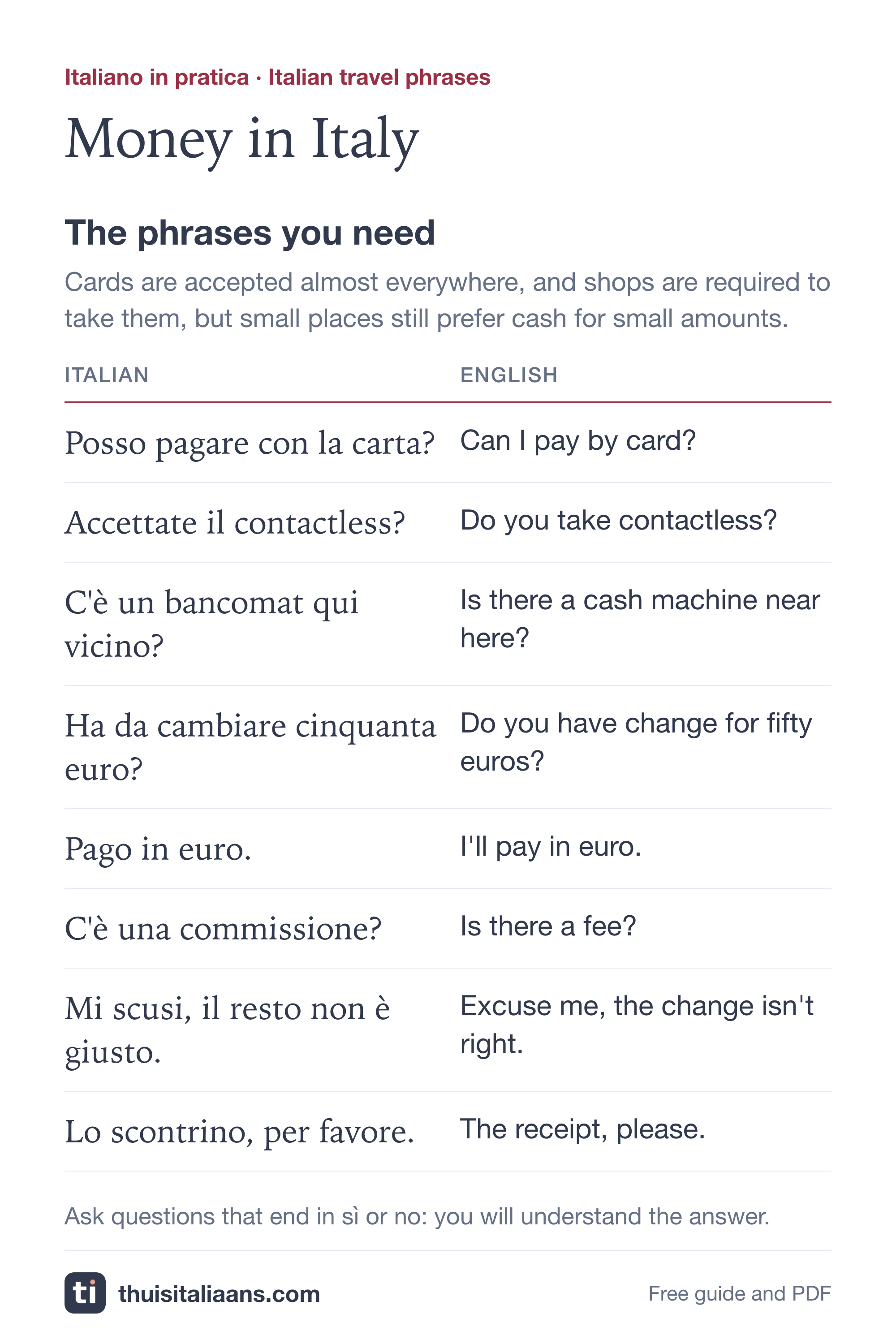 Italian phrases: Money in Italy
Not much: cards are accepted almost everywhere and shops must take them. Keep some cash for small amounts such as a coffee or a market stall.
In euro. The conversion offered by card terminals and cash machines is usually worse than your own bank's.
Both the cash machine and the debit card. «Pago con il bancomat» means «I'll pay by debit card».
Often not for small purchases: small shops and bars may refuse €100 and €200 notes. Ask «Ha da cambiare?» first.