Italiano in pratica
by Alessio · teacher of Italian for foreigners, ITALS master’s in teaching Italian abroad (Ca’ Foscari University, Venice) and a master’s in teaching Italian as a second language (Giustino Fortunato University, Benevento)
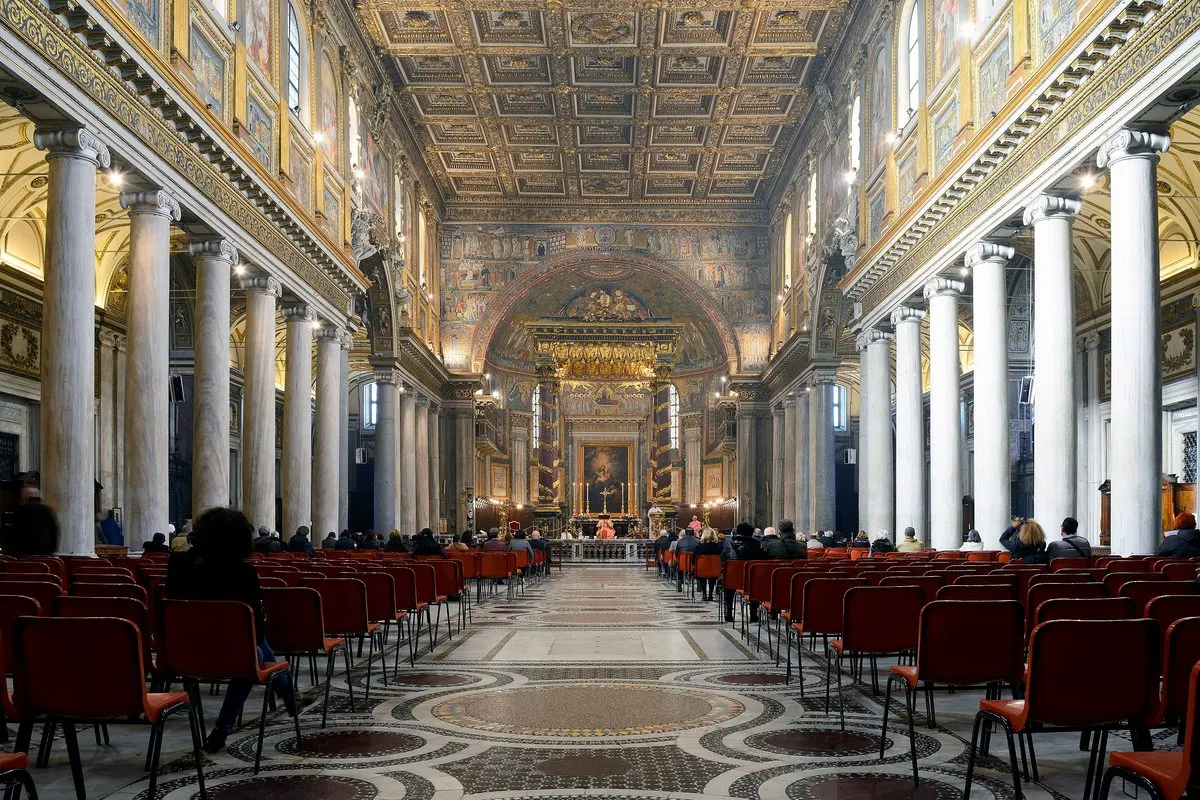
Churches are places of worship before they are museums: shoulders and knees covered, hats off, voices low, and no visits during Mass, la messa. Most churches are free; the big cathedrals often charge for parts of the visit and use timed tickets.
Some of the best art in Italy is in churches, often free, often empty, sometimes closed at lunchtime. A few rules of behaviour open almost every door, and a couple of closed questions do the rest.
Here's what to wear, when to go, how tickets work in the big cathedrals, and the questions to ask at the door.
| Italian | English |
|---|---|
| Si può entrare? | Can I come in?answer: sì or no |
| C'è la messa adesso? | Is there a Mass now?answer: sì or no |
| A che ora chiude la chiesa? | What time does the church close? |
| Il biglietto si fa qui? | Do you buy the ticket here?answer: sì or no |
| Si possono fare foto? | Can you take photos?answer: sì or no |
| Va bene così? | Is this OK?about your clothes |
| Si può salire sul campanile? | Can you go up the bell tower?answer: sì or no |
| Grazie, buona giornata. | Thank you, have a nice day. |
Read the Italian out loud once before you need it. The questions marked sì or no get a one-word answer you can understand.
Shoulders and knees covered, for men and women, and hats off for men. In the Vatican, St Mark's in Venice and many cathedrals the rule is checked at the door; elsewhere it's expected. A light scarf in your bag solves it in summer.
If you're stopped, ask a closed question: va bene se metto la sciarpa? Some cathedrals sell or lend paper shawls at the entrance.
| You say | English |
|---|---|
| Va bene così? | Is this OK?about your clothes |
| Va bene se metto la sciarpa? | Is it OK if I put the scarf on?sì or no |
| You hear | English |
|---|---|
| Le spalle vanno coperte. | Shoulders must be covered. |
| Con i pantaloncini non si entra. | You can't go in wearing shorts.no |
| Si tolga il cappello. | Please take off your hat. |
Tourists are welcome outside services: during Mass visitors are asked not to walk around. Many churches close at lunchtime, roughly from midday to three or four. Ask at the door: c'è la messa adesso?
Sunday mornings are for services; weekday mornings and late afternoons are the best times to visit.
| You say | English |
|---|---|
| C'è la messa adesso? | Is there a Mass now?sì or no |
| A che ora chiude la chiesa? | What time does the church close? |
| Si può entrare? | Can I come in?sì or no |
| You hear | English |
|---|---|
| Durante la messa non si visita. | No visits during Mass. |
| Riapriamo alle quattro. | We reopen at four. |

Most churches are free. The big cathedrals often charge for parts of the visit, such as the dome, the bell tower, the crypt or the museum, and some use timed tickets: Milan, Florence and Siena among them. Ask: il biglietto si fa qui?
For the dome and the bell tower, la cupola and il campanile, there are stairs, often hundreds of them, and sometimes no lift.
| You say | English |
|---|---|
| Il biglietto si fa qui? | Do you buy the ticket here?sì or no |
| L'ingresso è gratuito? | Is entry free?sì or no |
| Si può salire sul campanile? | Can you go up the bell tower?sì or no |
| C'è l'ascensore? | Is there a lift?sì or no |
| You hear | English |
|---|---|
| La chiesa è gratuita, la cupola si paga. | The church is free, the dome you pay for. |
| Sono quattrocento gradini. | It's four hundred steps. |

In the  amo Italian app you practise inside real-life pathways: il bar, il ristorante, i trasporti, la casa and more, with listening, dialogues and the grammar explained in English. This page gives you the phrases; the app trains your ear.
Half the A1 course free, no sign-up
★★★★★(22)by Alessio, teacher since 2018
Downloadamo Italian for iPhone ↗︎Search for amo Italian
Photos without flash are allowed in many churches, but not all and never during services: look for the sign, or ask si possono fare foto? Coin-operated lights, la luce a moneta, light up the paintings in side chapels for a minute or two.
Lighting a candle is done with an offering in the box next to it, l'offerta. It's fine for visitors to do it too.
| You say | English |
|---|---|
| Si possono fare foto? | Can you take photos?sì or no |
| Anche con il flash? | With flash too?usually no |
| Posso accendere una candela? | Can I light a candle?sì |
| You hear | English |
|---|---|
| Niente flash. | No flash. |
| Vietato fotografare. | No photography.on signs |
| L'offerta è libera. | Give what you like. |

An Italian church may hold a Raphael, or three Caravaggios, as San Luigi dei Francesi in Rome does, but it is first of all a place where people pray, and where Mass is said every day. The dress code follows from that: shoulders and knees covered, hats off for men, voices low. At St Peter's and at St Mark's in Venice guards check at the door and turn people away; elsewhere nobody stops you, but the regulars notice.

Religion runs through Italian life even for Italians who never go to Mass. Children are baptised, towns celebrate their patron saint with processions and fairs, and many Italians celebrate their onomastico, the feast of the saint they are named after, almost like a second birthday. Walk into a small church on a weekday morning and you will often find a few older people saying the rosary while visitors tiptoe past the frescoes.
Money works differently too. In England many great cathedrals charge for entry. In Italy most churches are free, and the few that charge, such as the cathedrals of Milan and Siena, use the money to look after buildings that cost a fortune to maintain; in Florence the cathedral itself is free and you pay for the dome. Small offerings keep the rest going: a coin for the light that shows a painting for a minute, or for a candle in front of a saint. Leaving one is fine, and appreciated.
Read next: Why is so much of Italy's art outside its museums? · What are the unwritten rules for photos in Italy?
Italians rarely answer with a bare sì or no. These are the forms you will actually hear, so you know which way the answer went.
| You hear | English | It means |
|---|---|---|
| Sì, certo. | Yes, of course. | yes |
| Certo! | Sure! | yes |
| Come no! | Of course! (literally: how not?) | yes |
| Volentieri. | Gladly. | yes |
| Va bene. | Fine, OK. | yes |
| Prego. | Go ahead / please do. | yes |
| No, mi dispiace. | No, I'm sorry. | no |
| Purtroppo no. | Unfortunately not. | no |
| Non c'è. | There isn't any. | no |
| È finito. | It's sold out / all gone. | no |
| Non si può. | That's not allowed. | no |
| Non ancora. | Not yet. | no |
Six real replies. Tap Yes or No for each one.
The grammar behind them
This guide as two printable pages, in English: the phrases to say, the yes/no questions and what you will hear.
All 43 phrase PDFs · €9Already included in the full course · €39 a year.
Or keep the eight phrases as an image, to save on your phone or pin:
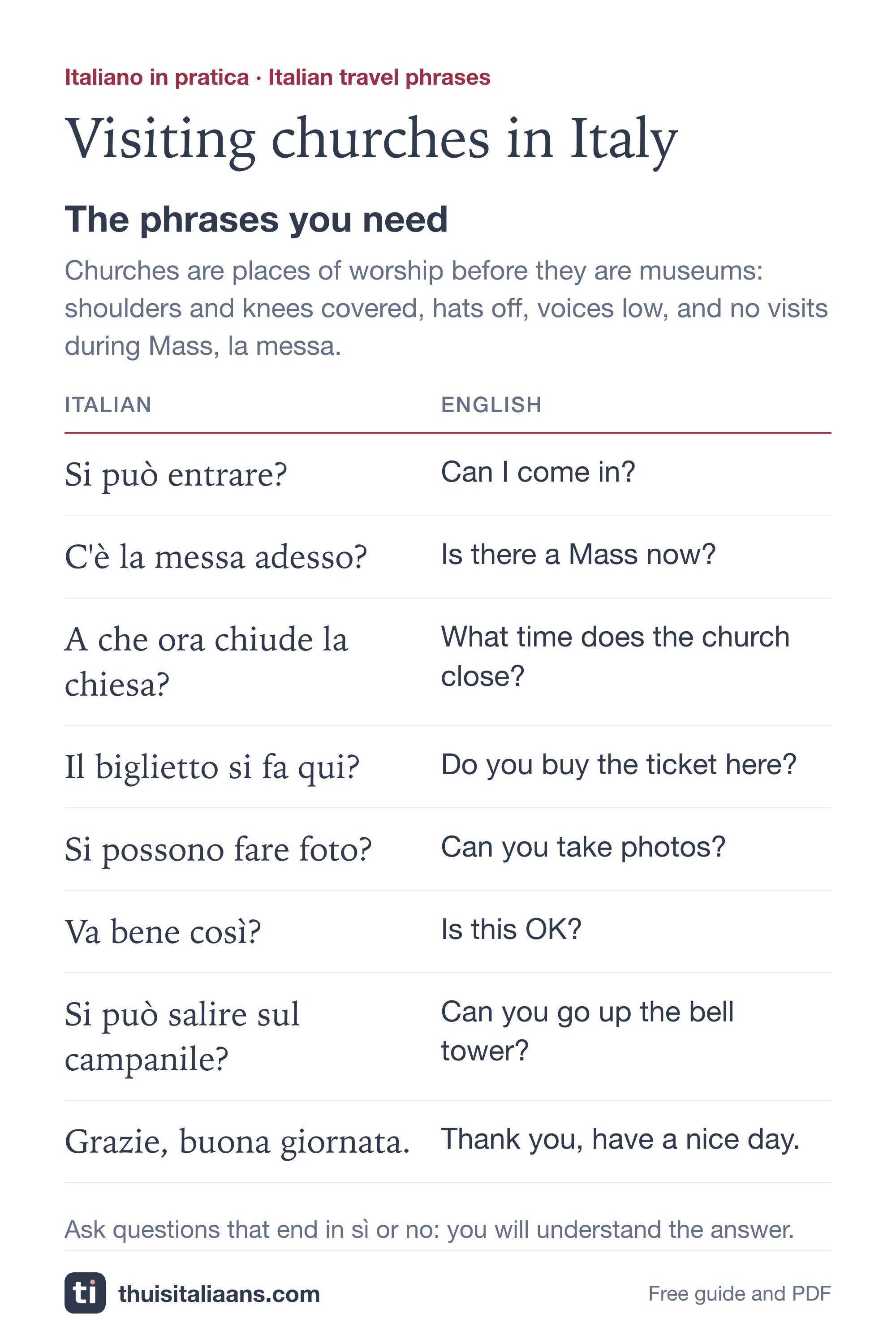 Italian phrases: Visiting churches in Italy
Shoulders and knees covered, for men and women, and hats off for men. It's checked at the door in the Vatican, St Mark's in Venice and many cathedrals.
Visitors are asked not to walk around during services. Visit on weekday mornings or late afternoons.
Most churches are free. Big cathedrals often charge for the dome, bell tower, crypt or museum, and some use timed tickets.
Often yes, without flash and not during services. Some churches forbid it: look for the sign.