Italiano in pratica
by Alessio · teacher of Italian for foreigners, ITALS master’s in teaching Italian abroad (Ca’ Foscari University, Venice) and a master’s in teaching Italian as a second language (Giustino Fortunato University, Benevento)
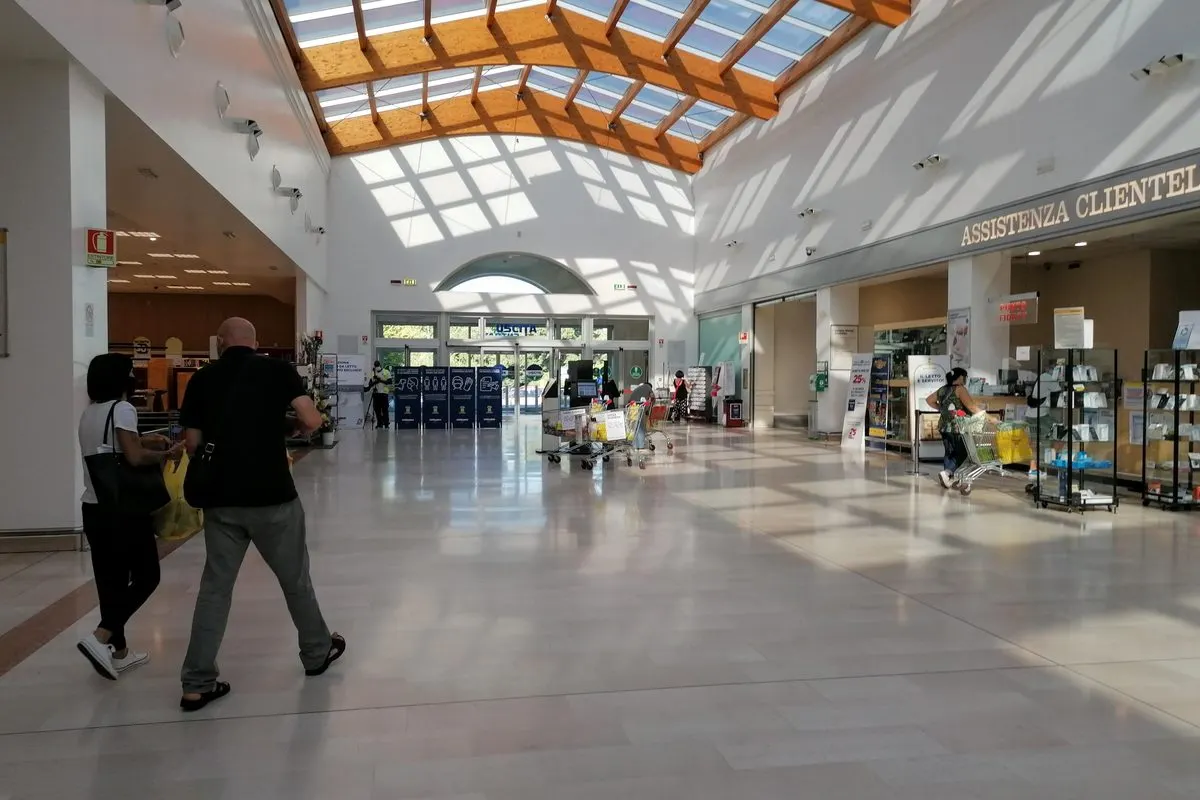
For loose fruit and vegetables, put on the disposable gloves and, in many supermarkets, weigh them yourself on the scale and stick the label on the bag. At the deli counter take a number. At the checkout expect two questions: ha la tessera? (loyalty card?) and whether you need a bag.
The supermarket feels familiar until you reach the fruit: gloves, a scale with pictures and numbers, and a queue at the till that stops because your bananas have no sticker.
Here's how it works, from the fruit to the deli counter to the checkout, with the two questions every cashier asks, both of them yes or no.
| Italian | English |
|---|---|
| Devo pesare la frutta? | Do I have to weigh the fruit?answer: sì or no |
| Dove sono i guanti? | Where are the gloves? |
| Il numerino, per favore. | The ticket number, please.at the deli counter |
| Un etto di prosciutto cotto. | A hundred grams of ham. |
| Avete il latte senza lattosio? | Do you have lactose-free milk?answer: sì or no |
| No, non ho la tessera. | No, I don't have the loyalty card. |
| Sì, una busta, grazie. | Yes, a bag, thanks. |
| Posso pagare con la carta? | Can I pay by card?answer: sì or no |
Read the Italian out loud once before you need it. The questions marked sì or no get a one-word answer you can understand.
Put on the disposable gloves from the dispenser, choose, and bag the fruit in the thin compostable bags, which cost a cent or two. In many supermarkets you then weigh it on the scale yourself: press the number or picture of the product and stick the printed label on the bag.
If there's no scale in the fruit section, it's weighed at the till. When in doubt: devo pesare la frutta?
| You say | English |
|---|---|
| Devo pesare la frutta? | Do I have to weigh the fruit?sì or no |
| Dove sono i guanti? | Where are the gloves? |
| Dov'è la bilancia? | Where's the scale? |
| You hear | English |
|---|---|
| Ha dimenticato di pesarla. | You forgot to weigh it. |
| Il numero è sul cartellino. | The number is on the price card. |
Take a number from the machine, il numerino, and wait to be called. Ham, cheese and salami are ordered by weight, in etti: un etto is 100 grams. When it's your turn you'll hear prego or mi dica.
Ask for it thinly sliced, tagliato sottile, and if the weight is a little over, you'll be asked lascio?: is it OK to leave it?
| You say | English |
|---|---|
| Il numerino, per favore. | The ticket number, please. |
| Un etto di prosciutto cotto. | A hundred grams of ham. |
| Due etti di mortadella. | Two hundred grams of mortadella. |
| Tagliato sottile, per favore. | Thinly sliced, please. |
| You hear | English |
|---|---|
| Il quarantadue! | Number forty-two!your turn? |
| Mi dica. | What can I get you? |
| Lascio? | Is a bit over OK?sì or no |
| Altro? | Anything else?sì or no |

Ask staff a closed question about the product: avete il latte senza lattosio? On labels, senza glutine is gluten-free, senza lattosio lactose-free, surgelato frozen, and da consumarsi preferibilmente entro means best before.
Water comes naturale, still, or frizzante, sparkling; leggermente frizzante is lightly sparkling.
| You say | English |
|---|---|
| Avete il latte senza lattosio? | Do you have lactose-free milk?sì or no |
| Dove trovo il pane? | Where do I find the bread? |
| È senza glutine? | Is it gluten-free?sì or no |
| You hear | English |
|---|---|
| In fondo a destra. | At the back on the right. |
| Corsia cinque. | Aisle five. |

In the  amo Italian app you practise inside real-life pathways: il bar, il ristorante, i trasporti, la casa and more, with listening, dialogues and the grammar explained in English. This page gives you the phrases; the app trains your ear.
Half the A1 course free, no sign-up
★★★★★(22)by Alessio, teacher since 2018
Downloadamo Italian for iPhone ↗︎Search for amo Italian
Almost always two things: whether you have the store loyalty card, ha la tessera?, and whether you need a bag, le serve una busta? Shopping bags are paid for, so bring your own if you can.
You pack your own shopping at the end of the belt. Many supermarkets also have self-service tills, casse automatiche.
| You say | English |
|---|---|
| No, non ho la tessera. | No, I don't have the loyalty card. |
| Sì, una busta, grazie. | Yes, a bag, thanks. |
| Posso pagare con la carta? | Can I pay by card?sì or no |
| You hear | English |
|---|---|
| Ha la tessera? | Do you have the loyalty card?sì or no |
| Le serve una busta? | Do you need a bag?sì or no |
| Bancomat o contanti? | Card or cash?a choice of two |
| Lo scontrino lo vuole? | Do you want the receipt?sì or no |

In cities most supermarkets are open all day, many on Sundays too, often with shorter hours. In small towns some close for lunch and on Sunday afternoon. On public holidays hours change: check the door.
Orario continuato means open all day without a break; festivi are public holidays.
| You say | English |
|---|---|
| È aperto domenica? | Is it open on Sunday?sì or no |
| A che ora chiude? | What time does it close? |
| You hear | English |
|---|---|
| Chiudiamo alle nove. | We close at nine. |
| Domenica orario ridotto. | Shorter hours on Sunday. |
In an Italian supermarket you don't touch loose fruit and vegetables with bare hands. Disposable gloves hang next to the thin bags, and using them is expected: it is the same courtesy that keeps your hands off the peaches at a market stall. The bags are compostable and, under a law in force since 2018, they can't be given away free: each costs a cent or two, and the price is printed on the receipt. You may bring your own clean bag for fruit and vegetables instead.

The shelves say a lot about what Italians eat. A pasta aisle can run the length of the shop, with dozens of shapes from several brands, and the counter sells mozzarella, ricotta and cured meats sliced to order. Water is sold in packs of six big bottles and carried home by the crate: Italy drinks more bottled water per person than any other country in Europe. Most chains are regional, and one city can have Esselunga, Coop, Conad and a local brand within a few streets.
The checkout is quick, and you are expected to keep up. Cashiers sit, scan fast and wait while you pack your own shopping at the end of the belt, so have your bag open before the first item arrives. Trolleys usually need a €1 coin. Since opening hours were liberalised in 2012 many city supermarkets open on Sundays, although in small towns Sunday afternoon is still quiet.
Read next: What does an Italian home expect of you? · Why is bread different in every Italian town?
Italians rarely answer with a bare sì or no. These are the forms you will actually hear, so you know which way the answer went.
| You hear | English | It means |
|---|---|---|
| Sì, certo. | Yes, of course. | yes |
| Certo! | Sure! | yes |
| Come no! | Of course! (literally: how not?) | yes |
| Volentieri. | Gladly. | yes |
| Va bene. | Fine, OK. | yes |
| Prego. | Go ahead / please do. | yes |
| No, mi dispiace. | No, I'm sorry. | no |
| Purtroppo no. | Unfortunately not. | no |
| Non c'è. | There isn't any. | no |
| È finito. | It's sold out / all gone. | no |
| Non si può. | That's not allowed. | no |
| Non ancora. | Not yet. | no |
Six real replies. Tap Yes or No for each one.
The grammar behind them
This guide as two printable pages, in English: the phrases to say, the yes/no questions and what you will hear.
All 43 phrase PDFs · €9Already included in the full course · €39 a year.
Or keep the eight phrases as an image, to save on your phone or pin:
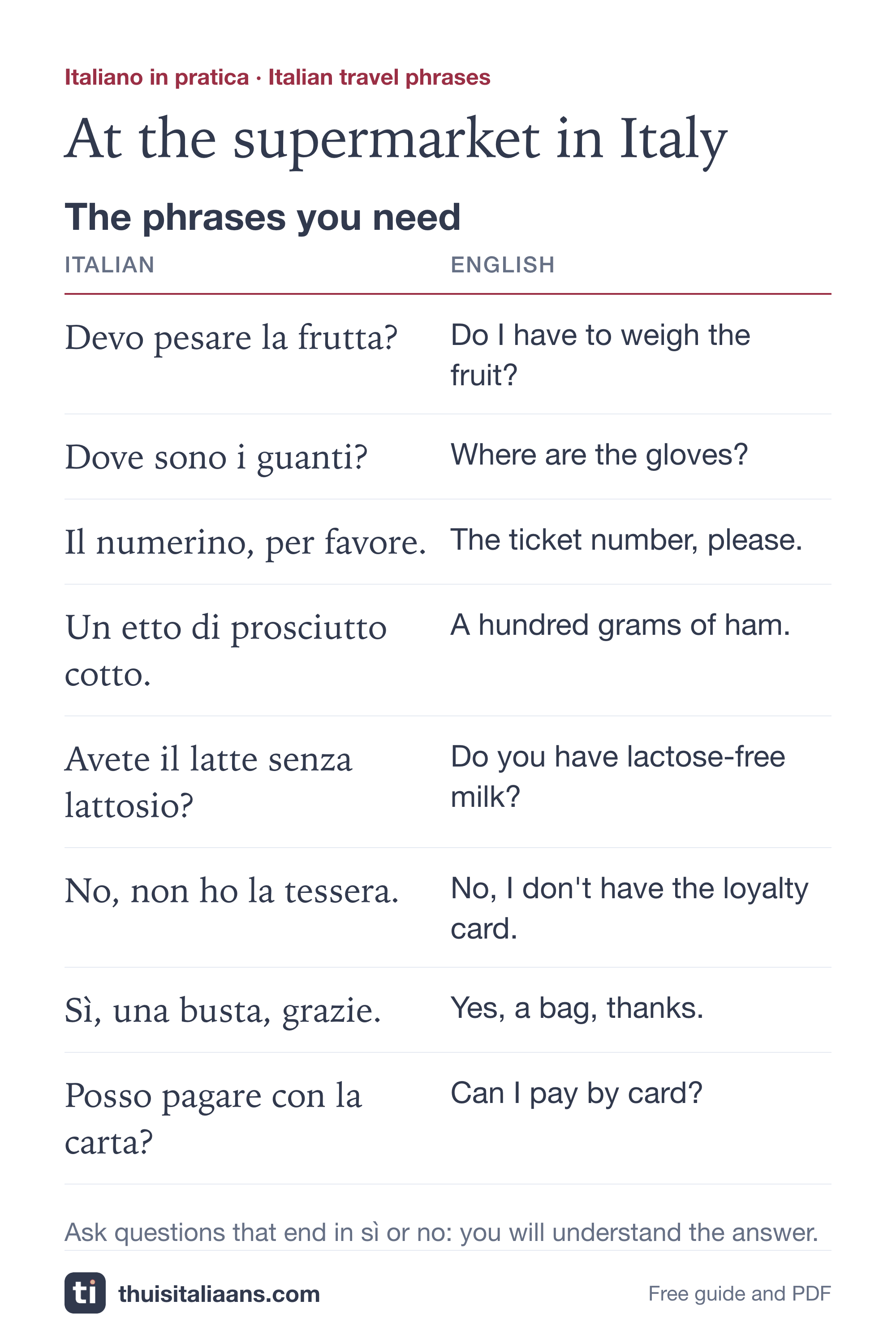 Italian phrases: At the supermarket in Italy
In many supermarkets, yes: use the gloves, bag the fruit, weigh it on the scale and stick the label on the bag. Where there's no scale in the aisle, it's weighed at the till.
Disposable gloves are provided for choosing loose fruit and vegetables by hand: it's a hygiene rule, and people are expected to use them.
«Do you have the loyalty card?» If you don't, answer «No, grazie».
100 grams. «Due etti» is 200 grams, «mezzo chilo» 500 grams.