Italiano in pratica
by Alessio · teacher of Italian for foreigners, ITALS master’s in teaching Italian abroad (Ca’ Foscari University, Venice) and a master’s in teaching Italian as a second language (Giustino Fortunato University, Benevento)
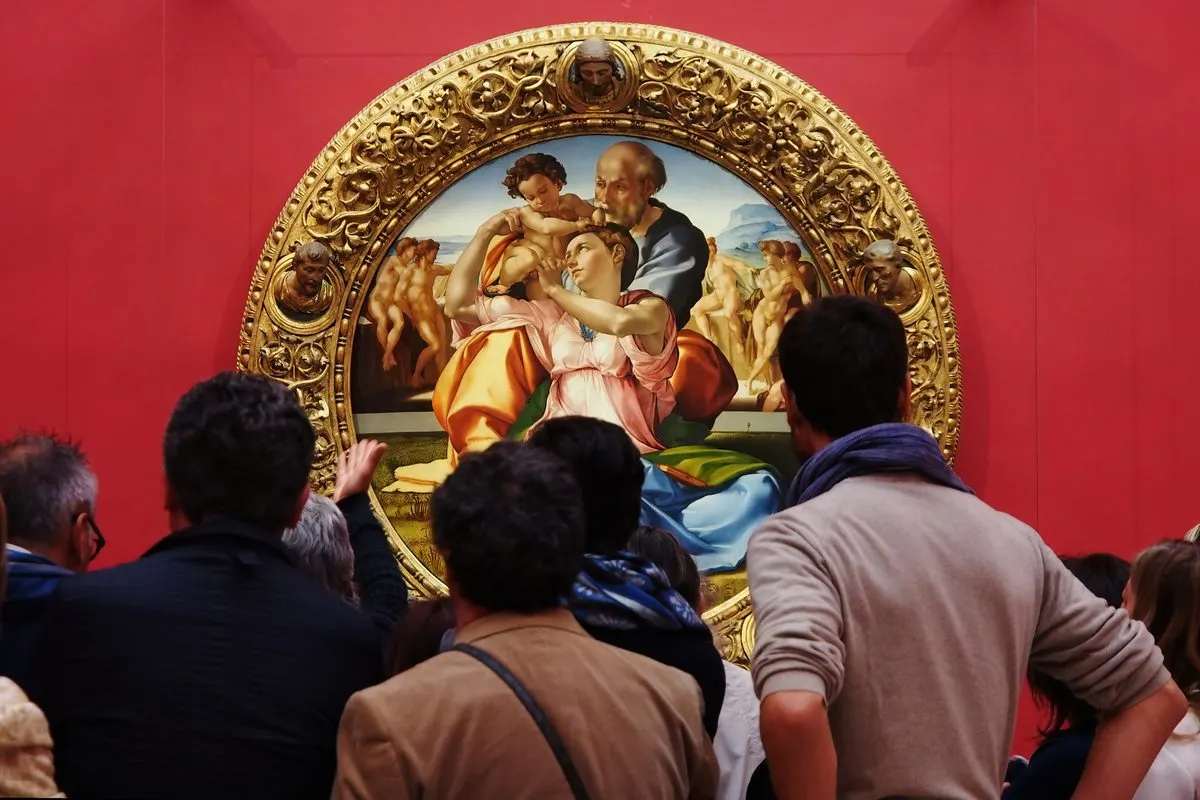
Book ahead for the big names: the Colosseum, the Uffizi, the Last Supper and the Vatican Museums sell out. State museums are free for under-18s and for everyone on the first Sunday of the month, and many close on Mondays. Big bags go in the cloakroom.
A queue that goes round the block, a ticket office with three windows and a sign in four languages, and a guard who stops you because of your backpack. Visiting an Italian museum is mostly about asking the right question before you join the wrong queue.
Here are those questions, with the words you'll see on the signs. All closed, so a sì or a no saves you an hour.
| Italian | English |
|---|---|
| Due biglietti, per favore. | Two tickets, please. |
| Ci sono riduzioni per studenti? | Are there student discounts?answer: sì or no |
| Bisogna prenotare? | Do you need to book?answer: sì or no |
| È aperto il lunedì? | Is it open on Mondays?answer: sì or no |
| C'è l'audioguida in inglese? | Is there an audio guide in English?answer: sì or no |
| Posso entrare con lo zaino? | Can I go in with my backpack?answer: often no |
| Si possono fare foto? | Can you take photos?answer: sì or no |
| A che ora chiude? | What time does it close? |
Read the Italian out loud once before you need it. The questions marked sì or no get a one-word answer you can understand.
For the most famous sites, yes: the Colosseum, the Uffizi, the Galleria dell'Accademia, the Last Supper in Milan and the Vatican Museums often sell out days or weeks ahead. For most other museums you can buy at the door.
A booked ticket comes with a time slot, la fascia oraria: arrive a little early. At the door you'll usually choose between intero, full price, and ridotto, reduced.
| You say | English |
|---|---|
| Bisogna prenotare? | Do you need to book?sì or no |
| Ho prenotato online. | I booked online.show the QR code |
| Ci sono biglietti per oggi? | Are there tickets for today?sì or no |
| Due interi, per favore. | Two full-price tickets, please. |
| You hear | English |
|---|---|
| È tutto esaurito. | It's sold out.no |
| Intero o ridotto? | Full price or reduced?a choice of two |
| Il prossimo ingresso è alle tre. | The next entry is at three. |

In Italian state museums under-18s go in free, young EU citizens aged 18 to 25 pay a reduced price, and entry is free for everyone on the first Sunday of every month. There's no general over-65 discount at state museums, but some city-run museums have one: ask.
Students from outside the EU don't always get a reduction, but asking costs nothing. Have an ID with you: you'll be asked to show it.
| You say | English |
|---|---|
| Ci sono riduzioni per studenti? | Are there student discounts?sì or no |
| C'è una riduzione per over 65? | Is there an over-65 discount?sì or no |
| I bambini pagano? | Do children pay?sì or no |
| Oggi è gratis? | Is it free today?sì or no |
| You hear | English |
|---|---|
| Ha un documento? | Do you have ID?show it |
| Sotto i diciotto anni è gratuito. | It's free for under-18s. |
| La prima domenica del mese. | The first Sunday of the month.the free day |
Many state museums close one day a week, usually Monday, and churches may close at lunchtime. Ticket offices stop selling 30 to 60 minutes before closing, so check the last entry, l'ultimo ingresso.
On public holidays opening hours change. A closed question before you cross town saves a wasted trip.
| You say | English |
|---|---|
| È aperto il lunedì? | Is it open on Mondays?sì or no |
| A che ora è l'ultimo ingresso? | What time is the last entry? |
| Oggi è aperto? | Is it open today?sì or no |
| La chiesa è aperta adesso? | Is the church open now?sì or no |
| You hear | English |
|---|---|
| Chiuso il lunedì. | Closed on Mondays. |
| La biglietteria chiude alle sei. | The ticket office closes at six. |
| Ultimo ingresso un'ora prima della chiusura. | Last entry one hour before closing. |

In the  amo Italian app you practise inside real-life pathways: il bar, il ristorante, i trasporti, la casa and more, with listening, dialogues and the grammar explained in English. This page gives you the phrases; the app trains your ear.
Half the A1 course free, no sign-up
★★★★★(22)by Alessio, teacher since 2018
Downloadamo Italian for iPhone ↗︎Search for amo Italian
Large bags, backpacks and umbrellas usually go in the cloakroom, il guardaroba, often free. In Italian state museums you may take photos for personal use without flash; a few places ban photos completely, the Sistine Chapel among them.
Churches are places of worship: shoulders and knees covered, and no photos during Mass. Look for the sign, or ask.
| You say | English |
|---|---|
| Posso entrare con lo zaino? | Can I go in with my backpack?often no |
| Dov'è il guardaroba? | Where's the cloakroom? |
| Si possono fare foto? | Can you take photos?sì or no |
| Anche con il flash? | With flash too?almost always no |
| You hear | English |
|---|---|
| Lo zaino va lasciato al guardaroba. | The backpack must be left in the cloakroom. |
| Niente flash. | No flash. |
| Vietato fotografare. | No photography.on signs |

Ask at the ticket office: c'è una visita guidata in inglese?, is there a guided tour in English? Audio guides, le audioguide, are rented at the entrance, often in several languages, and many museums now offer an app instead.
Guided tours have set times and a limited number of places: book at the desk as soon as you arrive.
| You say | English |
|---|---|
| C'è una visita guidata in inglese? | Is there a guided tour in English?sì or no |
| C'è l'audioguida in inglese? | Is there an audio guide in English?sì or no |
| L'audioguida è inclusa? | Is the audio guide included?sì or no |
| You hear | English |
|---|---|
| La visita dura un'ora. | The tour lasts an hour. |
| Parte alle undici. | It starts at eleven. |
| Mi lascia un documento? | Could you leave an ID with me?a deposit for the audio guide |
Italy has more UNESCO World Heritage Sites than any other country: 61 since the Domus de Janas tombs in Sardinia were added in 2025. Much of that heritage is not in museums at all. It is in churches, town halls, squares and archaeological sites, often in small towns with a single guard at the door. A day in Italy can include a Caravaggio in a side chapel that you light with a coin, and a three-room museum where you are the only visitor.

State museums, run by the Ministry of Culture, share a set of national rules: free entry for everyone under 18, of any nationality, a €2 ticket for EU citizens aged 18 to 25, and free entry for all on the first Sunday of the month. Compared with Britain, where national museums are free every day, entry in Italy usually costs something; compared with many other countries, it is cheap. Most state museums close one day a week, usually Monday.
Inside, the atmosphere is quieter and more formal than in many museums abroad. Custodians watch the rooms closely, touching is off limits, voices stay low and big bags go to the cloakroom. The famous names, the Uffizi, the Last Supper, the Borghese Gallery, work on timed tickets that sell out weeks ahead, while smaller museums nearby are often empty. Italians themselves tend to visit those, out of season, which is not bad advice for anyone.
Read next: Why do Italian churches ask you to cover your shoulders? · Why are children welcome everywhere in Italy?
Italians rarely answer with a bare sì or no. These are the forms you will actually hear, so you know which way the answer went.
| You hear | English | It means |
|---|---|---|
| Sì, certo. | Yes, of course. | yes |
| Certo! | Sure! | yes |
| Come no! | Of course! (literally: how not?) | yes |
| Volentieri. | Gladly. | yes |
| Va bene. | Fine, OK. | yes |
| Prego. | Go ahead / please do. | yes |
| No, mi dispiace. | No, I'm sorry. | no |
| Purtroppo no. | Unfortunately not. | no |
| Non c'è. | There isn't any. | no |
| È finito. | It's sold out / all gone. | no |
| Non si può. | That's not allowed. | no |
| Non ancora. | Not yet. | no |
Six real replies. Tap Yes or No for each one.
The grammar behind them
This guide as two printable pages, in English: the phrases to say, the yes/no questions and what you will hear.
All 43 phrase PDFs · €9Already included in the full course · €39 a year.
Or keep the eight phrases as an image, to save on your phone or pin:
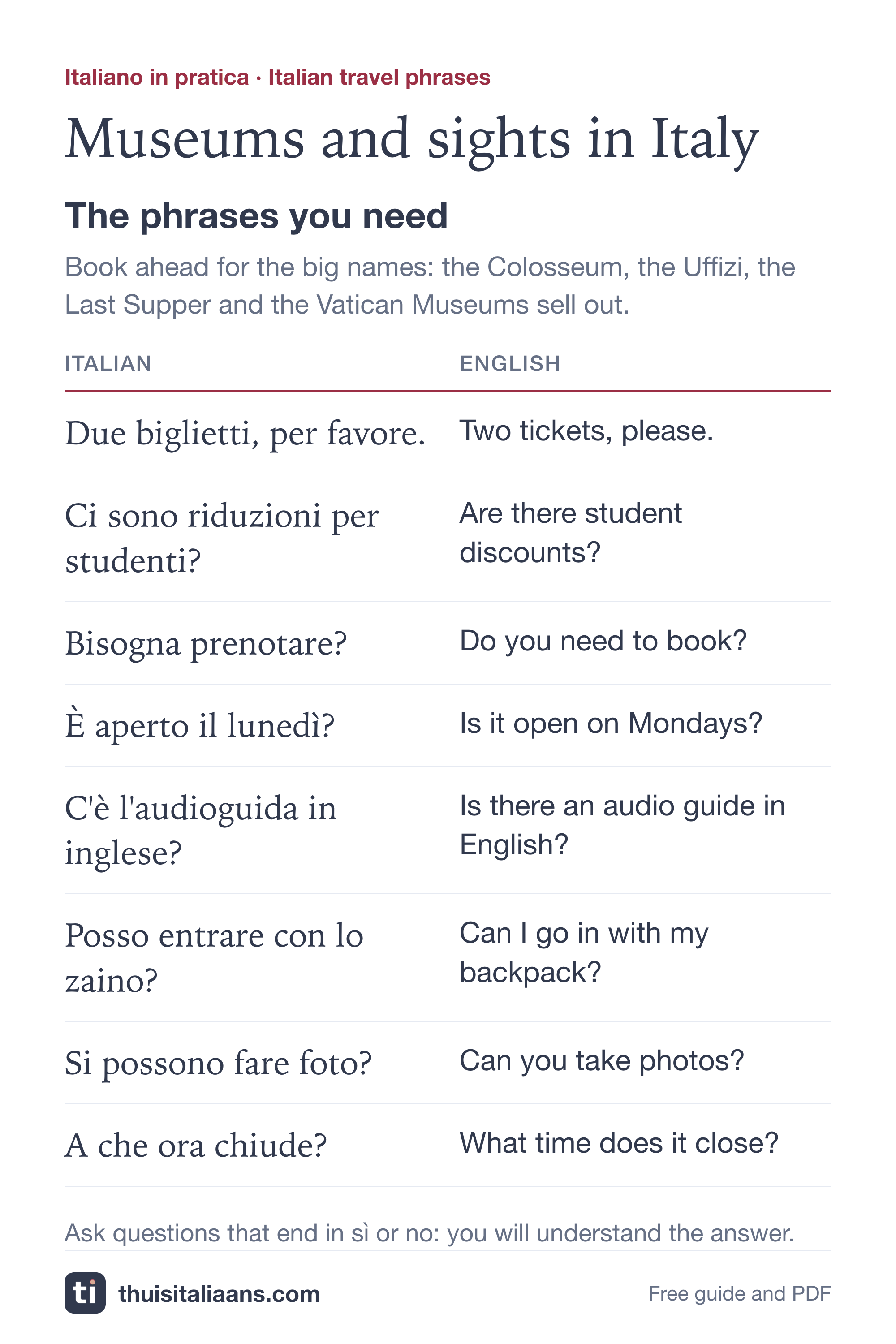 Italian phrases: Museums and sights in Italy
Yes: state museums and archaeological sites have free entry on the first Sunday of every month. Expect crowds, and check whether you still need to book a slot.
There's no general over-65 discount at Italian state museums. Some city-run museums and private sites have one, so ask: «C'è una riduzione per over 65?»
Many state museums close one day a week, usually Monday. Check before you go: «È aperto il lunedì?»
In state museums you may take photos for personal use without flash. Some places, like the Sistine Chapel, ban photography completely.
A reduced-price ticket, for example for young EU citizens. «Intero» is the full price.