

Grammar · A1
Simple prepositions
by Alessio · teacher of Italian as a foreign language, ITALS master’s

They are eight small, tireless words: di, a, da, in, con, su, per, tra. The real traps are three: a or in with places, da with people, di for origin. The rest is practice.
- 5min reading
- 19min exercises
- A1level
What you learn
- di, a, da, in, con, su
- When to use simple prepositions
- The most common mistakes
- Vocabulary: il viaggio
Italian and English side by side
This is where word-for-word translation fails hardest. English says in Rome and to Rome; Italian says a Roma for both, but in Italia for the country. Andare a scuola, andare in banca, essere da Marco: the preposition belongs to the expression, not to a rule you can derive. Learn them attached to their noun, the way you learned depend on rather than depend of.
Take this page with you
This chapter’s sheet as a free printable PDF (tables in Italian): rules, typical mistakes and the quiz with answers. A teacher’s tip: grammar sticks by reviewing it often, not by studying it once.


The words on this page
Drag each Italian word onto its definition, or tap a word first, then its box.
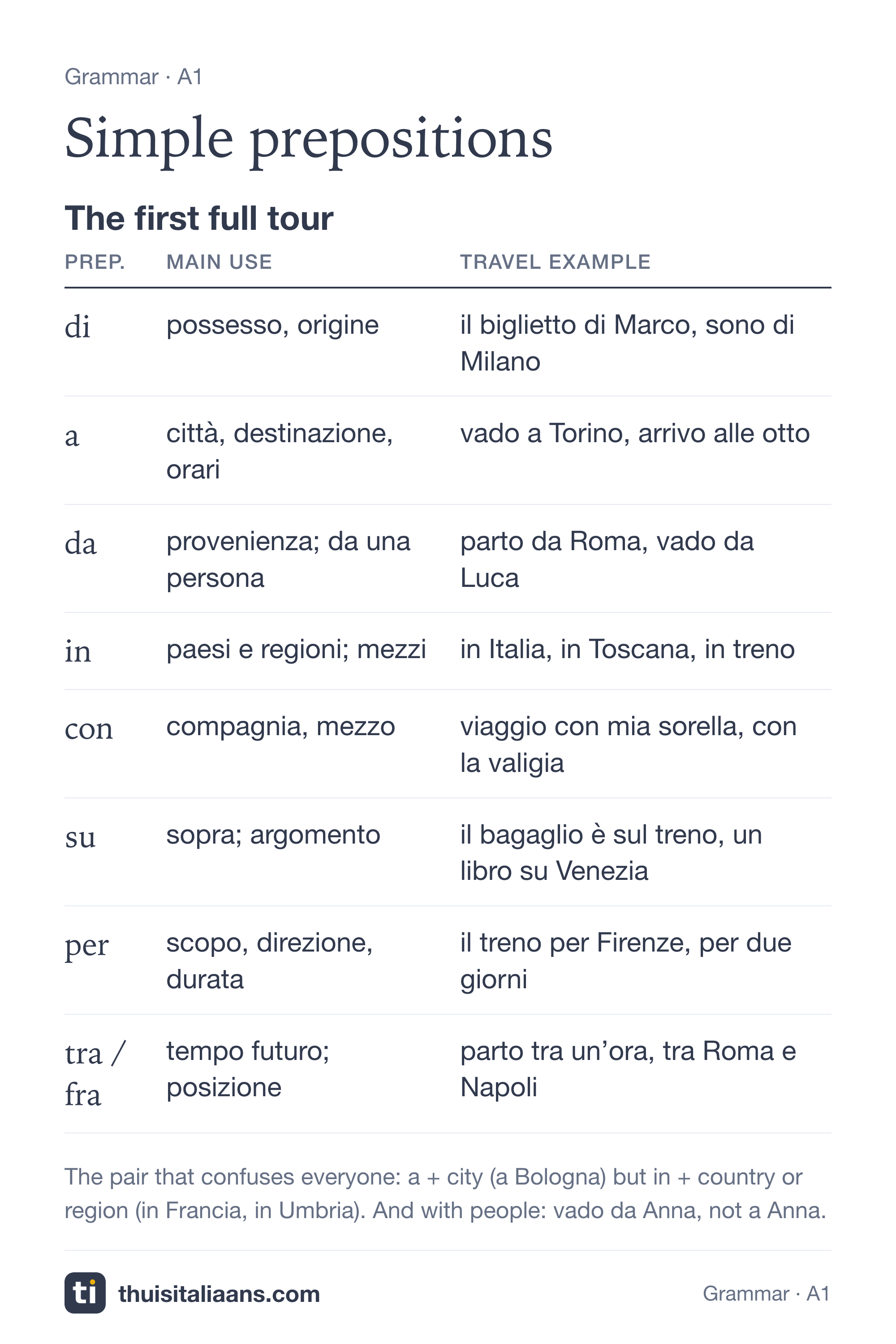
The first full tour
| Prep. | Main use | Travel example |
|---|---|---|
| di | possesso, origine | il biglietto di Marco, sono di Milano |
| a | città, destinazione, orari | vado a Torino, arrivo alle otto |
| da | provenienza; da una persona | parto da Roma, vado da Luca |
| in | paesi e regioni; mezzi | in Italia, in Toscana, in treno |
| con | compagnia, mezzo | viaggio con mia sorella, con la valigia |
| su | sopra; argomento | il bagaglio è sul treno, un libro su Venezia |
| per | scopo, direzione, durata | il treno per Firenze, per due giorni |
| tra / fra | tempo futuro; posizione | parto tra un’ora, tra Roma e Napoli |
The most common mistakes
vado in Roma→ vado a Roma (cities take a)abito a Italia→ abito in Italia (countries take in)vado a Marco stasera→ vado da Marco stasera (people take da)parto con il treno delle 9 per 2 ore→ the trip lasts two hours: per marks purpose or planned duration
Did you know?
Read and understand
This chapter’s grammar. Example: the Italian course group chat.
3 partecipanti
Questions
A che ora arriva chi viene da Firenze?
Perché «a Siena» ma «in centro»?
Completa: «Vado ___ Roma ___ macchina».

Exercises
Five exercises in order of difficulty. The last ones bring back what you have already seen.
01 A o in?
Cities take a, countries and regions take in. Complete.
- Abito Milano.
- Abito Italia.
- Vado Berlino.
- Vado Germania.
- Lavoro Toscana.
- Studio Bologna.
02 Di chi è, di dove è
Complete with di or da.
- Questo è il libro Marco.
- Sono Napoli.
- Vengo Napoli adesso.
- Lavoro lunedì a venerdì.
- Un bicchiere acqua, per favore.
- Vado mia sorella stasera.
03 Con, per, su, tra
Complete with the right preposition.
- Esco i miei amici.
- Questo regalo è te.
- Il libro è tavolo.
- Ci vediamo dieci minuti.
- Parto Roma domani.
- Vado piedi.
04 Il verbo chiede la sua preposizione
Every verb has its own. Complete.
- Vado scuola.
- Comincio lavorare alle nove.
- Finisco lavorare alle sei.
- Parlo mia madre.
- Parliamo lavoro.
- Penso te.
- Ho bisogno aiuto.
05 Dove sei, dove vai
Complete the message with prepositions, verbs and c’è / ci sono.
Review presente indicativo · essere e avere · c’è e ci sono
- Ciao! (io / essere) Firenze tre giorni.
- Sto un amico: la sua casa vicino centro.
- Qui molti turisti, ma bello lo stesso.
- Domani (io / partire) Siena treno.
- Torno Milano domenica: (io / avere) lezione lunedì.
- E tu, (venire) me il weekend prossimo?
These five are a taste. There are over seven hundred on the site, free and with no sign-up. All the exercises →

Every topic, a world
In the  amo Italian app, grammar is practised inside thematic pathways with field-specific vocabulary: il bar, i trasporti, il calcio, la moda, la burocrazia and seventeen more. Choose your world and the grammar comes along by itself, explained in your language too.
Half the path free, no sign-up
★★★★★(11)by Alessio, teacher since 2018
Downloadamo Italian for iPhone ↗︎Search for amo Italian

Read and understand
This chapter’s grammar. Example: a postcard from Siena.
Caro Jonas,
sono partito da Firenze alle otto e sono arrivato a Siena in un'ora.
Abito in centro, da una signora che affitta stanze. Vado a scuola a piedi.
Domenica andiamo in treno a Pisa, poi da Marta a Lucca.
Ci vediamo a luglio!
Sanne
ITALIANE
C.P.
Kerkstraat 9
3581 RA Utrecht
Questions
Come va a scuola Sanne?
«Abito da una signora» significa…
Completa: «Torno ___ casa ___ mezzanotte».
Want another text on this topic? Reading a food label
One more go
Choose the preposition:
- Domani vado Napoli treno.
- Questo è il biglietto Anna.
- Il treno Firenze parte dieci minuti.
- Stasera andiamo Luca a cena.
Frequently asked questions
Sono di Roma or vengo da Roma: which is right?
Both, for different jobs: di gives origin with essere (sono di Roma: I’m from Rome, it’s my city), da gives movement or provenance with other verbs (vengo da Roma: I’m coming from Rome, maybe just today). Verb decides preposition.
Why a scuola but in banca?
There is no logic to find, only pairs to memorise: a casa, a scuola, a letto, a teatro, but in banca, in ufficio, in chiesa, in piscina. Learn each place with its preposition, like a surname: after a while the wrong one simply sounds off.
Is there a difference between tra and fra?
None in meaning: both are “between / among / in (time)”. Italians choose by sound, avoiding clumsy repetitions: fra tre minuti flows better than tra tre minuti, and tra fratelli better than fra fratelli.
 The first full tour