Italiano in pratica
by Alessio · teacher of Italian for foreigners, ITALS master’s in teaching Italian abroad (Ca’ Foscari University, Venice) and a master’s in teaching Italian as a second language (Giustino Fortunato University, Benevento)
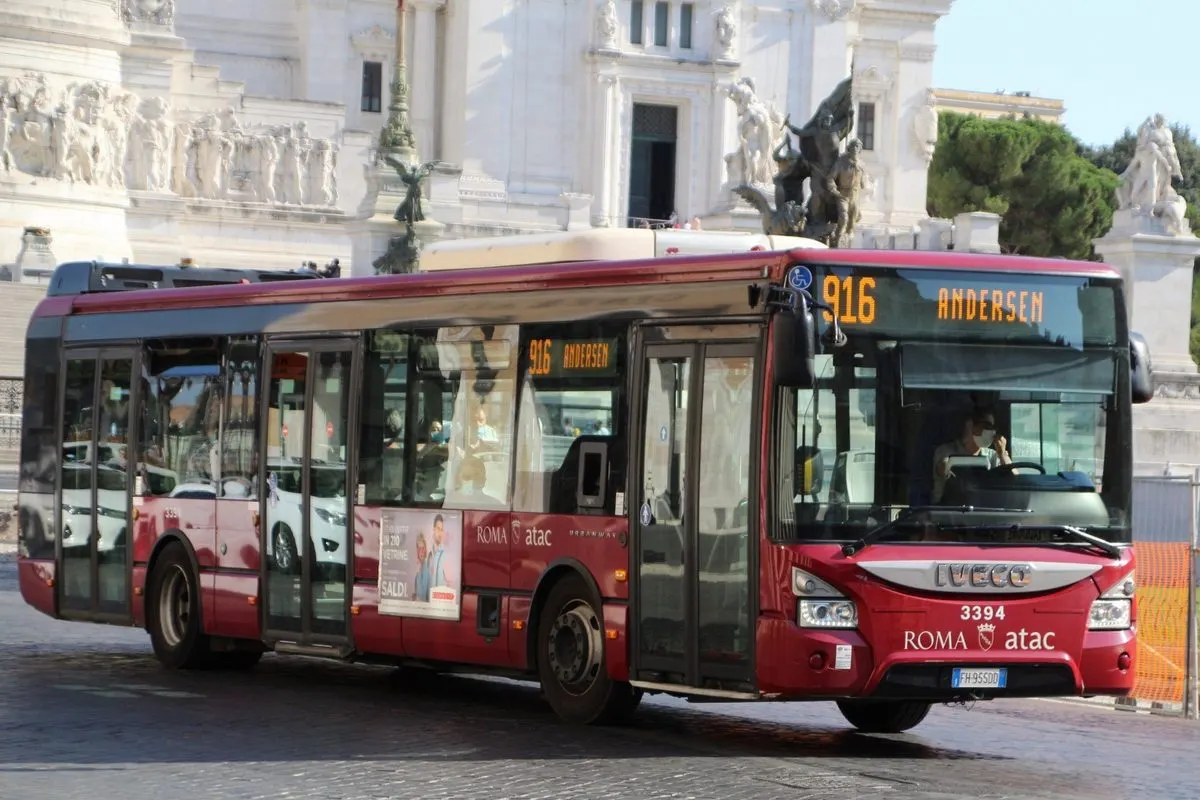
Buy bus tickets before you board, at a tabaccheria, a newsstand, a machine or in the app, and validate them on board. In Rome, Milan and other big cities you can simply tap a contactless card. Taxis wait at ranks or come when you call: you rarely hail one in the street.
Italian cities are made for walking, until your feet give up or it starts to rain. Then you need a bus, the metro or a taxi, and each one has a rule nobody tells you: tickets bought before you get on, a machine to stamp them in, a button to press so the driver stops.
Here are those rules, with the phrases to ask when you're not sure. As always on these pages, the questions end in sì or no, so you understand the answer even on a noisy bus.
| Italian | English |
|---|---|
| Un biglietto dell'autobus, per favore. | A bus ticket, please.at a tabaccheria |
| Questo autobus va in centro? | Does this bus go to the centre?answer: sì or no |
| Posso pagare con la carta sull'autobus? | Can I pay by card on the bus?answer: sì or no |
| Devo scendere qui per il Duomo? | Do I get off here for the cathedral?answer: sì or no |
| Mi dice quando scendere? | Will you tell me when to get off?answer: sì |
| Scende alla prossima? | Are you getting off at the next stop?to get past people |
| Mi porta a questo indirizzo? | Can you take me to this address?show the phone; answer: sì |
| Accetta la carta? | Do you take cards?answer: sì or no |
Read the Italian out loud once before you need it. The questions marked sì or no get a one-word answer you can understand.
Usually before you get on: at a tabaccheria (the shop with the T sign), at a newsstand, from a machine at metro stations or in the local transport app. In many cities the driver doesn't sell tickets, or sells them at a higher price.
A city ticket is usually valid for a set time, often 90 or 100 minutes, on buses, trams and the metro. Rome, Milan, Florence and a growing number of other cities also let you tap a contactless bank card on the reader instead of buying a ticket.
| You say | English |
|---|---|
| Un biglietto dell'autobus, per favore. | A bus ticket, please. |
| Vale anche per la metro? | Is it valid on the metro too?sì or no |
| Avete il biglietto giornaliero? | Do you have a day ticket?sì or no |
| Si può fare il biglietto a bordo? | Can you buy a ticket on board?sì or no |
| You hear | English |
|---|---|
| Quanti? | How many?say a number |
| Corsa semplice o giornaliero? | Single or day ticket?a choice of two |
| Vale novanta minuti. | It's valid for ninety minutes. |
Yes. Stamp a paper ticket in the machine on board, la macchinetta or l'obliteratrice, as soon as you get on; on the metro it is validated at the gate. If you pay by contactless card, tap it every time you board, always with the same card.
An unvalidated ticket counts as no ticket, and inspectors, i controllori, fine you on the spot. If the machine doesn't work, tell the driver straight away.
| You say | English |
|---|---|
| Dove si convalida? | Where do you validate it?on board, near the doors |
| La macchinetta non funziona. | The machine doesn't work.tell the driver |
| Devo timbrare anche questo? | Do I have to stamp this one too?sì or no |
| You hear | English |
|---|---|
| Biglietto, prego. | Ticket, please.an inspector |
| Il biglietto non è convalidato. | The ticket isn't validated.that means a fine |
Press the button marked prenotazione fermata, stop request, before your stop: drivers don't stop where nobody is waiting or has pressed it. If you're not sure which stop is yours, ask the driver or the person next to you a closed question.
On a crowded bus, people start moving towards the door a stop early. To get past, ask scende alla prossima? If they're not getting off, they'll let you through.
| You say | English |
|---|---|
| Questo autobus va alla stazione? | Does this bus go to the station?sì or no |
| Devo scendere qui? | Do I get off here?sì or no |
| Mi dice quando scendere, per favore? | Will you tell me when to get off, please?sì |
| Scende alla prossima? | Are you getting off at the next stop?sì or no |
| Permesso, scendo! | Excuse me, I'm getting off! |
| You hear | English |
|---|---|
| È la prossima. | It's the next one. |
| Tra tre fermate. | In three stops. |
| Deve cambiare. | You have to change.take another line |

In the  amo Italian app you practise inside real-life pathways: il bar, il ristorante, i trasporti, la casa and more, with listening, dialogues and the grammar explained in English. This page gives you the phrases; the app trains your ear.
Half the A1 course free, no sign-up
★★★★★(22)by Alessio, teacher since 2018
Downloadamo Italian for iPhone ↗︎Search for amo Italian
At a taxi rank, il posteggio dei taxi, at stations, airports and main squares, or by calling a taxi company or booking in an app. Hailing a taxi in the street rarely works in Italy.
Licensed taxis have a meter and are white in most cities. Some cities, Rome among them, have a flat fare between the airport and the centre. Taxis are required to accept cards: ask before you get in anyway, it saves an argument at the end.
| You say | English |
|---|---|
| Mi porta a questo indirizzo? | Can you take me to this address?show it on your phone |
| Accetta la carta? | Do you take cards?sì or no |
| C'è la tariffa fissa per l'aeroporto? | Is there a flat fare to the airport?sì or no |
| Può chiamarmi un taxi? | Could you call me a taxi?to hotel or restaurant staff |
| Mi fa la ricevuta? | Can I have a receipt?sì |
| You hear | English |
|---|---|
| Dove la porto? | Where can I take you?show the address |
| Con il traffico ci vogliono venti minuti. | With traffic it takes twenty minutes. |
| Ha bagagli? | Do you have luggage?sì or no |

Local transport strikes, scioperi, are announced in advance, and services still run in guaranteed time bands, fasce garantite, usually at the start and end of the working day. Metros in big cities generally stop running between half past eleven and half past midnight, later at weekends in some cities, with night buses after that.
When a strike is on, Italians say c'è sciopero. Ask at your hotel the day before.
| You say | English |
|---|---|
| Domani c'è sciopero? | Is there a strike tomorrow?sì or no |
| La metro è aperta fino a mezzanotte? | Is the metro open until midnight?sì or no |
| C'è un autobus notturno? | Is there a night bus?sì or no |
| You hear | English |
|---|---|
| Sì, ma ci sono le fasce garantite. | Yes, but there are guaranteed hours. |
| L'ultima corsa è alle undici e mezza. | The last run is at half past eleven. |

Bus tickets are sold before you board because Italian public transport grew up around a very Italian shop: the tabaccheria, with its T sign. Tobacco and salt were state monopolies for centuries, and the licensed shops that sold them became the place for every small official purchase: bus tickets, stamps, phone top-ups, lottery tickets, parking cards and the revenue stamps used on documents. Buying from the driver is sometimes possible, but it costs more and holds up the bus, so locals keep a few tickets in their wallet.

Taxis work differently from London or New York too. Each city issues a limited number of licences, so there are fewer taxis than visitors expect, and they wait at ranks or come when called rather than cruising for fares. Ride-hailing exists, but in Italy apps such as Uber work mostly with licensed drivers, taxis and hire cars with a driver, so they are not the cheap alternative they are in some countries.
Underground, Italian cities carry their history with them. Rome has only three metro lines, partly because every new tunnel runs into ancient remains: the works for Line C uncovered a Roman barracks, and some of its stations now display the finds. Naples went the other way and turned its new stations into galleries; Toledo, lined with blue mosaics, regularly appears on lists of the most beautiful stations in Europe. Milan has the largest network, with five lines, the newest completed in 2024.
Read next: How do trains fit into everyday life in Italy? · Why do Italians give directions with landmarks, not street names?
Italians rarely answer with a bare sì or no. These are the forms you will actually hear, so you know which way the answer went.
| You hear | English | It means |
|---|---|---|
| Sì, certo. | Yes, of course. | yes |
| Certo! | Sure! | yes |
| Come no! | Of course! (literally: how not?) | yes |
| Volentieri. | Gladly. | yes |
| Va bene. | Fine, OK. | yes |
| Prego. | Go ahead / please do. | yes |
| No, mi dispiace. | No, I'm sorry. | no |
| Purtroppo no. | Unfortunately not. | no |
| Non c'è. | There isn't any. | no |
| È finito. | It's sold out / all gone. | no |
| Non si può. | That's not allowed. | no |
| Non ancora. | Not yet. | no |
Six real replies. Tap Yes or No for each one.
The grammar behind them
This guide as two printable pages, in English: the phrases to say, the yes/no questions and what you will hear.
All 43 phrase PDFs · €9Already included in the full course · €39 a year.
Or keep the eight phrases as an image, to save on your phone or pin:
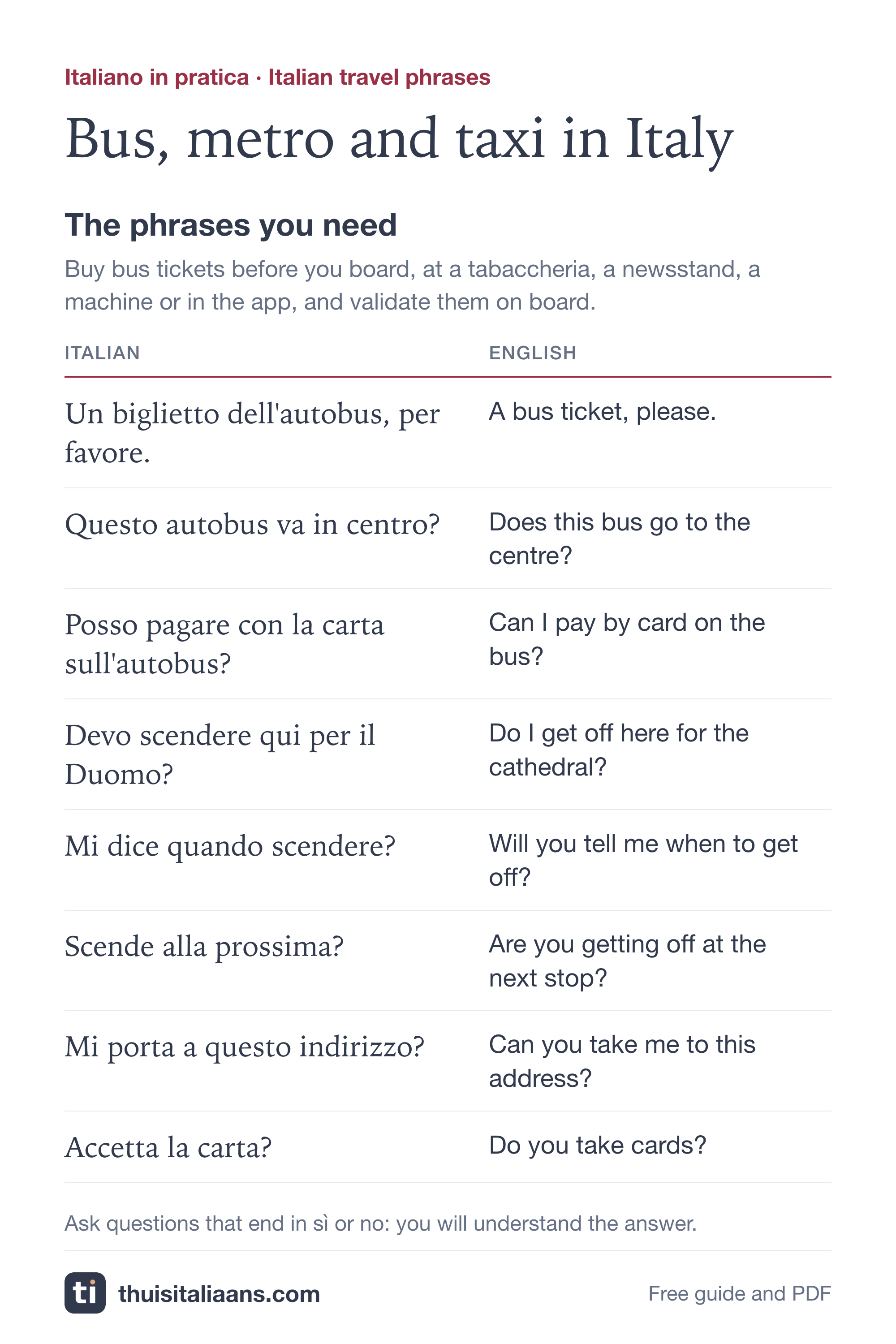 Italian phrases: Bus, metro and taxi in Italy
Sometimes, but often not, or only at a higher price. Buy them before you board at a tabaccheria, a newsstand, a machine or in the local transport app, or tap a contactless card where it's accepted.
Yes. Paper tickets must be stamped in the machine on board as soon as you get on; travelling with an unvalidated ticket can mean a fine.
Rarely. Taxis in Italy wait at ranks at stations, airports and main squares, or come when you call or book through an app.
They are required to accept card payments. It's still wise to ask before you get in: «Accetta la carta?»
Press the «prenotazione fermata» button before your stop. Drivers don't stop where nobody is waiting or has pressed it.