

Grammar · A2
Direct object pronouns
by Alessio · teacher of Italian as a foreign language, ITALS master’s

Direct object pronouns replace the object so you do not repeat it: compri il pecorino? Sì, lo compro. They go before the verb, and in the past they make the participle agree: l’ho comprata.
- 5min reading
- 18min exercises
- A2level
What you learn
- mi / ti, lo, la, ci / vi, li, le
- When to use direct object pronouns
- In the passato prossimo: agreement
- Vocabulary: il mercato
Italian and English side by side
English object pronouns come after the verb: I see him. Italian puts them before: lo vedo. They only move to the end when attached to an infinitive or an imperative: voglio vederlo, chiamalo! Getting the position right matters more than getting the form right.
Take this page with you
This chapter’s sheet as a free printable PDF (tables in Italian): rules, typical mistakes and the quiz with answers. A teacher’s tip: grammar sticks by reviewing it often, not by studying it once.


The words on this page
Drag each Italian word onto its definition, or tap a word first, then its box.
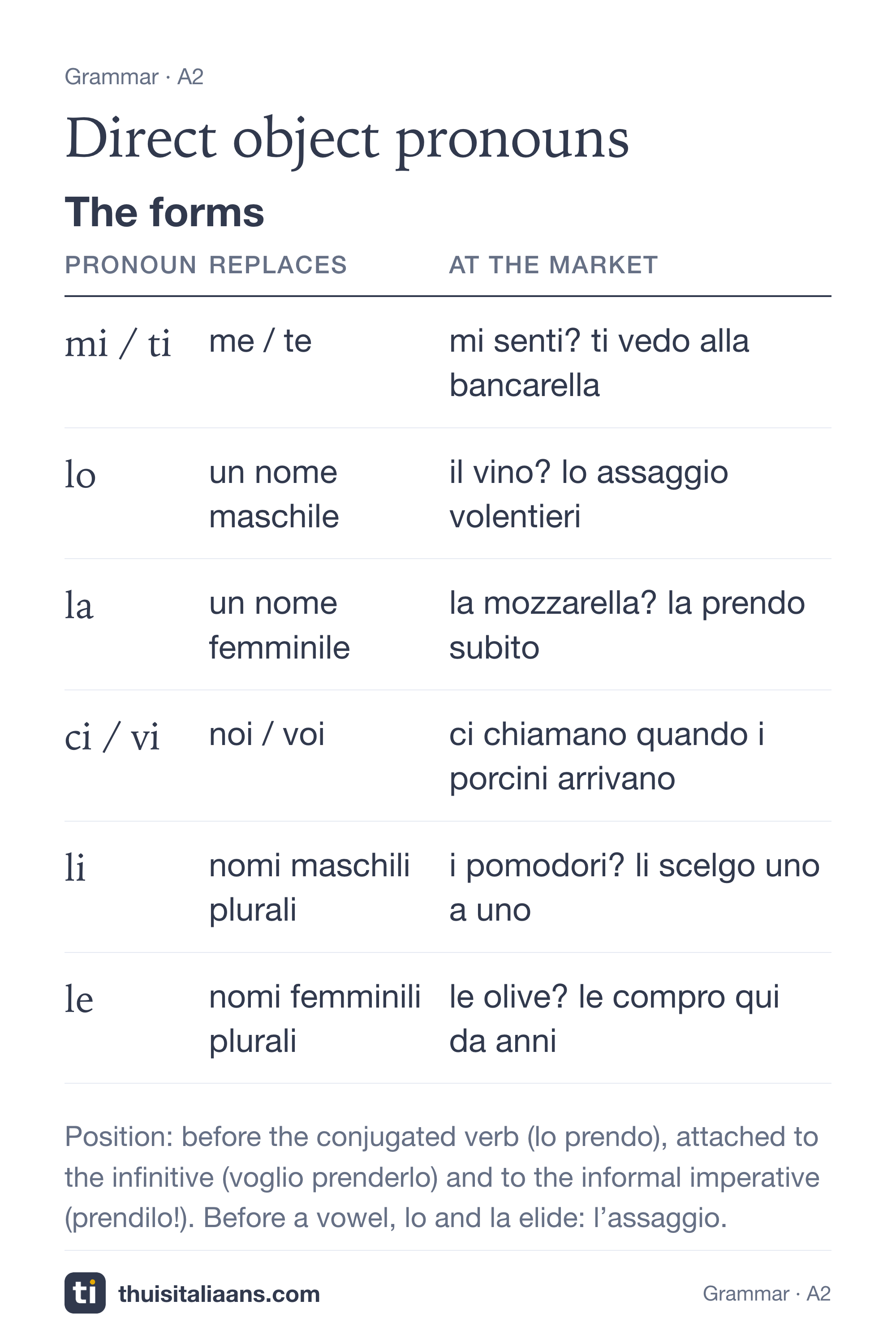
The forms
| Pronoun | Replaces | At the market |
|---|---|---|
| mi / ti | me / te | mi senti? ti vedo alla bancarella |
| lo | un nome maschile | il vino? lo assaggio volentieri |
| la | un nome femminile | la mozzarella? la prendo subito |
| ci / vi | noi / voi | ci chiamano quando i porcini arrivano |
| li | nomi maschili plurali | i pomodori? li scelgo uno a uno |
| le | nomi femminili plurali | le olive? le compro qui da anni |
In the passato prossimo: agreement
| Sentence | Why |
|---|---|
| il pane? l’ho preso | lo + ho = l’ho, participio maschile |
| la ricotta? l’ho presa | la fa accordare: presa |
| i carciofi? li ho presi | li: participio in -i |
| le arance? le ho prese | le: participio in -e |
The most common mistakes
compro lo domani→ lo compro domani (the pronoun goes before the verb)la mozzarella? l’ho comprato→ l’ho comprata (with la the participle agrees)vedo ti alla bancarella→ ti vedo alla bancarella (never after the conjugated verb)
Did you know?
Read and understand
This chapter’s grammar. Example: a household chat.
sta scrivendo…
Questions
Dove sono le chiavi della cantina?
Chi ha preso i palloncini?
In «le ho messe», «le» sostituisce…
Completa: «Il giornale? ___ leggo stasera».

Exercises
Five exercises in order of difficulty. The last ones bring back what you have already seen.
01 Le forme
Replace the part in brackets with the direct object pronoun.
- Leggo (il libro) →
- Vedo (la casa) →
- Compro (i biglietti) →
- Mangio (le mele) →
- Aspetto (Marco) →
- Chiamo (Anna e Sara) →
02 Dove si mette
The pronoun goes before the verb, but attaches to the infinitive. Complete.
- Il caffè? prendo volentieri.
- Le chiavi? Non trovo.
- Voglio comprar (il pane).
- Devo chiamar (Maria).
- Puoi aiutar? (me)
- conosci? (noi)
03 Mi, ti, ci, vi
Complete with the right pronoun.
- Marco chiama ogni sera. (a me)
- aspetto alle otto. (te)
- La professoressa ascolta. (noi)
- vedo domani, ragazzi. (voi)
- Nessuno capisce. (me)
- accompagno io. (te)
04 Al passato il participio si accorda
With lo, la, li, le the participle follows the pronoun. Complete.
- La pizza? ho mangiat.
- I libri? ho lett.
- Le lettere? ho scritt.
- Il film? ho vist ieri.
- Le tue amiche? ho incontrat in centro.
- I biglietti? ho comprat online.
05 Al telefono
Complete with the direct pronouns and the right tenses.
Review passato prossimo · scelta dell’ausiliare
- — Hai visto Luca? — Sì, ho vist stamattina.
- — E le chiavi? — Non trovo più: ho perse.
- — Vuoi che aiuti? (te) · Sì, grazie.
- — Chiami tu Anna? — chiamo adesso.
- — I documenti? — Devo ancora prepararli, finisco stasera.
- — Allora aspetto alle nove. (voi)
These five are a taste. There are over seven hundred on the site, free and with no sign-up. All the exercises →

Every topic, a world
In the  amo Italian app, grammar is practised inside thematic pathways with field-specific vocabulary: il bar, i trasporti, il calcio, la moda, la burocrazia and seventeen more. Choose your world and the grammar comes along by itself, explained in your language too.
Half the path free, no sign-up
★★★★★(11)by Alessio, teacher since 2018
Downloadamo Italian for iPhone ↗︎Search for amo Italian

Read and understand
This chapter’s grammar. Example: an office email.
Prima di venerdì: chi fa che cosa
daSilvia Nardi <s.nardi@studiomora.it>
ateam@studiomora.it
datamar 7 ott, 09:12
Buongiorno a tutti,
il contratto Rossi: l'ho riletto ieri sera e lo firmo oggi. Poi lo manda Piero al cliente.
Le fatture di settembre le ha controllate Anna: le trovate già nella cartella condivisa.
I biglietti per la fiera li compra Marco entro domani. La sala riunioni la prenoto io per giovedì alle nove.
Domande? Mi trovate in ufficio fino alle sei.
Silvia
Questions
Chi manda il contratto al cliente?
Dove sono le fatture di settembre?
«Le fatture le ha controllatE Anna»: perché il participio finisce in -e?
Completa: «I documenti? ___».
Want another text on this topic? Ordering pizza in a chat
One more go
Replace with the pronoun:
- Il parmigiano? prendo stagionato.
- Le zucchine? scelgo piccole.
- La torta? per stasera.
- I funghi? io.
- Vuoi assaggiare il pecorino? Sì, voglio .
Frequently asked questions
Why is it lo aiuto and not gli aiuto?
Because aiutare takes a direct object in Italian: aiutare qualcuno, no preposition. The same goes for ascoltare, aspettare, cercare, guardare: all direct, even where English says “listen to, wait for, look for/at”. The Italian verb decides, not the translation.
What is the pronoun for formal “you” as an object?
La, even for a man, and capitalised in formal writing: La ringrazio, dottore; La richiamo domani. It follows Lei, which is grammatically feminine: the courtesy system stays consistent all the way down.
Are mi, ti, ci, vi direct or indirect?
Both: the same four forms serve both jobs, and only context tells you which. Mi vede (direct: he sees me), mi scrive (indirect: he writes to me). The direct/indirect distinction only becomes visible in the third person: lo/la versus gli/le.
 The forms