

Grammar · A2
Possessives
by Alessio · teacher of Italian as a foreign language, ITALS master’s

Italian possessives agree with the thing owned, not with the owner: il suo appartamento works for both him and her. And, surprise: possessives usually need the article in front.
- 5min reading
- 18min exercises
- A2level
What you learn
- io, tu, lui / lei, noi, voi, loro
- When to use possessives
- The most common mistakes
- Vocabulary: la famiglia e la casa
Italian and English side by side
English possessives need no article: my house. Italian almost always adds one: la mia casa. The exception is single family members (mia madre, mio fratello), but the article comes back in the plural and with loro: le mie sorelle, la loro madre.
Take this page with you
This chapter’s sheet as a free printable PDF (tables in Italian): rules, typical mistakes and the quiz with answers. A teacher’s tip: grammar sticks by reviewing it often, not by studying it once.


The words on this page
Drag each Italian word onto its definition, or tap a word first, then its box.
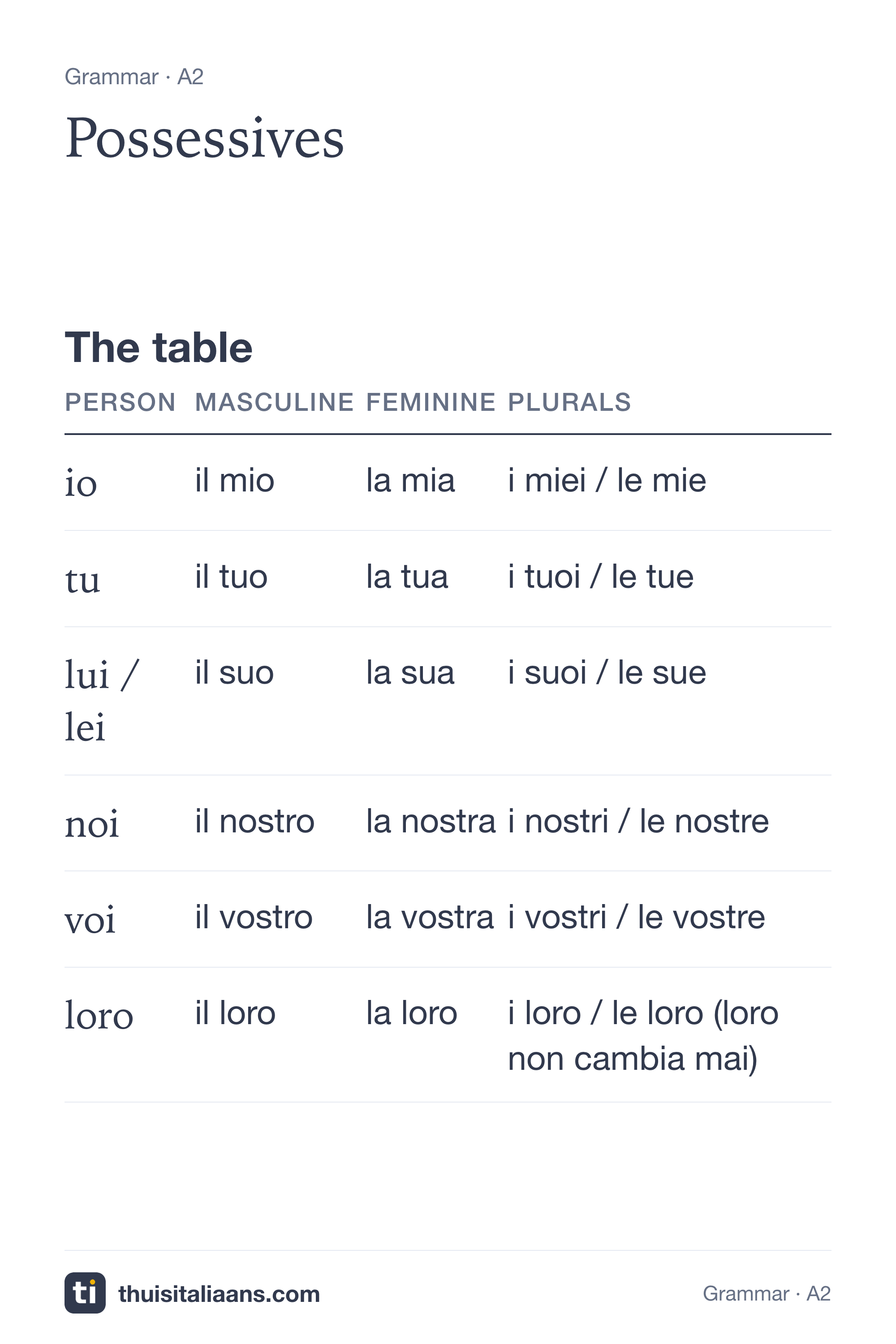
The table
| Person | Masculine | Feminine | Plurals |
|---|---|---|---|
| io | il mio | la mia | i miei / le mie |
| tu | il tuo | la tua | i tuoi / le tue |
| lui / lei | il suo | la sua | i suoi / le sue |
| noi | il nostro | la nostra | i nostri / le nostre |
| voi | il vostro | la vostra | i vostri / le vostre |
| loro | il loro | la loro | i loro / le loro (loro non cambia mai) |
Around the house
| Sentence | Note |
|---|---|
| la mia camera è al piano di sopra | accordo con camera, non con me |
| il nostro palazzo non ha l’ascensore | nostro come un normale aggettivo |
| casa mia, casa tua | espressione fissa senza articolo: vieni a casa mia? |
The most common mistakes
la mia madre cucina benissimo→ mia madre cucina benissimo (singular family member: no article)miei fratelli vivono qui→ i miei fratelli vivono qui (in the plural the article returns)loro casa è grande→ la loro casa è grande (with loro the article never drops)
Did you know?
Read and understand
This chapter’s grammar. Example: a family chat.
online
Questions
Chi viene con la moglie e i bambini?
Perché il padre arriva tardi?
Perché «mia madre» senza articolo, ma «la sua squadra» con l'articolo?
Completa: «___ sorella abita a Roma».

Exercises
Five exercises in order of difficulty. The last ones bring back what you have already seen.
01 L’articolo ci vuole
In Italian the possessive almost always takes the article. Complete.
- mia casa
- tuo libro
- suoi amici
- nostre idee
- vostro cane
- loro macchina
02 Accordo con la cosa, non con chi possiede
Complete the possessive.
- Marco e (il / suo) sorella
- Anna e (il / suo) fratello
- Anna e (il / suo) scarpe
- i ragazzi e (il / loro) zaini
- noi e (il / nostro) città
- voi e (il / vostro) figli
03 La famiglia al singolare
With singular family members the article drops (but not with loro). Add the article only where needed, otherwise write –.
- mia madre
- mie sorelle
- suo fratello
- loro madre
- tuo padre
- mia sorella maggiore
04 Di chi è?
Answer with the possessive, as in the example: (di Marco) → è sua.
- La borsa (di Anna) →
- I libri (di Marco) →
- La casa (di noi) →
- Le chiavi (di te) →
- Il cane (dei vicini) →
- L’idea (di me) →
05 In famiglia
Complete with possessives, articles and verbs in the past.
Review pronomi indiretti · passato prossimo · A1: articoli
- Ieri (io / vedere) mia zia e suo marito.
- loro figli (venire) con noi al parco.
- mie cugine (portare) loro cane.
- nostra giornata (essere) tranquilla.
- tuo fratello, invece, (rimanere) a casa.
- (a lui) piace stare da solo.
These five are a taste. There are over seven hundred on the site, free and with no sign-up. All the exercises →

Every topic, a world
In the  amo Italian app, grammar is practised inside thematic pathways with field-specific vocabulary: il bar, i trasporti, il calcio, la moda, la burocrazia and seventeen more. Choose your world and the grammar comes along by itself, explained in your language too.
Half the path free, no sign-up
★★★★★(11)by Alessio, teacher since 2018
Downloadamo Italian for iPhone ↗︎Search for amo Italian

Read and understand
This chapter’s grammar. Example: a school website.
Il nostro metodo
Ogni studente ha la sua strada: c'è chi impara con le canzoni e chi con i giornali.
I nostri corsi partono sempre da un test. Le vostre domande decidono il programma della settimana.
«Il mio compito è ascoltare», dice Stefano. «La lezione perfetta non è la mia: è la vostra».
E i risultati? Parlano i loro numeri: novanta studenti su cento arrivano all'esame e lo passano.
Questions
Da dove partono sempre i corsi?
Quanti studenti su cento passano l'esame?
«La lezione perfetta non è la mia: è la vostra». Di chi è la lezione perfetta?
Completa: «Ho visto Marco e Anna con ___ figli».
Want another text on this topic? Booking a hotel
One more go
With or without the article?
- sorella abita al terzo piano.
- genitori hanno una casa in campagna.
- cucina è appena rifatta.
- Vieni a casa stasera?
- balcone guarda sul cortile.
Frequently asked questions
Can a possessive stand alone, without the noun?
Yes, article included: Di chi è questa giacca? — È la mia. The plural i miei even has a life of its own: it means “my parents / my family” (stasera ceno dai miei).
How do I say “a friend of mine”?
Un mio amico: indefinite article + possessive + noun, no “of”. Likewise una sua collega, due miei cugini. The English “of mine” construction simply does not exist in Italian: resist the urge to add di.
What is proprio and when do I need it?
It is a possessive meaning “one’s own”, and it is the clean choice when the subject is impersonal or generic: ognuno porta il proprio libro. With lui/lei as subject it can replace suo to avoid ambiguity: Marco è uscito con la propria macchina (his own, not someone else’s).
 The table