

Grammar · A1
The articles: il, lo, la, i, gli, le
by Alessio · teacher of Italian as a foreign language, ITALS master’s

Italian articles follow one single rule: you do not choose them by meaning, but by looking at how the next word begins. That is why it is il vino but lo spumante, i formaggi but gli gnocchi: it is not about taste, it is about letters.
- 6min reading
- 19min exercises
- A1level
What you learn
- il / i, lo / gli, l' / gli, la / le, l' / le
- When to use the articles
- When Italian wants the article (and your language maybe does not)
- Vocabulary: la tavola
Italian and English side by side
English has one definite article, the, for everything. Italian has seven, and picks them by the sound that follows, not by meaning: il vino but lo spumante, i formaggi but gli gnocchi. The good news is that this is mechanical: no memorising, just look at the next letter. The harder habit is that Italian puts the article where English drops it: l'Italia è bella, mi piace il caffè.
Take this page with you
This chapter’s sheet as a free printable PDF (tables in Italian): rules, typical mistakes and the quiz with answers. A teacher’s tip: grammar sticks by reviewing it often, not by studying it once.


The words on this page
Drag each Italian word onto its definition, or tap a word first, then its box.
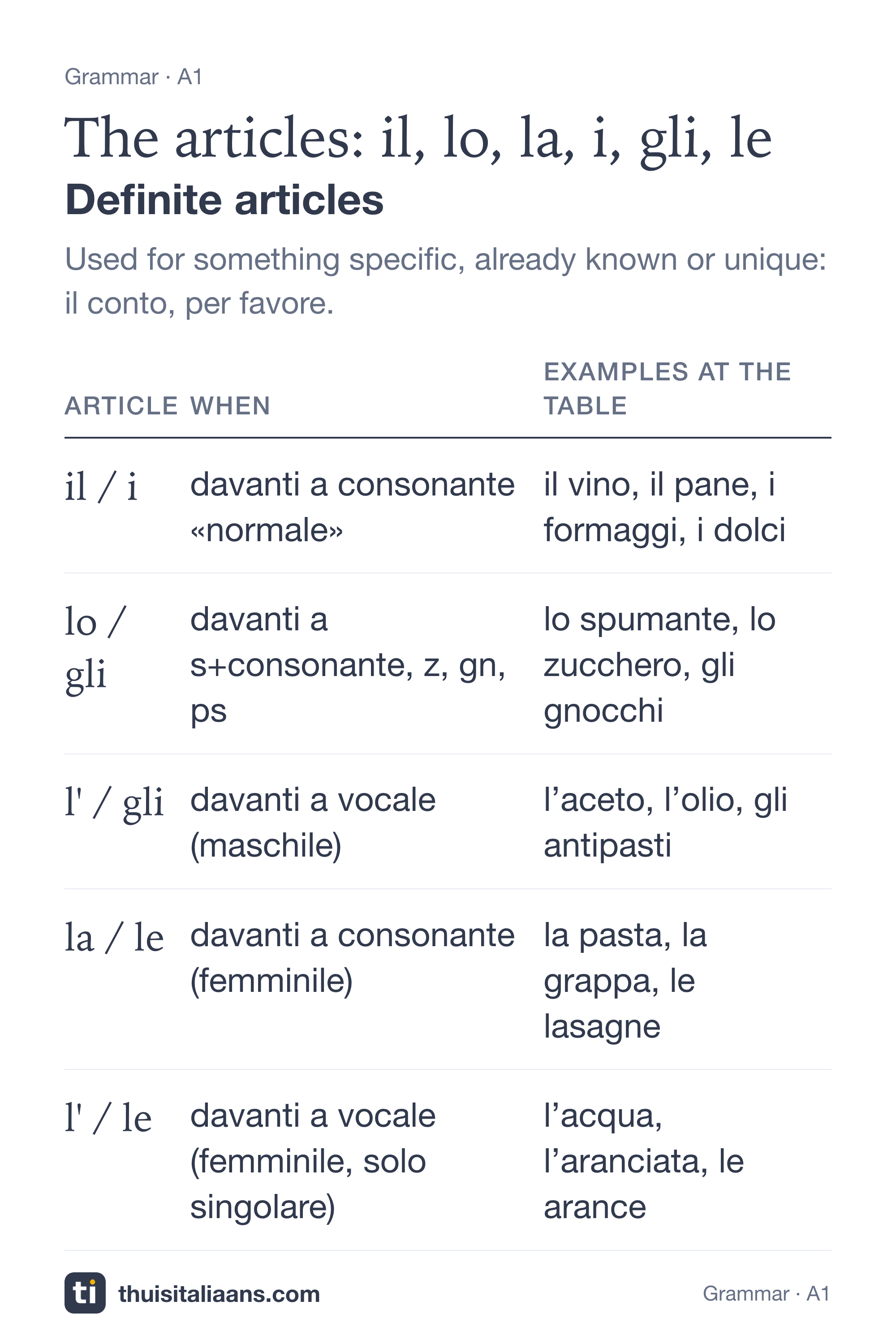
Definite articles
Used for something specific, already known or unique: il conto, per favore.
| Article | When | Examples at the table |
|---|---|---|
| il / i | davanti a consonante «normale» | il vino, il pane, i formaggi, i dolci |
| lo / gli | davanti a s+consonante, z, gn, ps | lo spumante, lo zucchero, gli gnocchi |
| l' / gli | davanti a vocale (maschile) | l’aceto, l’olio, gli antipasti |
| la / le | davanti a consonante (femminile) | la pasta, la grappa, le lasagne |
| l' / le | davanti a vocale (femminile, solo singolare) | l’acqua, l’aranciata, le arance |
Indefinite articles
Used for something non-specific, one among many: prendiamo una bottiglia?
| Article | When | Examples |
|---|---|---|
| un | maschile, davanti a consonante o vocale | un caffè, un amaro, un antipasto |
| uno | maschile, davanti a s+consonante, z, gn, ps | uno spritz, uno zabaione, uno gnocco |
| una | femminile, davanti a consonante | una pizza, una birra, una grappa |
| un' | femminile, davanti a vocale | un’aranciata, un’oliva, un’insalata |
When Italian wants the article (and your language maybe does not)
| Case | Italian | Note |
|---|---|---|
| Possessivi | il mio bicchiere, la tua forchetta | cade solo con i familiari al singolare: mia madre |
| Categorie intere | il vino fa parte della cultura italiana | parlando in generale, l’articolo c’è sempre |
| Lingue, paesi, ore | studio l’italiano, amo l’Italia, è l’una | quasi sempre con l’articolo |
The most common mistakes
il spumante→ lo spumante (s+consonant takes lo)i gnocchi→ gli gnocchi (gn takes gli)mio bicchiere è vuoto→ il mio bicchiere è vuoto (possessives take the article)un’antipasto→ un antipasto (masculine: no apostrophe)amo la Italia→ amo l’Italia (before a vowel, la is elided)
Did you know?
Read and understand
This chapter’s grammar. Example: a trattoria menu.
Questions
Quanto costa il dolce della casa?
Perché si dice «gli gnocchi» e non «i gnocchi»?
Quale articolo va con «spaghetti»?

Exercises
Five exercises in order of difficulty. The last ones bring back what you have already seen.
01 Il, lo, la, l’
Complete with the singular definite article.
- zucchero
- caffè
- amica
- studente
- pizza
- albergo
- psicologo
- ragazzo
02 Al plurale
Put article and noun into the plural.
- il libro →
- lo studente →
- l’amica →
- la casa →
- lo zaino →
- l’ospedale →
- il gnocco →
03 Un, uno, una, un’
Complete with the indefinite article.
- Vorrei spritz.
- Prendo caffè.
- Ho amica a Roma.
- C’è studente alla porta.
- Mangio pizza.
- È bel giorno.
- Cerco albergo.
04 Ci vuole l’articolo?
Italian uses the article where many languages do not. Add it where needed, or write –.
- Amo caffè italiano.
- Studio italiano.
- Vado a scuola lunedì (ogni lunedì).
- Mi chiamo Marco.
- signora Bianchi è in ufficio.
- Buongiorno, signora Bianchi!
- Abito in Italia.
05 La spesa di Elena
Complete with the right article, definite or indefinite. Always look at the letter that follows.
Review alfabeto e pronuncia
- Elena entra in supermercato vicino a casa.
- Compra zucchero, uova e spaghetti.
- Cerca anche olio buono.
- Alla cassa incontra amico di suo fratello.
- amico lavora lì da anno.
- Escono insieme e prendono gelato.
These five are a taste. There are over seven hundred on the site, free and with no sign-up. All the exercises →

Every topic, a world
In the  amo Italian app, grammar is practised inside thematic pathways with field-specific vocabulary: il bar, i trasporti, il calcio, la moda, la burocrazia and seventeen more. Choose your world and the grammar comes along by itself, explained in your language too.
Half the path free, no sign-up
★★★★★(11)by Alessio, teacher since 2018
Downloadamo Italian for iPhone ↗︎Search for amo Italian

Read and understand
This chapter’s grammar. Example: a shopping post-it.
Per la cena di stasera:
il pane, la caraffa nuova, l'olio buono
gli spinaci e le patate
lo zucchero e i biscotti
l'acqua frizzante, due bottiglie
P.S. gli gnocchi li faccio io ♥
Questions
Chi fa gli gnocchi?
Perché «lo zucchero» e non «il zucchero»?
Quale articolo va con «studente»?
Want another text on this topic? Reading an Italian menu · Ordering at an Italian bar
One more go
Fill in the right article, then check:
- zucchero è finito.
- Vorrei spritz e oliva ascolana.
- gnocchi fatti in casa sono i migliori.
- Prendo acqua frizzante e caffè.
- mia pizza preferita è margherita.
Frequently asked questions
Why is it lo yogurt and not il yogurt?
Because the y here works like the semivowel i: words beginning with i or y followed by another vowel take lo and uno, like lo iodio, uno yogurt. Same logic as lo studente: the article adapts to the sound that follows.
Why do Italians say la domenica with the article?
The article turns one day into a habit: la domenica pranzo dai nonni means every Sunday. Without the article it is a single occasion: domenica vado a Roma is this coming Sunday. One tiny word, two different calendars.
Why is there no article in vado a casa or sono in ufficio?
A small set of everyday places drops the article after a preposition: a casa, a scuola, in ufficio, in banca, in chiesa, a letto. They are fixed expressions, learned as chunks. As soon as you add detail, the article returns: nella casa dei miei nonni.
 Definite articles