Italiano in pratica
by Alessio · teacher of Italian for foreigners, ITALS master’s in teaching Italian abroad (Ca’ Foscari University, Venice) and a master’s in teaching Italian as a second language (Giustino Fortunato University, Benevento)
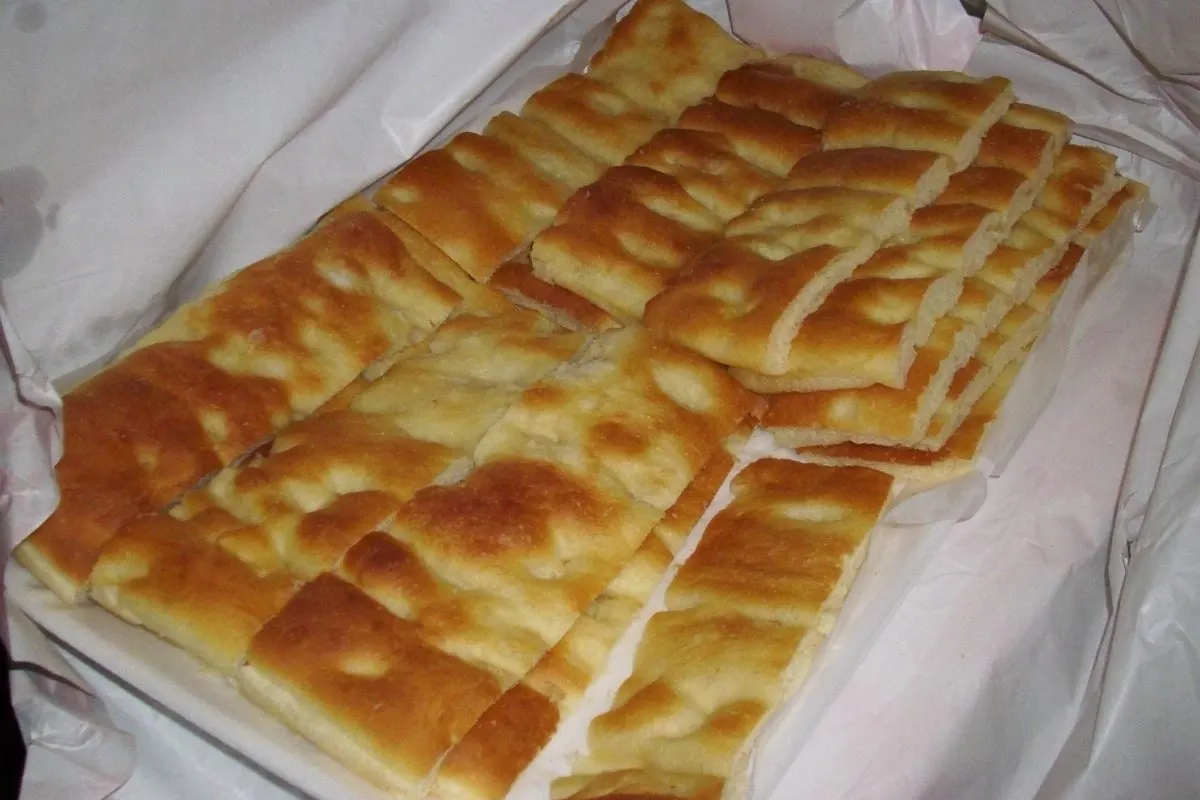
At the forno or panificio bread is sold by weight: say mezzo chilo or point and say questo. Focaccia and pizza bianca are cut to the size you show. At the pasticceria pastries are sold by the piece or by weight, and on Sundays Italians buy a vassoio, a tray, to bring to lunch.
Every Italian town has its bread, and every region calls it something different: rosetta in Rome, michetta in Milan, pane toscano without salt in Florence. You don't need the names. You need to point, say how much, and answer two or three questions.
Here's how, from the bakery to the pastry shop, with the closed questions that get you exactly what you want.
| Italian | English |
|---|---|
| Mezzo chilo di pane, per favore. | Half a kilo of bread, please. |
| Questo, per favore. | This one, please.pointing |
| Un pezzo di focaccia così. | A piece of focaccia this big.show with your hands |
| È integrale? | Is it wholemeal?answer: sì or no |
| È di oggi? | Is it today's?answer: sì or no |
| Due cornetti alla crema. | Two custard croissants. |
| Me lo incarta, per favore? | Could you wrap it, please?answer: sì |
| Basta così, grazie. | That's all, thanks. |
Read the Italian out loud once before you need it. The questions marked sì or no get a one-word answer you can understand.
By weight or by the piece. Point at the loaf and say questo, or ask for an amount: mezzo chilo, half a kilo, un chilo. Small rolls are counted: quattro rosette, four rolls.
Many bakeries close on Sunday, or open only in the morning; the bread for Sunday is bought on Saturday. Tuscan bread is made without salt: it's meant to go with salty food.
| You say | English |
|---|---|
| Mezzo chilo di pane, per favore. | Half a kilo of bread, please. |
| Questo, per favore. | This one, please. |
| Quattro panini. | Four rolls. |
| È integrale? | Is it wholemeal?sì or no |
| È senza sale? | Is it unsalted?sì or no |
| You hear | English |
|---|---|
| Glielo taglio? | Shall I slice it for you?sì or no |
| Va bene questo? | Is this one OK?sì or no |
| Sono settecento grammi, lascio? | It's seven hundred grams, is that OK?sì or no |
From big trays, cut to size: show the width with your hands and say così, like this. It's weighed and priced by the kilo. In Liguria it's focaccia, in Rome pizza bianca: flat bread with oil and salt, eaten as a snack at any time.
Ask whether they can warm it up, me la scalda?, and whether it's plain or with something on top: è semplice?
| You say | English |
|---|---|
| Un pezzo di focaccia così. | A piece of focaccia this big. |
| Un po' di più. | A bit more. |
| È semplice? | Is it plain?sì or no |
| Me la scalda? | Could you warm it up?sì or no |
| You hear | English |
|---|---|
| Così? | This much?sì or no |
| La taglio a metà? | Shall I cut it in half?sì or no |
| Altro? | Anything else?sì or no |

Name the pastry and how many: due cornetti, un cannolo. A cornetto (called brioche in the north) comes plain, vuoto, or filled: alla crema, custard, alla marmellata, jam, al cioccolato. Ask a closed question for the filling: è alla crema?
Regional classics: sfogliatella in Naples, cannolo in Sicily, maritozzo with whipped cream in Rome, bombolone in Tuscany.
| You say | English |
|---|---|
| Due cornetti alla crema. | Two custard croissants. |
| È alla crema? | Is it filled with custard?sì or no |
| Un cornetto vuoto. | A plain croissant. |
| Avete cornetti integrali? | Do you have wholemeal croissants?sì or no |
| You hear | English |
|---|---|
| Crema, marmellata o cioccolato? | Custard, jam or chocolate?pick one |
| Sono finiti. | They're sold out.no |
| Li mangia qui? | Will you eat them here?sì or no |

In the  amo Italian app you practise inside real-life pathways: il bar, il ristorante, i trasporti, la casa and more, with listening, dialogues and the grammar explained in English. This page gives you the phrases; the app trains your ear.
Half the A1 course free, no sign-up
★★★★★(22)by Alessio, teacher since 2018
Downloadamo Italian for iPhone ↗︎Search for amo Italian
Ask for un vassoio di paste, a tray of small pastries, and choose them one by one or say a total: per sei persone. They're weighed, wrapped in paper with a ribbon, and they make the perfect gift when you're invited to someone's home.
Paste here means pastries, not pasta. Sunday morning queues at the pasticceria are part of Italian life.
| You say | English |
|---|---|
| Un vassoio di paste, per favore. | A tray of pastries, please. |
| Per sei persone. | For six people. |
| Me lo incarta, per favore? | Could you wrap it, please?sì |
| È un regalo. | It's a gift. |
| You hear | English |
|---|---|
| Quali le metto? | Which ones shall I put in?point |
| Misto? | A mix?sì or no |
| Glielo incarto? | Shall I wrap it for you?sì or no |

One ingredient at a time, as a closed question: ci sono noci?, c'è il burro?, è senza glutine? Bakeries must be able to tell you the allergens, often from a list at the counter.
Vegan pastries exist in many cities now: ask avete qualcosa di vegano?
| You say | English |
|---|---|
| Ci sono noci? | Are there nuts in it?sì or no |
| C'è il burro? | Is there butter in it?sì or no |
| Avete qualcosa di vegano? | Do you have anything vegan?sì or no |
| È senza glutine? | Is it gluten-free?sì or no |
| You hear | English |
|---|---|
| C'è l'elenco degli allergeni. | There's the allergen list. |
| Senza glutine no, mi dispiace. | Nothing gluten-free, sorry.no |
Italy has hundreds of local breads, and the differences go beyond the name. The puzzle most visitors meet is Tuscany, where traditional bread is made without salt. The usual explanation goes back to the twelfth century, when Pisa is said to have blocked or heavily taxed the salt trade with Florence, so Florentine bakers learned to do without; even the consortium that protects Pane Toscano DOP admits the origins are uncertain. Whatever the reason, the bread stayed that way because it works: it balances salty cured meats and soaks up Tuscan soups such as ribollita and pappa al pomodoro.

Breakfast is the other surprise. Where a British, Dutch or German breakfast is savoury, bread with cheese, ham or eggs, the Italian one is sweet and light: a cornetto at the bar, or biscuits dipped in caffellatte at home. Bread belongs to lunch and dinner instead, and it sits on the table at every meal without butter, to be used for the last of the sauce.
Old bread is never thrown away lightly. Italian home cooking is full of recipes built on yesterday's loaf, from Tuscan panzanella to toasted breadcrumbs on pasta in the south, a habit from the days when nothing could be wasted. And on Sunday morning the queue at the pastry shop is a ritual of its own: anyone invited to lunch arrives with a tray of pastries wrapped in paper and ribbon, or with wine or flowers. Turning up empty-handed is the one thing not to do.
Read next: Why are there gloves in the fruit aisle? · Why do Italians drink their coffee standing up?
Italians rarely answer with a bare sì or no. These are the forms you will actually hear, so you know which way the answer went.
| You hear | English | It means |
|---|---|---|
| Sì, certo. | Yes, of course. | yes |
| Certo! | Sure! | yes |
| Come no! | Of course! (literally: how not?) | yes |
| Volentieri. | Gladly. | yes |
| Va bene. | Fine, OK. | yes |
| Prego. | Go ahead / please do. | yes |
| No, mi dispiace. | No, I'm sorry. | no |
| Purtroppo no. | Unfortunately not. | no |
| Non c'è. | There isn't any. | no |
| È finito. | It's sold out / all gone. | no |
| Non si può. | That's not allowed. | no |
| Non ancora. | Not yet. | no |
Six real replies. Tap Yes or No for each one.
The grammar behind them
This guide as two printable pages, in English: the phrases to say, the yes/no questions and what you will hear.
All 43 phrase PDFs · €9Already included in the full course · €39 a year.
Or keep the eight phrases as an image, to save on your phone or pin:
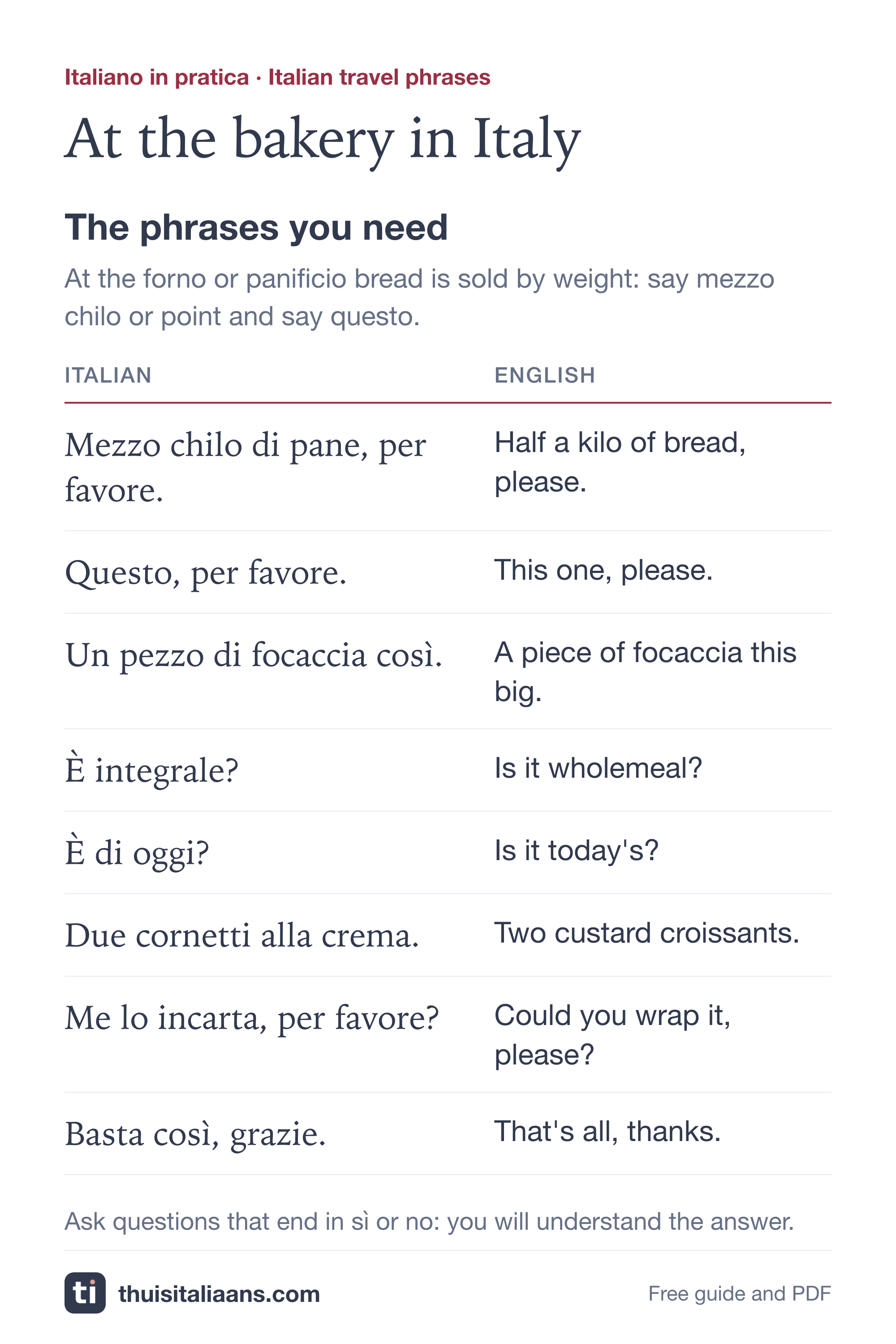 Italian phrases: At the bakery in Italy
By weight or by the piece. Point and say «questo», or ask for «mezzo chilo» (half a kilo). Small rolls are counted.
They're the same pastry: «cornetto» in central and southern Italy, «brioche» in much of the north.
Pastries. «Un vassoio di paste» is a tray of small pastries, a classic gift when you're invited to lunch.
Traditional Tuscan bread is made without salt and is meant to be eaten with salty local food such as cured meats.