Italiano in pratica
by Alessio · teacher of Italian for foreigners, ITALS master’s in teaching Italian abroad (Ca’ Foscari University, Venice) and a master’s in teaching Italian as a second language (Giustino Fortunato University, Benevento)
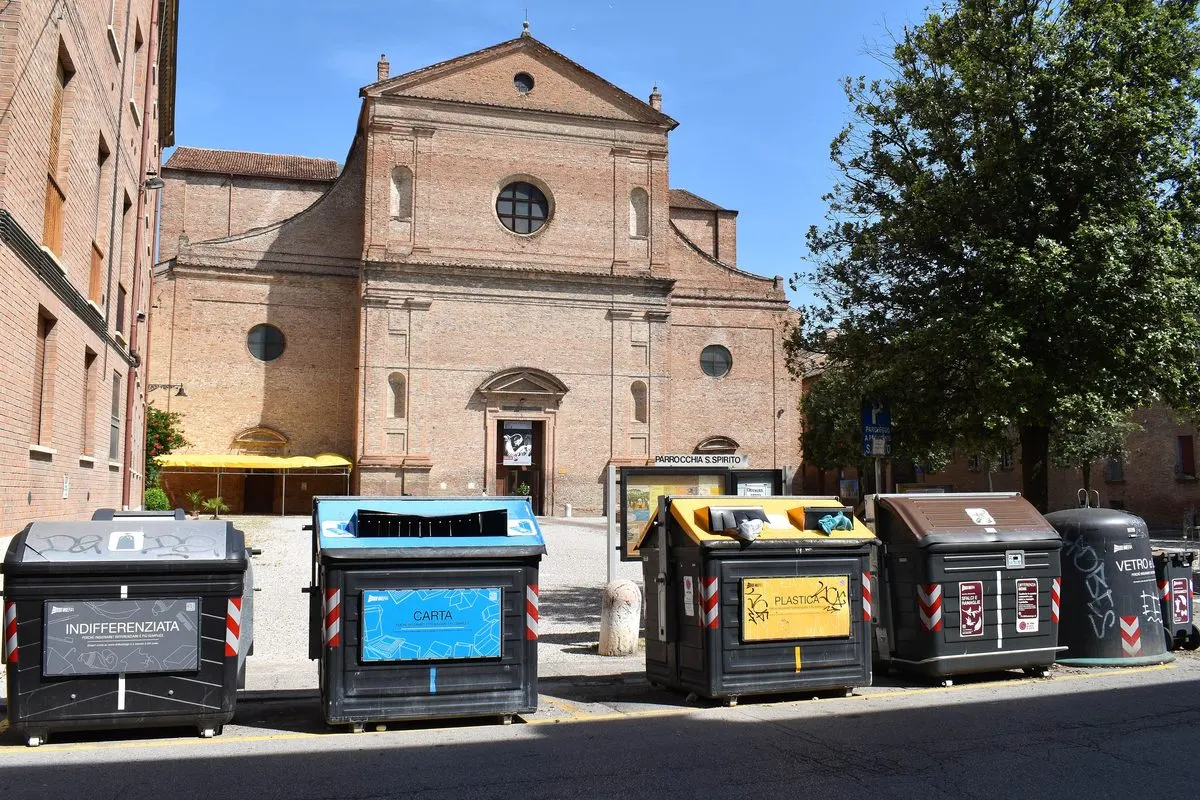
Three things surprise people in Italian rentals: rubbish is sorted into separate bins, often collected on set days; the electricity trips if you run the oven and the washing machine together, because many homes have a small supply; and the host may collect the tourist tax in cash.
An apartment feels like living in Italy for a week: your own kitchen, your own keys, the market downstairs. It also comes with the rules of an Italian home, which nobody explains until the bin men leave your bag on the pavement.
Here are those rules, the words for the things that break, and the closed questions to send your host.
| Italian | English |
|---|---|
| A che ora posso fare il check-in? | What time can I check in? |
| Il codice della cassetta non funziona. | The key box code doesn't work. |
| Dove si butta la plastica? | Where does the plastic go? |
| Quando passano a ritirare la carta? | When do they collect the paper? |
| È saltata la corrente. | The electricity has tripped. |
| Non c'è acqua calda. | There's no hot water. |
| Il riscaldamento si accende da solo? | Does the heating come on by itself?answer: sì or no |
| Posso lasciare i bagagli dopo il check-out? | Can I leave the bags after check-out?answer: sì or no |
Read the Italian out loud once before you need it. The questions marked sì or no get a one-word answer you can understand.
Either the host meets you with the keys, or you get a code for a key box, la cassetta delle chiavi. Agree the arrival time in advance and confirm it with a closed question: va bene se arrivo alle otto? The host has to register your ID, as hotels do.
Ask at arrival how the front door, il portone, and the intercom, il citofono, work: old buildings often have two doors and two keys.
| You say | English |
|---|---|
| A che ora posso fare il check-in? | What time can I check in? |
| Va bene se arrivo alle otto? | Is it OK if I arrive at eight?sì or no |
| Il codice della cassetta non funziona. | The key box code doesn't work. |
| Quale chiave apre il portone? | Which key opens the front door? |
| You hear | English |
|---|---|
| Mi manda una foto del documento? | Could you send me a photo of your ID? |
| La tassa di soggiorno si paga in contanti. | The tourist tax is paid in cash. |
| Il codice è 2580. | The code is 2580. |
Rubbish, la spazzatura, is sorted: organico or umido (food waste), carta (paper), plastica (often with metal cans), vetro (glass) and indifferenziato or secco (everything else). Some towns have street bins by colour, others collect door to door on set days.
The rules change from town to town: ask your host for the calendar, il calendario della raccolta, before you start a bag. A wrongly sorted bag may simply be left where you put it.
| You say | English |
|---|---|
| Dove si butta la plastica? | Where does the plastic go? |
| Quando passano a ritirare la carta? | When do they collect the paper? |
| C'è un calendario della raccolta? | Is there a collection calendar?sì or no |
| Le lattine vanno con la plastica? | Do cans go with the plastic?sì or no |
| You hear | English |
|---|---|
| Il vetro il martedì. | Glass on Tuesdays. |
| L'umido va nel sacchetto compostabile. | Food waste goes in the compostable bag. |
| I bidoni sono in cortile. | The bins are in the courtyard. |

Many Italian homes have a supply of about 3 kilowatts: the oven, the washing machine and a kettle or hairdryer together are enough to trip it. Turn something off, then find the meter, il contatore, and lift the switch back up.
Tell your host in one sentence: è saltata la corrente. They'll tell you where the meter is, often by the front door or on the landing.
| You say | English |
|---|---|
| È saltata la corrente. | The electricity has tripped. |
| Dov'è il contatore? | Where's the meter? |
| Posso usare il forno e la lavatrice insieme? | Can I use the oven and the washing machine together?often no |
| You hear | English |
|---|---|
| Alzi la levetta. | Lift the switch. |
| Non accenda tutto insieme. | Don't switch everything on at once. |

In the  amo Italian app you practise inside real-life pathways: il bar, il ristorante, i trasporti, la casa and more, with listening, dialogues and the grammar explained in English. This page gives you the phrases; the app trains your ear.
Half the A1 course free, no sign-up
★★★★★(22)by Alessio, teacher since 2018
Downloadamo Italian for iPhone ↗︎Search for amo Italian
Name the thing and add non funziona: la caldaia non funziona, the boiler doesn't work, lo scaldabagno non funziona, the water heater. For hot water: non c'è acqua calda. Send a photo with the message: it saves a visit.
In winter central heating in Italian buildings may only run at set hours: if it's cold at noon, ask before you assume it's broken.
| You say | English |
|---|---|
| Non c'è acqua calda. | There's no hot water. |
| La caldaia non funziona. | The boiler doesn't work. |
| Il riscaldamento si accende da solo? | Does the heating come on by itself?sì or no |
| Il telecomando del condizionatore dov'è? | Where's the air conditioning remote? |
| You hear | English |
|---|---|
| Il riscaldamento è centralizzato. | The heating is central.for the whole building |
| Mando qualcuno domani. | I'll send someone tomorrow. |

Apartment buildings, condomini, often have quiet hours, early afternoon and night: keep the noise down then. At check-out, ask the closed questions that matter: where to leave the keys, and whether you can leave your bags.
Leave the kitchen tidy and the rubbish sorted: it's what Italian hosts notice most.
| You say | English |
|---|---|
| Dove lascio le chiavi? | Where do I leave the keys? |
| Posso lasciare i bagagli dopo il check-out? | Can I leave the bags after check-out?sì or no |
| Devo buttare la spazzatura? | Do I have to take the rubbish out?sì or no |
| You hear | English |
|---|---|
| Lasci le chiavi sul tavolo. | Leave the keys on the table. |
| La porta si chiude tirandola. | The door locks when you pull it shut. |
Rubbish is the first lesson. Italian towns sort household waste into separate streams, and many collect it door to door on set days: food waste one evening, paper another, plastic another. The system works: in 2023 Italy collected 66.6 per cent of its urban waste separately, and many towns do much better than that. The rules change from one town to the next, so the calendar your host leaves is not a suggestion, and a bag put out on the wrong day may stay on the pavement with a sticker on it.

Electricity is the second. Most Italian homes have a 3 kW supply, which in practice trips at about 3.3 kW: the oven and the washing machine together, or a hairdryer and a kettle, are enough to plunge the flat into darkness. Italians grow up knowing which appliances can run at the same time. Tumble dryers are rare too: washing dries on a rack or on a line outside the window, and in summer it is dry in an hour.
The rest is about living with neighbours. Apartment buildings have house rules, often with quiet hours in the early afternoon and at night, and in summer people close the shutters at midday to keep the heat out, which is why a street can look deserted at two o'clock. Many Italians wear slippers at home and are convinced that bare feet on a cold floor bring on a cold. Finally, a legal holiday rental shows a national code, the CIN, at the entrance and in the online listing: it has been compulsory since 2025.
Read next: Why do Italians hang their washing outside? · Why are there gloves in the fruit aisle?
Italians rarely answer with a bare sì or no. These are the forms you will actually hear, so you know which way the answer went.
| You hear | English | It means |
|---|---|---|
| Sì, certo. | Yes, of course. | yes |
| Certo! | Sure! | yes |
| Come no! | Of course! (literally: how not?) | yes |
| Volentieri. | Gladly. | yes |
| Va bene. | Fine, OK. | yes |
| Prego. | Go ahead / please do. | yes |
| No, mi dispiace. | No, I'm sorry. | no |
| Purtroppo no. | Unfortunately not. | no |
| Non c'è. | There isn't any. | no |
| È finito. | It's sold out / all gone. | no |
| Non si può. | That's not allowed. | no |
| Non ancora. | Not yet. | no |
Six real replies. Tap Yes or No for each one.
The grammar behind them
This guide as two printable pages, in English: the phrases to say, the yes/no questions and what you will hear.
All 43 phrase PDFs · €9Already included in the full course · €39 a year.
Or keep the eight phrases as an image, to save on your phone or pin:
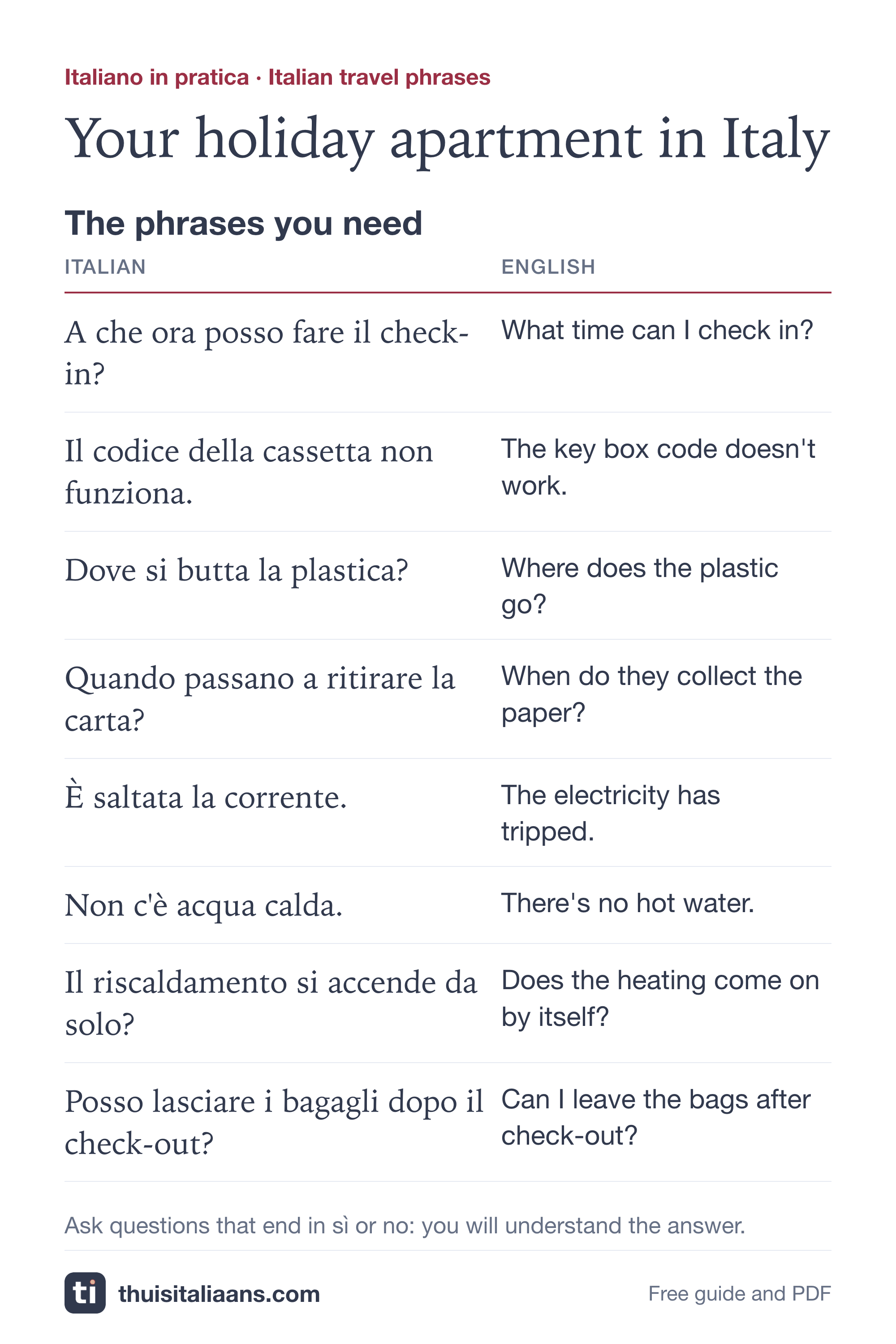 Italian phrases: Your holiday apartment in Italy
Waste is separated into organic, paper, plastic (often with cans), glass and general waste, either in coloured street bins or collected door to door on set days. Ask your host for the local calendar.
Many Italian homes have a supply of about 3 kilowatts. Running the oven, washing machine and kettle at once trips the meter: switch something off and lift the switch on the meter.
«Non c'è acqua calda».
Often yes: many towns charge it on holiday rentals too, and the host may collect it, sometimes in cash.