

Grammar · A2
Ne and ci
by Alessio · teacher of Italian as a foreign language, ITALS master’s

Ne replaces «of something» or a quantity: quanti caffè vuoi? Ne prendo due. Ci replaces a place: vai al bar? Ci vado sempre. Two tiny words, one huge level-up.
- 6min reading
- 15min exercises
- A2level
What you learn
- quantità, una parte, parlare di, con c’è
- When to use ne and ci
- Ne: quantity and topic
- Vocabulary: la spesa al mercato
Italian and English side by side
English says I have three of them only when it wants to be explicit; Italian requires ne: ne ho tre. And ci replaces a place already mentioned, like English there: ci vado domani. Both are small words that carry a lot, and both are usually skipped by English speakers.
Take this page with you
This chapter’s sheet as a free printable PDF (tables in Italian): rules, typical mistakes and the quiz with answers. A teacher’s tip: grammar sticks by reviewing it often, not by studying it once.


The words on this page
Drag each Italian word onto its definition, or tap a word first, then its box.
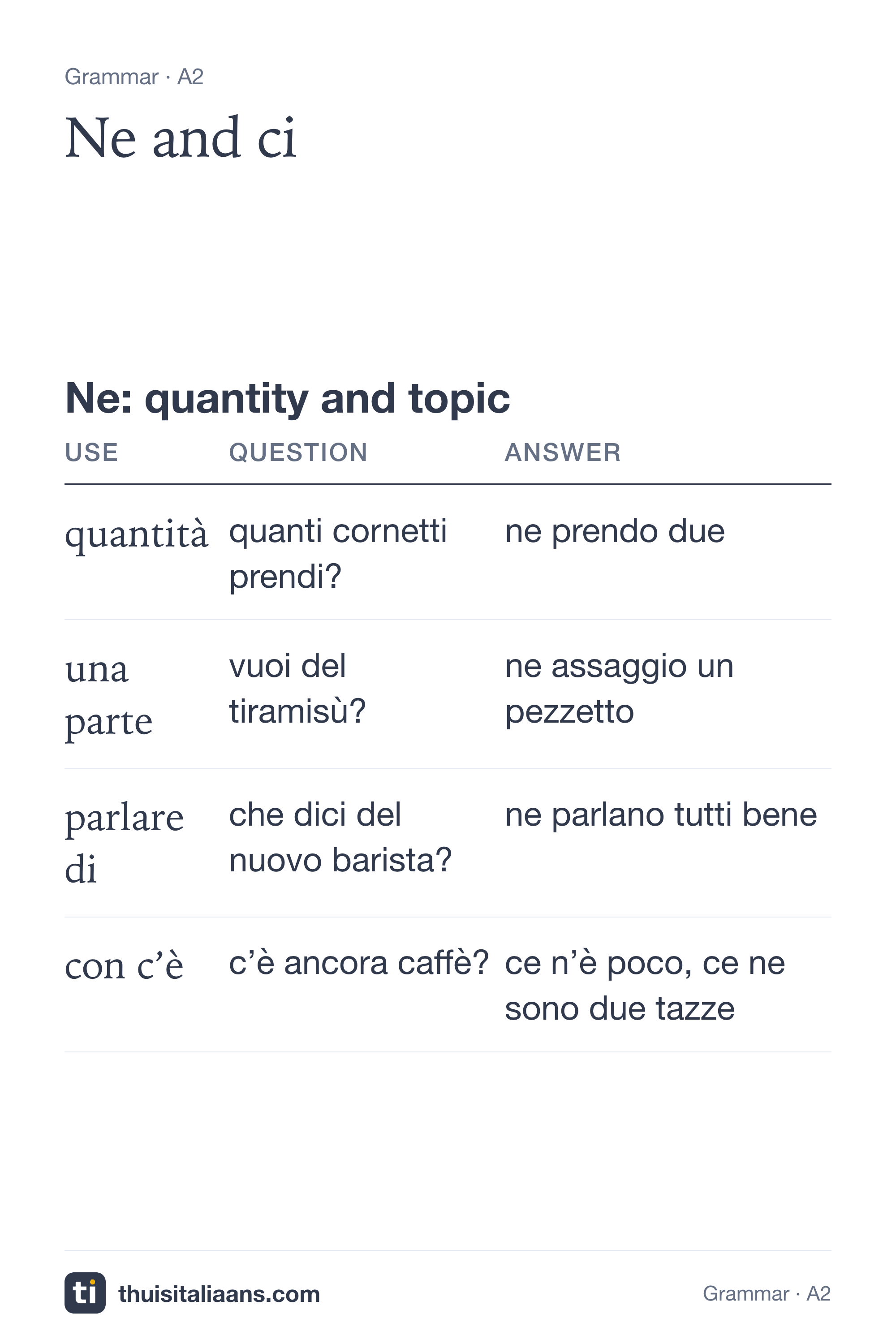
Ne: quantity and topic
| Use | Question | Answer |
|---|---|---|
| quantità | quanti cornetti prendi? | ne prendo due |
| una parte | vuoi del tiramisù? | ne assaggio un pezzetto |
| parlare di | che dici del nuovo barista? | ne parlano tutti bene |
| con c’è | c’è ancora caffè? | ce n’è poco, ce ne sono due tazze |
Ci: the place
| Question | Answer |
|---|---|
| vai spesso in quel bar? | ci vado ogni mattina |
| siete stati alla nuova pasticceria? | ci siamo stati domenica |
| quando torni a Napoli? | ci torno a dicembre |
The most common mistakes
quanti caffè vuoi? Prendo due→ ne prendo due (quantities need ne)vai al bar? Sì, vado sempre→ ci vado sempre (the place comes back with ci)ne ho preso tre (di paste)→ ne ho prese tre (agreement with the quantity)
Did you know?
Read and understand
This chapter’s grammar. Example: a chat about groceries.
ultimo accesso 12:40
Questions
Quanti pomodori deve prendere?
Quante pesche ha preso alla fine?
In «ne avevano poche», «ne» sostituisce…
Completa: «Bel film! Che cosa ___ pensi?»

Exercises
Five exercises in order of difficulty. The last ones bring back what you have already seen.
01 Ne di quantità
Answer using ne, as in the example: Quanti libri hai? (tre) → Ne ho tre.
- Quante sorelle hai? (due) →
- Quanto pane vuoi? (poco) →
- Quanti caffè bevi al giorno? (tre) →
- Vuoi delle mele? (sì, quattro) →
- Hai amici in Italia? (molti) →
- Quanti anni hai passato lì? (nessuno) →
02 Ne = di questo
Ne also replaces “about this”. Complete.
- Parliamo del lavoro? — Sì, parliamo domani.
- Hai bisogno di aiuto? — Sì, ho bisogno.
- Che ne pensi del film? — penso bene.
- Sei sicuro di questo? — sono sicuro.
- Hai voglia di uscire? — Non ho voglia.
- Ti ricordi di Marco? — Sì, me ricordo.
03 Ci = lì, in quel posto
Complete with ci.
- Vai a Roma? — Sì, vado domani.
- Sei mai stato in Sicilia? — No, non sono mai stato.
- Andate al mare? — andiamo ogni estate.
- Abiti ancora in centro? — Sì, abito da dieci anni.
- Quando torni a casa? — torno stasera.
- In quel ristorante ho mangiato bene.
04 Ci con pensare, credere, riuscire
Complete with ci.
- Pensi al lavoro? — Sì, penso sempre.
- Credi alle sue parole? — Non credo.
- Riesci ad aprirlo? — Non riesco.
- Tieni molto a questa cosa? — Sì, tengo.
- Hai provato a chiamare? — ho provato due volte.
- Fai caso agli errori? — faccio caso sempre.
05 Al mercato
Complete with ne, ci, pronouns and the passato prossimo.
Review pronomi diretti · pronomi indiretti · passato prossimo
- — Sei andato al mercato? — Sì, sono andato stamattina.
- — Hai comprato le arance? — ho comprate un chilo.
- — E il pane? — ho preso: era finito.
- — Ti serve altro? — Sì, ho bisogno di latte.
- — Ci vado io stasera, (a te) prendo tutto.
- — Pensi di farcela? — penso di sì.
These five are a taste. There are over seven hundred on the site, free and with no sign-up. All the exercises →

Every topic, a world
In the  amo Italian app, grammar is practised inside thematic pathways with field-specific vocabulary: il bar, i trasporti, il calcio, la moda, la burocrazia and seventeen more. Choose your world and the grammar comes along by itself, explained in your language too.
Half the path free, no sign-up
★★★★★(11)by Alessio, teacher since 2018
Downloadamo Italian for iPhone ↗︎Search for amo Italian

Read and understand
This chapter’s grammar. Example: a club's email.
Cena sociale di sabato: ci siamo quasi
daPaolo Grandi <paolo.grandi@mail.it>
asoci@circoloilfaro.it
datamer 4 giu, 18:20
Cari soci,
per la cena di sabato siamo a quaranta iscritti. Posti liberi ne restano sei: chi vuole venire deve scrivermi entro giovedì.
Il vino lo porta Franco: ne porta dodici bottiglie, sei rosse e sei bianche. Ai dolci ci pensa la signora Bice, come sempre.
Per chi non è mai stato al circolo: in autobus ci arrivate con il 14, fermata Molo.
Il tema della serata resta un segreto: ne parliamo sabato.
A presto,
Paolo
Questions
Quanti posti liberi restano?
Chi si occupa dei dolci?
«Ai dolci ci pensa la signora Bice»: «ci» sostituisce…
Completa: «Buona questa torta: ___ prendo un'altra fetta».
Want another text on this topic? Asking for directions
One more go
Ne or ci?
- Quanti cornetti vuoi? prendo due, grazie.
- Conosci quel bar in piazza? vado ogni mattina.
- Vuoi del tiramisù? assaggio solo un po'.
- Siete mai stati a Torino? siamo stati l’anno scorso.
- C’è ancora caffè? Ce una tazza.
Frequently asked questions
Can I answer Quanti fratelli hai? with just Ho due?
No: with a number or quantity and no noun, ne is obligatory: ne ho due. Italian cannot leave the quantity hanging without saying “of them”: quanti caffè? Ne prendo uno. Vuoi delle olive? Ne ho già prese troppe.
What does ci mean in ci penso io?
There ci replaces a + a thing: pensare a qualcosa → ci penso (I’ll take care of it). The same happens with credere a (non ci credo) and riuscire a (non ci riesco): ci is not only place, it is also “to/about it”.
Why does ci become ce in ce n’è?
Before ne (and before lo, la, li, le), ci changes to ce for pronunciation: ce n’è ancora? ce lo metto io. Same vowel shift you will meet again with mi → me in the combined pronouns.
 Ne: quantity and topic