Italiano in pratica
by Alessio · teacher of Italian for foreigners, ITALS master’s in teaching Italian abroad (Ca’ Foscari University, Venice) and a master’s in teaching Italian as a second language (Giustino Fortunato University, Benevento)
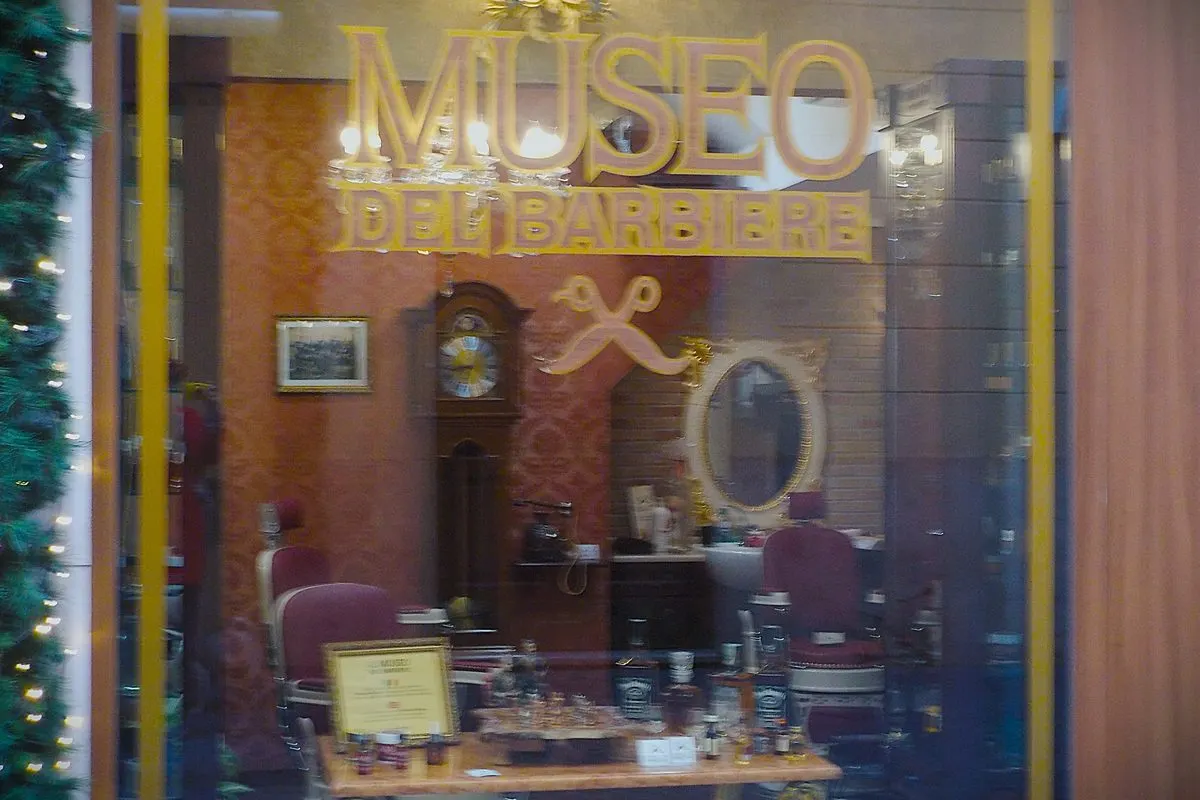
A parrucchiere cuts and styles hair, mostly for women or for everyone; a barbiere is for men's cuts and beards. Many are closed on Monday. Bring a photo, and use closed questions to check as you go: un po' più corti?
A haircut is the moment when a misunderstood word lasts for weeks. The good news: hairdressers everywhere work with photos and gestures, and the Italian you need is a few words for length and shape.
Here they are, with the questions the hairdresser asks and the closed questions that let you check before the scissors move.
| Italian | English |
|---|---|
| Avete posto oggi? | Do you have a free slot today?answer: sì or no |
| Solo una spuntatina, per favore. | Just a trim, please. |
| Un po' più corti ai lati. | A bit shorter at the sides. |
| Così, come nella foto. | Like this, as in the photo. |
| Con la macchinetta, il numero due. | With the clippers, number two. |
| Mi sistema anche la barba? | Could you trim my beard too?answer: sì or no |
| Va benissimo, grazie. | That's perfect, thanks. |
| Quanto le devo? | How much do I owe you? |
Read the Italian out loud once before you need it. The questions marked sì or no get a one-word answer you can understand.
A parrucchiere cuts, colours and styles hair, often for everyone; a barbiere does men's cuts and shaves. Booking is common, by phone or on WhatsApp, but many will fit you in: ask avete posto oggi? Many salons close on Monday.
A piega is a blow-dry or styling; taglio e piega, cut and style, is a common price on the list.
| You say | English |
|---|---|
| Avete posto oggi? | Do you have a free slot today?sì or no |
| Vorrei prenotare un taglio. | I'd like to book a haircut. |
| Domani mattina va bene? | Is tomorrow morning OK?sì or no |
| You hear | English |
|---|---|
| Alle undici va bene? | Is eleven OK?sì or no |
| A che nome? | Under what name? |
| Il lunedì siamo chiusi. | We're closed on Mondays. |
Start with the size of the change: solo una spuntatina, just a trim, or un taglio più corto, a shorter cut. Then show a photo and say così, like this. That's half the conversation done.
Length is measured with fingers: tolga due dita, take off two fingers' width, is clearer than any centimetre.
| You say | English |
|---|---|
| Solo una spuntatina, per favore. | Just a trim, please. |
| Così, come nella foto. | Like this, as in the photo. |
| Tolga due dita. | Take off two fingers' width. |
| Non troppo corti. | Not too short. |
| You hear | English |
|---|---|
| Cosa facciamo? | What are we doing today? |
| Quanto tolgo? | How much shall I take off?show with your fingers |
Ai lati is at the sides, dietro at the back, sopra on top. La frangia is the fringe, la riga the parting, la macchinetta the clippers, used with a number, like everywhere: il numero due.
To check as the cut goes on, ask closed questions with più: più corti dietro?, shorter at the back?
| You say | English |
|---|---|
| Un po' più corti ai lati. | A bit shorter at the sides. |
| Lunghi sopra. | Long on top. |
| Con la macchinetta, il numero due. | With the clippers, number two. |
| La riga a destra. | Parting on the right.a sinistra: on the left |
| Mi spunta la frangia? | Could you trim the fringe?sì |
| You hear | English |
|---|---|
| Sfumato? | Faded?sì or no: short at the sides, blended |
| La riga dove la porta? | Where do you wear your parting? |
| Così va bene? | Is this OK?sì or no |

In the  amo Italian app you practise inside real-life pathways: il bar, il ristorante, i trasporti, la casa and more, with listening, dialogues and the grammar explained in English. This page gives you the phrases; the app trains your ear.
Half the A1 course free, no sign-up
★★★★★(22)by Alessio, teacher since 2018
Downloadamo Italian for iPhone ↗︎Search for amo Italian
Before: whether you want a wash, lo shampoo?; during: così va bene?; at the end, with the mirror behind your head: va bene? and whether you want gel or spray. All closed questions.
Tipping isn't expected; rounding up for a good cut is a nice gesture. Pay at the till: quanto le devo?
| You say | English |
|---|---|
| Sì, anche lo shampoo. | Yes, a wash too. |
| Va benissimo, grazie. | That's perfect, thanks. |
| Niente gel, grazie. | No gel, thanks. |
| Quanto le devo? | How much do I owe you? |
| You hear | English |
|---|---|
| Lo shampoo lo facciamo? | Shall we wash it?sì or no |
| Le metto un po' di gel? | Shall I put some gel on?sì or no |
| Dietro va bene? | Is the back OK?sì or no |

La barba is the beard: ask whether they can trim it too, mi sistema anche la barba?, or for a shave, la rasatura. I baffi is the moustache.
Say how much shorter with the same words as for the hair: un po' più corta, solo i contorni, just the edges.
| You say | English |
|---|---|
| Mi sistema anche la barba? | Could you trim my beard too?sì or no |
| Solo i contorni. | Just the edges. |
| Un po' più corta. | A bit shorter.about the beard |
| You hear | English |
|---|---|
| Barba corta o lunga? | Short or long beard?a choice of two |
| Panno caldo? | Hot towel?sì or no |
Walk past an Italian hair salon on a Monday and the shutter is probably down. Hairdressers and barbers work on Saturday, their busiest day, and traditionally take Monday as their day of rest. A popular story places the origin in Florence in 1742, when the city's barbers are said to have closed to watch a public execution; it makes a good tale, but the plain explanation is the weekly rest after a working Saturday.

The salon has a social role that visitors notice. For many older Italian women the weekly piega, a wash and blow-dry, is a fixed appointment, often on Friday or Saturday, ready for Sunday; for men the barber's has long been the place to talk about football and the neighbourhood. Behind both is a value Italians call bella figura: looking well groomed is a form of respect for the people you meet, not vanity.
The practical side follows from that. Booking is normal, more and more often by WhatsApp; prices are on a list by the till; tipping isn't expected, although rounding up after a good cut is a kind gesture. Bring a photo: Italian hairdressers are used to working from pictures, and it saves a lot of vocabulary.
Read next: Why do Italian shopkeepers serve you instead of letting you browse? · How are Italian greetings different from greetings at home?
Italians rarely answer with a bare sì or no. These are the forms you will actually hear, so you know which way the answer went.
| You hear | English | It means |
|---|---|---|
| Sì, certo. | Yes, of course. | yes |
| Certo! | Sure! | yes |
| Come no! | Of course! (literally: how not?) | yes |
| Volentieri. | Gladly. | yes |
| Va bene. | Fine, OK. | yes |
| Prego. | Go ahead / please do. | yes |
| No, mi dispiace. | No, I'm sorry. | no |
| Purtroppo no. | Unfortunately not. | no |
| Non c'è. | There isn't any. | no |
| È finito. | It's sold out / all gone. | no |
| Non si può. | That's not allowed. | no |
| Non ancora. | Not yet. | no |
Six real replies. Tap Yes or No for each one.
The grammar behind them
This guide as two printable pages, in English: the phrases to say, the yes/no questions and what you will hear.
All 43 phrase PDFs · €9Already included in the full course · €39 a year.
Or keep the eight phrases as an image, to save on your phone or pin:
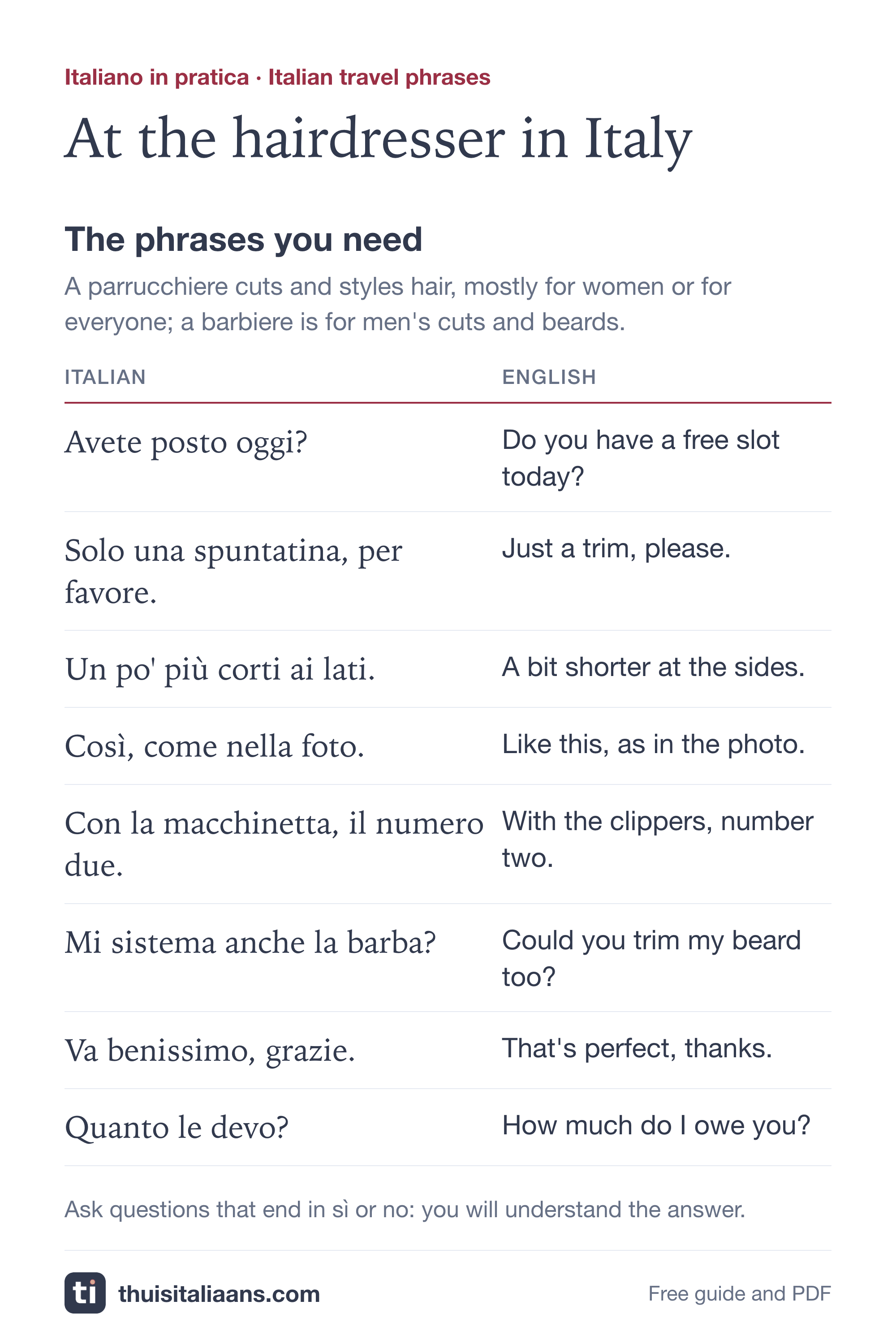 Italian phrases: At the hairdresser in Italy
«Solo una spuntatina, per favore».
A parrucchiere cuts and styles hair, often for everyone; a barbiere does men's haircuts, shaves and beards.
Many are closed on Monday. Call or message first: «Avete posto oggi?»
It's not expected. Rounding up after a good cut is appreciated.