Italiano in pratica
by Alessio · teacher of Italian for foreigners, ITALS master’s in teaching Italian abroad (Ca’ Foscari University, Venice) and a master’s in teaching Italian as a second language (Giustino Fortunato University, Benevento)
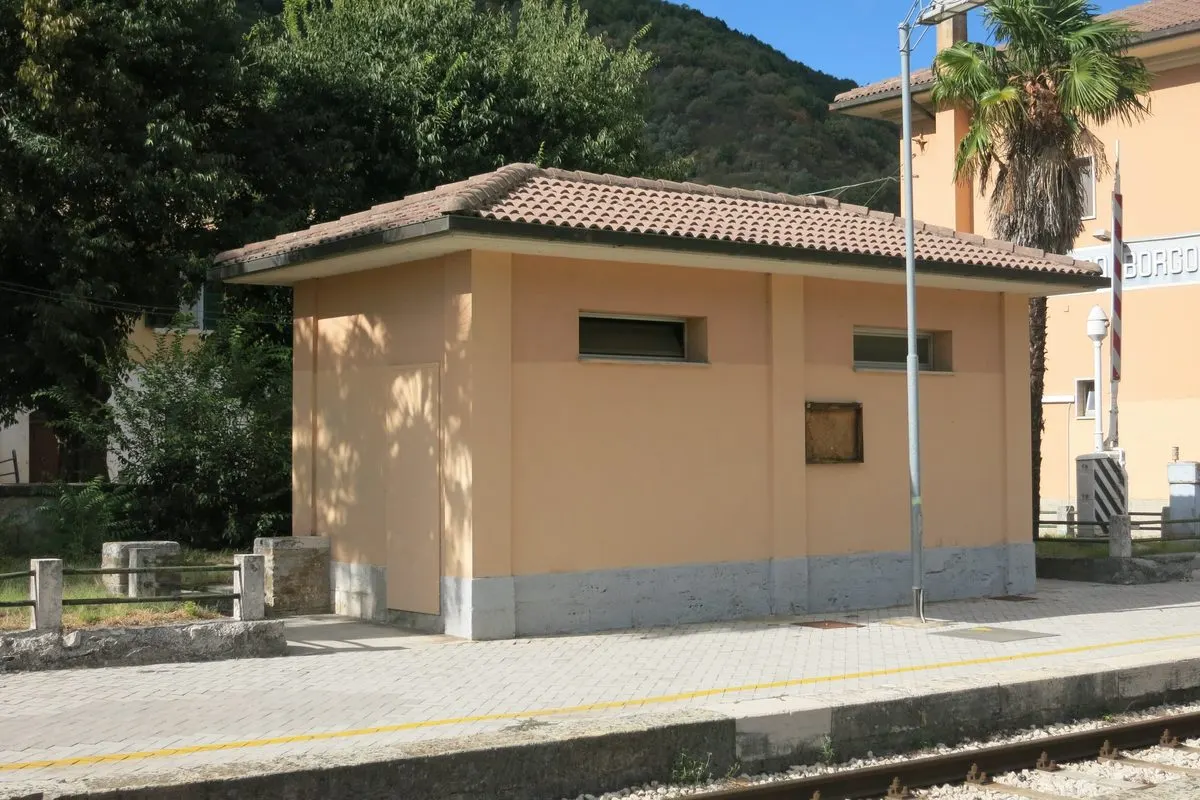
The question is dov'è il bagno?, where is the toilet? In bars the toilet is often for customers only: order a coffee, then ask posso usare il bagno? Public toilets in stations and city centres are usually paid, with coins or a card.
It's the question nobody practises and everybody needs. Public toilets in Italy are not everywhere, and the ones in bars, cafés and restaurants are meant for customers. A coffee at the counter costs little and solves the problem.
Here's what to say, what the signs on the doors mean, and the closed questions for the rest: whether you need a key, whether you pay, whether it's for customers only.
| Italian | English |
|---|---|
| Scusi, dov'è il bagno? | Excuse me, where's the toilet? |
| C'è un bagno? | Is there a toilet?answer: sì or no |
| Posso usare il bagno? | Can I use the toilet?answer: sì or no |
| È solo per i clienti? | Is it for customers only?answer: often sì |
| Serve la chiave? | Do I need the key?answer: sì or no |
| Si paga? | Do you have to pay?answer: sì or no |
| È libero? | Is it free (not occupied)?answer: sì or no |
| Manca la carta. | There's no toilet paper. |
Read the Italian out loud once before you need it. The questions marked sì or no get a one-word answer you can understand.
Scusi, dov'è il bagno? is all you need. Il bagno is the everyday word; on signs you'll also see toilette, servizi or WC.
The answer is often a gesture and a few words: in fondo a destra, at the back on the right, or giù per le scale, down the stairs.
| You say | English |
|---|---|
| Scusi, dov'è il bagno? | Excuse me, where's the toilet? |
| C'è un bagno qui? | Is there a toilet here?sì or no |
| È di sopra? | Is it upstairs?sì or no |
| C'è un bagno pubblico qui vicino? | Is there a public toilet near here?sì or no |
| You hear | English |
|---|---|
| In fondo a destra. | At the back on the right. |
| Giù per le scale. | Down the stairs. |
| Di sopra. | Upstairs. |
Often not: in many bars the toilet is for customers only, riservato ai clienti. Order something small, a coffee or a bottle of water, then ask. Some bars hand you a key, or print a code on the receipt.
In a quiet bar, a polite request sometimes works anyway: posso usare il bagno, per favore? The worst you'll hear is solo per i clienti.
| You say | English |
|---|---|
| Posso usare il bagno? | Can I use the toilet?sì or no |
| Un caffè, e posso usare il bagno? | A coffee, and can I use the toilet?the classic combination |
| Serve la chiave? | Do I need the key?sì or no |
| Il codice è sullo scontrino? | Is the code on the receipt?sì or no |
| You hear | English |
|---|---|
| Solo per i clienti. | Customers only.no, unless you order |
| Ecco la chiave. | Here's the key. |
| Il codice è sullo scontrino. | The code is on the receipt. |
Usually not. Public toilets in stations, city centres and at tourist sites tend to cost about a euro, paid with coins at a turnstile or by card. Toilets in museums, shopping centres and motorway service areas are generally free.
Keep a few coins in your pocket: not every turnstile takes cards, and many give no change.
| You say | English |
|---|---|
| Si paga? | Do you have to pay?sì or no |
| Accetta la carta? | Does it take cards?sì or no |
| Ha da cambiare? | Do you have change?sì or no |
| You hear | English |
|---|---|
| Un euro. | One euro. |
| Solo monete. | Coins only. |
| Non dà resto. | No change given. |

In the  amo Italian app you practise inside real-life pathways: il bar, il ristorante, i trasporti, la casa and more, with listening, dialogues and the grammar explained in English. This page gives you the phrases; the app trains your ear.
Half the A1 course free, no sign-up
★★★★★(22)by Alessio, teacher since 2018
Downloadamo Italian for iPhone ↗︎Search for amo Italian
Uomini or Signori is men, Donne or Signore is women. Careful: Signore with an -e at the end is for women, Signori with an -i for men.
On the lock, libero means free and occupato occupied. Guasto or fuori servizio means out of order. Accessible toilets carry the wheelchair symbol and often have a baby changing table, il fasciatoio.
| You say | English |
|---|---|
| Uomini · Signori | Men |
| Donne · Signore | Womennote the -e |
| libero · occupato | free · occupied |
| guasto · fuori servizio | out of order |
| È libero? | Is it free?sì or no |
| You hear | English |
|---|---|
| È occupato. | It's occupied.no |
| Quello è guasto. | That one's out of order. |

One short sentence to the staff: manca la carta, there's no toilet paper, manca il sapone, there's no soap, or lo sciacquone non funziona, the flush doesn't work.
Many Italian bathrooms have a bidet next to the toilet: it isn't a second toilet.
| You say | English |
|---|---|
| Manca la carta. | There's no toilet paper. |
| Manca il sapone. | There's no soap. |
| Lo sciacquone non funziona. | The flush doesn't work. |
| La porta non si chiude. | The door doesn't lock. |
| You hear | English |
|---|---|
| Grazie, ci penso io. | Thanks, I'll see to it. |
| Usi l'altro. | Use the other one. |
Visitors from Japan, Germany or the Netherlands are used to clean public toilets at every station and square. In Italy there are fewer, and the ones in stations and city centres usually cost about a euro. Italians have a different system: the bar. With a bar on almost every corner, buying a coffee or a bottle of water and then using the toilet is the normal solution, and nobody thinks it odd.

Inside, you will meet the bidet, the low basin next to the toilet. A 1975 ministerial decree lists it among the fittings every Italian home must have, along with the toilet, the washbasin and a bath or shower, so most Italians grow up with one and find washing with water cleaner than paper alone. Bidets are common in Portugal and much of South America too, and Japan has its own high-tech version built into the toilet; in Britain, the US and Scandinavia they are rare, which is why «what is that for?» is such a common question.
Two more small surprises. Toilets in bars and public places often have no seat at all, and Italians simply hover. And on the door, read the last letter: Signori, ending in i, is for men, and Signore, ending in e, is for women.
Read next: Why do Italians drink their coffee standing up? · Why are children welcome everywhere in Italy?
Italians rarely answer with a bare sì or no. These are the forms you will actually hear, so you know which way the answer went.
| You hear | English | It means |
|---|---|---|
| Sì, certo. | Yes, of course. | yes |
| Certo! | Sure! | yes |
| Come no! | Of course! (literally: how not?) | yes |
| Volentieri. | Gladly. | yes |
| Va bene. | Fine, OK. | yes |
| Prego. | Go ahead / please do. | yes |
| No, mi dispiace. | No, I'm sorry. | no |
| Purtroppo no. | Unfortunately not. | no |
| Non c'è. | There isn't any. | no |
| È finito. | It's sold out / all gone. | no |
| Non si può. | That's not allowed. | no |
| Non ancora. | Not yet. | no |
Six real replies. Tap Yes or No for each one.
The grammar behind them
This guide as two printable pages, in English: the phrases to say, the yes/no questions and what you will hear.
All 43 phrase PDFs · €9Already included in the full course · €39 a year.
Or keep the eight phrases as an image, to save on your phone or pin:
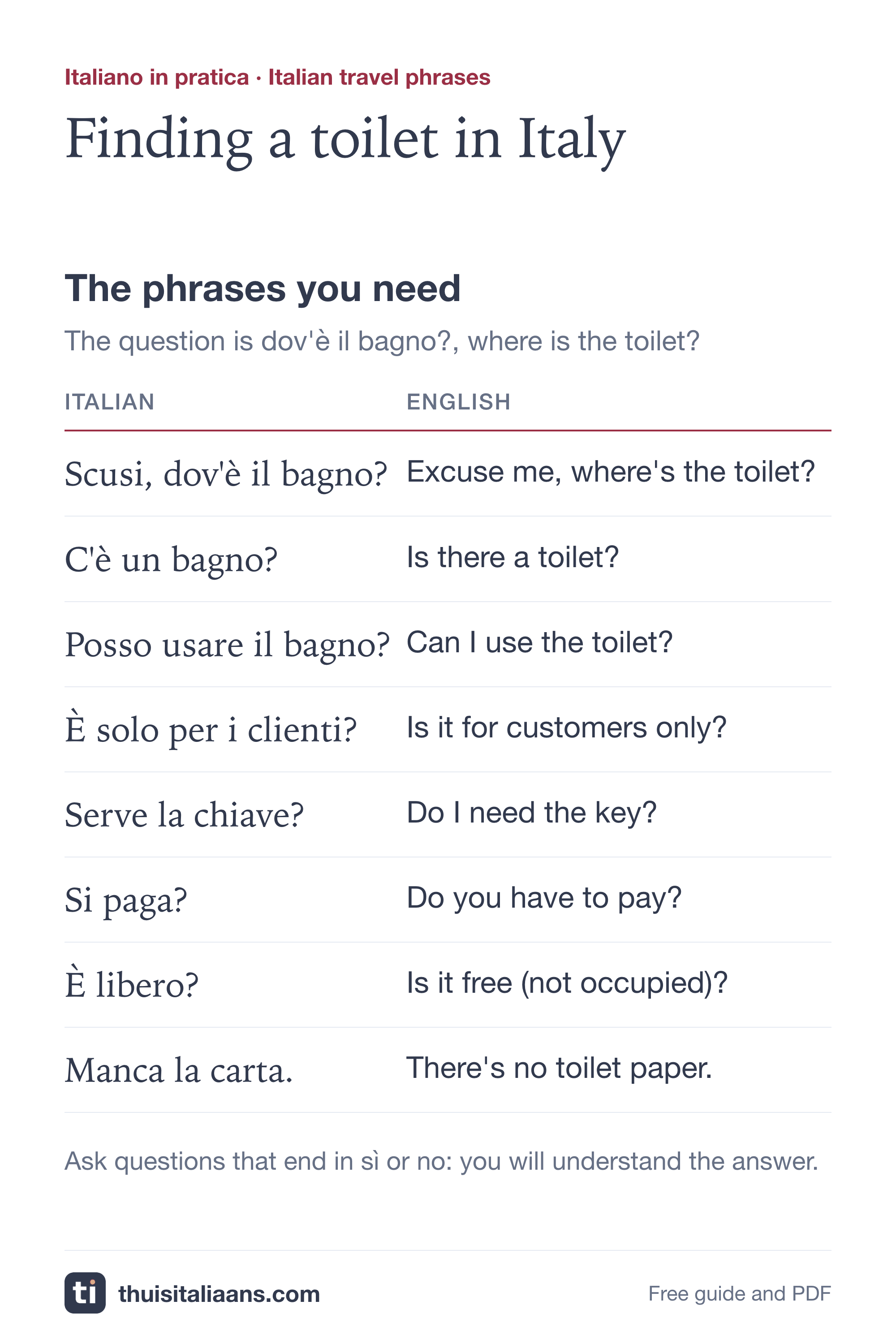 Italian phrases: Finding a toilet in Italy
«Dov'è il bagno?». Put «scusi» first to be polite: «Scusi, dov'è il bagno?».
Many bars keep the toilet for customers. Order a coffee or a bottle of water, then ask «Posso usare il bagno?».
Usually yes, about a euro in stations and city centres. Toilets in museums and motorway service areas are generally free.
Women. «Signore» (with -e) means ladies; «Signori» (with -i) means gentlemen.