Italiano in pratica
by Alessio · teacher of Italian for foreigners, ITALS master’s in teaching Italian abroad (Ca’ Foscari University, Venice) and a master’s in teaching Italian as a second language (Giustino Fortunato University, Benevento)
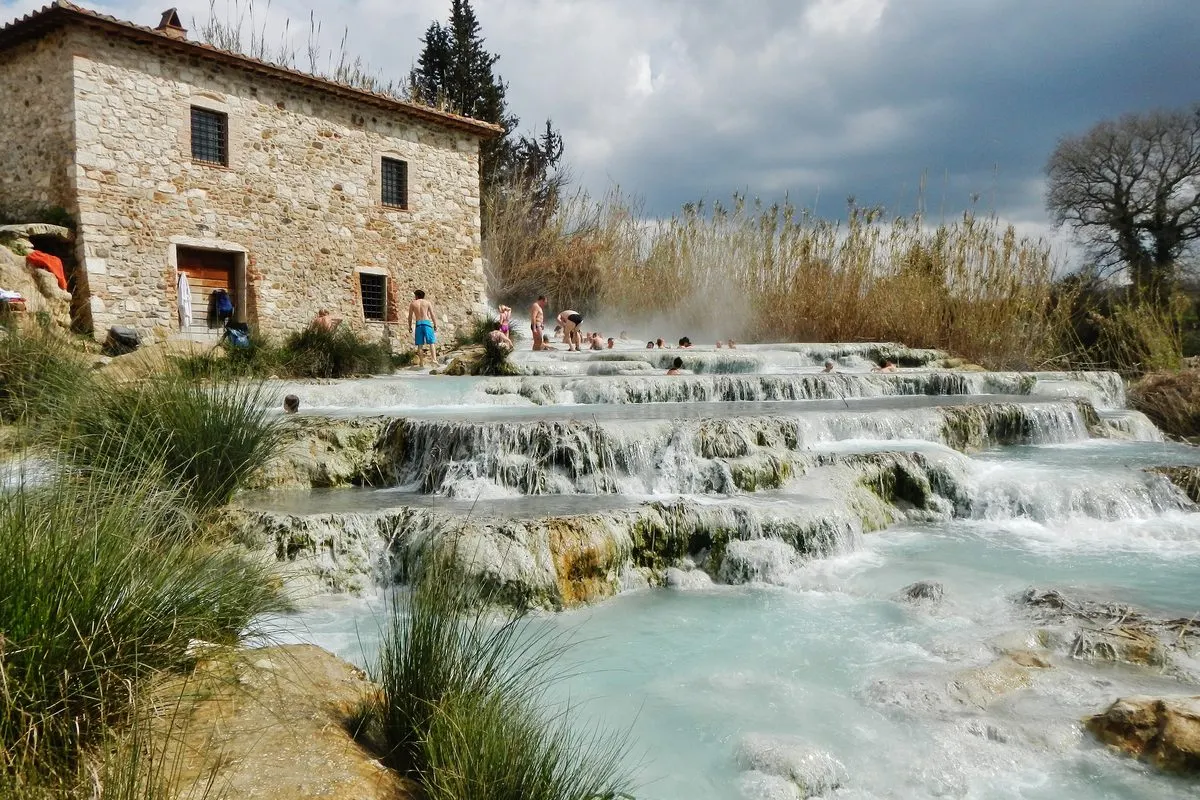
Italy has hot springs from Tuscany to Ischia. There are two kinds of visit: free springs in the open, like the Cascate del Mulino at Saturnia, where you just walk in; and paid thermal spas with pools and rules. In paid pools a swim cap and flip-flops are often required: check before you go, or buy them at the desk.
Italians have been bathing in hot springs since the Romans, and they still go to the terme on a winter Sunday the way others go to the cinema. The water is warm, the rules are many, and they're written on a sign you can't read yet.
Here are the two kinds of thermal bath, what to bring, the rules that surprise visitors, and the questions to ask at the desk.
| Italian | English |
|---|---|
| Un ingresso per due, per favore. | Entry for two, please. |
| La cuffia è obbligatoria? | Is a swim cap required?answer: sì or no |
| Si può noleggiare l'accappatoio? | Can you rent a bathrobe?answer: sì or no |
| Le ciabatte sono incluse? | Are flip-flops included?answer: sì or no |
| C'è un armadietto? | Is there a locker?answer: sì or no |
| I bambini possono entrare? | Can children go in?answer: sì or no |
| Fino a che ora è aperto? | Until what time is it open? |
| L'acqua è molto calda? | Is the water very hot?answer: sì or no |
Read the Italian out loud once before you need it. The questions marked sì or no get a one-word answer you can understand.
Free springs, terme libere, are natural pools in the open with no ticket and no staff, like the Cascate del Mulino at Saturnia in Tuscany. A thermal spa, stabilimento termale, has pools, changing rooms, a ticket and rules, and often treatments and a restaurant.
At the free springs, bring a towel and water shoes: the rock is slippery and there are few facilities. At a spa, you pay for an entry of some hours or a full day, often with a robe and towel kit for an extra charge.
| You say | English |
|---|---|
| Le terme libere sono gratis? | Are the free springs free of charge?sì or no |
| C'è un parcheggio? | Is there a car park?sì or no |
| Sono aperte anche di sera? | Are they open in the evening too?sì or no |
| You hear | English |
|---|---|
| L'ingresso è libero. | Entry is free. |
| Attenzione, si scivola. | Careful, it's slippery. |
It depends on the place. Many pools in Italy, public ones above all, require a swim cap, la cuffia, and pool flip-flops, le ciabatte, never worn outside. Some thermal spas don't require a cap. Ask at the desk, or bring one: it weighs nothing.
If you forget, most spas sell caps and flip-flops at the entrance. Street shoes are not allowed beyond the changing rooms.
| You say | English |
|---|---|
| La cuffia è obbligatoria? | Is a swim cap required?sì or no |
| Vendete le cuffie? | Do you sell swim caps?sì or no |
| Le ciabatte sono incluse? | Are flip-flops included?sì or no |
| You hear | English |
|---|---|
| In vasca ci vuole la cuffia. | You need a cap in the pool. |
| Qui non serve. | You don't need one here.no cap needed |
| Le scarpe vanno lasciate qui. | Shoes must be left here. |

Say how many and for how long: un ingresso per due, giornaliero for the day, or a few hours. Then ask the closed questions that change the price: robe, towel, locker, and whether there's an evening entry, often cheaper.
You'll usually get a wristband that opens your locker and records extras. Keep it on: losing it costs money.
| You say | English |
|---|---|
| Un ingresso per due, per favore. | Entry for two, please. |
| Si può noleggiare l'accappatoio? | Can you rent a bathrobe?sì or no |
| C'è un armadietto? | Is there a locker?sì or no |
| C'è l'ingresso serale? | Is there an evening entry?sì or no |
| You hear | English |
|---|---|
| Giornaliero o tre ore? | A day ticket or three hours?a choice of two |
| Il braccialetto apre l'armadietto. | The wristband opens the locker. |
| Il kit costa dieci euro. | The kit costs ten euros. |

In the  amo Italian app you practise inside real-life pathways: il bar, il ristorante, i trasporti, la casa and more, with listening, dialogues and the grammar explained in English. This page gives you the phrases; the app trains your ear.
Half the A1 course free, no sign-up
★★★★★(22)by Alessio, teacher since 2018
Downloadamo Italian for iPhone ↗︎Search for amo Italian
Thermal water is often between 36 and 40 degrees, and spas post advice on time limits. People with heart or blood pressure problems, pregnant women and small children should ask before going in; staying too long can make anyone dizzy.
Drink water, come out every fifteen or twenty minutes, and get up slowly. Many spas set a minimum age for some pools and saunas.
| You say | English |
|---|---|
| I bambini possono entrare? | Can children go in?sì or no |
| L'acqua è molto calda? | Is the water very hot?sì or no |
| Mi gira la testa. | I feel dizzy. |
| You hear | English |
|---|---|
| Non più di venti minuti alla volta. | No more than twenty minutes at a time. |
| Sotto i dodici anni no. | Not under twelve.no |

For pleasure, and also for health: in Italy thermal cures are a recognised treatment, and some are partly covered by the national health service with a doctor's prescription. That's why many spas look like a clinic at one end and a holiday resort at the other.
On a weekday morning you'll meet retired locals on a cure; on a winter Sunday, families from the city. Book ahead at weekends.
| You say | English |
|---|---|
| Fate anche fanghi? | Do you also do mud treatments?sì or no |
| Bisogna prenotare? | Do you need to book?sì or no |
| You hear | English |
|---|---|
| Nel fine settimana conviene prenotare. | At weekends it's best to book. |
| Con la ricetta del medico. | With a doctor's prescription. |
Italy sits on a volcanic, restless crust, and hot water comes out of the ground from the Euganean Hills near Padua to Ischia and Sicily. The Romans built bath complexes over many of these springs, and the habit never really stopped. Where in northern Europe a spa is mostly a place for pampering, in Italy the terme are also part of the health system: some thermal treatments can be prescribed by a doctor, and spa towns grew around the cure as much as around leisure.

There are two very different ways to bathe. The free springs, terme libere, are natural pools open to everyone: the most famous are the Cascate del Mulino at Saturnia, in southern Tuscany, where warm sulphurous water runs over white limestone terraces day and night, all year round, with no ticket. The thermal spas, by contrast, have pools, changing rooms, opening hours and rules.
Those rules are what surprise visitors. Italian pools, public ones above all, often require a swim cap and pool flip-flops that are never worn outside, and some thermal spas follow the same habit while others don't. It's not fussiness for its own sake: it keeps hair and street dirt out of the water. A cap in your bag costs nothing and saves a trip to the shop at the entrance.
Read next: How is an Italian rifugio different from a hotel in the mountains? · Why are Italian beaches lined with rows of umbrellas?
Italians rarely answer with a bare sì or no. These are the forms you will actually hear, so you know which way the answer went.
| You hear | English | It means |
|---|---|---|
| Sì, certo. | Yes, of course. | yes |
| Certo! | Sure! | yes |
| Come no! | Of course! (literally: how not?) | yes |
| Volentieri. | Gladly. | yes |
| Va bene. | Fine, OK. | yes |
| Prego. | Go ahead / please do. | yes |
| No, mi dispiace. | No, I'm sorry. | no |
| Purtroppo no. | Unfortunately not. | no |
| Non c'è. | There isn't any. | no |
| È finito. | It's sold out / all gone. | no |
| Non si può. | That's not allowed. | no |
| Non ancora. | Not yet. | no |
Six real replies. Tap Yes or No for each one.
The grammar behind them
This guide as two printable pages, in English: the phrases to say, the yes/no questions and what you will hear.
All 43 phrase PDFs · €9Already included in the full course · €39 a year.
Or keep the eight phrases as an image, to save on your phone or pin:
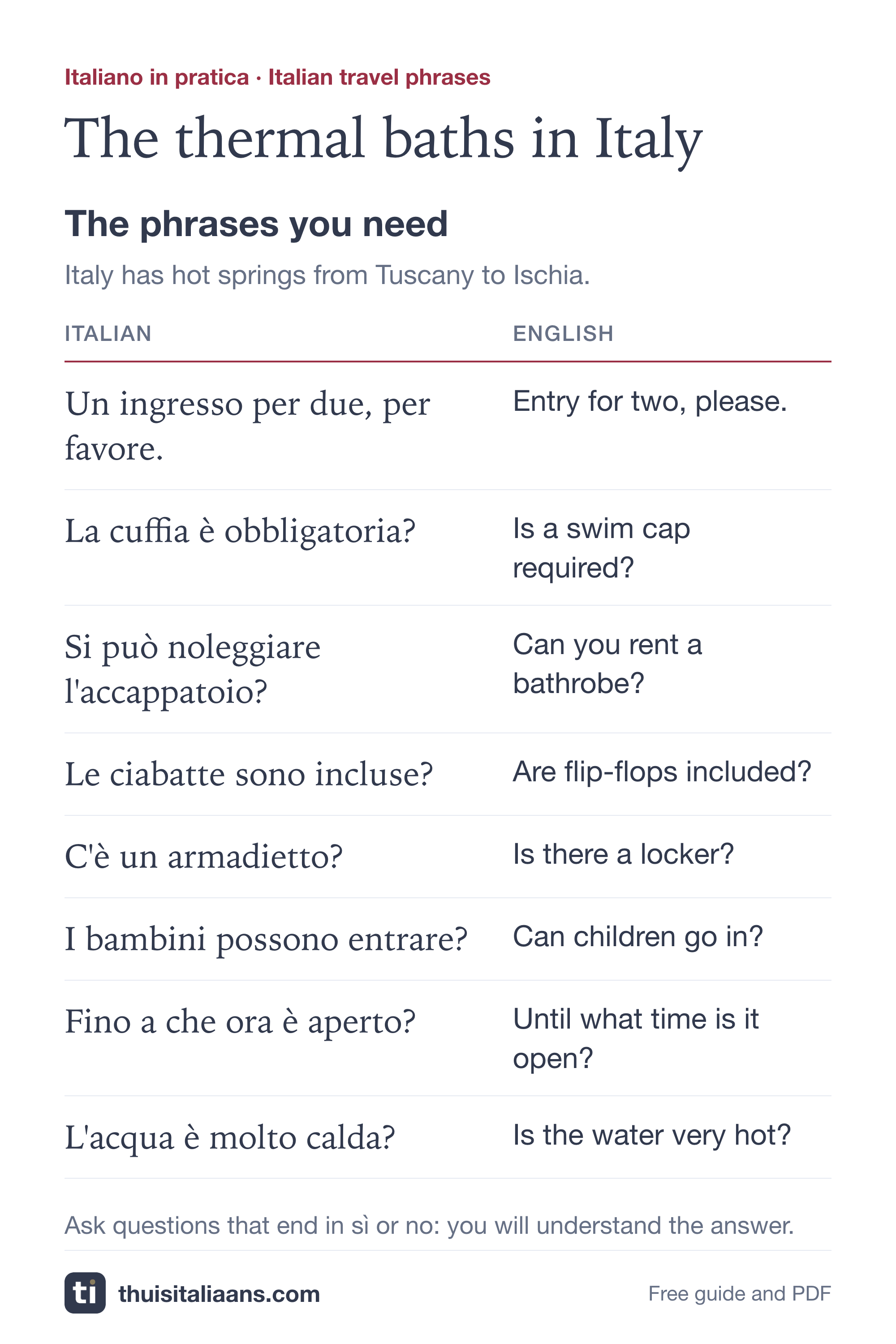 Italian phrases: The thermal baths in Italy
Often, but not everywhere. Many pools require a cap and pool flip-flops; some thermal spas don't. Ask «La cuffia è obbligatoria?» or bring one.
The Cascate del Mulino at Saturnia are free and open all day. The nearby thermal spa is paid.
Swimsuit, swim cap, pool flip-flops, towel and robe. Most spas rent robes and towels and sell caps.
Often between 36 and 40 degrees. Come out every fifteen or twenty minutes and drink water.
Usually yes, with limits for some pools and saunas. Ask at the desk.